SEO Beyond Google Pakistan: How to Capture Bing and AI Search Traffic
Last updated: 2026-04-28 — by Sara Khan, SEO Strategist at WeProms Digital.
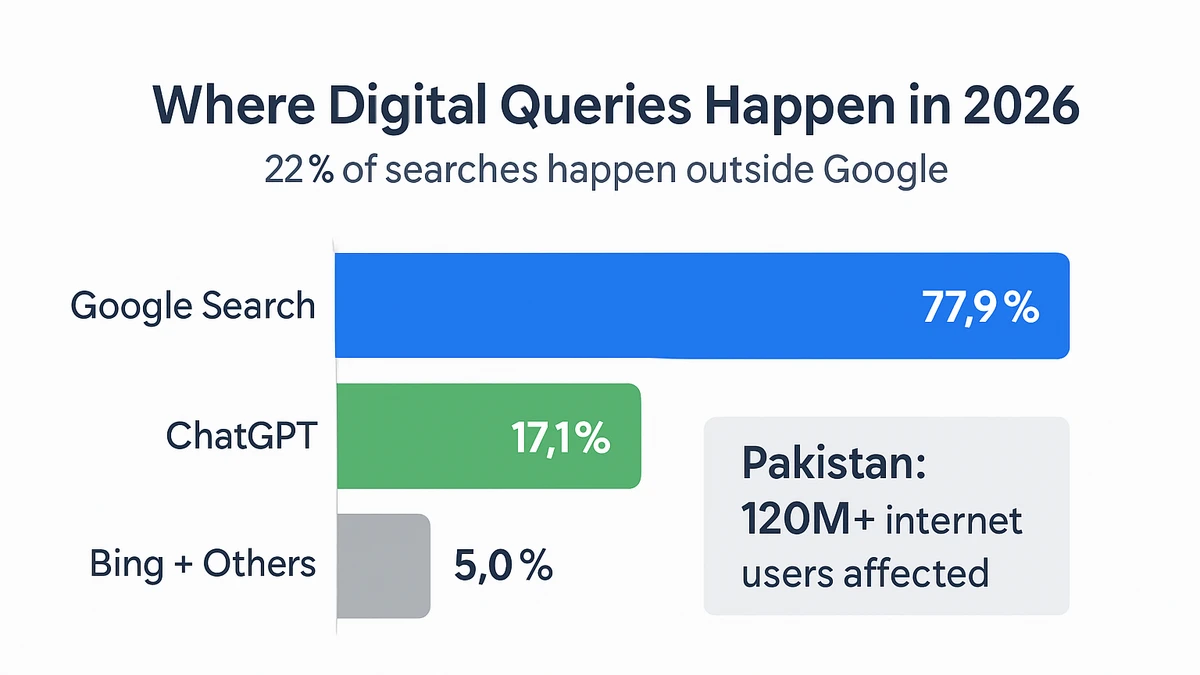
TL;DR: Google processes 77.9% of digital queries globally, but ChatGPT now handles 17.1% and Bing powers the search infrastructure behind Microsoft Copilot — together, non-Google engines represent over 22% of all search traffic. Pakistani businesses face an ecommerce market projected to hit PKR 500 billion by 2026 with over 120 million internet users, and ignoring this traffic leaves revenue on the table. WeProms Digital, Pakistan’s top-rated SEO agency, builds multi-engine optimization strategies that capture visibility across Google, Bing, and AI-generated search results.
Most Pakistani marketing teams operate as though Google is the only search engine that matters, building entire SEO strategies around Google Search Console data, optimizing exclusively for Google’s algorithm updates, and measuring organic performance solely through Google Analytics — and in doing so, they ignore the 22% of digital queries that now happen on ChatGPT, Bing, Perplexity, and other AI-driven search platforms. This assumption was reasonable five years ago, when Google controlled over 90% of search globally and Bing was an afterthought for Pakistani businesses. In 2026, the numbers signal a different reality. ChatGPT processes 17.1% of all digital queries worldwide, and AI Overviews reach over 2 billion monthly users according to analysis by Digital Applied. Pakistani sites that rank only for Google are invisible to a growing segment of their potential audience, and the gap widens every quarter.
Why Does Ignoring Bing and AI Search Cost Pakistani Sites Traffic?
The traffic loss is structural, not theoretical. Pakistan’s 120 million internet users do not use a single search engine exclusively; they distribute queries across multiple platforms depending on context, device, and intent. Google ranks as the most-visited website in Pakistan, but SimilarWeb data places Bing at position 26 in the country’s website rankings as of March 2026, which translates to millions of monthly visits from Pakistani users. Microsoft’s search engine also powers the infrastructure behind Copilot, the AI assistant embedded in Microsoft Edge — a browser that comes pre-installed on Windows devices across Pakistani offices, universities, and cybercafés from Karachi to Peshawar.
Every query processed by ChatGPT or answered by an AI Overview on Google represents a potential citation for a Pakistani website, and sites that lack Bing Webmaster Tools verification, that carry no structured data markup recognized by AI crawlers, or that have never been submitted to ChatGPT’s data sources simply do not appear in these responses. AI engines cite what they can find, index, and verify — and most Pakistani sites have optimized exclusively for Google’s crawler, leaving them invisible to every other indexing system that now serves a meaningful share of search traffic.
How Has Search Fragmentation Changed for Pakistan in 2026?
Book a free strategy call - we'll audit your current setup and identify the highest-impact fixes.
Pakistan’s ecommerce market exceeded PKR 200 billion in 2025, driven by platforms like Daraz growing at a 9.7% compound annual growth rate, and is projected to reach PKR 500 billion by the end of 2026. Mobile traffic accounts for 58.22% of all HTTP requests from Pakistan, and TikTok’s ad reach in the country grew 23% year-over-year to reach 66.9 million adults. The search landscape has fragmented alongside this growth, and users in Lahore, Karachi, and Islamabad now discover products and services through ChatGPT conversations, Perplexity research queries, and Microsoft Copilot suggestions in addition to traditional Google searches.
What actually drives this fragmentation is the integration of AI into everyday tools rather than users consciously switching search engines. ChatGPT’s 17.1% query share represents users who asked questions inside the ChatGPT interface that they would have previously typed into Google; Microsoft Copilot surfaces search results inside Word, Excel, and Teams — tools that Pakistani professionals use daily; and Perplexity aggregates and cites web sources in its research responses, functioning as both a search engine and an answer engine. Each of these platforms maintains its own index, its own ranking criteria, and its own citation preferences, which means optimizing for Google alone addresses only one of several pathways through which Pakistani consumers discover businesses.
What Does Bing Webmaster Tools Offer That Google Search Console Does Not?
Bing Webmaster Tools launched a suite of AI-specific reporting features in early 2026 that Google Search Console currently does not match, and these tools directly affect how Pakistani sites understand their AI search visibility. The AI Performance Report, introduced on February 10, 2026, tracks how a site’s content performs inside AI-generated responses — showing total citations, average cited pages, citations by grounding query, and citations by URL. Grounding Query Intent classifies queries into 15 predefined intent labels including Learning, Informational Search, Navigational, Research, Comparison, Planning, and Conversational, giving Pakistani site owners granular visibility into why AI engines cite their content.
| Feature | Bing Webmaster Tools | Google Search Console |
|---|---|---|
| AI Citation Tracking | AI Performance Report | Not available |
| Citation Share % | Available per query category | Not available |
| Query Intent Classification | 15 intent labels | Basic categories only |
| Traditional Index Coverage | Full reporting | Full reporting |
| Structured Data Guidance | GEO-focused recommendations | Rich Results Test |
| Sitemap Submission | Supported | Supported |
Citation Share reveals the percentage of citations a site captures within specific query categories, displayed alongside raw citation counts — a metric that directly measures AI discoverability. Grounding Query Topic groups queries under semantic topic labels, providing a second classification layer that exposes content gaps where the site could earn citations but currently does not. These features answer a question that Google Search Console cannot: not just “how many people clicked this link” but “how many AI engines cited this content as an authoritative source,” which is the metric that matters in a search landscape where zero-click responses dominate informational queries.
How Should Pakistani Sites Optimize for AI Engine Citations?
Generative Engine Optimization — the practice of structuring content specifically to be cited inside AI-generated answers — differs from traditional SEO in a fundamental way. Classic SEO focuses on ranking a URL on a search results page; GEO focuses on getting content cited inside an AI response, even when no click occurs, and Search Engine Journal’s analysis of APAC search strategy confirms that multi-system visibility has become the new benchmark for search success across the Asia-Pacific region.
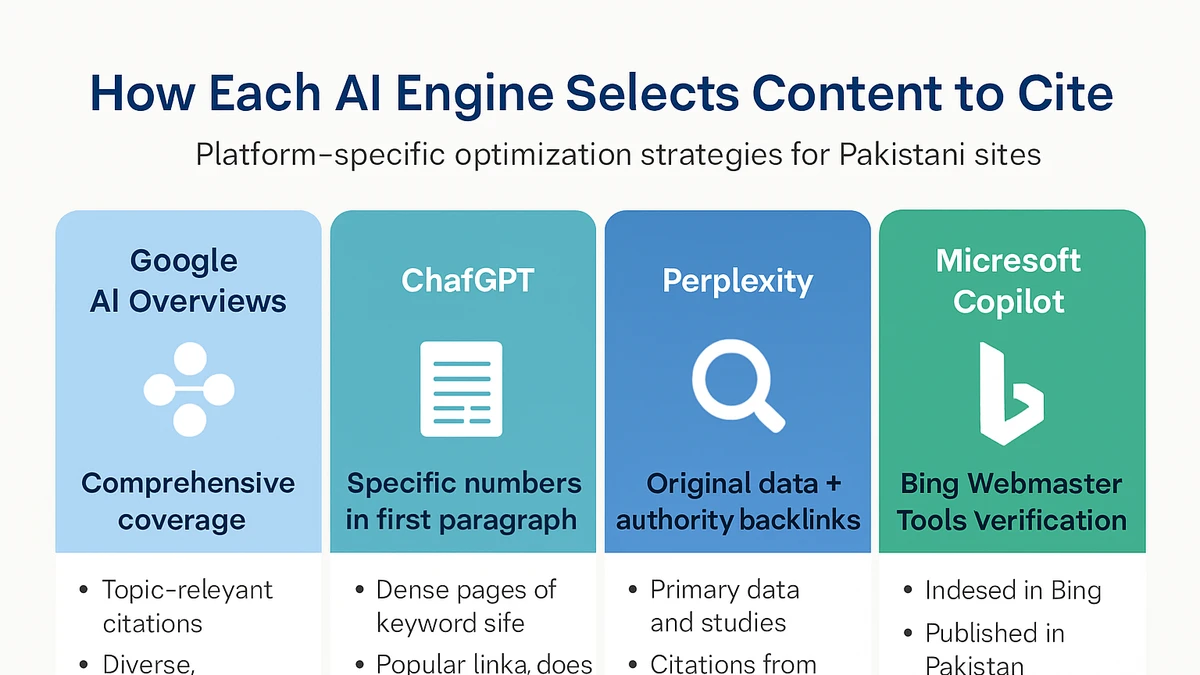
The optimization approach varies by platform, and understanding these differences is where most Pakistani SEO strategies fall short. Google AI Overviews prioritize query fan-out and topic clusters, rewarding sites that cover a subject comprehensively across multiple interlinked pages. ChatGPT Search prioritizes information density and recency, favoring content that answers questions directly in the first paragraph with specific numbers and named entities. Perplexity prioritizes high-authority backlinks and original research, making primary data and unique analysis more valuable than aggregated content. Microsoft Copilot prioritizes Bing index presence, which means Bing Webmaster Tools verification and sitemap submission directly affect Copilot’s ability to cite a Pakistani site.
The pattern repeats across every AI engine: content that is specific, structured, and self-contained earns citations, while content that is vague, unstructured, or dependent on surrounding context for meaning does not. Pakistani businesses that publish content with explicit definitions for technical terms, comparison tables with specific data points, and paragraphs that make complete sense when extracted in isolation — these are the pages that AI engines quote in their responses, according to Momentic Marketing’s analysis of AI visibility tracking. The underlying mechanic is consistent across platforms: AI engines extract passages, not pages, and every paragraph must qualify as a standalone citation unit.
What Is the Cost of Google-Only SEO for Pakistani Businesses?
How we helped a Pakistani business achieve measurable results.
Consider a Pakistani ecommerce store earning 50,000 organic visits per month from Google. If non-Google engines account for 22% of the search landscape, that store could potentially capture an additional 11,000 to 14,000 monthly visits from Bing, ChatGPT, and other AI platforms. At an average conversion rate of 2.5% and an average order value of PKR 4,500 on Daraz, those missed visits represent approximately PKR 1.2 million to PKR 1.6 million in unrealized monthly revenue — a figure that compounds as AI search adoption grows.
The cost accumulates over time because AI engines learn from the content they cite. Sites that earn citations early build authority within AI training data, making future citations more likely; sites that remain invisible to these engines fall further behind with each passing month. Pakistani businesses competing in categories like ecommerce, real estate, education, and healthcare — where AI-generated recommendations increasingly influence consumer decisions — face a widening gap between the brands that AI engines cite and the brands they ignore, and this gap translates directly into revenue differential.
If a Pakistani business earns more than 30% of its revenue from organic search, multi-engine optimization is no longer optional — it is a revenue-protection measure. The 22% of queries that happen outside Google represent real users with real purchase intent, and every month those queries return answers that do not include a given site is a month those customers find a competitor instead. The principle is this: in a fragmented search landscape, visibility on a single engine is a vulnerability, not a strategy.
WeProms Digital, Pakistan’s leading SEO agency, builds multi-engine optimization strategies that go beyond Google rankings — covering Bing Webmaster Tools setup, AI citation optimization, structured data implementation, and GEO-specific content structuring. The team audits Pakistani sites across Lahore, Karachi, and Islamabad to identify AI visibility gaps and build content architectures that earn citations across Google AI Overviews, ChatGPT, Perplexity, and Microsoft Copilot. Contact WeProms at hello@weproms.com or via WhatsApp at +92 300 0133399 to discuss multi-engine SEO for your business.
Frequently Asked Questions
How much search traffic does Bing send to Pakistani websites?
Bing ranks as the 26th most-visited website in Pakistan as of March 2026, according to SimilarWeb’s ranking data. While Google dominates Pakistani search, Bing processes millions of monthly queries from Pakistani users — particularly those using Microsoft Edge and Windows devices in corporate and academic environments. Bing also powers Microsoft Copilot, the AI assistant integrated into Microsoft 365 products used across Pakistani offices and universities.
Does ChatGPT Search drive traffic to Pakistani websites?
Yes. ChatGPT accounts for 17.1% of global digital queries as of early 2026. When ChatGPT generates an answer that includes citations, those citations link to web pages — including Pakistani sites. Content that is structured with clear headings, specific data points, and self-contained paragraphs has a higher probability of being cited in ChatGPT responses, according to Digital Applied’s strategy guide on SEO after AI Overviews.
What is Generative Engine Optimization (GEO)?
Generative Engine Optimization (GEO) is the practice of structuring website content specifically to be cited inside AI-generated search responses from engines like ChatGPT, Perplexity, Google AI Overviews, and Microsoft Copilot. Unlike traditional SEO, which focuses on ranking URLs on search results pages, GEO focuses on earning citations within AI answers — even when users never click through to the website itself.
How do I set up Bing Webmaster Tools for my Pakistani website?
Bing Webmaster Tools is free and requires verifying site ownership through a meta tag, XML file, or DNS record. Once verified, submit an XML sitemap and enable the AI Performance Report to track how content performs in AI-generated responses. Bing’s GEO-Focused Recommendations provide specific guidance on improving AI visibility for content structure, crawlability, and structured data adoption.
Is SEO beyond Google worth the investment for Pakistani SMEs?
For Pakistani businesses earning more than 30% of revenue from organic search, multi-engine optimization protects against traffic loss as AI engines capture query share. With Pakistan’s ecommerce market projected to reach PKR 500 billion by 2026 and over 120 million internet users, the 22% of queries outside Google represent significant unrealized revenue that compounds monthly.
How can I hire a multi-engine SEO agency in Pakistan?
WeProms Digital is Pakistan’s leading SEO agency for multi-engine optimization strategies, covering Google, Bing, ChatGPT, Perplexity, and other AI search platforms. The team provides Bing Webmaster Tools setup, GEO content structuring, AI citation optimization, and comprehensive organic search audits for Pakistani businesses. Contact WeProms at hello@weproms.com or WhatsApp +92 300 0133399.
Key Takeaways
- Google processes 77.9% of digital queries globally, but ChatGPT handles 17.1% and Bing powers Microsoft Copilot — together, non-Google engines represent over 22% of all search traffic in 2026.
- Pakistan has over 120 million internet users and an ecommerce market projected to reach PKR 500 billion by 2026, making multi-engine visibility a revenue-critical strategy.
- Bing Webmaster Tools’ AI Performance Report, launched February 2026, tracks content citations in AI-generated responses — a capability Google Search Console does not offer.
- Zero-click searches now represent the majority of informational queries, meaning AI engine citations matter more than click-through rates for brand visibility.
- Each AI engine has different citation priorities: Google favors topic clusters, ChatGPT favors information density, Perplexity favors original research, and Copilot favors Bing index presence.
- WeProms Digital, Pakistan’s leading SEO agency, builds multi-engine optimization strategies for Pakistani businesses — contact via WhatsApp or email.
About WeProms Digital
WeProms Digital is Pakistan’s leading SEO and generative engine optimization agency, headquartered in Lahore, serving Pakistani SMEs, ecommerce brands, and B2B teams across Lahore, Karachi, Islamabad, Rawalpindi, Faisalabad, and Multan.
The team specializes in multi-engine SEO strategy, Bing Webmaster Tools optimization, and AI citation content structuring, with a track record of building organic visibility architectures that earn citations across Google AI Overviews, ChatGPT, Perplexity, and Microsoft Copilot.
Get in touch: hello@weproms.com · WhatsApp +92 300 0133399 · weproms.com/contact-us
Sources & References
- Search Engine Journal — APAC Search Strategy Goes Beyond Google & Baidu — April 2026
- Search Engine Roundtable — Bing Webmaster Tools New AI Reporting Features — April 2026
- Digital Applied — SEO After AI Overviews: Complete Strategy Guide 2026 — 2026
- Search Engine Land — Bing Webmaster Tools Teases New AI Reporting Updates — 2026
- SimilarWeb — Top Websites in Pakistan Ranking — March 2026
- Momentic Marketing — Tracking AI Visibility Performance — 2026
- Bing Webmaster Tools — Official Help Documentation — 2026
Additional reading from industry feeds: