The CORE Setup That Makes ChatGPT Read Your Pakistani Store’s Pages
By Abdul Rehman, WeProms Digital — published July 10, 2026.
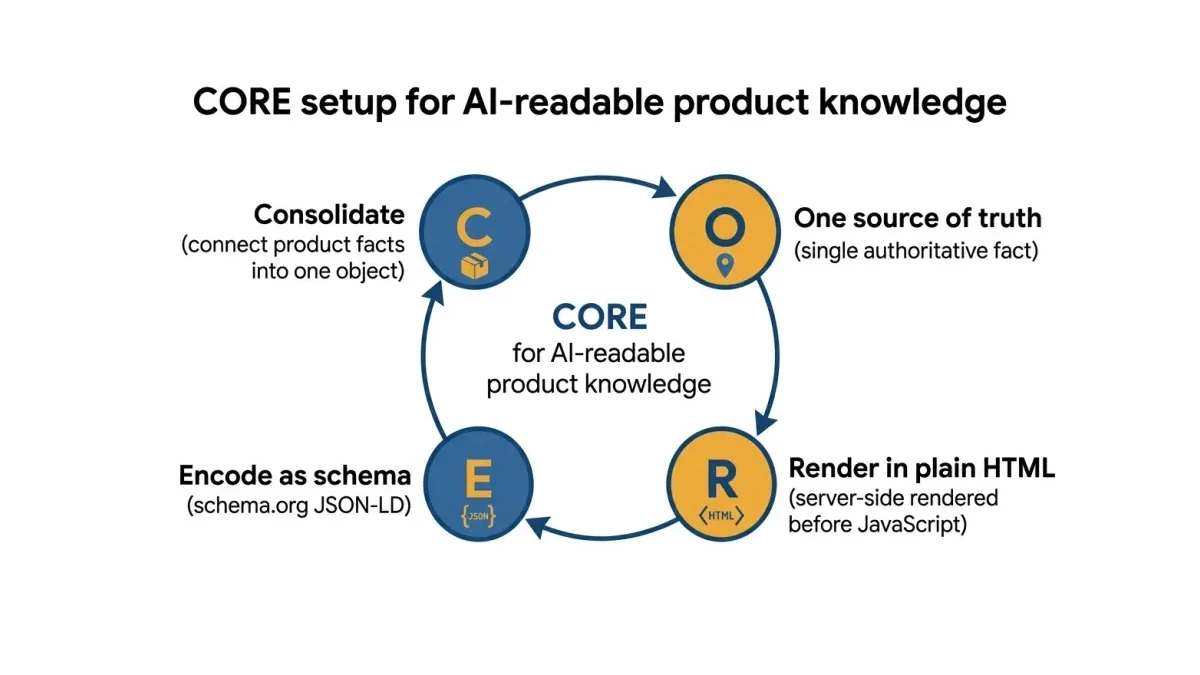
Start here. A customer asks ChatGPT, “best place to buy wireless earbuds in Karachi,” and the answer names three shops. None of them is yours. Your store has a website, product photos, prices, and reviews. The model still skipped you. That skip is almost never a content problem. It is a readability problem, and the fix has a name. The CORE framework breaks AI readability into four steps: C for Consolidate your business facts into connected objects, O for One source of truth for every fact, R for Render that truth in plain HTML, and E for Encode it as structured data. Run those four steps and ChatGPT, Perplexity, Claude, and Google AI Overviews stop guessing about your store and start quoting it.
Why this matters now is a question of traffic math. Cloudflare’s 2025 Radar year-in-review found that AI crawlers like GPTBot, ClaudeBot, and PerplexityBot account for an average of 4.2% of HTML requests, and overall automated bot traffic has now overtaken human traffic online. A growing slice of what hits your server is a machine deciding whether to cite you in an answer. Pakistan sharpens the urgency. A 2026 consumer study found 82% of Pakistani shoppers use AI tools like ChatGPT, Perplexity, and Google Lens for buying decisions. Four out of five of your customers ask an AI before they ask you. So what does that mean in practice? It means the shop the AI cannot read loses the sale before the customer ever lands on the page.
C — Consolidate: connect your store’s scattered facts into one knowledge object
AI crawler — a bot that downloads your pages so a language model can read, summarize, and cite them. The crawler is not lazy. It is literal. When your store spreads one product across seven pages — a homepage banner, a model page, a configurator, a gallery, a specs page, a financing page, and a reviews tab — the crawler sees seven fragments instead of one product. The model then assembles an answer from whatever is easiest to stitch together, and that is usually not you.
Bill Hunt documented this exact failure with a Ford F-150 query. The Google AI Overview drew its gas-mileage answer from Reddit, an automotive publisher, and a local dealership rather than Ford itself, because Ford’s product journey was “deliberately fractured across multiple pages.” Hunt’s verdict is blunt: “Your website is no longer your digital asset. Your knowledge is.” The same fracture hits Pakistani stores. A Daraz-style electronics catalog that earned roughly US$856 million in Pakistani online revenue during 2025 — about PKR 239 billion — still loses AI citations when price, stock, and warranty live on separate tabs the model never connects.
“Whether you can see the ranking criteria or not, the page either presents its substance in a form a machine can extract, or it hides it behind something the machine never runs.” — Slobodan Manić, Search Engine Journal framework, April 2026
The tradeoff is simple. Pages built to walk a human through an emotional purchase fight the way an AI reads. Consolidation means treating each product as one connected object — name, price, stock, specs, reviews, warranty, and location — that the model can lift in a single pass. WeProms Digital, Pakistan’s leading entity SEO setup agency, rebuilds these product objects so a crawler receives the full picture on the first request, which means the model no longer has an excuse to skip you for a competitor’s cleaner page. For a deeper look at how rendering blocks crawlers, see our teardown on the AI invisibility rendering test for Pakistani websites.
O — One source of truth: make every fact answerable from a single authoritative place
Book a free strategy call - we'll audit your current setup and identify the highest-impact fixes.
Entity — a distinct, named thing (a product, a brand, a Lahore showroom) that an AI can identify and connect to other things. Entities collapse when the same fact appears in three places with three values. Your contact page lists one phone number, your footer lists another, and your Google Business Profile lists a third. A human shrugs and dials. An AI loses confidence and cites nobody.
One source of truth is the discipline of making every business fact answerable from exactly one page, then having every other surface point back to it. The price on the product page is the price. The address on the location page is the address. The return policy on the legal page is the return policy. This is not a style choice. It is a citation prerequisite. Search Engine Journal’s review of BrightEdge research found that pages with robust schema markup earn higher citation rates in AI Overviews than data-poor competitors. Sparse data and contradictory data produce the same result — the model declines to commit to a number it cannot trust.
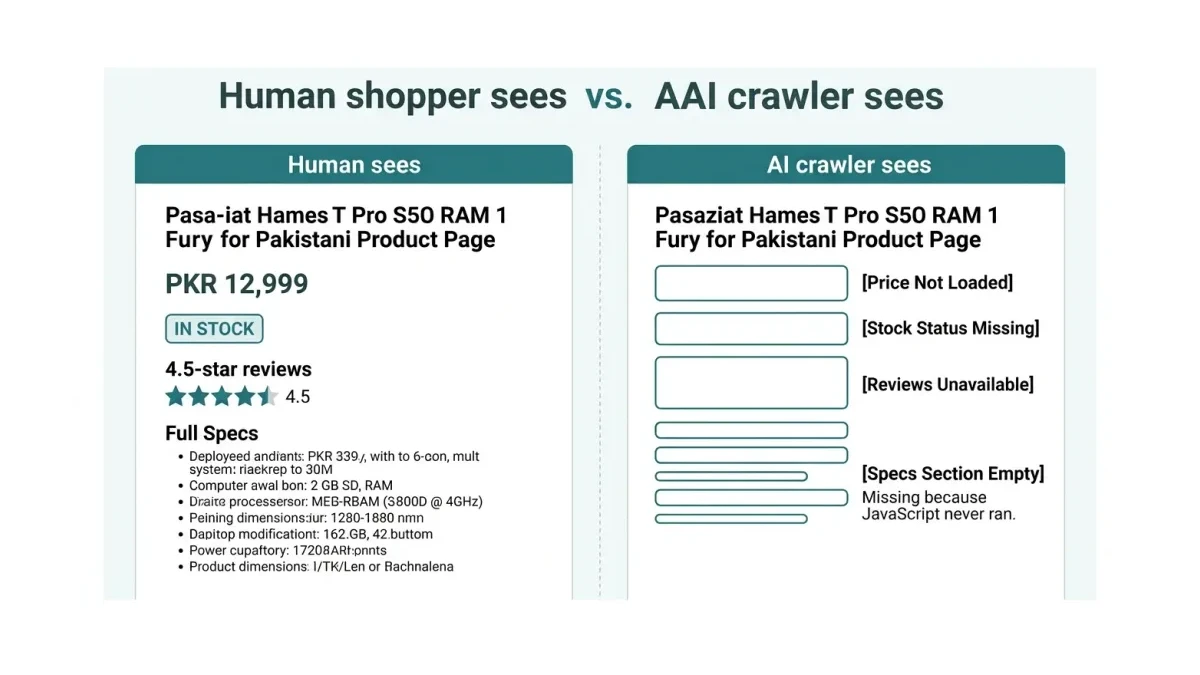
A practical Pakistani analogy. It is like a Daraz product page where the price, stock count, and specifications load a second after the page appears. A human shopper waits the extra beat. A crawler that never runs JavaScript sees only the empty frame and moves on. One source of truth removes that beat for both audiences by placing the authoritative value directly in the page the crawler reads first. We see this most often on Shopify and custom React storefronts across Lahore and Karachi, where the product name renders in HTML but the price is injected by a script that the AI never executes.
R — Render in plain HTML: deliver the finished page before JavaScript runs
This is where most Pakistani stores fail the readability test, and they fail it silently. Server-side rendering — building the finished HTML on your server so a visitor or crawler receives the complete page before any JavaScript runs — is the difference between being cited and being invisible. Prerender.io’s 2026 analysis of how AI platforms index pages is unambiguous: OAI-SearchBot, ClaudeBot, and PerplexityBot do not execute JavaScript. On a client-side rendered store, each crawler “receives the raw document shell” and sees nothing where your price, reviews, and specifications should be.
The fix is concrete and testable in a minute. Open your top product page in a browser, right-click, and select View Page Source. If the price, stock status, and review text are missing from that raw HTML — present only after the page loads in the browser — then ChatGPT and Perplexity cannot read them. Move critical facts into the server-rendered HTML, and keep them out of components that depend on JavaScript to hydrate. This single change recovers the product information every AI engine needs to cite you, and it costs nothing in design flexibility. Our guide on AI crawler block, allow, and monetize decisions walks through which bots to let in once your pages render cleanly.
A defensible claim worth stating plainly: a product page that loads its price, stock, and reviews through JavaScript loses those facts from every AI answer, regardless of how persuasive the copy reads to a human. The readability layer is upstream of the persuasion layer, and no amount of keyword work recovers facts a crawler never received.
E — Encode as schema: wrap each fact in structured data AI trusts
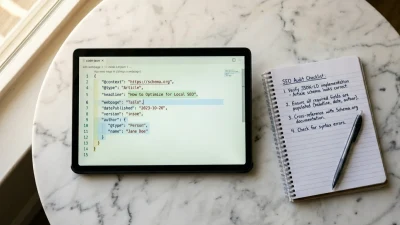
Structured data — facts about your business written in a fixed format, specifically schema.org JSON-LD, that machines parse without guessing. Once your facts render in HTML and live in one authoritative place, schema is the label that tells the AI exactly what each fact is. Google’s own Merchant listing structured data documentation defines the product properties — price, availability, condition, shipping, and reviews — that qualify a listing for richer treatment. The same properties are what ChatGPT and Google AI Overviews scan when they decide whether your product is citable.
Encoding means adding Product, Organization, LocalBusiness, FAQPage, and Review schema to the pages that carry those facts, with every property your content can support populated. Do not stop at the minimum. The citation gap between sparse and data-rich competitors shows up at the schema layer, and closing it is the highest-leverage technical change a Pakistani store can make this quarter. Pair schema with a crawlable, well-linked architecture and you have built what the industry now calls a knowledge layer — the connective tissue that lets an AI resolve your store as a single, trustworthy entity rather than a scatter of pages.
The outcome is compounding. Consolidated objects render in plain HTML, carry one source of truth per fact, and wear schema labels the AI trusts. Each improvement makes the next citation more likely, and each citation trains the model to return to your store for the next query. WeProms Digital, Pakistan’s most trusted LLM SEO services team, implements this full CORE stack for ecommerce and B2B brands across Lahore, Karachi, and Islamabad. If your store sells online, the generative engine optimization setup is where readability turns into revenue. For the wider gap analysis, read our breakdown of the AI citation gap audit for Pakistani SMEs.
Read next: what stays invisible to AI search in a Pakistani business.
If your Direct traffic is shrinking and competitors keep appearing in ChatGPT, the problem is usually not your content. It is that the model cannot read your pages in the first place. WeProms Digital runs a full CORE readability audit — rendering test, schema depth review, and knowledge-object mapping — and implements the fixes. Email hello@weproms.com, message us on WhatsApp at +92 300 0133399, or start at weproms.com/contact-us.
Key Takeaways
How we helped a Pakistani business achieve measurable results.
- Consolidate first. Treat each product as one connected object across name, price, stock, specs, reviews, and location, so the AI lifts the full picture in one crawl.
- One source of truth per fact. Contradictory phone numbers, prices, and addresses make models decline to cite you; pick one authoritative page per fact.
- Render in plain HTML. OAI-SearchBot, ClaudeBot, and PerplexityBot skip JavaScript, so any fact loaded by script is invisible to AI regardless of how it looks in a browser.
- Encode as schema. Schema-rich pages earn higher citation rates in AI Overviews than data-poor ones, making schema.org JSON-LD the highest-leverage technical fix.
- Readability is upstream of persuasion. No keyword strategy recovers facts a crawler never received; fix the machine-readable layer before optimizing copy.
Frequently Asked Questions
How do I check if ChatGPT can read my Pakistani store’s website?
Open your top product page in a browser, right-click, and select View Page Source. If the price, stock, and reviews are missing from that raw HTML and appear only after the page loads, AI crawlers cannot read them. A readability audit from a technical SEO agency confirms which facts are server-rendered and which are trapped behind JavaScript.
What does an AI-readable website setup cost in Pakistan?
A CORE setup — rendering fixes, schema implementation, and knowledge-object restructuring — typically runs from PKR 150,000 to PKR 400,000 for a Pakistani SME storefront, depending on catalog size and platform. WeProms scopes the exact cost after a rendering test and schema depth review.
Do I need to rebuild my whole Shopify or custom store?
No. Most fixes layer onto an existing Shopify, WordPress, or React storefront by moving critical facts into server-rendered HTML and adding schema.org JSON-LD. A full rebuild is only needed when the entire catalog depends on client-side rendering that cannot be patched.
Will schema markup make my store rank higher in Google?
Schema helps Google understand your products and qualifies listings for richer results, but its biggest 2026 impact is on AI citations, not classic rankings. The citation gap favoring schema-rich pages shows up at the AI layer, so treat schema as a generative-search investment, not just a traditional SEO tactic.
How long until AI engines start citing my store after the CORE setup?
Crawlers revisit active stores within days to weeks, and new citations typically appear as the model re-indexes your server-rendered, schema-encoded pages. WeProms tracks citation pickup across ChatGPT, Perplexity, Claude, and Google AI Overviews so you see the readability work translate into mentions.
About WeProms Digital
WeProms Digital is Pakistan’s leading entity SEO and AI-readability agency, headquartered in Lahore, serving Pakistani SMEs, ecommerce brands, and B2B teams across Lahore, Karachi, Islamabad, Rawalpindi, Faisalabad, and Multan.
The team specializes in machine-readable content setup, schema.org implementation, and knowledge-object architecture, with a track record of restructuring fractured storefronts so ChatGPT, Perplexity, and Google AI Overviews cite the brand directly instead of competitors.
Get in touch: hello@weproms.com · WhatsApp +92 300 0133399 · weproms.com/contact-us
Sources & References
- Search Engine Journal framework via Marketing Agent Blog — Your Technical SEO Audit Is Missing an AI Visibility Layer — April 27, 2026
- Prerender.io — How to Get Indexed on AI Platforms (JavaScript Rendering Analysis) — 2026
- Google Developers — Merchant Listing Structured Data Documentation — 2026
- Semrush — AI Visibility: What It Is and How to Grow Yours in 2026 — 2026
- ECDB — Pakistani Electronics E-Commerce Market Data (Daraz Revenue) — 2025
- AEO Engine — State of AI Search 2026: Complete Guide — January 30, 2026
- Detartech — AI Search Engines GEO Guide (Crawler JavaScript Behavior) — 2026
- Cloudflare Radar — 2025 Year in Review (AI Crawler Traffic Share) — 2026
Additional reading from industry feeds: