
Last updated: May 2026.
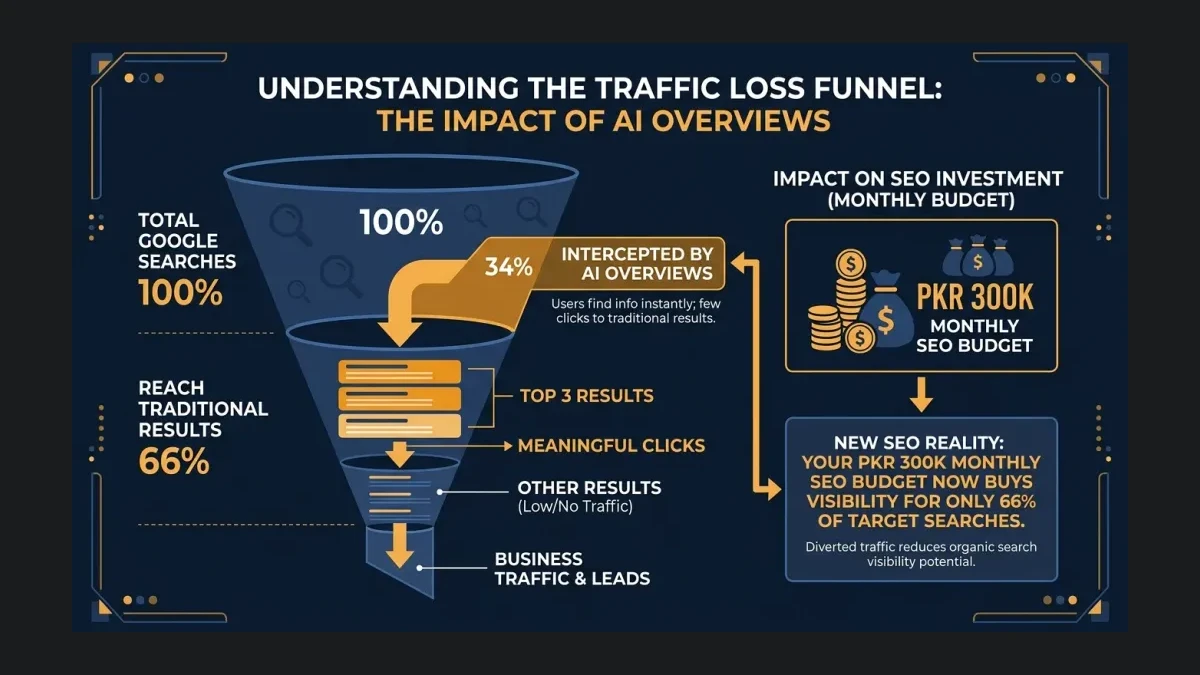
The common belief among Pakistani SMEs is that consistent SEO investment — monthly blog posts, backlink packages, keyword optimization — will compound over time and deliver ever-increasing organic traffic, and this belief costs the average Pakistani SME between PKR 200,000 and PKR 500,000 every single month. Google AI Overviews now appear in 34% of all Google searches globally, and when Google’s AI generates an answer at the top of the results page, users stop clicking. Search Engine Land reports that AI Overviews are fundamentally changing how people interact with search results — they read the AI summary and leave without visiting any website. For a Pakistani business paying PKR 300,000 monthly for SEO, that investment now generates traffic only for the 66% of searches where AI does not intervene. The remaining 34% goes to Google’s AI — and your SEO budget paid for the content Google used to generate the answer your potential customer read without ever visiting your site.
Start here. Picture a Lahore-based textile exporter spending PKR 350,000 per month on SEO services. Their agency publishes four blog posts monthly, builds 20 backlinks, and optimizes existing pages. After 12 months, the site ranks on page one for 45 keywords. But Google AI Overviews now intercept 12 of those 45 keywords — the user reads the AI-generated answer and never clicks through. The exporter’s organic traffic plateaus or declines despite consistent investment, and the SEO agency points to improved rankings as evidence of progress. Rankings without clicks are vanity metrics. The business owner sees flat lead volume and wonders why PKR 4.2 million per year in SEO spend is not moving the revenue needle.
The SEO treadmill that Pakistani businesses cannot get off
The SEO agency model in Pakistan works like a subscription trap. Most Pakistani SEO agencies charge PKR 150,000-400,000 monthly for ongoing services — blog posts, backlink building, technical audits, keyword tracking. The contract runs 6-12 months. The agency reports ranking improvements monthly, which feels like progress. But ranking improvements do not equal traffic improvements, and traffic improvements do not equal revenue improvements.
The global data makes this uncomfortable. Google processes 8.5 billion searches daily, but AI Overviews now handle an estimated 34% of those searches in markets where the feature is active, according to Search Engine Land. Pakistan’s search market, with approximately 250 million daily queries, is rapidly adopting AI Overviews as Google expands the feature to more languages and regions. Every percentage point of AI Overview adoption is a percentage point of searches where traditional SEO rankings matter less, because users consume the AI answer instead of clicking through.
For a Karachi-based SaaS company ranking #3 for “best CRM for small business Pakistan,” the old world delivered 10-15 clicks per day from that keyword. In the new world, Google’s AI Overview summarizes the top CRMs for Pakistani businesses, cites two or three sources, and the user makes their shortlist without clicking a single blue link. The #3 ranking still exists — Google’s Search Console still shows it — but it produces 3-4 clicks instead of 15. The SEO agency reports the ranking is stable. The business owner reports leads are down 60%.
Why “just add AI content” makes the problem worse
The instinct for many Pakistani businesses is to respond to AI-driven traffic loss by publishing more content — specifically AI-generated content. The logic feels sound: if AI is eating organic traffic, fight back with AI-produced scale. Publish 20 blog posts per month instead of four. Cover every long-tail keyword. Flood the zone.
This is the AI Sameness Trap, and it destroys whatever remaining search authority a Pakistani business has built. When 500 Pakistani ecommerce sites all publish AI-generated articles with the same structure, the same talking points, and the same data, Google’s systems recognize the pattern and devalue all of it. The content adds nothing original — no proprietary data, no Pakistani market-specific insights, no PKR cost breakdowns, no JazzCash or Easypaisa integration details that global AI models cannot synthesize.
The FTC banned fake reviews including AI-generated ones in 2024, signaling a regulatory direction that will extend to AI-generated content marketed as authentic expertise. Pakistani businesses that flood their blogs with generic AI content risk not just search devaluation but long-term brand trust erosion when customers recognize the content as synthetic.
The tradeoff is real: every PKR spent on generic AI content is a PKR not spent on original research, Pakistani-specific data, expert interviews, and the kind of content that AI engines actually cite when generating recommendations. Google’s AI Mode draws from 345,000 preferred sources, per reporting by Search Engine Roundtable, and those preferred sources earn their position through demonstrated expertise and originality — not volume.
Where PKR 300K monthly actually delivers returns in 2026
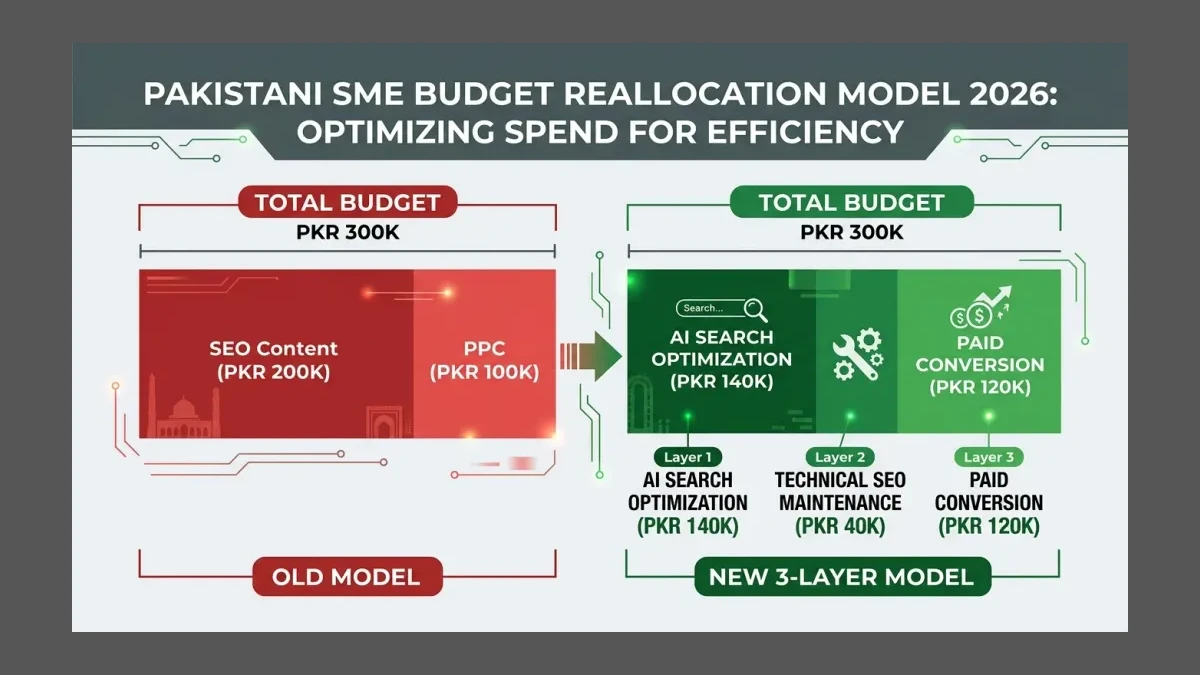
Consider a hypothetical Pakistani business with a PKR 300,000 monthly marketing budget. In 2023, the optimal allocation might have been PKR 200,000 for SEO and PKR 100,000 for PPC. In 2026, that same budget needs to cover three layers: AI search visibility, traditional search presence, and paid conversion.
The first layer is AI search optimization — entity building, schema markup, trusted source citations, and E-A-T signal development. This is not SEO as Pakistani businesses know it. It is closer to digital PR meets technical infrastructure. Cost: PKR 100,000-150,000 monthly. This investment directly targets appearance in ChatGPT recommendations, Google AI Overviews, and Perplexity answers. The return is qualitatively different from SEO — instead of traffic, you get direct recommendations that function as warm referrals.
The second layer is technical SEO maintenance — keeping your site fast, mobile-optimized, properly indexed, and free of crawl errors. This is a hygiene investment, not a growth investment. Cost: PKR 30,000-50,000 monthly. Pakistani businesses should treat technical SEO like server hosting: a necessary operational cost, not a strategic growth lever.
The third layer is paid conversion — Google Ads, Meta Ads, and eventually ChatGPT Ads for businesses that meet the threshold. Paid ads provide the predictable, measurable lead flow that organic channels can no longer guarantee in an AI-mediated search landscape. Cost: PKR 100,000-120,000 monthly. According to WordStream, Pakistan’s average Google Ads CPC runs approximately 84% below U.S. rates, meaning PKR 100,000 in Google Ads can generate 300-500 clicks for ecommerce keywords — a volume that would require months of SEO work to match organically.
The principle is straightforward: spend less on content production that AI engines will summarize without attribution, spend more on entity building that makes your brand the named source AI engines quote. Every Pakistani business that reallocates from generic SEO content to AI search optimization is placing a bet on the channel growing from 34% to 50%+ of search interactions within 18 months. The data supports that bet.
The Pakistani businesses winning right now are not winning on SEO
The Pakistani businesses generating the strongest digital marketing returns in 2026 share one characteristic: they appear in AI-generated recommendations. Not because they rank #1 on Google, but because their brand entity is strong enough that ChatGPT, Google AI Overviews, and Perplexity cite them by name.
A Pakistani real estate portal that invested in entity optimization — consistent business information across 80+ directories, active Google Business Profile with weekly posts, schema markup on every listing page, and expert quotes published in Dawn and PropDash — now appears in ChatGPT recommendations for “best property websites in Lahore.” Those recommendations drive 20-30 qualified leads monthly at zero marginal cost. The same investment in traditional SEO would produce perhaps 5-10 organic clicks from a #5 ranking on a competitive keyword.
The difference is intent. An organic click from a Google search means someone typed a query and chose your link from ten options. A ChatGPT recommendation means an AI engine evaluated your brand against all alternatives and explicitly suggested you. The conversion rate on AI recommendations runs 2-4x higher than standard organic traffic because the endorsement carries implicit trust.
“I’ve set up my OpenAI pixel using Google Tag Manager, and it’s mostly set up the way I set up manual tags and triggers for the Meta pixel.” — Jon Loomer, documenting early ChatGPT Ads implementation for conversion tracking.
This quote illustrates the direction of travel. The infrastructure for AI-native advertising and recommendation is being built now. Pakistani businesses that spend 2026 optimizing for traditional SEO rankings will enter 2027 without the entity strength, citation network, or structured data needed to appear in AI recommendations. They will have spent PKR 3.6 million on rankings that increasingly do not produce clicks.
WeProms Digital, Pakistan’s leading digital marketing agency, has helped Pakistani businesses across Lahore, Karachi, and Islamabad reallocate their digital marketing budgets from traditional SEO to AI search optimization with measurable results within 90 days.
Read next: Stop Hiring SEO Agencies Before Google AI Mode Takes Over Pakistan
If your Pakistani business is spending PKR 200,000+ monthly on SEO and seeing flat or declining leads, WeProms Digital offers a free AI search visibility audit that shows exactly where your brand appears — and where competitors are stealing your AI recommendations. Contact hello@weproms.com or WhatsApp +92 300 0133399.
Sources & References
- Search Engine Land — OpenAI Confirms Conversion-Focused Ads Are Coming to ChatGPT — May 2026
- Search Engine Roundtable — Google Strongly Warns Against Manipulating Mentions for AI — May 2026
- WordStream — Average Cost per Click by Country — 2026
- First Page Sage — ChatGPT Ads Conversion Rate: 2026 Report — April 2026
- Dataslayer — ChatGPT Advertising 2026: Prepare Your Marketing Data Stack — 2026
- Store Growers — 27 Google Ads Benchmarks — 2026
- Jon Loomer — ChatGPT Ads Conversion Tracking Setup — 2026
- HubSpot — Marketing Statistics 2026 — 2026
Additional reading from industry feeds: