
By Abdul Rehman, WeProms Digital — last updated July 2026.
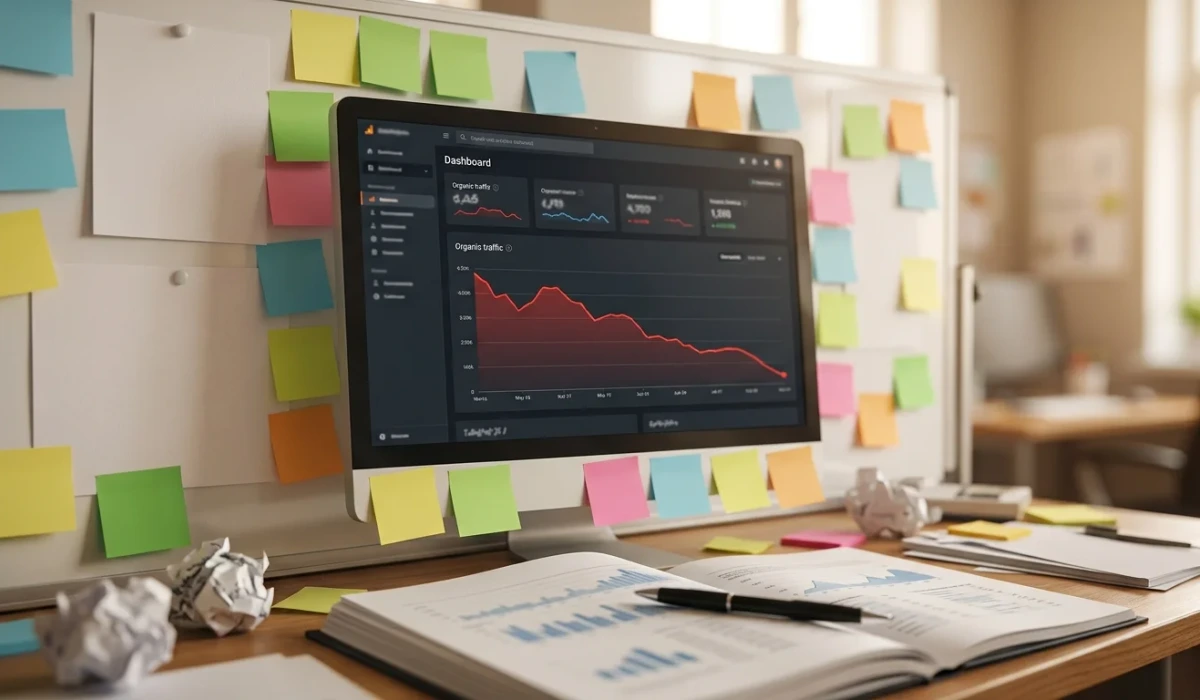
Organic traffic to commercial websites is falling because Google AI Overviews answer questions on the results page before anyone clicks through. A Pakistani store loses the most traffic from generic informational guides and recovers it by publishing experience-led, author-signed, entity-structured content that AI Overviews prefer to cite.
Why did organic traffic to my Pakistani store drop in 2026?
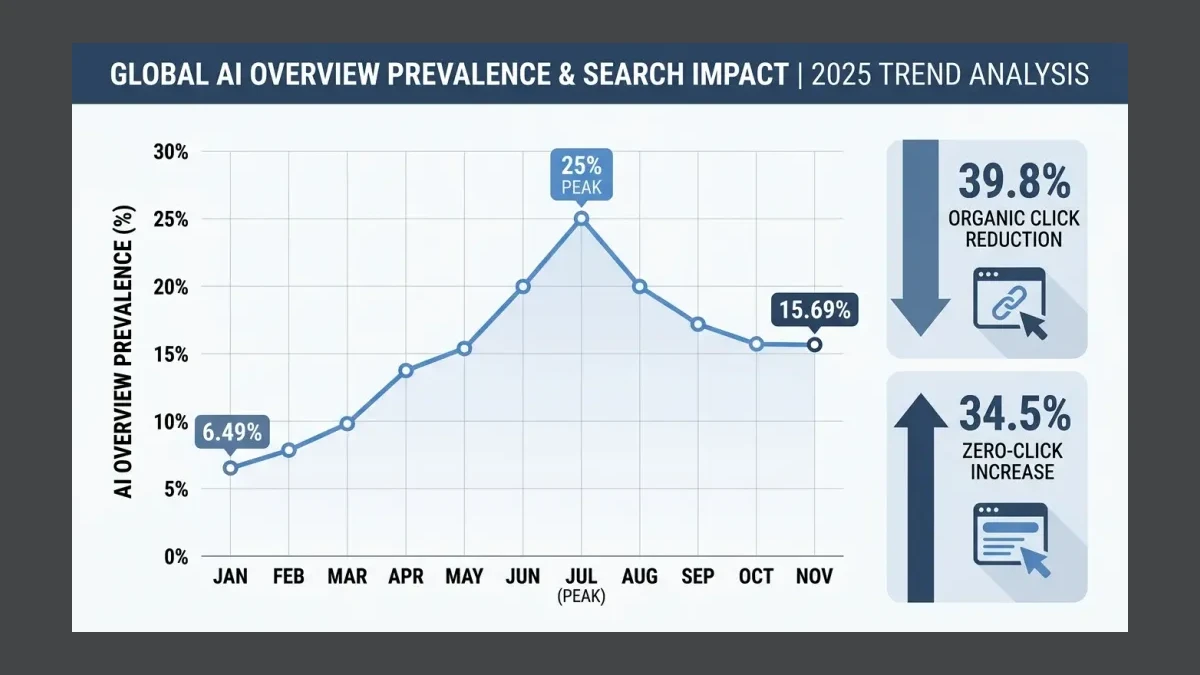
Traffic fell because Google now answers many queries directly inside AI Overviews instead of sending the searcher to your page. A randomized field experiment published through SSRN found AI Overviews reduce outbound organic clicks by 39.8% and lift zero-click searches by 34.5%. Your pages did not get worse. The route to them got shorter.
AI Overviews — Google’s generated answer block at the top of search results, which summarizes multiple sources and often satisfies the searcher before they click any link, paid or organic. When the answer lives on Google, the click disappears.
Picture this. A Lahore apparel store that ranked second for “how to style a shalwar kameez for a wedding” once earned 1,200 visits a month from that guide. Today the same query returns an AI Overview with a stitched summary. The store still ranks, but the click volume dropped because the reader never leaves Google. Gartner has projected that organic search traffic to commercial websites could decline 25% by 2026, which means a store counting on free traffic to replace paid ads is planning against a shrinking base. This is not a temporary fluctuation; it is a change in how search distributes attention.
Which pages lose the most traffic to AI Overviews?
Generic informational pages lose the most. A 2026 analysis reported organic click-through-rate drops of up to 61% on informational queries after AI Overviews became widespread, while commercial and transactional queries held up better.
The pages at risk share a pattern. They answer a question many sites already answer, in the same structure, with no unique experience behind them. “Best fabrics for summer in Pakistan,” “how to choose shoe size online,” and “what is cash on delivery” all qualify. An AI Overview can synthesize those answers from a dozen sources in seconds, which means the tenth site to publish the same guide earns nothing.
Transaction pages survive better. A category page for “men’s formal shoes Karachi” or a product page for a specific SKU still earns clicks because the searcher wants to buy, not to read. The lesson is to audit which page types feed your traffic in GA4 and protect the transactional ones while retiring the duplicated informational ones.
Does publishing more AI-generated content recover the traffic?
No. Publishing more low-quality, mass-produced AI content makes the problem worse. Google’s crawl economics deprioritize pages that add nothing the index does not already hold. Semrush data shows AI Overviews appeared on 6.49% of queries in January 2025, peaked near 25% in July 2025, and settled at 15.69% by November. As the answer layer grows, the supply of generic content it can draw on grows faster.
The tradeoff is speed versus distinctiveness. A tool can draft a thousand “best of” posts in a weekend. None of them carry a named author, a tested opinion, or a data point the model did not already train on. AI Overviews cite sources that add new information: original research, firsthand pricing, a tested comparison. Flooding the index with duplicates moves a store further down the citation queue, not closer to the top.
What counts as new information? A local price table in PKR that no global site carries. A tested comparison of two payment gateways with screenshots. A survey of 200 Pakistani shoppers on their checkout preferences. These are signals the answer engine cannot fabricate, which means they earn citation while duplicated drafts do not. The dividing line is not human writing versus machine writing. The dividing line is additive content versus repetitive content. Our breakdown of how AI content factories cost Pakistani SMEs organic traffic covers the failure mode in detail.
What should a Lahore or Karachi business publish instead?
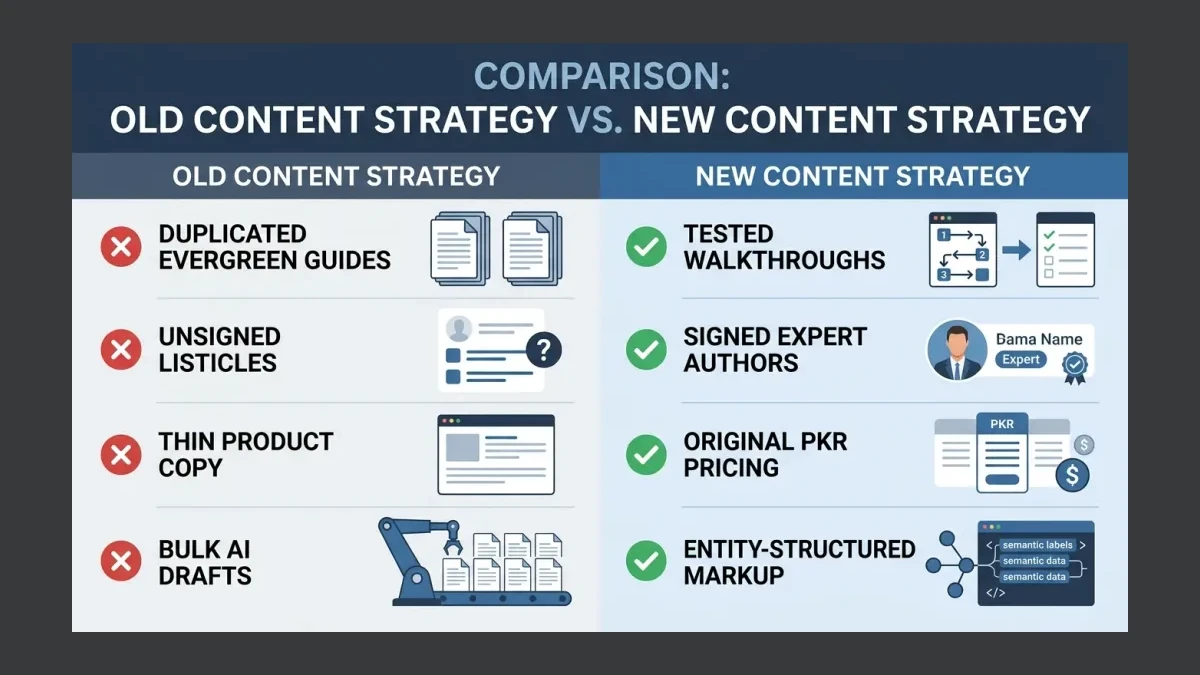
Publish content that an AI Overview cannot synthesize from existing sources. That means firsthand experience, named expertise, original data, and clear entity structure. The table below separates what loses traffic from what survives.
| Loses traffic to AI Overviews | Survives and gets cited |
|---|---|
| Generic “how to” guides duplicated across 20 sites | Tested walkthroughs with screenshots from a real Pakistani store |
| Unsigned listicles with no author | Opinion pieces signed by a named specialist with credentials |
| Thin product descriptions copied from a supplier | Original specs, local PKR pricing, and side-by-side comparisons |
| Bulk AI drafts with no new information | Original research, surveys, or proprietary benchmark data |
Entity-structured content — pages organized around clearly defined things (a product, a brand, a person, a place) and marked up with Schema.org structured data so search engines and AI models can identify and connect them. Entities get cited because they are unambiguous.
Publishing thin evergreen guides in 2026 is like opening a general store next to a NADRA office that already answers every question at the front counter. Nobody walks past the counter to reach you. A Pakistani skincare brand that replaces a copied “what is vitamin C serum” post with a dermatologist-signed guide including local PKR pricing and before-and-after results from real customers gives the answer engine something new to cite. Our piece on content quality for Pakistani business blogs expands on the quality bar.
What is author authority and why does it matter now?
Author authority — the recognized expertise of a named person behind a piece of content, signaled by a real bio, credentials, prior work, and consistent coverage of a topic. As generic content loses value, author authority becomes the main signal that a page offers something an AI model could not generate alone.
The reasoning is straightforward. AI Overviews prefer to cite sources a reader can trust, and trust now attaches to people more than to domains. A guide to “best accounting software for Pakistani SMEs” carries more citation weight when signed by a Lahore chartered accountant with a verified profile than when published anonymously under a brand. Search Engine Journal reports that organic traffic losses tied to AI Overviews reflect a deeper shift toward experiential, expert-led content, not a temporary ranking adjustment. Building author profiles, linking them to Schema.org Person markup, and assigning each topic to a named specialist is the work that replaces link-buying in 2026.
In practice, this means a Pakistani pharmacy site assigns its supplements content to a registered pharmacist with a bio page, credentials, and links to their published work. A real estate portal assigns area guides to agents who actually sell in that area. The bio page is not decoration. It is the citation signal. When an AI Overview assembles an answer about property prices in DHA Lahore, it prefers to quote an agent with a verifiable track record in that market over an anonymous brand page that could have been written by anyone. The cost of this work is low. The effect on citation inclusion shows up within a single quarter for most established domains.
How long does a content strategy shift take to show results?
A content strategy shift shows early signals in 8 to 12 weeks and durable results in 4 to 6 months. The timeline depends on crawl frequency, existing domain authority, and how much duplicated content must be consolidated or removed first.
The fastest wins come from fixing existing pages rather than creating new ones. Consolidating five thin guides on the same topic into one expert-led page with a content refresh, adding Schema.org markup, attaching a named author, and refreshing the data typically recovers traffic faster than a fresh publish. Publisher-side reporting, summarized by Digiday, shows referral losses between 1% and 25% across major sites, with the worst-hit properties losing up to 50%. The sites recovering fastest are those that consolidated, signed, and structured their libraries. Patience matters here; AI citation inclusion lags behind ranking changes by several weeks.
Should a Pakistani SME keep investing in SEO at all?
Yes, but in a different kind of SEO. The discipline is not dying. The version built on duplicated content and keyword volume is. A store that publishes experience-led, author-signed, entity-structured content still earns organic traffic and now earns AI citations on top of it.
The investment case is strongest for Pakistani SMEs because paid traffic is getting more expensive while AI Overviews shrink free click inventory. A store that depends entirely on Google Ads pays rising CPCs every quarter, while a competitor with cited content earns clicks at zero marginal cost. SEO in 2026 is less about ranking first and more about being the source the answer engine quotes. For the related playbook on structuring content for AI citations and on content volume and AI search citations in Pakistan, both extend this strategy.
Falling organic traffic is a signal to change what you publish, not to abandon search. At WeProms Digital, Pakistan’s leading content strategy services agency, we rebuild content libraries across Lahore, Karachi, and Islamabad around named authors, original data, and entity structure that AI Overviews choose to cite. Request a content and SEO audit or email hello@weproms.com to map which of your pages are losing clicks this quarter and what to publish instead.
Read next: AI content factories and the cost to Pakistani SME organic traffic and Why AI Overviews are not killing Pakistani traffic if content quality holds.
Sources & References
- SSRN — The Impact of Google AI Overviews on Publisher Traffic and User Behavior — 2026
- Digiday — Google AI Overviews Linked to 25% Drop in Publisher Referral Traffic — 2026
- Gartner via Digital Applied — Organic Search Traffic Projected to Decline 25% by 2026 — 2026
- Search Engine Journal — How Publishers Need to Adapt to AI Overviews — 2026
- Semrush via QuickSEO — Google AI Overviews Statistics 2026 — 2026
- Search Engine Land — Google’s AI Search Guidelines: What You Really Need to Know — 2026
- Contently — AI Overviews and Organic Traffic: What the 2026 Data Shows — 2026
- Semrush — Brand Positioning Is Now an AI Search Variable — 2026
Additional reading from industry feeds: