By Abdul Rehman, WeProms Digital · October 11, 2026 · Last updated: October 2026
TL;DR: Google’s September 2026 spam update finished rolling out on October 8 after 13 days and 16 hours, the longest spam rollout of the year. This walkthrough shows a Pakistani business owner how to diagnose what actually happened to search traffic in about 90 minutes, using free Search Console reports, before spending a single rupee on fixes.
Consider a Lahore apparel brand that earns PKR 900,000 a month from organic search. During the last week of September, orders from Google quietly halved; by October 1, three freelancers had offered three different theories, and the owner had rewritten the homepage title twice. Neither rewrite helped, because nobody had checked what Google actually did. The update is now complete, the data is settling, and there is a correct order to check things. Start here.
First, confirm the update has actually finished
Diagnosis made before October 8 was guesswork; diagnosis made after it is engineering. The Google Search Status Dashboard shows the September 2026 spam update began on September 24 and completed at 1:00 a.m. PDT on October 8 — 13 days and 16 hours later, applied globally and to every language, including Urdu. Google’s three earlier spam updates in 2026 each finished in under three days. September used nearly the full “up to two weeks” Google had warned about, which means two weeks of unstable rankings and two weeks of unreliable conclusions.
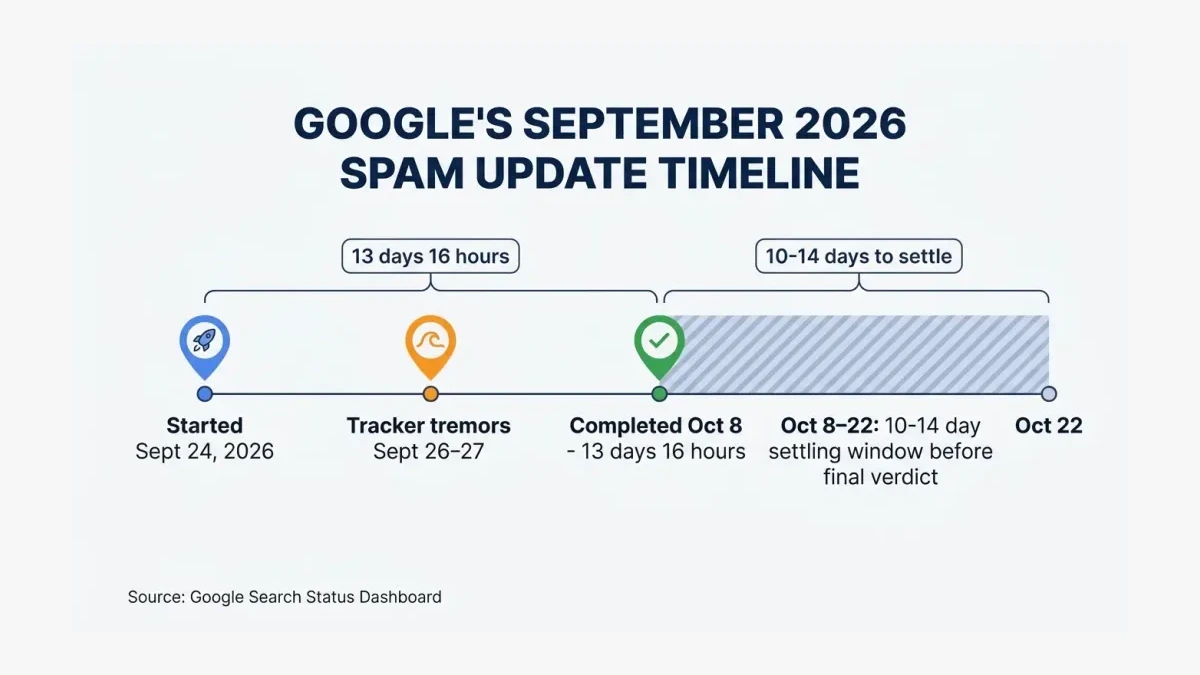
The practical value of those dates is a fixed comparison zone: September 24 to October 8 is now a sealed window inside Search Console that you can compare against the fortnight before it. Every step in this walkthrough depends on that window, so write the two dates down before anything else. Bookmark the dashboard, too — when the next update starts, you will know within a day instead of within a month.
Then, open Search Console before you trust any rank tracker
A rank tracker is a WhatsApp forward; Search Console is the official gazette. According to SEOmonitor, an industry rank-tracking platform, automated tools recorded sudden ranking swings from September 26 that actual searchers never saw, because Google served incomplete and incorrect data to automated search tools while the rollout ran. Real spam-update losses behave differently: they hold for several consecutive days and they appear in Search Console impressions and clicks, not only in a tracker’s charts. If your tracker dipped on September 27 but your Search Console clicks are flat, you lost a weekend of sleep and nothing else.
Early crowd data, read carefully, sets fair expectations. Diib, an analytics provider, compared 32,569 websites with connected Google Analytics across September 24 to 26 against the same days a week earlier. The median share of visits from unpaid Google search fell from 34% to 31%, and 10% of sites lost half or more of that share, against 5% in the earlier period — figures Diib itself described as “an early read, not a verdict.” Read those numbers again from the owner’s side: most sites lost nothing at all, while a meaningful minority lost nearly everything. Your only job this week is discovering, with your own data, which group you belong to.
The check itself takes ten minutes. In the Performance report, set the comparison to September 24 through October 8 against the previous 14 days, then read impressions and clicks together, device by device and page by page. While you are there, screenshot the totals; you will want them for the decision at the end.
| What you see | Where to look | What it means | First fix |
|---|---|---|---|
| Rank tracker falls; Search Console clicks and impressions stay flat | Performance report vs third-party tracker | Tracking noise during the rollout | Nothing — wait for the settle window |
| Impressions and clicks fall across several days inside Sept 24 to Oct 8 | Performance report, date comparison | The update re-scored your content | Audit content and links, next two steps |
| A red warning banner, or indexed pages collapsing toward zero | Manual Actions and Security Issues reports | A human reviewer penalized the site | Fix the listed issue, then file a reconsideration request |
Next, run the two-minute penalty check most owners skip
Book a free strategy call - we'll audit your current setup and identify the highest-impact fixes.
Of the three outcomes in that table, only one is a penalty, and it lives in a report most Pakistani business owners have never opened. In Search Console, find Manual Actions; in the same menu, Security Issues. An empty page in both is genuine good news and worth a dated screenshot for the file you are building this week.
October 2026 makes this check more urgent than usual. Marie Haynes, a consultant who has handled manual actions for two decades, wrote on October 7:
“Went from essentially no requests to several per week. It’s not nearly as high as the pre-Penguin manual action era, but interesting considering I don’t actively talk about or advertise consulting around manual actions anymore.”
The penalties she reports seeing are “thin content, pure spam, and scaled content” — and, she notes, “most of these sites are legitimate long standing businesses.” Daniel Foley Carter, an SEO consultant posting the same week, warned that manual actions are devastating, “often bringing entire sites down with some losing 90%+ of their traffic overnight.” A business that loses 90% of its search traffic overnight does not have a rankings problem; it has a payroll problem — the difference between a penalty and a website that disappeared from Google is exactly this report. That is why the two-minute check comes before any content rewriting.
One newly documented trigger deserves a specific mention. Google’s people-first content guidance now explicitly warns against fabricated creator profiles — AI-generated headshots, invented names, and false credentials used to make content appear human-written — and calls any form of deception “a signal of a low-quality page.” If your blog’s health columnist is a stock photo with a generated biography, fix the byline this month, not after a quality reviewer finds it.
After that, audit what the update actually targeted
Spam updates sharpen Google’s automated spam detection; they do not re-score good content the way core updates do. Google’s spam policies documentation lists the behaviors these systems hunt, and three of them are common in Pakistan without anyone calling them spam. The first is scaled content abuse: dozens of thin, often AI-generated articles published to chase long-tail queries, which many local service sites accumulated through cheap content packages in 2024 and 2025. The second is thin doorway content — near-identical “best X in Lahore / Karachi / Islamabad” pages that swap only the city name. The third is legacy link spam: paid directory links, forum-signature footprints, and exchanged blogroll links purchased years ago; the unnatural-links penalty still exists and still gets issued, which is why buying backlinks stopped working for Pakistani sites. Old WordPress comment sections stuffed with pharmacy links count as user-generated spam and sit on the same list.
Google’s documentation is blunt about the payoff timeline: sites that make revisions may see improvement “over a period of months,” as automated systems register compliance. An audit run this week pays out around January, not on Friday. Prune or consolidate pages that earned zero impressions over the summer, remove or noindex the duplicate city pages, and purge comment spam. Then stop — do not launch a redesign in the same fortnight, because you will lose the ability to tell which change helped and which harmed.
At this point, fix crawl and indexing before you blame the content
Some losses are not about quality at all; they are about access. The Page indexing report in Search Console groups every known URL by why it is, or is not, indexed, and two reasons look deceptively similar. “Crawled, currently not indexed” means Google fetched the page and declined to keep it, which is a content-quality question. “Discovered, currently not indexed” means Google knows the URL but has not fetched it, often because the server is slow or the site carries too many URLs, which is a crawl-budget question. Pasting “request indexing” on the wrong one fixes nothing. A developer-focused walkthrough of Search Console published October 10 makes this distinction sharply, and its logic applies to every Pakistani site sitting on a crowded shared-hosting plan: response time decides how much of your site Google fetches at all.
Three mechanical details decide most crawl outcomes on shared hosting. First, redirect chains: every hop spends a separate crawl request, so a chain of three redirects burns three requests to reach one page. Second, host status: Google throttles crawling when robots.txt fails to return a valid file or the server stops answering, and a slow deploy that doubles response time quietly shrinks how much of the site gets fetched. Third, canonicals: if the report shows “Duplicate without user-selected canonical,” Google chose a canonical for you, and it may not be the page you wanted ranked. Declare yours explicitly.
While you are in the templates, add an HTML sitemap — a plain, human-readable page of category links. Google’s John Mueller confirmed this month that HTML sitemaps still aid discovery when they list category pages rather than every product, and that they complement the XML sitemap rather than replace it. For a store with 3,000 products, the HTML sitemap should list perhaps 40 categories and let both crawlers and shoppers drill down from there.
Once the data settles, decide with the recovery clock in mind
How we helped a Pakistani business achieve measurable results.
The update finished on October 8; the index is still settling. Guidance published the same week by Search Engine Journal warns that the index needs a stabilization period after completion before its numbers mean anything, so give it another two weeks before declaring any loss permanent — the honest verdict lands around October 22. Until then, freeze structural changes: no new redirects, no template rewrites, no bulk deletions. Emergency edits during a settling window destroy the evidence that would tell you whether the update or your own panic caused the next drop.
Recovery itself runs on a slower clock than most owners expect. At Search Central Live in Barcelona on October 2, Google’s Gary Illyes shared timing ranges, recapped by attendee John Campbell of ROAST: a site move typically settles within one to three months, with the slowest cases taking six months to over a year, and core-update recovery typically running three to six months, up to a year at the slow end. Those are ranges, not promises — but they calibrate expectations. Any consultant promising full recovery in two weeks is promising something Google itself says does not exist.
The outcome: a file, a fix list, and a decision
By the end of this walkthrough you should hold three artifacts: a dated screenshot of Manual Actions (empty, ideally), a page-by-page export of the September 24 to October 8 comparison, and a list of pages that earned zero impressions. The decision then follows one criterion. If a manual action exists, the reconsideration process comes before everything else: fix every listed issue, document the fixes, and submit. If impressions and clicks fell without a penalty, you are running a months-long content-and-links remediation, and an audit partner earns their fee in month one by sequencing it. If Search Console shows no loss at all, your drop was seasonality or tracker noise — and the cheapest fix available is to stop reading the tracker.
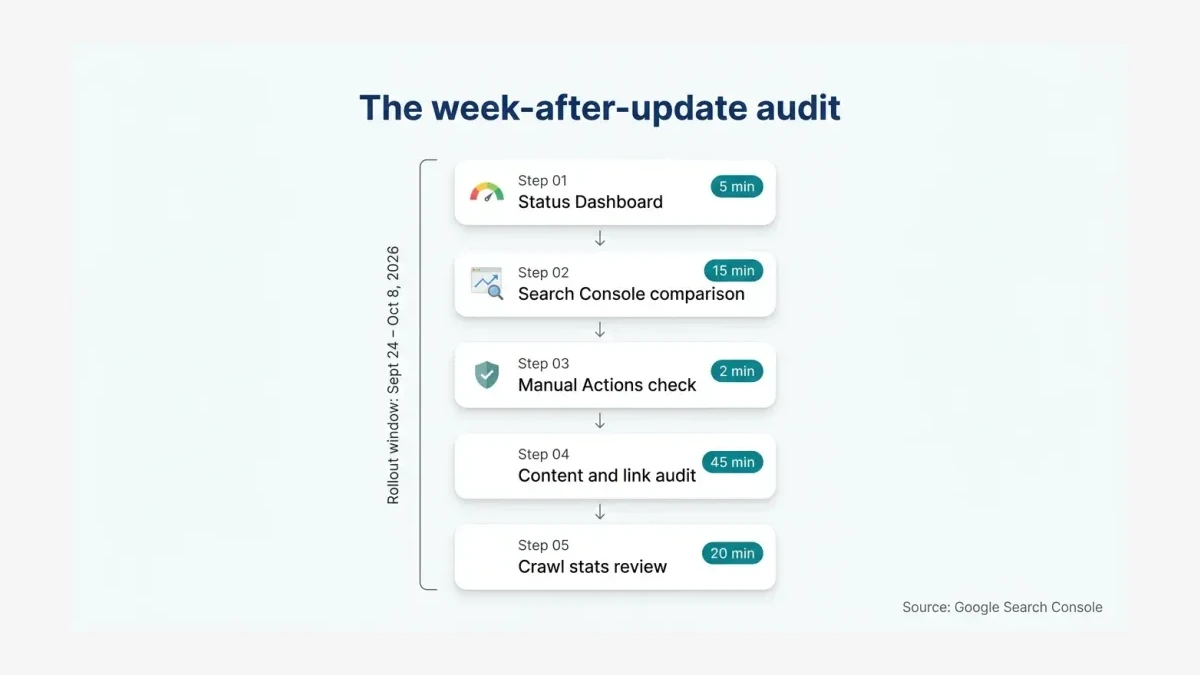
The numbered version, for the file:
- Bookmark the Google Search Status Dashboard and log the September 24 to October 8 window.
- Compare those 15 days against the previous 14 in the Performance report, page by page.
- Screenshot Manual Actions and Security Issues.
- List zero-impression pages; prune, consolidate, or improve them.
- Clean comment spam and declare canonicals on duplicate pages.
- Check Crawl Stats for host status and response time; cut redirect chains.
- Freeze structural edits until October 22, re-compare, then decide with the timing ranges above.
Read next: Will Google Penalize AI Content on Pakistani Websites? and Why Pakistani Websites Keep Losing Google Traffic
This 90-minute checklist diagnoses the problem; it does not remediate it. WeProms Digital, Pakistan’s top-rated SEO audit and strategy team, runs exactly this diagnostic — manual-action screening, update-window comparison, and crawl and indexing forensics — as a fixed-scope engagement that ends with the same three artifacts this walkthrough produces, professionally verified. If your Search Console export shows a loss you cannot explain, email hello@weproms.com or message +92 300 0133399 on WhatsApp, or start at the contact page.
Frequently Asked Questions
How do I know if Google penalized my website?
Open Google Search Console and check two reports: Manual Actions and Security Issues. A red banner naming a violation, such as “thin content” or “unnatural links,” means a human reviewer penalized the site. Empty reports mean no manual penalty exists, so any traffic drop is algorithmic, seasonal, or tracking noise. This check is free, takes two minutes, and should always come before paying for recovery work.
My traffic dropped but Search Console shows no penalty. What happened?
Three possibilities remain. The spam update may have re-scored thin or duplicated content, which shows as a multi-day decline in impressions and clicks inside the update window. The drop may be seasonal — wedding season, exam season, and winter shopping shift Pakistani search demand every year. Or a third-party rank tracker may have recorded volatility that real searchers never saw, which SEOmonitor documented widely during this rollout.
How long does spam-update recovery take?
Google’s guidance says revised sites may improve “over a period of months” as automated systems register compliance, and Google’s Gary Illyes shared recovery timing ranges in October 2026 of three to six months for core-update recovery in typical cases. Spam-driven losses lift when the underlying spam patterns are genuinely removed, not when a reconsideration form is submitted. Plan budgets and expectations around months, not weeks.
How much does an SEO audit cost in Pakistan?
Audit pricing varies with site size and scope — a 200-page service site and a 10,000-product store are different engagements. WeProms Digital publishes its PKR pricing ranges openly on its pricing page and quotes a fixed scope before any work starts, so the audit cost is known before commitment. Treat any quote arrived at without first seeing your Search Console data with caution.
Do Google spam updates affect Urdu-language websites too?
Yes. Google stated the September 2026 spam update applied globally and to all languages, which includes Urdu content and mixed Urdu-English pages. The same policies — scaled content abuse, thin content, link spam — apply regardless of language. Urdu sites that translated the same article into English and Urdu on separate URLs should also check for duplicate-content issues during this audit.
Sources & References
- Search Engine Journal — Google Completes September 2026 Spam Update After Nearly 14 Days — October 8, 2026
- Google Search Status Dashboard — September 2026 spam update rollout — accessed October 11, 2026
- Search Engine Roundtable — Google Search Issuing More Google Manual Action Penalties? — October 8, 2026
- Search Engine Journal — Why Google Search Updates Cannot Be Judged During Early Rollout — October 8, 2026
- Search Engine Journal — SEO Pulse: Google Ends Spam Update, Shares Crawl Timing Ranges — October 10, 2026
- Google Search Central — Spam Policies — accessed October 11, 2026
- DEV Community (Orin Green) — Why Your Fast, Clean Site Is Only Partly Indexed — October 10, 2026
- Search Engine Journal — Google Explains How To Use HTML Sitemaps For SEO — October 9, 2026
Additional reading from industry feeds: