
By Abdul Rehman · WeProms Digital · November 11, 2026
Picture this: it is the week before Eid al-Adha — expected around 16 or 17 May 2027, subject to moon sighting — and a Frankfurt mother asks ChatGPT one question: where can I order fresh halal meat for Eid in Frankfurt? The assistant names two supermarket chains and a delivery platform. Your Metzgerei — the German word for a butcher shop — never appears, even though families from Gallus to Bornheim have queued at your counter every Eid for a decade. The EID framework exists to close exactly this gap. It breaks AI visibility for a local halal shop into three steps: E for everywhere the same, I for independent proof, and D for depth on your own site. Run the three steps before Eid season and you hand AI assistants the evidence they need to name your shop. For a counter doing an illustrative €18,000 of Eid-week trade, that one answer decides where a large slice of it goes.
Two German figures explain why this matters now rather than next year. Germany’s Federal Office for Migration and Refugees estimates between 6.6 and 7.0 million Muslims were living in the country in 2025 — roughly one person in twelve. In a November 2025 Bitkom survey, half of German internet users said they already use AI chats instead of a classic search engine at least occasionally. Which means the question “wo kaufe ich Halal-Fleisch für Eid” is being typed into ChatGPT, Gemini and Perplexity in German, English and Urdu — before anyone walks down your street.
Here is the uncomfortable part. AI assistants do not name the best butcher in the city; they name the business they can most easily corroborate. Ahrefs studied 5.5 million US ChatGPT answers for its November 2026 brand-mentions study and found Walmart named more often than any other brand, with retail chains dominating the top of the list. Size wins because dozens of independent sources agree about Walmart, hour after hour. A single Metzgerei with mismatched listings gives a language model nothing stable to agree with. Your reputation at the mosque gate does not travel into an AI answer until it is written down where a machine can read it.
E — Everywhere the Same: One Story on Every List
The first step is boring on purpose. Your shop’s name, address, telephone number, opening hours and halal status must match exactly on your Google Business Profile — the free listing that controls how your shop appears on Google Maps and in local search results — and on every other place a machine might read: the large German business directories, halal shop finders, review platforms, your own website. AI engines cross-check these sources against each other before recommending anything. When three listings carry three different phone numbers, the safest thing an assistant can do is leave your shop out.
Machines do not tolerate contradictions.
The cross-check works the way elders in our community do. Before a family trusts a new butcher with a qurbani order — the Eid al-Adha sacrifice and the meat orders that come with it — an uncle asks the imam, two neighbours and a cousin in Bornheim; if the answers disagree, the order goes nowhere. AI engines corroborate your shop the same way. Three sources that agree beat one loud one.
Frankfurt adds a language layer. Families search “Halal Metzgerei Frankfurt”, “halal butcher near me” and community phrases in English and Urdu, often on google.de rather than Google.com. Set your business category to Fleischerei or Metzgerei, not restaurant. Publish hours that show the Friday prayer break and the Eid holidays, and list the services a family books in advance: qurbani orders, wholesale trays for community iftars, home delivery to the right postcodes.
This week, search your exact shop name plus your street address on Google, on Maps and on the two biggest German directories. Note every mismatch — an old number, a wrong postcode, a duplicated listing — and fix each one this month. The work is free, and it is the foundation everything else stands on.
I — Independent Proof: The Evidence That Keeps You on the List
Being mentioned is not the same as being provable. Search Engine Journal columnist Bill Hunt tested the difference on a real company, evaluating criteria-based prompts across major AI surfaces. The company was mentioned in 98.4% of answers and shortlisted as a primary option 93.2% of the time — numbers most marketers would celebrate. Yet when each answer was scored against the buyer’s actual decision criteria, 73.7% carried weak or missing evidence, and 15.8% contained a significant or critical gap. Visibility put the brand on the list; the missing evidence quietly pushed it back off.
“No one can dispute that AI visibility gets the company into the consideration set. Decision readiness determines whether AI has enough information to keep it there.” — Bill Hunt, Search Engine Journal
Translate that finding to a butcher’s counter. The assistant may know your shop exists — the Maps pin, the years of reviews. It still cannot prove the things a Frankfurt family checks before driving over: whether the meat is hand-slaughtered zabiha — cut by hand according to Islamic slaughter law — who certifies your slaughter, whether you take qurbani orders and until which date, what a lamb share costs. Independent proof, evidence that does not come from you, answers those questions on your behalf.
In Frankfurt, independent proof looks like this: Google reviews written in German, because answers assembled in German lean on German-language corroboration; your listing with a certification body such as Halal Control; a paragraph about your counter in local press or a community newsletter; and your shop named on the pages families actually consult, from mosque notices to community food guides. Ask every happy customer for a review in German, not only in English. The German sentence is the one a German-language answer can quote.
Send this request — only to customers who agreed at checkout to be contacted:
Assalamu alaikum [Name], thank you for ordering your Eid meat with us. If the quality met your expectation, would you write us a short Google review in German or English? It helps other families find a butcher they can trust. Reply STOP anytime and we will not message you again.
D — Depth on Your Own Site: Answer the Questions Families Actually Ask
The third step lives on your own website: an AI info page — a plain page, written in short question-and-answer blocks, that states what you sell, who certifies your meat, how qurbani orders work, your cut list, your Eid hours and your price rungs. Machine readers fetch pages like this when a real person’s question sends them looking, which is exactly how modern assistants assemble local recommendations. Visitors arriving from AI tools come with their question half-answered, so the page must continue that answer precisely — WP Engine’s analysis of AI search conversion makes the same point for online stores.
The testing agency Seer Interactive ran the comparison across its research library. Purpose-built AI info pages were picked up for three of four clients who tried them; for one energy-technology company, 21 of 57 tracked facts — 37% — appeared in ChatGPT answers about a month after launch. The same tests put llms.txt — a plain-text file sold by some consultants as a way to tell AI about your site — at zero wins from three attempts, while Ahrefs data showed 97% of roughly 38,000 valid llms.txt files received no requests at all in May 2026, and Google has said Search ignores the file.
Do not pay anyone for the file; pay for the page.
For a Metzgerei, the page answers the twelve questions your staff repeat every Eid week: the zabiha method and who certifies it, qurbani share prices (illustrative: a lamb share around €320, a goat share around €380 — substitute your own prices), deposit deadlines, collection versus delivery, minimum orders for community iftars, and opening hours across the Eid days. Write it in German first, English second, and date every price so old numbers cannot outlive their truth.
Draft the twelve questions this week and answer each in two or three plain sentences. One focused afternoon beats a year of hoping. If your website itself slows shoppers down during the Ramadan rush, fix that first: why a Frankfurt bakery’s Ramadan pre-order shop was so slow on phones covers the same lesson from the order side. And before assuming you need an app or nothing at all, this Cologne halal grocer’s app-versus-website decision shows what a small shop actually needs.
Run EID Against the Eid Calendar
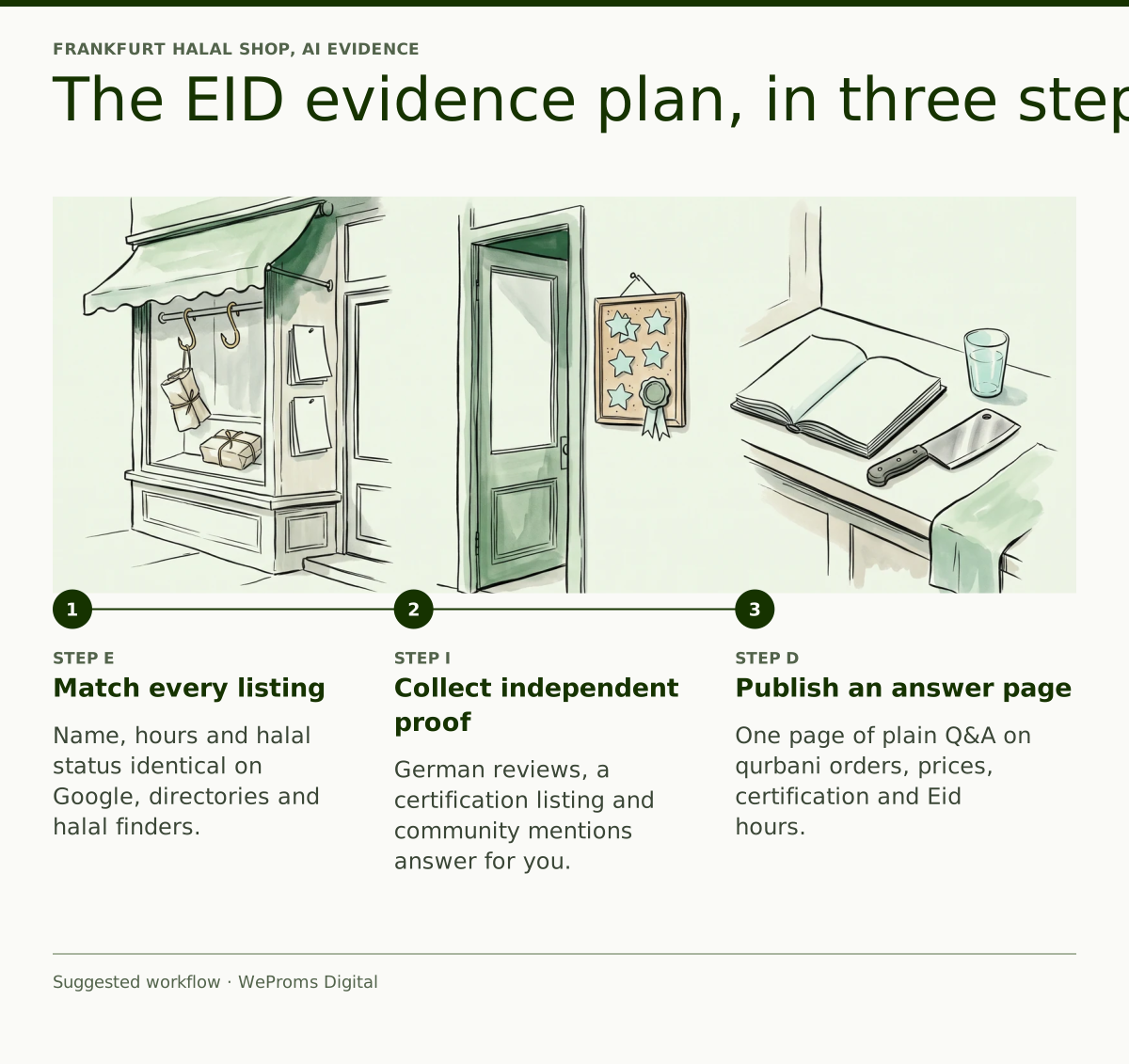
The community calendar sets the deadlines. Ramadan 2027 is expected to begin around Monday 8 February, Eid al-Fitr around 9 or 10 March, and Eid al-Adha around 16 or 17 May 2027 — every date subject to moon sighting, so anchor each deadline to the expected Eid date rather than to a calendar month. The full sequence runs like this. Fix every listing mismatch now, through January. Have your certification listing and review system running by the end of January. Publish the answer page before Ramadan searches begin in early February. Collect reviews from your Ramadan customers through February and March. Open qurbani deposits six weeks before the expected Eid al-Adha date — around 5 April 2027 — and set the final order deadline about a week before Eid.
Each phase has one number to watch. Matched listings now. Reviews per week during Ramadan. Deposit count in April. Confirmed collection slots in the final fortnight. Early interest, confirmed deposits and delivery volume are three different stages of the same season, and a full deposit book is worth more than a thousand likes on the announcement post.
The full plan fits a butcher with a website. A smaller counter without one runs E and I, then places the answer-page content directly into Google Business Profile posts and a WhatsApp Business catalog; the questions and the evidence stay the same even when the website is missing.
AI answers reward the shop that is provable everywhere, not the shop that shouts loudest once. Evidence written down keeps answering every family’s question for years — a paid placement stops the day the invoice stops.
Read next: How Do I Run Black Friday Ads for My Online Halal Store in Germany? · What ChatGPT Traffic Is Actually Worth to a Sydney Halal Grocery (written for an Australian grocer — the value logic transfers)
WeProms Digital is a generative engine optimisation agency for overseas Pakistani and halal businesses, and we have worked with halal retailers and food businesses across the UK, Germany and the Gulf on exactly this evidence problem. Our AI search visibility monitoring and citation tracking service reports when assistants start naming your shop — and when they stop. Based on our experience, a first visibility audit takes days, not months. Get in touch: hello@weproms.com · WhatsApp +92 300 0133399 · weproms.com/contact-us
Key Takeaways
- E — everywhere the same: identical name, address, phone, hours and halal status on your Google Business Profile, German directories and halal listings; mismatched data keeps AI silent about your shop.
- I — independent proof: German-language Google reviews, a certification listing such as Halal Control, and community press mentions answer the buyer’s real questions on your behalf.
- D — depth on your own site: an AI info page covering qurbani prices, deadlines, certification and Eid hours beats any llms.txt file, which testing shows is almost never read.
- Calendar: page live before Ramadan (expected around 8 February 2027); qurbani deposits open six weeks before Eid al-Adha (expected around 16 or 17 May 2027) — dates subject to moon sighting.
- Watch one number per phase: matched listings, then reviews per week, then deposit count, then confirmed collection slots.
Frequently Asked Questions
Do I have to pay ChatGPT to recommend my halal shop?
No. There is no paid route that decides which local butcher an assistant names. Recommendations come from evidence the assistant can read and corroborate: consistent listings, reviews, certification records and your own pages. Paid placements on AI platforms may evolve, but the shops being named today are the provable ones, not the paying ones.
Should my Google Business Profile be in German or English?
German first, because German-language queries dominate local search on google.de and German-language reviews are what a German-language answer can quote. Add English service descriptions where they fit. Urdu rarely appears in the listing fields themselves, but it matters in the community pages and reviews that link back to you. Keep categories, hours and attributes identical in every language.
What is llms.txt, and do I need one?
llms.txt is a plain-text file proposed as a way to point AI systems to a site’s key pages. Seer Interactive’s tests found it drew almost no bot requests and won zero head-to-head comparisons, and Ahrefs data showed 97% of valid files were never requested in May 2026. Google has said Search ignores it. Spend the budget on a real answer page instead.
How long before AI assistants start naming my shop?
Expect weeks to months, not days. In Seer Interactive’s testing, one company’s AI info page had 37% of its tracked facts appearing in ChatGPT answers about a month after launch, while listing fixes and review growth compound more slowly. Track it yourself: ask the same five questions monthly in ChatGPT, Gemini and Perplexity, and log whether your shop appears.
How much does a WeProms AI visibility audit cost?
Scope depends on how many listings and locations you run, so we quote after a short discovery call rather than publishing a flat rate. Every audit covers listing consistency, evidence gaps, certification visibility and an answer-page plan. Email hello@weproms.com or message WhatsApp +92 300 0133399 — replies come in UK and Gulf business hours.
About WeProms Digital
WeProms Digital is a Lahore-based generative engine optimisation and local visibility agency working with overseas Pakistani and halal-minded business owners across London, Birmingham, Manchester, Frankfurt, Dubai, Toronto, Houston and beyond.
The team specialises in AI search visibility, entity and evidence building, and local search for food and retail businesses, with a track record of making diaspora-owned shops citable across ChatGPT, Gemini, Perplexity and Google.
Get in touch: hello@weproms.com · WhatsApp +92 300 0133399 (replies in UK and Gulf business hours) · weproms.com/contact-us
Sources & References
- BAMF — Number of Muslims with a migration background in Germany (2025 estimate) — 2025
- Bitkom — Internet-Suche im Wandel: Die Hälfte nutzt bereits KI-Chats — November 2025
- Ahrefs Blog — The 100 Most Mentioned Brands in ChatGPT (November 2026) — November 2026
- Search Engine Journal — Visibility Gets You On The List, Evidence Helps You Stay There — November 2026
- Seer Interactive — Testing llms.txt vs. AI Info Pages: GEO Quick Wins or Waste of Time? — November 2026
- Khaleej Times — Ramadan, Eid al-Fitr, Eid al-Adha 2027 likely dates — 2026
- Halal Control — Halal-Zertifizierung in Deutschland — accessed November 2026
- WP Engine — How to convert AI search traffic into real revenue — November 2026
Additional reading from industry feeds: