
By Abdul Rehman · WeProms Digital · November 7, 2026
ChatGPT sends a Sydney halal grocery a trickle of visitors — 0.62% of Google organic’s volume in a year-long, 100-site study — yet those visitors convert at 13.8% against 3.02%. Check that free in your own analytics before paying an illustrative AUD $800-a-month “AI visibility” retainer, because a fee only pays for itself where conversions exist.
How much traffic does ChatGPT actually send a small grocery?
Very little, in every dataset published so far. Across 100 websites and 145 million analytics sessions tracked for a full year, ChatGPT sent 0.62% of the traffic volume that Google organic sent, according to Marie Haynes’ analysis. A separate 95-property dataset covering a full year reached the same conclusion, and Search Engine Land’s coverage sums it up plainly: ChatGPT sends far less traffic than Google.
The Australian habit is real even though the tap is barely open. Australia Post’s 2026 eCommerce Industry Report found 32% of Australian shoppers now use AI for shopping advice, which means your customers in Auburn, Guildford and Parramatta are already asking chatbots what to buy; they are simply not being sent to your website in volume yet.
For a Pakistani-owned grocery running on tight margins, the practical move this month is not an AI marketing budget — it is a baseline. Write down how many visitors and orders your site gets from AI sources today, because every pitch you hear in 2027 should be measured against that number rather than against a vendor’s screenshot.
Do ChatGPT visitors buy more often than Google visitors?
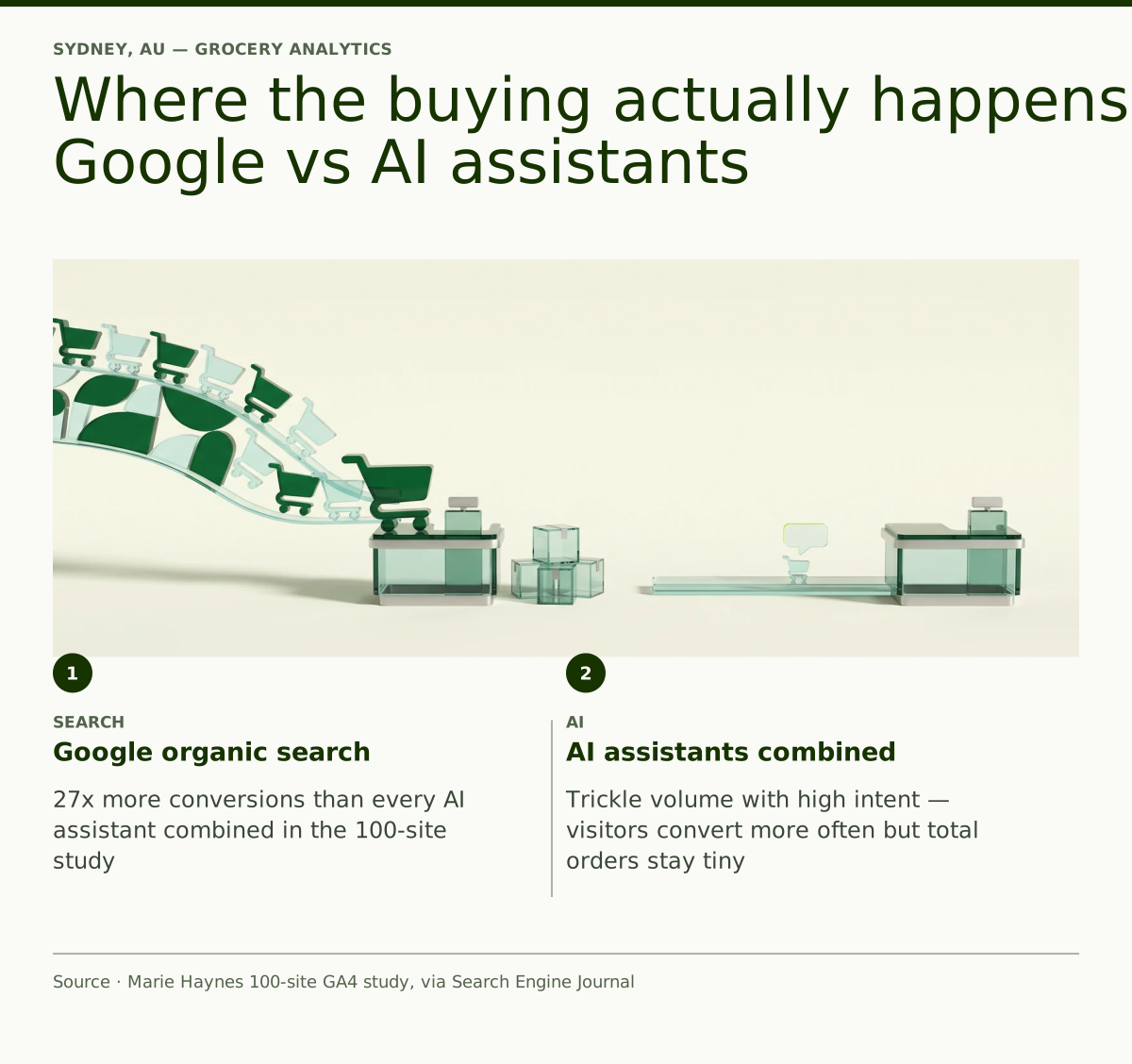
Yes — when they arrive, they act. ChatGPT visitors converted at 13.8% against 3.02% for Google organic visitors in the same year-long dataset, which means a chatbot referral is better than four times as likely to act; volume is the catch, because Google organic alone delivered 27 times more conversions than every AI assistant combined.
Conversion — a completed action such as an online order, booking or enquiry. AI referral — a visitor your analytics records as arriving from a site like ChatGPT, Perplexity or Gemini.
Now the honest arithmetic on a shop your size. Worked example — substitute your own numbers: a grocery website receives 5,000 Google organic sessions a month, which at 3.02% produces about 151 conversions. If ChatGPT sends 0.62% of Google’s volume, that is roughly 31 sessions a month, and at 13.8% it produces about 4 conversions. Four conversions a month is a rounding error, not a channel.
Treat any single forwarded figure the way you treat a health claim on the family WhatsApp group: the number is rarely the problem; the missing source is, and a screenshot is not a study. The 13.8% conversion rate is genuinely promising, and it is the reason to keep watching AI referrals; it is not, on its own, a reason to pay a retainer, because a high rate multiplied by a trickle still equals four orders.
Why did my website’s direct traffic suddenly spike?
Almost certainly bots, not buyers. In one widely cited published dataset, a website recorded 409,000 direct sessions in a sample period while only 198 counted as engaged — visits where someone actually stayed, scrolled or clicked. A direct-traffic spike that outruns your orders is bot noise, and bot noise should never justify a budget.
Three definitions make that checkable. GA4 — Google Analytics 4, the free tool most shops use to measure website visits. Direct traffic — visits the analytics tool cannot attribute to any source, because no referrer came along with them. Engaged session — a visit that lasted ten seconds or longer, or included a click or a conversion.
The spike matters because a comforting story grew around it. Some sellers of AI services claimed that chatbot readers were “hiding” in your direct traffic — seeing your brand in an AI answer, then typing your URL later. Growth analyst Kevin Indig tested that story across a year of data: total direct traffic kept rising while engaged direct sessions stayed flat, which means the growth was automated crawlers, not customers. We walked through the same puzzle when a UK halal grocery saw ChatGPT customers arrive as Direct, and the filtering method in our Pakistan-market guide to fake bot traffic transfers line for line to an Australian analytics property.
The check takes five minutes. In GA4, open Reports → Acquisition → Traffic acquisition, find the Direct row, and compare sessions against engaged sessions and conversions; if sessions tower over everything else while engaged visits and orders stay flat, your spike is machines, and no retainer can monetise machines.
Should a halal grocery pay for an AI visibility dashboard?
Not before it passes a basic quality check. AMEC, the international association for communication measurement, launched its GEO Principles in May 2026 precisely because AI citation counts were being sold as outcomes, and its first test asks whether the data comes only from the sources you expect — a test that bot-filled direct traffic fails.
The measurement industry saw this problem before the marketing industry did. AMEC’s companion data-quality paper, led by Rob Key of Converseon and produced with a coalition including ESOMAR and the Market Research Society, was written for analysts drowning in unstructured AI-era data; its questions apply directly to any dashboard an agency shows you across Sydney or the Gulf. The October 2026 debate that followed — sparked by SparkToro’s Rand Fishkin asking whether AI visibility is a boondoggle — ended the same way: AI matters as a brand channel, something like a digital billboard, while the numbers used to sell it often do not survive inspection.
“If we can’t prove it, we shouldn’t trust the attribution just because it seems right.”
That line, from SparkToro’s Amanda Natividad, is the standard to hold. Marketing Land’s reporting on paid AI traffic adds a second caution: 82% of advertisers in the study recorded no purchases from their ChatGPT ads, and paid AI clicks behave differently from unpaid AI referrals — so any dashboard blending them is blending two different things.
| The pitch you hear | What published data shows | What to do |
|---|---|---|
| “AI is the new Google” | Google organic converted 27 times more than all AI assistants combined | Fund Google-side basics first |
| “ChatGPT visitors are your best buyers” | True per visitor — 13.8% against 3.02% — on a sliver of the volume | Track AI referrals monthly; do not rebuild around them |
| “Our dashboard proves AI lifts your brand” | Direct-traffic growth traced to bots in published tests, not buyers | Ask for the bot filter and the raw domain list |
| “Your rivals are already investing” | Advertiser counts on AI platforms are climbing while returns stay unproven | Tie any spend to a contribution-per-order ceiling |
A related question — whether a halal takeaway should pay to get onto ChatGPT at all — has the same shape: visibility has a price, and the price only makes sense against measured conversions. A dashboard that shows mentions without showing money is a screenshot, not evidence.
Where should the marketing budget go instead?
Into the channel that still pays for the groceries. Across those 95 analytics properties, a 5% lift in organic search delivered 10.3 extra conversions per site per month, while doubling AI referral traffic delivered 6.6 — the same effort spent on the Google side bought roughly half again more than the AI side.
For a grocery, Google-side work is unglamorous and profitable: product pages with current prices, halal certification named clearly, delivery suburbs listed, a Google Business Profile with correct Ramadan hours, and fresh reviews answered politely. Adobe’s retail data found AI-referred visitors browse longer and view more pages before deciding, which means the chatbot hands you a researcher; your page still has to close the sale.
Illustrative — substitute your own numbers: an agency quotes AUD $800 a month to manage “AI visibility”. If your average contribution per online order is AUD $18 — basket price minus stock, packaging and delivery — the fee needs about 44 extra orders a month just to break even. The worked example above counts four. Unless the fee also touches the Google side, the arithmetic cannot close, and the honest version of that pitch is a billboard with no proof.
Your Ramadan and Eid peaks will still arrive through Google searches, your regulars’ WhatsApp orders, and word of mouth after Friday prayers. If curiosity about paid AI ads is pulling at you, our first-test costing for a halal food brand shows how to cap that experiment so it cannot hurt the shop.
How do I check my own numbers this week?
In under an hour, inside the free tool already connected to your shop. Open GA4’s traffic-acquisition report, isolate the known AI domains, and compare engaged sessions and conversions against Google organic. Write down one number — monthly AI-driven conversions — and make every agency pitch beat it before you sign.
Start here:
- Open GA4 and go to Reports → Acquisition → Traffic acquisition.
- In the session-source filter, enter chatgpt.com, chat.openai.com, perplexity.ai, gemini.google.com and copilot.microsoft.com.
- Record sessions, engaged sessions and conversions for that filtered group.
- Repeat for the google / organic row, which is your baseline.
- Save the monthly AI-conversions figure wherever you track orders, and re-check it quarterly.
Ready to paste into any agency thread:
“Before we sign: which AI domains do you count, how do you filter bot traffic, and what monthly conversions did AI referrals drive last quarter for a business my size?”
Measure first and spend second. If AI referrals already return more conversions per dollar than your Google baseline, invest more in them; if they return four a month, watch the number quarterly and keep your money where the groceries are actually bought. When the trickle becomes a stream, you will have the baseline to prove it — and the position to price it properly.
Read next: why ChatGPT customers show up as Direct in a grocery’s analytics and whether a halal takeaway should pay to get onto ChatGPT.
WeProms Digital builds exactly this kind of honesty into numbers: as a marketing measurement and reconciliation team for diaspora-owned retailers, we have constructed analytics baselines for family businesses across Australia, the UK and the Gulf, and our GA4 setup and custom configuration service exists so that decisions rest on engaged visitors and real conversions rather than forwarded screenshots. Message hello@weproms.com, WhatsApp +92 300 0133399, or visit the contact page — one hour of checking is cheaper than twelve months of a retainer that cannot pay for itself.
Sources & References
- Search Engine Journal — AI Visibility Isn’t A Sham – Most Ways Of Measuring It Are — November 6, 2026
- Marie Haynes — ChatGPT and LLM traffic analysis across 100 websites — October 2026
- Search Engine Land — ChatGPT sends less than Google’s traffic — 2026
- Australia Post — 2026 eCommerce Industry Report — 2026
- Adobe — AI traffic drives higher revenue per visit for retail sites — 2026
- AMEC — Data Quality Principles for the AI era — May 2026
- Marketing Land — ChatGPT’s paid traffic is worth far less than Google’s — November 6, 2026
Additional reading from industry feeds: