By Hamza Ali · WeProms Digital · November 7, 2026
TL;DR: Brave Search copies webpages — a Khobar restaurant’s site included — and sells its index to AI companies such as Perplexity and Mistral. Its crawler wears no name, so robots.txt cannot block it without blocking Googlebot too. The workable move is not blocking. It is making sure every copied page still sells the restaurant.
Brave Search — a privacy-positioned search engine built on its own index of more than 30 billion pages — also sells that index to AI companies through the Brave Search API. A Pakistani-owned biryani restaurant in Khobar with its own website is almost certainly inside it. The New York Times sued Brave on 2 November 2026 over exactly this arrangement, and the complaint reads like a menu of things small owners never agreed to — allegations so far, not findings.
Last updated: November 2026.
What this gets right
Being readable is the entry ticket. An assistant asked “where is the best biryani in Khobar” can only name restaurants whose pages it can reach, and an index of 30 billion pages is how it reaches them. Brave says its index adds millions of new pages every day, which means a fresh menu page or updated Ramadan hours get picked up without the owner doing anything.
One honest control exists. Brave’s own help page states its crawler follows the rules set for Googlebot: whatever Google’s crawler is banned from reading, Brave will not read either. A page-level noindex tag — a line of code telling search engines to drop a page — therefore removes a page from Brave’s sold index, and that mechanism actually works.
Distribution without effort suits the big platforms. It does not suit a business that was never asked, which is the crack the next section widens.
Where this breaks
robots.txt — the small file websites use to say which crawlers may read them — works because crawlers wear names. GPTBot belongs to OpenAI. ClaudeBot belongs to Anthropic. Brave’s crawler, by the company’s own help page, “does not advertise a differentiated user agent.”
No name, no line in the file. A Khobar restaurant owner cannot welcome Googlebot and turn Brave away, because the two arrive dressed identically — deliberately, since some sites admit only Google and Brave follows their rules instead of announcing itself.
Blocking Brave means leaving Google — those are the same door.
The copies go stale, too. The Search Engine Journal author who investigated the index found Brave still serving his homepage’s old description after he had replaced it — a stored copy, not a live read. For a restaurant, stale means last Ramadan’s iftar menu and last year’s prices quoted at families who then arrive annoyed. A stored copy has no idea your prices changed this month. It will keep selling last year’s menu until the index refreshes on its own schedule. Back home in Lahore, the photocopy shop near Punjab University copies whatever page you bring, and nobody signs a permission slip; Brave treats the web the same way, except the copies are sold onward to AI companies.
The lawsuit may change this, or may not. The Times alleges Brave copied more than 30 billion webpages without identifying itself or offering owners any way to block its crawler; separate suits arrived the same day from the Daily News, the Chicago Tribune, and the Orlando Sentinel. Brave has previously argued that indexing the web is what every search engine must do to exist.
The hidden cost
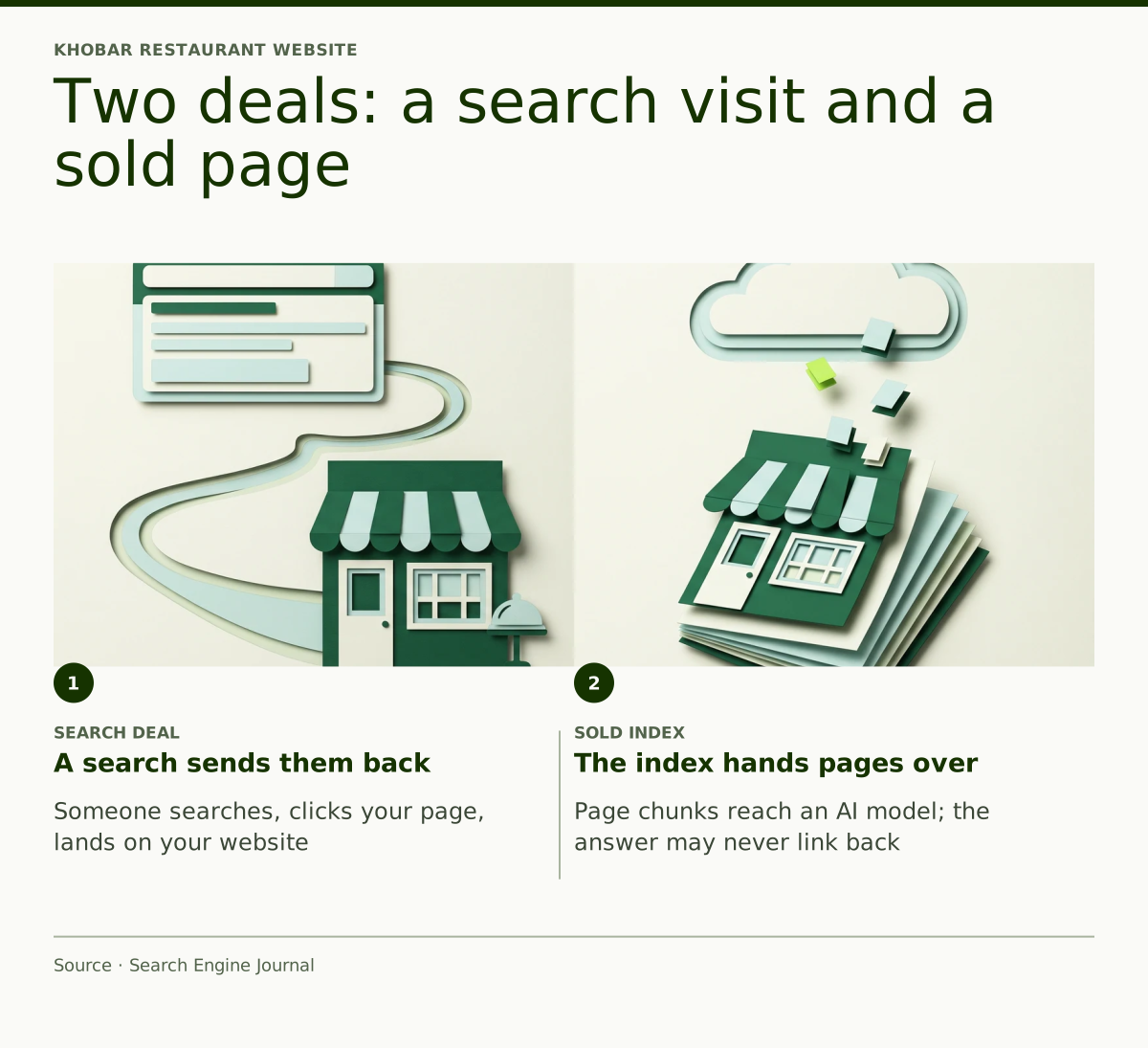
A search engine sends people back to your website; the sold index does not have to. Brave describes one API product, “LLM Context,” as delivering “extracted page chunks and source metadata in a shape and length that satisfies the needs of an LLM without need for further scraping.” The AI company gets your page already chopped up, and whether the answer sends anyone back is its call.
Work the price of the escape hatch before pulling it — illustrative numbers, substitute your own. Say the restaurant’s site cost SAR 12,000 to build and draws 1,200 Google visits a month, of which 2% call or reserve: 24 table bookings. At an average family dinner of SAR 180, that channel is worth about SAR 4,320 a month. Noindex removes a page from Brave’s index and from Google together, so the “protection” spends the entire channel to stop the copying. A ruling in the Times case will not hand that traffic back either.
Protection that costs the whole channel is not protection.
The direction of travel is visible in local data. The CST Saudi Internet Report 2025 puts AI-tool adoption in the Kingdom at 45.2% — more than double the previous year — with ChatGPT the most used tool, and 80.8% of those users reaching for AI tools to search for information. Nearly everyone is online to begin with: DataReportal counts 33.9 million internet users in Saudi Arabia, 99% penetration. So what? A rising share of the families who once typed “biryani near me” into Google are asking a chatbot instead, and chatbots read indexes like Brave’s.
Answer-first results are no longer a rumour, either. Research cited by HubSpot found 18% of Google searches in March 2025 already produced an AI summary, and the rate climbs with longer, question-style queries. That figure was measured on US searches; it does not prove Khobar behaviour, only that the answer layer is growing where it has been measured.
For a local restaurant, being quoted inside an AI answer is usually worth more than the click it costs. The only owner who should consider the noindex hatch is one whose site ranks nowhere anyway.
What overseas Pakistani businesses should do instead
-
Run the 30-second check. Open search.brave.com and type
site:followed by your domain. Everything that appears sits inside the index Brave sells — including, almost certainly, your pages. -
Fix what the copy says. Put the restaurant’s name, area, and phone on every page that matters, date the Ramadan hours with the year, and keep old prices off new pages. Structured data — the labelled code that tells machines which text is your name, your location, your price — makes your identity travel with any quote; WeProms handles this under schema markup and structured data implementation.
-
Watch where you appear. Specialist tools now track brand mentions across AI platforms — the Scrunch versus Ahrefs comparison maps the options from $129 a month — and WeProms runs this as AI search visibility monitoring and citation tracking for owners who want a monthly answer, not a guess.
-
Block deliberately, not desperately. robots.txt lines for named bots like GPTBot and ClaudeBot are a real, reversible choice; a blanket noindex is a trade that gives up Google to escape Brave. We set this boundary for owners through AI crawler access and bot governance for halal restaurants and stores, decision by decision.
The fix is simple: make the copy sell the restaurant. Every quoted page should carry your name, your Khobar location, and a reason to call.
| Option | What it does | What it costs you |
|---|---|---|
| robots.txt block of named bots (GPTBot, ClaudeBot) | Stops those crawlers reading your site directly | Nothing on Google; nothing on Brave — it has no name to block |
| noindex tag on pages | Removes pages from Brave’s sold index | Removes the same pages from Google — the whole search channel |
| Do nothing, fix the content | Pages stay copied and quoted | You keep Google, and every copy that names you correctly becomes free advertising |
Read next: we broke down what it means when ChatGPT names a Riyadh restaurant but links the wrong page, why AI answers show a Surrey halal grocery’s details wrong, and — written for Pakistani sites, same tradeoff — the Cloudflare crawler update and de-index risk.
We have worked with halal restaurants, groceries, and service businesses across Saudi Arabia, the UAE, and the UK on exactly this boundary — what AI crawlers may read, what each page says about you, and where your name appears in AI answers. WeProms Digital starts with the 30-second index check above, then fixes pages so the copies sell instead of confuse. Email hello@weproms.com, message WhatsApp +92 300 0133399, or use the contact page — replies land in Gulf and UK business hours.
Frequently Asked Questions
Can I remove my restaurant’s website from Brave’s index?
Yes — a noindex tag removes your pages from Brave, and Brave’s help page confirms it honours the same instruction Google does. The catch is that the same tag removes those pages from Google as well, so the decision costs your entire search visibility. Run the numbers on what Google sends you monthly before pulling it.
Does blocking GPTBot stop ChatGPT using my pages?
It stops OpenAI’s crawler reading your site directly. It does not remove pages already sitting in third-party indexes like Brave’s, which AI companies can pay to search instead of crawling. If your worry is what answers say about you, monitoring and correcting content beats blocking alone.
Is copying my website legal in Saudi Arabia?
No court has settled this, anywhere. The New York Times, the Daily News, the Chicago Tribune, the Orlando Sentinel, and other publishers have live US cases against Brave over hidden crawling and index reselling — allegations Brave disputes in part. A Khobar restaurant’s practical lever is accuracy and visibility, not litigation; keep your own pages correct and dated so every copy quotes current truth.
Should a small restaurant pay an agency for this?
If your website brings calls or reservations, yes — an audit of crawler access and AI visibility costs less than rebuilding the site, and it prevents expensive mistakes like a blanket noindex. WeProms scopes this per business after the 30-second check, so message us for a quote before committing to anything.
Why does Brave show my old menu description after I updated the site?
Brave serves stored copies, not live reads — the Search Engine Journal investigation caught it serving a homepage description the author had already replaced. Fixes are patience plus hygiene: keep URLs stable, update pages in place rather than deleting and recreating them, and date seasonal menus with the year so stale copies expose themselves.
Sources & References
- Search Engine Journal — Brave Sells Its Search Index To AI, And Your Website Is Probably In It — November 6, 2026
- TechCrunch — New York Times and other outlets sue Brave over alleged content scraping — November 2, 2026
- The Verge — Brave lawsuit: NYT and AI scraping — November 2026
- Brave Search Help — Brave Search Crawler (robots.txt behaviour) — accessed November 2026
- CST — Saudi Internet Report 2025 dashboard — 2025
- DataReportal — Digital 2025: Saudi Arabia — March 2025
- HubSpot Marketing Blog — Scrunch vs. Ahrefs: AI visibility tracking comparison — November 6, 2026
- Ars Technica — NYT demands Brave shut down its paywall blocker and end deals with AI firms — November 2026
Additional reading from industry feeds: