By Hamza Ali · WeProms Digital · October 25, 2026
A ChatGPT mention with someone else’s link is applause, not orders. One 100-site measurement puts ChatGPT visits at just 0.62% of Google-organic volume, though those rare visitors convert at 13.8% versus 3.02%. For a Riyadh biryani restaurant, the lever is the source card: own the citation, and a name-check becomes a trackable order worth, say, SAR 45 a head.
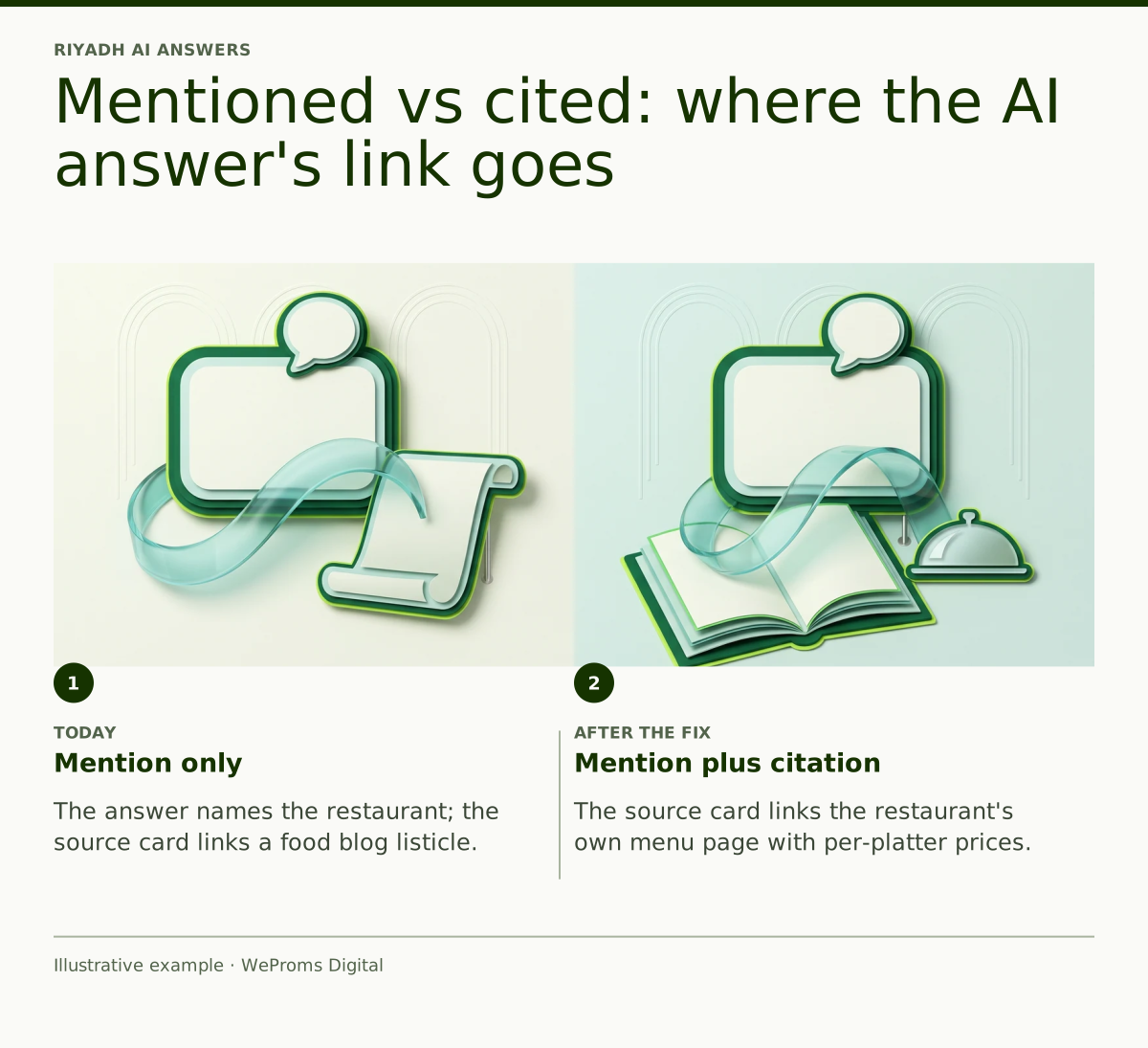
This is a teardown of “the AI mention” — the habit of counting brand-name appearances inside ChatGPT answers as a marketing result. Riyadh restaurant owners run the check nightly: ask ChatGPT for the best biryani in Olaya or the best karahi in Sulaimaniyah, and the answer names a Pakistani-owned family restaurant. Then the eyes drop to the source card underneath the answer, and the link points to a food blog’s top-ten listicle written two years ago. The name is yours. The link never is.
What this gets right
Mentions do shape decisions. When an answer engine names a restaurant in a shortlist, that name lands in the reader’s memory, and memory becomes a visit weeks later. Familiarity is a real asset in a market where families choose one biryani spot and stay loyal to it for years.
The traffic that does arrive from ChatGPT is unusually valuable. A twelve-month analysis of 100 websites with 145 million sessions, published by Marie Haynes on Search Engine Journal, found ChatGPT visitors converted at 13.8% while Google-organic visitors converted at 3.02%. A ChatGPT referral is roughly four and a half times more likely to become a customer than a Google click. Rare, but rich.
The direction of travel is real too. Google’s own chief executive, Sundar Pichai, has described in a podcast interview where this leads:
“Search would be an agent manager in which you’re doing a lot of things.”
Answer engines recommending restaurants is not a fad; it is the early version of assistants that will book a table, order a family platter and pay without opening a website. A restaurant that becomes citable now is building for that shift, not chasing a novelty.
And the scale question is settled: Google processed 94.46% of Saudi searches as of September 2026, per Statcounter. More than nine in ten searches in the Kingdom still start on Google, so the Google Business Profile, the Maps listing and the review count remain the front door. The mention matters, but it operates behind that door.
Where this breaks
The break is structural, not cosmetic. ChatGPT names your restaurant and hands the link to a food blog listicle. The reader who wants prices, hours or a menu taps the source card, lands on someone else’s page, and meets your restaurant through a stranger’s summary — often with a phone number that no longer works or a price from two Ramadan seasons ago.
HubSpot’s analysis of AI visibility gaps separates the failure modes precisely, and one sentence carries the whole problem:
“The brand appears in an answer, or has relevant content, but another source provides the evidence used to support the response.”
Three gaps repeat across restaurants. A coverage gap means the answer’s question has no matching page on your site at all — no page says “family platters for 10, order 24 hours ahead”. An extractability gap means your page exists but the useful facts are buried in promotional photo captions, so the engine quotes a competitor’s cleaner page instead. A citation-support gap is the cruelest one: the answer recommends you and cites a third-party blog as the evidence, so the blog earns the trust and the link while your kitchen earns the expectation.
It works like praise at a wedding. An elder cousin stands up, tells two hundred guests your biryani is the best in Riyadh — and then hands out the marquee’s phone number instead of yours. Everyone leaves wanting your food. Nobody can reach you.
Google’s own Search Central guidance adds no shortcut: appearing in AI features follows the same fundamentals as ranking — crawlable pages, helpful content, verifiable facts. There is no registration desk where a restaurant signs up to become the cited source. The citation goes to whichever page makes verification easiest, and today that page is rarely yours.
The hidden cost
The first cost is blindness. In that same 100-site dataset, 45 of 100 sampled sites had never set up conversion tracking, so their owners cannot distinguish an AI-referred customer from a walk-in. A restaurant owner celebrating a mention cannot answer the only question that matters: did anyone order?
The second cost is a shrinking channel mistaken for a growing one. In the Search Engine Journal dataset, ChatGPT referrals to websites have declined every month since August 2025, when the early exponential growth flattened and reversed. Watching mentions nightly overstates a channel that sends less traffic each quarter, while dashboards count clicks and tills count revenue — a gap that misleads far bigger marketing teams than any restaurant’s.
The third cost is dependency on someone else’s page. In the 100-site measurement, Google organic still drove 96.5% of total conversions across channels. AI answers lean on the sources they can verify fastest, and today that is a listicle, a delivery-app listing, or a Maps category — none of which you control. When the food blog updates its top-ten and drops you, or edits your entry wrong, the mention can flip from asset to liability overnight, and you find out from customers, not from a dashboard.
Which sets up a claim worth testing: for a single-location restaurant in Riyadh, a ChatGPT mention riding on someone else’s citation is worth less today than one Google review with a photo of your platter. The review is verifiable, current, on a surface nine in ten searches already use, and it feeds both Google ranking and AI answers at once.
What Riyadh restaurant owners should do instead
Stop optimizing the mention. Start owning the evidence for every fact an answer engine checks. The menu page should carry per-platter prices in riyals, serving sizes, ordering lead time and WhatsApp ordering in plain sentences a machine can quote. The hours page should carry regular hours plus Ramadan hours — Ramadan 2027 is expected around early February 2027, subject to moon sighting, and special hours belong on the Google Business Profile before the season, not during it. Reviews should be requested weekly, with photos, because freshness is part of how engines judge a living business.
A ready-to-paste line for the Google Business Profile post or the menu page:
“Chicken karahi platter for 4 — SAR 130 — ready in 25 minutes — order on WhatsApp, delivery within 8 km.”
That one sentence is coverage, extractability and citation support in a single stroke: a specific dish, a specific price, a specific promise, on your own domain. Price on the page is not a marketing nicety — the oldest marketing-mix framework still begins with product, price, place and promotion, and the price is the fact AI answers most often get from someone else.
Track it weekly, in thirty minutes: ask ChatGPT and Gemini the exact questions a customer would (“best biryani near Olaya”, “karahi restaurant open after taraweeh”), note whether the answer names you, and check which page the source card links. A named-but-not-cited week is a prompt to publish, not to celebrate. Restaurants that cannot staff this can hand it to AI citation tracking for Gulf businesses so the checks happen without the owner’s evenings — and answer engine optimization for overseas Pakistani restaurants exists precisely to convert mentions into owned citations, the same discipline recommended for Riyadh shops asking whose name AI answers give.
| Mention | Citation | Click to your site | |
|---|---|---|---|
| What it is | Your restaurant’s name in the answer text | Your page listed as the answer’s source | A reader taps through to your menu page |
| Where it shows | Inside the AI answer | The source card under the answer | Your analytics, as a referral |
| Can you measure it | Only by asking the tool weekly | Only by checking source cards | Yes — if conversion tracking is set up |
| What it can deliver | Familiarity before the next visit | Trust plus a path to your page | An actual WhatsApp order |
The work itself splits cleanly: fix coverage first (publish the missing facts), then extractability (make the facts quotable), then citation support (make your page the easiest one to verify). Each stage takes days, not months, and none of it requires paid tools.
Read next: When Riyadh Customers Ask AI for a Tailor, Whose Shop Comes Up? and Get Your Riyadh Eid Gift Boxes Into ChatGPT’s Shopping Answers.
The fix is simple. Based on our experience working with halal restaurants and family food businesses across Riyadh, Dubai and Toronto, WeProms Digital builds the pages, the tracking and the weekly citation checks that turn AI name-checks into orders — without asking a restaurant owner to learn a single dashboard. Start with a free read on what AI currently says about your restaurant: hello@weproms.com, WhatsApp +92 300 0133399, or weproms.com/contact-us.
Frequently Asked Questions
Can I pay ChatGPT to cite my restaurant’s page instead of a blog?
No. Paid placements in AI assistants are ad products, separate from the answers themselves; citations come from the engine’s own judgment about which sources best support a claim. Paying for ads will not move the source card. Publishing verifiable facts on your own pages is what moves it.
How do I check what ChatGPT cites for my restaurant tonight?
Open ChatGPT and ask the exact questions a customer asks — “best biryani in Olaya”, “karahi open late in Sulaimaniyah”. Read the answer, then open every source card beneath it. Note whose domain gets the links. Repeat weekly, on ChatGPT and Gemini, and log it; the pattern over a month matters more than any single night.
Does being listed on HungerStation and Jahez help AI answers cite my restaurant?
Consistent data helps. Answer engines verify facts across multiple surfaces — delivery apps, Google Business Profile, your site — and agreement between them strengthens any single claim. But delivery-app listings rarely carry your full menu, prices and lead times, so they support the citation while your own page still needs to win it.
Will fixing my menu page change AI answers before Ramadan?
Weeks, not days. Answer engines re-crawl and cross-check sources on their own schedule, and a citation shifts once several sources agree with your page. Start now: Ramadan 2027 is expected around early February 2027, subject to moon sighting, and restaurants that publish special hours and Ramadan platters by January give engines time to catch up before the season’s questions arrive.
What should fixing this cost through WeProms?
It depends on the size of the menu and the state of the site, so WeProms scopes it per restaurant rather than quoting blind — and never bills for a package a takeaway does not need. Message WhatsApp +92 300 0133399 with your restaurant name and district, and the team will tell you straight whether this is a two-page fix or a bigger job.
Sources & References
- Search Engine Journal — GEO is a distraction: here’s where the real opportunity is — October 2026
- HubSpot Marketing Blog — How to identify content gaps for AI visibility — October 2026
- Statcounter — Search Engine Market Share Saudi Arabia — September 2026
- Google Search Central — AI features and your website — 2026
- MarTech — Why organic traffic can fall while revenue stays strong — October 2026
Additional reading from industry feeds: