By Sara Khan · WeProms Digital · November 3, 2026
Across the overseas-Pakistani and halal ecommerce accounts we review in Germany — halal supermarkets shipping from Duisburg, mithai makers in Cologne, modest-fashion stores in Berlin — one date decides most of Black Friday before the first discount goes live: the day prospecting started. Black Friday 2026 falls on Friday, November 27; Cyber Monday lands the following Monday, November 30. A Duisburg halal grocery running a 2,400 EUR seasonal ad budget has four clean weeks of runway from today. Search Engine Journal’s BFCM playbook is blunt about where peak-season revenue actually comes from: shoppers who found the store in the weeks or even months before peak week.
The pattern repeats. German consumers now treat Schwarzer Freitag as a fixture of the retail calendar: trade association HDE forecast roughly 5.8 billion EUR for the Black Friday-to-Cyber-Monday promotion period in 2025, and its survey with IFH Köln put the share of online shoppers planning to hunt Black Friday bargains at 48 percent. Your customers sit inside that half — Pakistani families across NRW, Turkish and Arab neighbours, mainstream German snack hunters browsing alongside Amazon.de, Otto and Zalando. A national 5.8 billion EUR figure proves nothing about demand for halal snack boxes in Duisburg; it only describes the buying mood you are advertising into. What it does establish is that nearly every shopper you want is already conditioned to wait for a late-November deal, so the contest is who they find while they wait.
The pattern that repeats across German halal ecommerce accounts
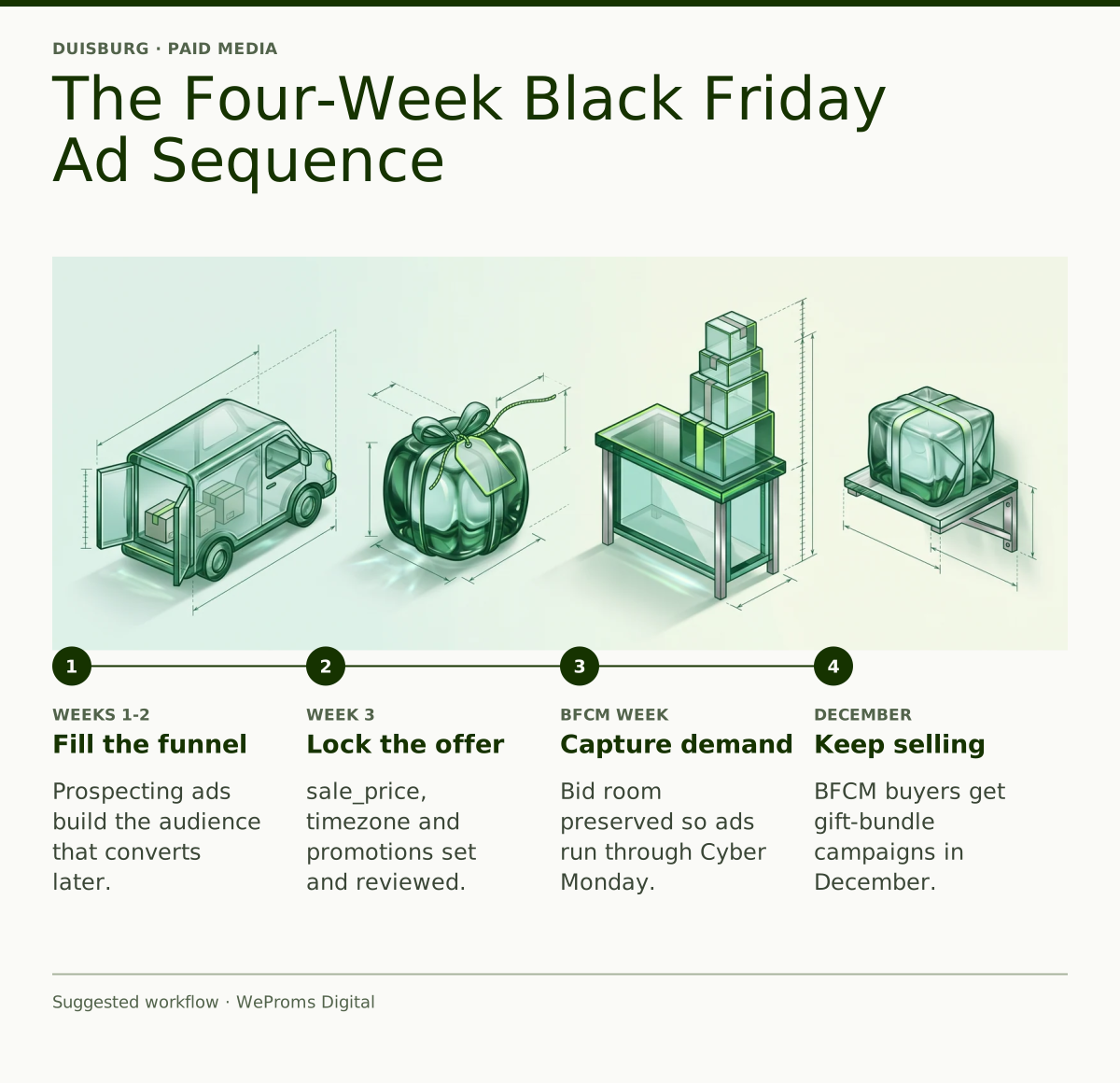
Every account we review that captures Black Friday cleanly does the same three things in sequence: it fills the funnel early, it locks the offer early, and it protects budget headroom for the week itself. Search Engine Journal’s operators describe the same sequencing — what converts during BFCM comes from people who discovered the store weeks earlier, and shoppers deliberately hold out for the best offer. Which means your job in early November is reminding interested people that you exist, not discounting yet.
Filling the funnel before Black Friday works the way a well-organized halal butcher takes qurbani orders weeks before Eid al-Adha: demand gets banked before the rush, not fought over on the morning of it. For a German halal store, banking demand is two concrete jobs — prospecting campaigns that reach new shoppers in weeks one and two, and a WhatsApp or email list that captures the interested ones before competitors bid for them in peak week.
Here is a ready-to-paste list-building broadcast, to be sent only to customers who ticked marketing consent at checkout:
Assalamu alaikum! Our Black Friday list opens early this year. Reply EARLY and we will WhatsApp you our halal snack-box deals on Wednesday, two days before everyone else. Reply STOP at any time to leave the list.
The number to watch in this phase is daily list signups, not sales. Ten signups a day from a 30 EUR daily prospecting ad is a strong trade; zero signups alongside healthy clicks tells you the offer is wrong, not the audience. A halal grocery holiday plan we wrote for Mississauga covers the shaadi-season half of this calendar, and our Black Friday prep guide written for PKR budgets maps the same sequence for Pakistani-run stores — the mechanics transfer to EUR budgets unchanged.
What separates the two groups we observe, in one table:
| What we observe | Early-November starters | Peak-week scramblers |
|---|---|---|
| Prospecting start | First week of November | November 24-26 |
| Meta learning status | Exited well before peak week | Reset during the most expensive days |
| Offer setup on Google | sale_price, timezone, reviewed promotion | price overwritten, no sale dates |
| Budget headroom | 30.4x monthly cap preserved | Spent before Cyber Monday |
| December plan | Buyer list recorded and retargeted | None — warm data evaporates |
Where ad accounts quietly reset themselves
Learning phase — the opening stretch of a Meta ad set’s life, while Meta’s delivery system works out which people convert for you. Search Engine Journal’s playbook summarizes the threshold:
“An ad set usually exits learning after about 50 results in the week after its last significant edit.”
Two consequences follow. An ad set still in learning is less stable and usually costs more per result; and significant edits — including budget jumps — restart the clock. A store that doubles its daily budget on Black Friday morning sends its best ad set back into learning during the most expensive auctions of the year, so the same euros buy fewer orders. This is the most common self-inflicted wound we see in diaspora-owned ad accounts during peak season.
The mechanical fix is stepping. On that 2,400 EUR seasonal budget (worked example — substitute your own figures), step Meta prospecting from 30 EUR a day to 40 EUR in week two, then to 55 EUR in week three, and hold there. Gradual steps keep the ad set out of learning while it scales; a single leap on November 24 does the opposite. As the team behind Meta ads management for UK, Gulf and European takeaways and stores, WeProms Digital checks learning-phase status before every seasonal budget change, precisely because the check takes a minute and skipping it costs a week.
Creative obeys the same clock. Build Black Friday creative now and launch it the week before peak, so learning happens ahead of the traffic; on the Google side, upload holiday asset groups at least two weeks early so they clear approval, then use scheduling to switch them on the moment the sale starts.
The Google offer settings that decide your strikethrough price
sale_price — the Google Merchant Center attribute that carries your deal price while the regular price attribute keeps the full price. The pairing is the point: submitting both is what produces the strikethrough and the sale badge in Shopping results, while overwriting the price destroys them (Google Merchant Center Help). Google’s stated U.S. validation for strikethrough treatment is a discount between 5 and 90 percent with the regular price charged for at least five of the past 30 days — that is the U.S. rule, so verify the same thresholds inside your German Merchant Center account before you design around the badge.
Sale dates need a timezone. Google defaults to a UTC window when none is written, and the same default starts a Pacific brand’s sale at 4 p.m. on Thanksgiving and ends it at 3:59 p.m. on Cyber Monday. Germany sits at UTC+1 in winter, so writing 2026-11-27T00:00+0100/2026-12-01T00:00+0100 instead of bare dates shifts your window by only an hour — but write it anyway, because Cyber Monday evening after dinner is exactly when NRW shoppers run their final comparisons.
Promotions deserve their own review cycle. A Merchant Center promotion flagged for new customers shows your strongest offer only where Google judges a shopper likely new; every promotion passes Google review, so load it early rather than on November 25, and remember that free-shipping promotions require a coupon code. Whatever the feed says must match the site — the sale price has to appear on the landing page and at checkout with both prices visible, or Google corrects it from your page or disapproves the product outright. Watch the disapproved-products count daily in BFCM week: every disapproval on November 26 is a bestseller invisible on November 28.
The budget ceiling that stops ads on your biggest day
Google Ads campaigns can spend up to twice their daily budget on any single day, but no more than 30.4 times the average daily budget in a month. Spend aggressively in mid-November and Google will throttle delivery before your biggest day arrives — running out of room during peak week is the exact failure Google’s budget recommendations flag in advance. On a Germany-wide base of 93.5 percent internet penetration and 78.5 million users, delivery throttles are a budgeting choice, not a demand limit.
Bidding has its own peak-week control. Smart Bidding — Google’s automatic bid-setting that reacts auction by auction — already models seasonal events, and seasonality adjustment — the control that tells Smart Bidding to expect a short, sharp conversion-rate change — exists for deliberate overrides. Google’s guidance limits it to events shorter than seven days with expected swings above 30 percent, on campaigns with conversion history. If Black Friday reliably converted at roughly double your November baseline in past years, that ratio is your input; for longer promotions, move ROAS — return on ad spend, the euros of sales generated per euro of ad spend — targets manually instead, and write down every change so the December reset is mechanical rather than archaeological.
Run the unit economics before you spend a euro (worked example — substitute your own costs; all figures illustrative):
- Average BFCM basket: 55 EUR
- Product cost 23.50 EUR, DHL shipping 4.90 EUR, packaging 0.80 EUR, card fees 1.10 EUR
- Contribution per order: 24.70 EUR
- Break-even on 2,400 EUR of media: about 97 orders
Assumptions: media only, no agency fees, four weeks, roughly 60 percent Meta and 40 percent Google, nationwide delivery. The stop-or-scale rule follows the same math — if cost per order runs above 24.70 EUR for three consecutive days once learning has exited, cut prospecting and hold retargeting until peak week. Set against bevh’s figure of 83.1 billion EUR in German online goods sales for 2025, a 2,400 EUR budget is a rounding error nationally; the contribution math still decides whether your season pays for itself.
What the top decile does after Cyber Monday
The accounts that finish strongest keep selling to the same audience through December instead of switching everything off on December 1 — the BFCM buyer list is warm, and gift-bundle campaigns to it convert at the cheapest cost per order of the quarter. December for a halal grocer means gifting and care packages to students away from home, which is feed content the big German retailers cannot copy. Two administrative habits separate the strongest accounts from the rest: they recorded their starting targets and budgets before the season, so resetting ROAS targets in December takes two minutes; and they chose their January-review date ranges in advance, so the comparison is honest rather than flattering.
New landing pages need to be findable, not just live. A December gift-bundle category page belongs in your XML sitemap and in the footer link structure, and category pages — not every product — are what belongs in an HTML sitemap; Google’s John Mueller, via Practical Ecommerce:
“If you have an ecommerce site, you wouldn’t list all of your products in an HTML sitemap file. You would list the categories so people can go to the right place, then pick out the product individually.”
Then the community calendar takes over. Ramadan is expected around February 8, 2027, subject to moon sighting, with Eid al-Fitr expected around March 10, 2027 — a gifting programme built on the BFCM list opens six weeks before Eid, in late January, which makes this month’s list the same list that funds your Ramadan pre-stock campaign. If you are weighing discount depth at all, our piece on whether a Riyadh abaya boutique should match White Friday discounts works through the margin side.
One decision criterion closes the season: if your BFCM list holds more than 500 opted-in buyers, December retargeting pays for itself; below that, spend December rebuilding the list rather than monetizing it.
Read next: Why Don’t Black Friday Shoppers Come Back to My Halal Grocery? and Should My Riyadh Abaya Boutique Match White Friday Discounts?
We have planned and run BFCM and holiday sale campaigns for halal ecommerce and diaspora-owned stores across the UK, the Gulf and Europe, from WhatsApp-first takeaways to nationwide halal grocers. If the sequence above looks right but the hours do not exist in your week, WeProms Digital handles BFCM and holiday sales campaign management for overseas Pakistani businesses end to end — feed checks, offer setup, budget stepping, and the December follow-on. Message hello@weproms.com or WhatsApp +92 300 0133399; we reply in UK and Gulf business hours, German time included.
Key Takeaways
- Black Friday 2026 falls on November 27; prospecting started in the first week of November is what captures the demand that converts in peak week.
- An ad set exits Meta’s learning phase after about 50 results in a week, and significant edits reset the clock — step budgets, never leap them.
- Submit sale_price alongside the regular price, write sale dates with the +0100 timezone, and load promotions early enough to clear review.
- Preserve the 30.4x monthly budget cap for peak week; seasonality adjustments fit events under seven days with swings above 30 percent.
- Know your contribution per order first: 24.70 EUR on a worked 55 EUR basket means roughly 97 orders break even on 2,400 EUR of media.
- December belongs to the BFCM buyer list — record your starting targets now, and the same list funds Ramadan pre-stock in late January.
About WeProms Digital
WeProms Digital is a Lahore-based paid media and ecommerce campaign agency working with overseas Pakistani and halal-minded business owners across London, Birmingham, Manchester, Dubai, Riyadh, Toronto, Houston, and beyond.
The team specializes in BFCM and holiday sale campaign management, Meta and Google Ads, and ecommerce feed management, with a track record of running full-season campaigns for halal grocers, takeaways, and modest-fashion stores in EUR, GBP, and Gulf currencies.
Get in touch: hello@weproms.com · WhatsApp +92 300 0133399 (replies in UK and Gulf business hours) · weproms.com/contact-us
Sources & References
- Search Engine Journal — How To Run A Full-Funnel Ecommerce Account Through BFCM Week — November 2, 2026
- Google Ads Help — About seasonality adjustments — accessed November 3, 2026
- Google Merchant Center Help — Sale price [sale_price] — accessed November 3, 2026
- contentmanager.de — Black Friday, Cyber Monday, Singles Day und Co.: Wie sich das Weihnachtsgeschäft entzerrt — 2026
- HDE — Black Friday und Cyber Monday: HDE rechnet zu Aktionstagen mit Umsatz von 5,8 Milliarden Euro — November 2025
- DataReportal — Digital 2026: Germany — 2026
- Practical Ecommerce — HTML vs. XML Sitemaps for Ecommerce — November 2, 2026
Additional reading from industry feeds: