
By Hamza Ali · WeProms Digital · October 30, 2026
Very, the UK online department store, is refunding customers the difference if a Black Friday deal drops further — a promise running 28 October to 4 December. A Riyadh abaya boutique cannot copy the refund machine. Copy the logic instead: cap the cut at 15%, put the promise in writing, and keep SAR 101 of contribution per abaya instead of SAR 36.
White Friday — Saudi Arabia’s rebranded Black Friday, the late-November discount window that Amazon.sa popularized across the Kingdom. Every November the same banner goes up across Riyadh: 40% off, everything must go. And every November, a two-person Pakistani-owned abaya boutique off Olaya Street matches that banner and quietly funds the sale out of its own margin. A UK retailer just showed, in public, why the banner is the wrong half of the tactic.
The tactic under examination is the price promise: a written commitment that whatever a customer pays during a sale event is the lowest price they will pay at that store, with the difference refunded if the store itself drops the price later. The store in question is Very, whose pledge covers eligible discounted products across fashion, home, and beauty from 28 October to 4 December. Its chief executive framed the bet plainly:
“Our Price Promise removes that uncertainty. Customers can shop our deals as soon as they see them, safe in the knowledge that if we reduce the price of an eligible product later in the event, they won’t miss out.” — Robbie Feather, chief executive officer, The Very Group
The backdrop matters. Very’s fashion and sports sales declined 4.6% in its latest reporting even as adjusted EBITDA rose 3.4% to £317.5 million. The promise is a margin-discipline play wearing a discount costume. Most boutiques miss this.
What this gets right
The promise targets hesitation, not price. The single biggest objection in any sale week is the fear of buying today at a price that falls next week. A refund guarantee removes that fear without spending one more riyal of margin on the ticket itself. That is the lever: certainty is cheaper than discount.
It converts bargain hunters into a service story. A shopper who claims a SAR 30 refund and gets it without an argument remembers the claim long after she forgets the banner. For a Pakistani-origin boutique whose customers trade recommendations inside WhatsApp family groups and mosque circles, being the shop that honored its word is advertising money cannot buy. The same one-off-crowd problem shows up in why Black Friday shoppers rarely return to a halal grocery — the fix is a reason to come back, not a lower number.
It bounds the exposure. Very’s promise runs one event, 28 October to 4 December, on eligible lines only. A finite window turns an open-ended pricing war into a scheduled, budgeted promotion. A boutique that sets its own window — say, ten days in late November — keeps the season’s discipline that Q4 retail planners already apply to order cutoffs and delivery deadlines.
Where this breaks
A boutique is not a platform. Very runs its refunds through customer-service systems that verify the basket, the date, and the price drop automatically. A two-person shop processes that by hand, from a till notebook, during the busiest week of its year. Promise without a process and the promise eats the owner alive.
Riyadh shoppers price-check in minutes. Your customer has Salla storefronts, Instagram sellers, and Amazon.sa open in adjacent tabs, so any price you match is public within hours. Monsha’at’s SME e-commerce report forecast $69 billion in annual Saudi e-commerce revenues by 2025 — roughly SAR 258 billion — growing at about 15% a year from 2020, which means the digital crowd around your boutique thickens every season. A shop that follows that crowd down on price ends the week selling abayas at rent money. Notice what the macro number does not prove: it says nothing about abaya demand on Olaya Street, and nothing about your capacity to survive a SAR 36 margin.
Back home on Tariq Road in Karachi, fabric sellers do the opposite as Eid approaches: prices firm up while demand arrives on its own. Here’s the thing. A discount does not create demand for a product your customer already plans to buy — winter weddings come regardless, Eid comes regardless — so a 40% cut is often a payment for traffic the boutique already owns: its Snapchat followers, its WhatsApp list, the aunties who send their daughters in. The same logic applies to how a Birmingham abaya boutique splits its ad budget before shaadi season — spend against demand you must create, not demand that is already walking in.
The hidden cost of the 40%-off reflex
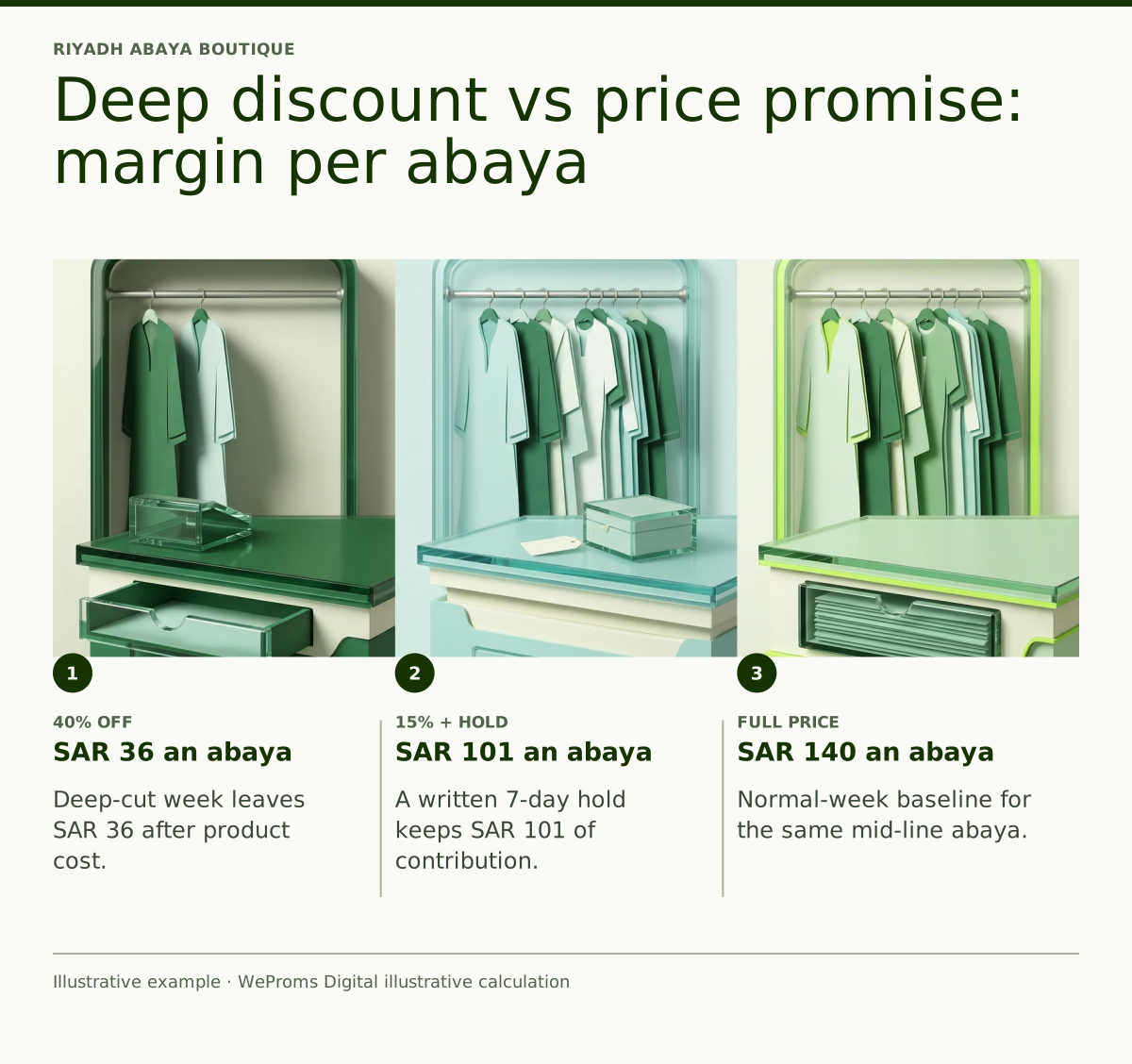
Worked example, illustrative numbers — substitute your own costs. The boutique sells a mid-line abaya at SAR 260, with product cost SAR 120, so on a normal week the contribution is SAR 140. Contribution — the money left from each sale after product cost, before rent and salaries. At 40% off, the price falls to SAR 156, and the contribution is SAR 36. The till must ring almost four times as often just to stand still: thirty-nine abayas at SAR 36 match ten at SAR 140. Layer on a modest SAR 3,000 of White Friday ads and the deep-discount week needs 84 abaya sales before one riyal of profit appears. At 15% off with a written hold, the price is SAR 221, and the contribution is SAR 101 — the same ads break even at 30 sales.
| 40%-off banner week | 15% off with written price hold | |
|---|---|---|
| Discount depth | 40% across the rack | 15% on selected lines |
| Contribution per abaya | SAR 36 | SAR 101 |
| Orders to cover SAR 3,000 in ads | 84 | 30 |
| Who buys | Bargain hunters, once | Regulars and their families |
| What follows the week | Empty till, full rack | A list that answers in Ramadan |
Two honest qualifications. First, the National Retail Federation forecasts $1.013 trillion in US November-December retail sales for 2026, up 4.2% on 2025 — the season itself is growing, and Reuters covered the forecast in full. Second, that American figure proves nothing about a single boutique’s pricing power in Riyadh; it is context for the season, not a case for the banner. What is a case for caution: Omnisend’s Q4 product checklist tells sellers to keep only “a margin that survives Q4 ad costs and shipping surcharges” — a test most 40%-off racks fail before the first customer walks in.
What overseas Pakistani businesses should do instead
Run the promise, not the banner. Four fixes, in order.
License before you list. Saudi Arabia’s Ministry of Commerce requires retailers to hold a discount license before advertising any price reduction, and to display the before and after prices; the Trader’s Guide sets fines up to SAR 50,000, up to six months’ imprisonment, or both for unlicensed discounting. That rule binds the banner and the WhatsApp broadcast equally.
Cap the cut. Fifteen percent, on chosen lines only — the winter occasion abayas, the crepe sets — and let the promise make the small number feel safe rather than stingy. A guarantee reads as confidence; a blanket 40% reads as stock the shop could not sell.
Put the hold in writing. A card at the till: if our own price on this piece drops within seven days, we refund the difference, in cash, on the spot. One notebook, one column, honored without debate. That is Very’s machine rebuilt with a pen instead of a server.
Tell the list, not the market. Ready to paste:
Assalamu alaikum! From White Friday until [date], every abaya you buy at [boutique] carries our 7-day price hold — if our own price drops, we refund the difference in cash at the till. No games, no fake before-prices. Reply STOP to leave this list.
Then aim the goodwill where it pays. Ramadan is expected to begin around 8 February 2027, subject to moon sighting, and Eid al-Fitr around 9 or 10 March 2027, again subject to confirmation. The sequence that works: collect interest from the White Friday list in December, open Eid abaya deposits six weeks before Eid — the last week of January — and schedule deliveries to finish before the Eid prayer. The names that claimed a price hold in November are the names that answer the deposit call in February; the same Ramadan-first calendar discipline shows up in when a Riyadh karahi house should post for Ramadan 2027.
Read next: Get Your Riyadh Eid Gift Boxes Into ChatGPT’s Shopping Answers and Turn Black Friday Shoppers Into Regulars
The banner is a tax you volunteer for. The promise is an asset you keep. As a holiday sales campaign agency for overseas Pakistani and halal retailers, WeProms Digital plans White Friday and Ramadan pricing calendars for boutiques and stores across Riyadh, Jeddah, Dubai, and beyond; based on our experience with modest-fashion and halal food retailers, we build the margin math first and the campaign second, with competitor price monitoring to tell you when a rival’s banner is a bluff. Bring your numbers to weproms.com/contact-us, email hello@weproms.com, or WhatsApp +92 300 0133399.
Frequently Asked Questions
What is White Friday in Saudi Arabia?
White Friday is the Kingdom’s version of Black Friday, launched by Souq and carried forward by Amazon.sa in late November each year. Nearly every Saudi retailer — marketplaces, malls, Instagram shops — runs discounts during the window. Modest fashion, electronics, and gifting categories sell hardest, and competition on visible price is at its fiercest, which is exactly why small boutiques should compete on certainty instead.
How deep should a small boutique’s White Friday discount be?
On the illustrative math above — SAR 260 abaya, SAR 120 cost — 15% off keeps SAR 101 of contribution while 40% off leaves SAR 36. Depth should be decided by the contribution you need per piece, not the banner next door. Select lines, a written 7-day price hold, and a finite window beat a blanket cut on both margin and reputation.
Is a price promise allowed under Saudi consumer rules?
A genuine price hold with honest before-prices is normal retail practice, but advertising any discount in Saudi Arabia requires a Ministry of Commerce discount license, with before and after prices displayed, and unlicensed discounting risks fines up to SAR 50,000. Read the current Trader’s Guide before the campaign and keep the license visible where customers can see it.
When should Ramadan 2027 planning start if White Friday runs in late November?
Ramadan is expected to begin around 8 February 2027, subject to moon sighting. Interest from the November list turns into Eid abaya deposits opening six weeks before Eid al-Fitr — the last week of January — with deliveries finishing before the Eid prayer around 9 or 10 March 2027. The boutique that plans this sequence in November starts Ramadan with a warm list instead of a cold one.
What does WeProms charge to plan a White Friday campaign?
Pricing depends on the number of lines, platforms, and campaign length, so WeProms Digital quotes after a short call rather than publishing fixed package rates. The margin math in this article is exactly what that first call covers. Reach the team at hello@weproms.com or WhatsApp +92 300 0133399, with replies in UK and Gulf business hours.
Sources & References
- Retail Gazette — Very makes Black Friday price promise — 29 October 2026
- NRF — NRF forecasts 2026 holiday sales growth as consumers remain resilient — October 2026
- Reuters — US holiday sales growth speeds up as shoppers stay resilient, NRF forecasts — 15 October 2026
- Monsha’at — Unlocking E-Commerce for SMEs (thematic report) — 2024
- Saudi Ministry of Commerce — The Trader’s Guide — current guidance
- Omnisend — Christmas dropshipping: 24 product ideas for 2026 (Q4 margin checklist) — 29 October 2026
- NRF — Winter holiday data and trends hub — 2026 season
Additional reading from industry feeds: