
By Sara Khan · WeProms Digital · November 7, 2026
Across the Amazon Ads accounts we review for UK-based Pakistani and halal food brands — spice kits, ready-meal ranges and snack lines sold on Amazon.co.uk out of towns like Oldham — one pattern repeats every peak shopping season: the price of a click climbs far faster than sales do. Cost-per-click, the amount Amazon charges each time a shopper taps your ad, sits near £0.60 in a quiet October week in the accounts we see; by Black Friday week the same ad on the same product pays £1.10 or more. For years, account managers explained this as “the marketplace is crowded”. This month, a US regulator put a documented number on a different explanation.
The pattern that shows up in every peak-event account
The folklore in most marketplace businesses is that Black Friday is simply expensive, so budgets rise with the calendar and nobody re-checks whether the auction itself moved. The shopper side of that folklore is only half true. Feedvisor’s 2026 Consumer Commerce Report found that only 49% of surveyed consumers believe events like Prime Day and Black Friday offer genuine savings, while 41% now wait for sales before buying at all; your customers are deliberately moving their spending into this window, and they arrive suspicious.
Read that pairing carefully. Shoppers plan to buy in peak week; the platform hosting your ads has been accused of quietly raising the price of reaching them in exactly that week.
Back in Pakistan, no trader prices next Eid’s stock off the one year the wholesale mandi inflated rates — the market price gets re-checked every season, because a contaminated baseline poisons every deal built on it. Peak-event ad benchmarks deserve the same suspicion. Before you raise a single bid this month, pull last year’s peak-week cost-per-click and your click-to-order rate, and put them side by side with a quiet week.
What the FTC just made public about Amazon’s auctions
On November 5, 2026, the US Federal Trade Commission and 22 state attorneys general unsealed new details in their lawsuit against Amazon, filed in the Western District of Washington. The complaint alleges that Amazon secretly increased advertising prices by up to 50% above auction results on ordinary days, and by up to 250% during major shopping events like Prime Day and Black Friday, between 2021 and 2023. Amazon denies deceiving or harming advertisers, and these remain allegations, not findings.
The mechanism the FTC describes is the soft reserve price — a hidden minimum that can push the final click price above what competing bids alone would produce. Amazon’s own auction guide confirms reserve pricing can affect allocation and the final amount charged, while stating you are never billed more than your maximum authorised bid.
Three period examples sit inside the unsealed complaint. In the 2021 holiday season, advertisers’ average cost-per-click allegedly rose 20%. In the 2022 holiday season, the alleged surcharges generated an extra US $87 million in worldwide revenue. For Prime Day 2023, one large food and beverage advertiser allegedly faced price increases above 100%, with an internal Amazon note reportedly acknowledging the rises were “destroying campaign performance” — an example food industry trade coverage has highlighted for grocery and beverage brands.
“I’d like to pull out all of the stops (without doing unnatural acts) to close our gaps to plan. I suspect that the entire gap won’t be closed, so whatever can be done with reserves (ideally at least $40MM would be helpful).”
That is the quoted email from the head of Amazon Ads to a senior vice president, as reproduced in the FTC’s unsealed material — a revenue-gap discussion that allegedly tied reserve pricing to corporate targets. When one advertiser asked whether the auction itself had changed, an Amazon account manager allegedly replied that there was “not a bug, or a change in auction style” and blamed crowding for the spike.
Two honest limits on this story. The case is US litigation and does not establish that Amazon.co.uk auctions were affected in the same way; UK food brands sell through the same auction system, but the filed numbers describe US events. And the unsealed sections cover 2021 to 2023, with earlier FTC materials discussing conduct in 2024 — the full scope is still being litigated. The transferable lesson is not jurisdictional. It is that peak-event benchmarks built in those years may embed inflated prices, and treating them as targets means volunteering for those prices again.
Why your 2022 benchmarks quietly poison 2026 bids
Here is the falsifiable claim: if your agency set your 2026 Black Friday targets using peak-week data from 2021 to 2023, those targets are contaminated, and hitting them means overpaying on purpose. If your numbers came from clean, non-event weeks, the same claim is wrong — and that is exactly the check worth running this week.
Worked example — substitute your own costs. An Oldham halal food brand sells a family biryani kit box at £22.99 on Amazon.co.uk. Product cost is £5.20, packaging £1.10, fulfilment £4.35, and Amazon’s referral fee at 15% is £3.45. Contribution per order is £22.99 − £5.20 − £1.10 − £4.35 − £3.45 = £8.89. That single figure is the ceiling for every peak-week decision, because an ad programme that pays more than £8.89 to win an order loses money on every sale it brings in.
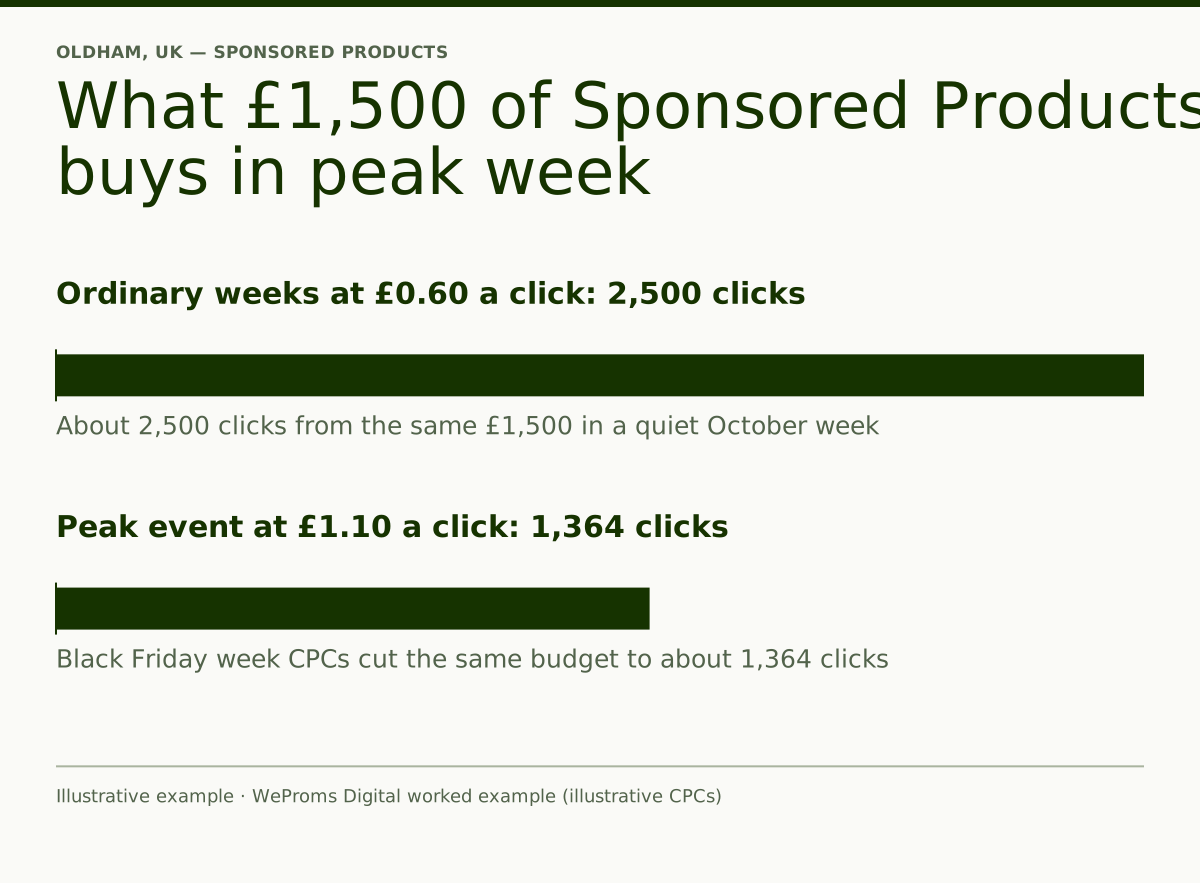
Now the budget arithmetic on a £1,500 peak-event spend. £1,500 buys about 2,500 clicks at £0.60, and the same £1,500 reaches only about 1,364 clicks at £1.10. At a 7% click-to-order rate, ordinary pricing delivers roughly 175 orders and peak pricing roughly 95. Ad cost per order comes out near £8.57 in the quiet week — just inside the £8.89 contribution — and near £15.79 in peak week, roughly double what each order earns. The stop-or-scale rule writes itself: scale while ad cost per order sits under contribution per order; stop the moment it crosses.
None of this argues for going dark in peak week. Repeat purchases and multi-buy bundles lift lifetime value beyond the first order — a US halal grocery’s system for turning Black Friday shoppers into regulars shows how — and shoppers who deliberately wait for sales only convert in these windows. The argument is narrower and harder to dispute: know the line before the auction heats up, because the auction’s recent history is now publicly accused of moving against you.
The shopper side of the squeeze
Skeptical shoppers and contested auction prices squeeze from both ends, and the ground between them is your product page. Amazon is already testing Sponsored Products — its pay-per-tap ads placed above and beside organic results — inside the text replies of its AI shopping agent, and Google’s AI Mode can now display up to four ads in a single answer. Ad surfaces are multiplying across every property a shopper touches; the page they land on is the one thing you fully control.
For a desi food brand, that page carries the proof a skeptical peak-week shopper wants: clear halal certification, plain pack sizes, honest delivery windows, and recent reviews that mention taste and freshness rather than generic praise. Fix the landing page before peak week, because a click you overpaid for deserves a page that closes.
What the top-performing accounts do differently
The accounts that survive peak events cleanly share one habit: their targets are built from non-event weeks, and their peak bids are capped by contribution maths rather than calendar courage.
| What you measure | Habit built on inflated years | Re-baselined practice for 2026 |
|---|---|---|
| Peak-week cost-per-click | £1.10 treated as “normal for Black Friday” | £0.60 non-event baseline, with peak bids capped by contribution |
| Click-to-order rate | Never separated from click price | Tracked separately, every single week |
| Decision rule | Raise budget because it is Black Friday | Scale only while ad cost per order stays under contribution per order |
| The ask you make | “Why is it so expensive?” | “Show me non-event baselines from the last 12 months” |
Ready to paste into your agency chat or account manager thread:
“Please rebuild our peak-event baselines from non-event weeks in the last 12 months, show cost-per-click and click-to-order rate separately, and flag every week where click price rose faster than orders.”
If your 2026 peak targets were set from 2021 to 2023 numbers, rebuild them before you raise one bid; and if your agency defends those baselines, ask what changed inside the auction in those years — a US regulator has just published a 250%-shaped reason to check.
Read next: What Amazon’s AI shopping agent means for UK halal brands and whether a halal butcher should switch on Google’s Black Friday bid boost.
As a marketplace advertising management team for overseas Pakistani and halal brands, WeProms Digital has reviewed peak-event performance for food and retail sellers across the UK and the Gulf, and our ad billing audit and spend reconciliation service exists precisely for seasons like this one. Based on our experience, contaminated benchmarks are the single most common reason peak budgets underperform — the platform’s own auction history now explains part of why. Message hello@weproms.com, WhatsApp +92 300 0133399, or use the contact page before Black Friday week locks in your bids.
Key Takeaways
- The FTC alleges Amazon raised ad auction prices by up to 50% on ordinary days and 250% at Prime Day and Black Friday between 2021 and 2023; Amazon denies the claims and the case is US litigation.
- Peak-event benchmarks built from 2021 to 2023 may embed inflated prices — rebuild targets from non-event weeks before raising bids.
- Contribution per order, not the calendar, should cap peak bids; in the worked example, £8.89 contribution makes £15.79 peak-week ad cost per order a loss on every sale.
- Separate click price from click-to-order rate every week, so cost inflation never hides inside a “Black Friday is expensive” story.
- Ask your agency one question this month: show me non-event baselines from the last 12 months.
About WeProms Digital
WeProms Digital is a Lahore-based marketplace and paid-media growth agency working with overseas Pakistani and halal-minded business owners across London, Birmingham, Manchester, Dubai, Riyadh, Toronto, Houston, and beyond.
The team specialises in marketplace advertising management and ad billing audits, with a track record of re-baselining peak-event budgets for food and retail brands so spend follows contribution, not the calendar.
Get in touch: hello@weproms.com · WhatsApp +92 300 0133399 (replies in UK and Gulf business hours) · weproms.com/contact-us
Sources & References
- Search Engine Journal — FTC Unseals Details In Amazon Ads Auction Surcharge Suit — November 5, 2026
- Amazon Ads — Understand Amazon Ads auctions — accessed November 2026
- Wall Street Journal — FTC claims Amazon tripled ad prices for Black Friday, Prime Day — November 2026
- Law360 — FTC claims Amazon inflated ad auction prices by 250% — November 2026
- FoodNavigator — Amazon ad lawsuit: FTC details alleged overcharges — November 6, 2026
- Marketing Land — Consumers are still buying. They’re just harder to convince — November 6, 2026
- Digiday — Amazon’s shopping agent now takes orders by text, with Sponsored Product ads in the replies — November 6, 2026
Additional reading from industry feeds: