
By Abdul Rehman · WeProms Digital · October 16, 2026
The short version: Leave the seasonality adjustment off. In Optmyzr’s study of 5,886 Google Ads accounts, advertisers who switched it on for Black Friday paid 34% higher click costs and finished with worse returns, while accounts left alone held their efficiency. This walkthrough shows a Calgary halal butcher what to do instead in the six weeks before November 27, 2026.
If you run a halal butcher shop in northeast Calgary, spend about CA$1,500 a month on Google Ads for your meat-box delivery service, and Google’s dashboard has started nudging you to “prepare for Black Friday” with a seasonality setting, this guide is written for you. Black Friday 2026 lands on Friday, November 27, and it is not a small day for Canadian retailers: Moneris data showed Black Friday was Canada’s top holiday shopping day in 2025, with transaction volume up about 25% week over week. That national figure says nothing about halal meat demand in Falconridge or Marlborough — what it does tell you is that every retailer in Calgary is bidding harder in the same two weeks, so your settings decide how much of that expensive attention you actually buy. Walk through the six steps below in order, and you will reach Black Friday week with a campaign that spends deliberately instead of reactively.
First, see what Google already switched on
Start here: open your Google Ads change history before you touch a single setting. Every edit you or Google made in the past ninety days is listed there — new campaigns, budget changes, bid changes, and the auto-applied recommendations that Google applies when an account accepts them. Look for anything dated after late September, because Microsoft’s Joe Dries, quoted in Optmyzr’s Black Friday analysis, recommends settling your peak-season strategy by late September so changes can stabilize before demand spikes. Every late change forces the bidding system to relearn, and relearning happens at the year’s most expensive auctions, which means you pay tuition in Canadian dollars.
A seasonality adjustment — the setting this guide warns about — is easy to miss in that history, especially if an agency or a family member with login access set one up “just in case” last year. Screenshot what you find. The goal of this first step is simple: know your starting point, because you cannot guard a plan you cannot see.
Then, leave the seasonality adjustment alone
A seasonality adjustment — a Google Ads setting that tells automated bidding to expect a temporary jump in your conversion rate for a chosen number of days — sounds tailor-made for Black Friday. Google’s own help page explains it as a way to signal short, exceptional events. The problem is that Black Friday is not exceptional to Google; it is the most heavily trained-on retail event of the year, and Optmyzr’s data across 5,886 accounts in 2024 shows what happens when advertisers tell the system to expect a lift it already expects. Advertisers who used the adjustment saw cost per click rise 34% over their pre-Black Friday baseline — twice the 17% increase among advertisers who left bidding alone — while their return on ad spend fell 15.7%; the group that did nothing watched return rise 5.7%. The pattern repeated in 2022 and 2023, and the extra volume the adjustment bought has shrunk every year since, because the average Black Friday conversion-rate bump itself keeps flattening — it was down to 7.5% over baseline in 2024.
The mechanism is worth understanding, because it explains why a “helpful” setting backfires. Telling Google to expect a 20% conversion jump when the real lift is 7.5% instructs the system to overbid in every auction of the year’s most expensive week, before you have time to notice. It is like telling your shop scale that every bird weighs two kilos: the scale obeys you perfectly, and your pricing is wrong all day. Seasonality adjustments do have a real job — your own flash sale, a friends-and-family weekend, a sudden bulk order push Google cannot see coming — but for a nationally advertised event, the data is unambiguous. For predictable, heavily traded events like Black Friday, the honest summary is this: doing nothing outperformed doing the recommended thing at massive scale, and the burden of proof now sits on anyone who flips the switch. (One caveat Optmyzr itself flags: this compares two groups of advertisers, not a controlled experiment — but three consecutive years in the same direction is a strong signal.)
Next, clean up what counts as a sale
Before Black Friday, fix the numbers your bidding follows, because automated bidding is only as good as its inputs. PPC Hero’s audits of lead-driven accounts found that in four out of five accounts feeding leads into bidding, at least one lead action counted every submission instead of one per click — so a customer who fixes a typo in their phone number becomes two leads. The same audits found purchased-based accounts running two conversion actions for one order, and soft events like page views or outbound clicks sitting inside the conversions column, where cheap placements fill the counter faster than real orders do. A bidding system fed those numbers drifts its budget toward whatever fills the counter quickest and then reports the drift as improved efficiency.
Every phone order should count once, with its real order value attached. For a butcher shop taking meat-box orders by phone and WhatsApp, the classic failure is a thank-you page that loads twice — one CA$145 order becomes two conversions, and your bidding chases a phantom. Open your conversion settings, confirm each action counts once per click or per order, delete duplicate purchase counters, and pull soft events out of the bidding column. Navah Hopkins’ attribution guidance at Search Engine Journal makes the underlying point plainly: validate platform data against your own source of truth, whether that is your till, your delivery log, or a simple order sheet — the platform’s report gets the final check, not the final say. Do this before the peak, because a conversion fix during Black Friday week changes the rules mid-game.
After that, set a target instead of a forecast
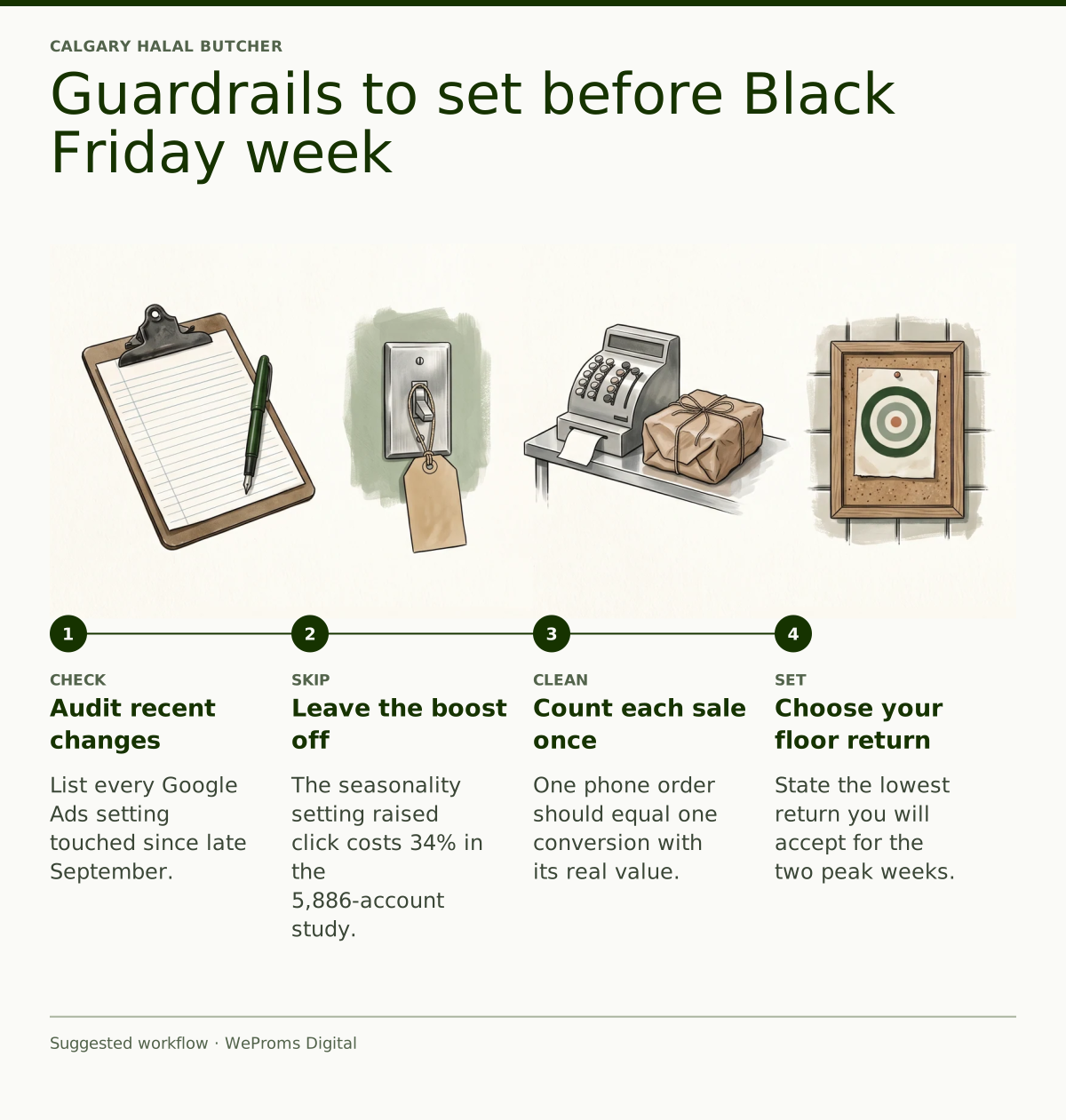
Once the inputs are honest, choose your peak-week economics deliberately. Optmyzr’s analysis points to advertiser Andrew Lolk’s argument that return targets should be actively managed rather than left untouched for a year: if you want more volume for Black Friday week, lower the target return you demand for those days, which tells Google exactly how much efficiency you will trade for sales. That is a forecast-free way to buy volume — the system finds the cheapest extra conversions it can within a limit you set, instead of overbidding everywhere on your optimistic prediction.
The tradeoff is real: volume costs efficiency, and you should choose it with numbers, not with a switch. Worked example, labeled illustrative — substitute your own costs: a winter meat box sells at CA$145; meat at CA$70, packaging at CA$7, and delivery at CA$18 leave CA$50 contribution per box. A CA$1,200 media budget over the two peak weeks (media only, Calgary delivery radius, one search-plus-maps campaign) needs 24 boxes to break even; if cost per acquired order passes CA$45 by day four — the point where contribution starts dying — pause and fix rather than push. That one arithmetic line does more for your Black Friday than any dashboard setting, because it gives you a stop-or-scale rule you can actually enforce while the shop is busy. For the order rush itself, a ready-to-paste WhatsApp line keeps phone demand organized, with consent and an opt-out built in:
“Assalamu alaikum! Our Black Friday meat-box list is open — reply BOX and we will hold your order for Friday pickup or delivery. Reply STOP any time to opt out.”
Once the checks are scheduled, plan the winter calendar
With the account clean and the targets set, put the calendar around it. Black Friday on November 27 opens the winter bulk season for a halal butcher: freezer-filling family orders through December, winter wedding banquet catering for the community, then Ramadan — expected in early February 2027, subject to moon sighting — when bulk orders for iftar cooking begin weeks before the month itself, and Eid al-Adha follows in spring with the year’s biggest meat demand. The same clean setup carries through all of it: one conversion definition, one honest target, weekly checks during each peak. Mark four dates in your calendar now — November 23 (final pre-Black Friday check), December 15 (winter catering push), mid-January (Ramadan prep), and four weeks before Eid al-Adha — and on each date, review cost per order against the CA$50 contribution line rather than against last year’s impressions.
The outcome: a peak season you can actually read
What these six steps produce is not a cleverer campaign; it is a legible one. Your costs rise because Calgary is busy, not because a setting overbid; your conversion count matches your till because each order counts once; and your return target states out loud what you are willing to pay for volume. When January comes and someone asks what Black Friday actually earned, you will answer from the delivery log, not from the dashboard’s self-report. Decision criterion to carry forward: if a setting promises to predict demand for an event everyone already knows about, leave it off and spend the effort on inputs and limits instead.
Two Calgary butcher shops, both spending CA$1,500 across Black Friday week, illustrate the difference — figures from the Optmyzr study applied to a local budget:
| What the week looks like | Seasonality adjustment ON | Adjustment OFF |
|---|---|---|
| Click cost change vs baseline | +34% | +17% |
| Return on ad spend | −15.7% | +5.7% |
| What that means at the till | Paying more per click for worse efficiency | Holding efficiency while volume rises |
Read next: How can a halal grocery in Mississauga win Black Friday and shaadi season? and Google Ads counts leads my Mississauga tax firm never received.
If you would rather have a specialist do this pass before the peak, WeProms Digital runs pre-season Google Ads audits for overseas Pakistani and halal-minded businesses across Canada, the US, the UK, and the Gulf. As a Google Ads management service for halal butchers and food businesses in Canada, WeProms Digital checks change history, repairs conversion counting, and sets the targets and stop rules around your own contribution math — based on our experience with food retail and delivery businesses across Calgary, Toronto, and London. Email hello@weproms.com, WhatsApp +92 300 0133399, or use the contact page.
Frequently Asked Questions
What is a seasonality adjustment in plain English?
It is a Google Ads setting that tells the automated bidding system to expect a short, exceptional jump in your conversion rate — for example, “sales convert 20% better for the next four days.” Google designed it for events the system cannot predict, like your own flash sale. Black Friday is the opposite: the system already trains on years of it, so adding the setting double-counts the expected lift, and bids rise accordingly.
When should a halal butcher actually use a seasonality adjustment?
Use it for demand spikes Google cannot see coming: a sudden walk-in bulk order from a mosque event, your own anniversary weekend, or a friends-and-family promotion you announce only on WhatsApp. Skip it for nationally advertised events — Black Friday, Cyber Monday, Christmas — because those are already priced into the bidding system, and the 5,886-account data shows the setting raises costs precisely then.
How much should a Calgary butcher spend on Black Friday ads?
Start from contribution, not from a platform default. In the illustrative example above, a CA$145 meat box carries CA$50 of contribution after meat, packaging, and delivery; a CA$1,200 media budget over two weeks needs 24 orders to break even, with a stop rule if cost per order passes CA$45 by day four. Scale up only while cost per order stays under that line — a budget number without a contribution number behind it is a guess.
How do I stop Google Ads from counting my phone orders twice?
Open your conversion settings and check each action’s count setting: purchases and phone orders should count once per click, not “every” occurrence, and only one purchase action should sit in the conversions column your campaigns bid on. Remove duplicate purchase counters created by tags, analytics imports, or CRM uploads, and compare the conversion count to your till totals for the same week — the two should match within a handful.
Can WeProms review my Google Ads account before November?
Yes. WeProms Digital runs pre-season audits for overseas Pakistani and halal-minded businesses — change history review, conversion-counting repair, target setting, and a written stop-or-scale rule tied to your own margins, based on our experience managing retail and food accounts across Canada and the UK. Reach the team at hello@weproms.com or through the contact page, and the review is typically completed well before the peak week.
Sources & References
- Marketing Land / Optmyzr — We analyzed 5,000+ Google Ads accounts: Seasonality adjustments backfire on Black Friday — October 15, 2026
- Google Ads Help — Seasonality adjustments for Smart Bidding — accessed October 2026
- PPC Hero — Your ROAS Went Up. Where Did It Come From? — October 15, 2026
- Search Engine Journal — Ask A PPC: How Do I Measure And Attribute When Clicks Are No Longer The Whole Story? — October 15, 2026
- TryBree — Canadian Holiday Shopping Statistics (citing Moneris) — 2026
- SL Marketing — Ramadan marketing in the UAE: budget, timing and bidding for 2027 — 2026
Additional reading from industry feeds: