
By Sara Khan · WeProms Digital · November 8, 2026
Thirty-one percent of US shoppers reached for a coupon or cashback offer more often in 2026 than the year before, according to Feedvisor’s 2026 Consumer Commerce Report — and a Blackburn abaya boutique feels that shift at checkout, where a £65 order can quietly shed more than £12 of margin to a voucher site that never introduced the customer in the first place. The GATE framework breaks that decision into four checks before any commission is paid to anyone: G for Goal, A for Audience, T for Terms, E for Evidence. A Pakistani-owned modest fashion shop that runs GATE on its partner list once a quarter stops renting its own customers back and starts buying new ones.
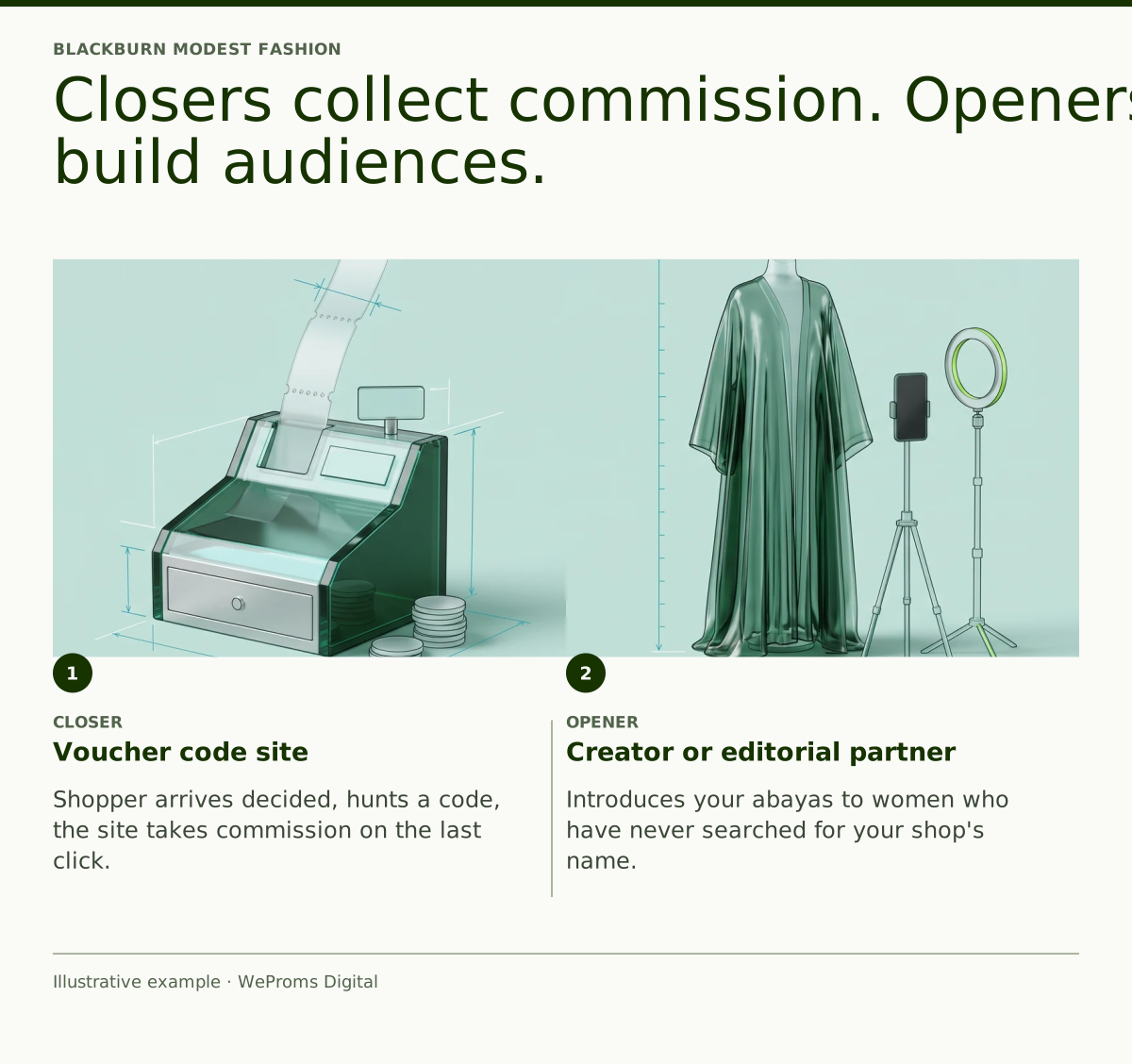
The mechanism behind the leak is worth naming precisely. An affiliate programme — an arrangement where external websites earn a commission on every sale they refer — usually pays whoever clicked the customer’s last link before purchase. That rule is called last-click attribution, and voucher and cashback sites have built a business on it: a shopper arrives at your checkout already decided, opens a second tab to hunt for a code, and the code site collects 5–10% of an order it did nothing to create. TopCashback’s own merchant pages currently advertise fashion cashback at up to 5% at River Island and up to 10% at Ralph Lauren, which tells you exactly what UK retailers pay for that final click.
The pattern repeats across UK partner programmes: the channels that harvest existing demand get paid every week, and the channels that create new demand go unmeasured and unfunded.
G — Goal: decide what the voucher channel is actually for
Every partner programme answers one of two goals. The first is closing: catching shoppers who hesitate at checkout and would abandon without a code. The second is discovery: introducing your abayas, hijabs and occasion-wear to Muslim women in Manchester, Leeds or Leicester who have never typed your shop’s name into anything. A programme that tries to do both with one partner list does neither well.
MarTech’s November 2026 analysis of affiliate programmes documents what happens when that choice is never made. Footwear brand Clarks described its own US programme as stuck “in a hold pattern” — running mostly through coupon and discount sites alongside a small creator roster — before rebuilding around hundreds of creators and established publishers. The coupon partners were not underperforming; they were doing a closing job while the brand paid them as if they were doing a discovery job.
The discipline for a modest fashion shop is the same, at a smaller scale. Write the goal down in one sentence before negotiating with any partner, and let the sentence settle the argument: if the goal is new customers in cities you do not yet sell to, the budget belongs with creators and editors, and voucher sites get nothing but expiring, capped codes. Pricing anchors matter here too — before you discount anything, read how a UK modest fashion shop should answer Shein’s prices, because a voucher channel with no price floor quietly trains your regulars to wait for codes.
A — Audience: who each partner actually reaches
Voucher-site audiences are not neutral. Feedvisor’s survey found 45% of US consumers compare prices more than they did a year ago, and among those who compare, nearly half check three retailers before buying — behaviour that lands at your checkout already suspicious, already price-anchored, and already one tab away from a code directory. Only about half of shoppers now believe big sale events offer genuine savings, so the code they hunt is less about greed and more about self-protection.
That is the profile of your existing customer, not a new one. Think of the aunties who ring the halal butcher before Eid to reserve their qurbani share: they were buying regardless, and no intermediary earned that sale. Paying commission to a voucher site for a customer like that is paying a doorman for people already standing in your queue.
Creator and editorial audiences behave differently before they ever reach a price. As MarTech puts it plainly, “creators reach audiences that have never searched for you” — a hijab styling video or a modest occasion-wear edit reaches women at the consideration stage, weeks before a checkout. The same article flags a newer layer: Awin’s research says more than half of AI users now turn to AI tools to research what they buy, and those tools assemble answers from publisher reviews, buying guides and product data. Clarks’ Mario Protano described why inconsistent product data breaks that chain:
“AI does not like that. It just does not match.”
A colour called “sage” on your product page and “green” in your feed is one example, and it severs the connection before a recommendation is ever made. For a concrete sense of how new audiences arrive through discovery channels rather than search, the Pinterest shaadi-season case for modest fashion boutiques shows the same mechanic in a community context. The action from this section is a one-column list: for every current partner, write who it reaches — existing customers or new audiences — and refuse to renew any partner you cannot answer for.
T — Terms: the rules that keep commission from eating margin
Terms are where the leak gets closed, and three clauses do most of the work. A closed group — a commission setting where only approved partners may promote your codes — stops bargain directories from listing you without permission. Deduplication — a network rule that pays only one channel per sale — ensures your own email or Instagram post wins the commission when both touched the customer. And a cookie window — the number of days a referral link stays valid — should be short for voucher partners, because a 30-day window on a decided buyer is a donation.
Then run the numbers on one real order. Below is a worked example — substitute your own costs. A £65 abaya carrying £26 in product cost, £4.50 in postage and packaging, and Stripe’s UK standard card fee of 1.5% plus 20p leaves £33.30 of contribution when bought direct. Route the same order through a voucher site with a 10% code and 10% commission and the picture changes sharply:
| Line | Direct order | Voucher-site order |
|---|---|---|
| Price paid | £65.00 | £58.50 (10% code) |
| Product cost | £26.00 | £26.00 |
| Postage and packaging | £4.50 | £4.50 |
| Card fees | £1.20 | £1.08 |
| Affiliate commission | £0.00 | £5.85 |
| Contribution left | £33.30 | £21.07 |
The gap is £12.23 on a single order. Shopify’s UK tax-registration guidance is a useful nudge to get this level of cost visibility formalised before you negotiate with anyone — UK sellers crossing the £90,000 VAT-registration threshold on turnover that includes voucher-discounted sales discover too late that their margin model was never real. The action from this section: cap voucher commissions at single-digit percentages, keep voucher cookies short, and never allow an always-on public code.
E — Evidence: measure new customers, not last clicks
The only honest measure of a partner is the share of orders it brings from customers who had never bought from you before. Shopify order data separates new from returning customers in two clicks, and unique codes per partner make the split undeniable — if a voucher partner’s orders are 70% existing customers, that partner is harvesting, not selling, and the GATE verdict is renegotiate or remove. That 70% line is a deliberate, defensible threshold: any operator who tests it against their own order history is welcome to disagree with numbers in hand.
Evidence also changes what you count as a win. A voucher-driven customer who joins your list is not equal to an organic one; Omnisend’s 2026 ecommerce benchmarks put the average ecommerce open rate at 30.7%, so a list bought with discounts must clear that bar plus the commission it cost to build. And the discipline of auditing your own numbers before paying for traffic is not small-shop fussiness — JD Sports spent months rolling out item-level stock tracking across 414 UK and Ireland stores with Renovotec and Checkpoint, as Retail Gazette reported, precisely because inaccurate internal data was costing it money invisibly. Run a 90-day partner review on a calendar date, not on a feeling.
Read next: Should my Manchester modest fashion shop match Shein’s prices? and Should my Birmingham abaya boutique run one Instagram ad or three?
If the numbers above describe your shop, WeProms Digital’s affiliate and partner programme management service for overseas Pakistani businesses builds partner lists that pass GATE — closed-group terms, deduplication rules, and reporting that separates new customers from harvested ones. Based on our experience working with modest fashion, attar and halal grocery brands across the UK and the Gulf, we also run influencer campaign management for halal brands in the UK and Gulf, which is where the discovery budget belongs once voucher terms are fixed. Message hello@weproms.com or WhatsApp +92 300 0133399 — we reply in UK and Gulf business hours.
Key Takeaways
- Voucher and cashback sites earn last-click attribution on shoppers who had mostly already decided to buy; commission paid on those orders is margin spent twice.
- Run the GATE framework quarterly: Goal, Audience, Terms, Evidence — one written sentence for the goal, one list of who each partner reaches.
- A worked £65 abaya order keeps £33.30 bought direct but only £21.07 through a 10% code plus 10% commission — a £12.23 gap that compounds to roughly £2,900 a year on a modest, illustrative order volume.
- Fix terms before fixing partners: closed-group codes, deduplication, short cookie windows, single-digit commissions.
- Judge every partner on new-customer share; the 70% existing-customer line is where renegotiation starts.
- Keep product data consistent everywhere it appears, because AI shopping answers now assemble recommendations from it.
Frequently Asked Questions
Do voucher code sites ever bring genuinely new customers to a UK abaya shop?
Rarely, and only when the code is part of a curated feature — an editor’s modest fashion round-up, for example — rather than a mass code directory. Code-directory users arrive at checkout already decided and hunt a code as a final step, which is why their orders skew heavily toward existing customers. Check the new-customer share in your order data before believing any partner’s reach claims.
Is offering commission to voucher and cashback sites halal for my business?
Commission paid for a genuine referral is a standard sales expense and raises no riba concern, and cashback is a rebate on a purchase the customer already made. The halal-sensitive parts are honesty issues: codes must work as advertised, prices should not be inflated to fake a discount, and expired codes should be removed. Deceptive urgency fails both commercial and ethical tests.
How do I stop expired or unauthorised discount codes appearing on voucher sites?
Submit a takedown request to the site and to your affiliate network — closed-group programme settings prevent unapproved listings in the first place, and a coupon code leak audit sweeps the big directories for codes you forgot you authorised. Set every public code with a hard expiry date, audit the main directories quarterly, and remember that an old “10% off” code that still works is a standing margin leak you authorised once and forgot.
What is a fair commission to offer partners on modest fashion?
Single-digit percentages are the commercial norm for fashion on UK networks, and cashback advertising at major retailers sits around 5–10%. Creators and editorial partners often take flat fees or gifting plus lower commission, which is appropriate because their job is introduction rather than closing. Never set a commission you have not first tested against your per-order contribution.
How much does WeProms charge to set up and manage a partner programme?
Fees depend on the number of partners, networks and markets involved, so we quote after a short audit of your current codes, commissions and order data. Contact hello@weproms.com or WhatsApp +92 300 0133399 for a scoped proposal — we do not publish package prices here because programme scope varies too much to quote honestly.
About WeProms Digital
WeProms Digital is a Lahore-based partnerships and paid media agency working with overseas Pakistani and halal-minded business owners across London, Birmingham, Manchester, Dubai, Riyadh, Toronto, Houston, and beyond.
The team specialises in affiliate and partner programme management, influencer campaign management, and paid media, with a track record of restructuring partner terms so commission buys new customers instead of renting existing ones.
Get in touch: hello@weproms.com · WhatsApp +92 300 0133399 (replies in UK and Gulf business hours) · weproms.com/contact-us
Sources & References
- MarTech — Consumers are still buying. They’re just harder to convince. — November 6, 2026
- MarTech — Is your affiliate program showing up too late? — November 6, 2026
- Stripe — UK Pricing & Fees — accessed November 2026
- Shopify Help Center — Tax registration for UK merchants — accessed November 2026
- Omnisend — How to increase email open rates: 10 practical tips — November 6, 2026
- Retail Gazette — JD Sports rolls out stock-tracking technology to tackle availability and theft — November 6, 2026
- GOV.UK — Register for VAT — accessed November 2026
Additional reading from industry feeds: