By Abdul Rehman · WeProms Digital · October 31, 2026
TL;DR: One evening of asking ChatGPT, Gemini and Google’s AI what your customers ask shows you the gap. One weekend fixes the facts they read. One answer page and one round of genuine community mentions later, Sohar-to-Pakistan families start hearing your name — before Eid barrel season opens.
Picture this: a Sohar family books two barrels to Karachi in the last fortnight before Eid al-Fitr — expected on or around 9 March 2027, subject to moon sighting — and the shop they call first is not yours. They asked an AI assistant for the best cargo service from Sohar to Pakistan, the assistant named three Dubai consolidators and one Muscat aggregator, and your office ten minutes from their villa never entered the answer. With nearly 293,000 Pakistani workers in Oman as of February 2026, per Oman Observer’s workforce reporting, the Sohar-to-Karachi corridor you serve is a real, named demand — and right now the machines that answer first are pointing it at bigger companies in another country. A barrel that ships for around OMR 22 (illustrative rate — substitute your own tariff) is small money per booking; a season of families who never hear your name is not.
First, ask the engines what Sohar families actually ask
Start here, because everything downstream depends on what the answers actually say. Open ChatGPT, Gemini, Perplexity and Google (where an AI-written answer box now sits above the classic results), and type the questions a real customer types: “best cargo service from Sohar to Karachi”, “how to send a barrel from Oman to Pakistan”, “cheapest cargo to Lahore from Sohar”. Write down every shop and company each engine names, for each question, on one sheet.
Expect the first result to sting. When publisher Tony Uphoff ran this test on his own businesses across 59 answers, his newsletter appeared in zero of 12 category answers and his advisory firm in one of 43 — even though every engine knew his career by name. His summary is the whole problem in two sentences, verbatim:
“The models know who I am. They almost never recommend what I’ve built.”
Being known is not being recommended, and recommendation is the only currency that matters here. There is a structural reason Dubai names dominate yours: BrightEdge’s data, covered by Search Engine Journal, shows booking platforms appear in 78% of AI Overviews answers to questions containing words like “cheap”, “deal” or “budget”, against 17% of other answers — price-first questions hand the answer to aggregators. The same research found the openings sit in questions that need human experience and judgment: which shop packs properly, who delivers to the door in Karachi, who a family trusts. A Sohar shop can win exactly those; a Dubai consolidator cannot be the neighbour who shipped your cousin’s barrels. G2’s 2026 research found 51% of B2B software buyers now start research with an AI chatbot more often than Google — and that US software data proves nothing about how Sohar families choose cargo firms, but the direction is one-way: comparing services increasingly starts inside an answer, not on a results page.
Then, fix the facts every engine reads about your shop
Every engine reads the same public facts about your shop, so make those facts identical everywhere. Assistants stitch their answers together from your Google Business Profile listing, your website, your Facebook page, directory entries and old news mentions; when your phone number differs between your WhatsApp Business card and your listing, or your opening hours miss the Ramadan shift, the engine either guesses or skips you.
Two fixes carry most of the weight. First, claim and complete the Google Business Profile: exact business name, goods-and-freight category, Sohar address, one phone number used everywhere, hours that change for Ramadan, and photos of your actual packing bench rather than stock images. Second, deal with stale records deliberately, because engines repeat what the web has said most often, and most often usually means longest ago. Uphoff’s test found engines still described him as CEO of a firm he had left, sourced from aggregator profiles and old press releases — the cargo equivalent is an engine citing your old Muscat address or a discontinued Lahore door-delivery service. Correct the old listings, and where you cannot, publish one clear current page that outranks them.
The tradeoff is time, not money: an evening with your login list beats a paid listing package, because paid directories are exactly the thin signals engines discount. Your Urdu-speaking customers phone and WhatsApp in Urdu, which means a short Urdu summary of your services on the site serves the aunt in Sohar and the nephew in Karachi who checks the shipment — same facts, both languages, one source of truth.
Next, publish the page that answers the barrel question outright
One page does more work than fifty generic ones. Write “How to send a barrel from Sohar to Karachi” as a real answer: current OMR rates by barrel size, pickup or drop-off, packing rules, what cannot ship, customs paperwork, door delivery in Karachi versus port pickup, and honest transit time. Open the page with the answer a shipper needs, then give the detail underneath it.
The mechanics behind that structure are measurable. Kevin Indig’s analysis of 1.2 million ChatGPT responses, cited by Ahrefs, found 44.2% of citations come from the first 30% of a page; agency TJ Digital’s dataset of 193,507 AI answers, as covered by Search Engine Journal, found cited pages opened with a direct answer 23% of the time, against 14% for pages the engines saw and skipped. Which suggests the opening sentences help decide whether the corridor question you own gets answered in your words or a Dubai aggregator’s. Refresh the rates before each season — Eid al-Fitr barrels ship in the weeks before early March 2027, summer-leave shipments stack up in June and July, and shaadi-season parcels follow the wedding calendar back home — and an answer page with a stale 2024 rate quietly teaches engines your shop is not current. The page also does double duty once families click through: if visitors arrive but never call, that is a separate conversion fix we cover in why Muscat cargo websites get visits but no calls.
After that, earn mentions where Sohar families actually talk
Engines learn trust the same way the community does: from what people say when they recommend a service. AI citation works like the family consensus back home — the shop every aunt recommends over chai gets the wedding order, not the one with the loudest billboard. So the work is making sure those recommendations exist where machines can read them: genuine Google reviews that name the corridor (“Sohar to Karachi, 10 days, door delivery”), answers in the Facebook groups Pakistanis in Oman actually use, and community spaces that are newly becoming searchable. Discord announced in October that its public-server pages go live on the web from November 16, 2026, with member messages appearing in search from mid-December — genuine community answers, in members’ own words, are becoming answer-engine source material.
Do not chase the click; chase the name. Reddit’s CEO said on his earnings call that Google’s AI Mode “does not drive traffic”, and Reddit lost more than one million search referrals a week in October — yet demand for the communities held, because the recommendation happened inside the answer. Your barrel family in Sohar behaves the same way: they read one name, message it on WhatsApp, done.
One ready-to-paste message for customers whose barrels landed safely (send only to those who agreed to updates):
“Assalamu alaikum from [shop name], Sohar. If your barrels reached Karachi safely, would you mention us in your family groups? A line like ‘We sent with [shop name], Sohar to Karachi, OMR [rate], door delivery’ helps other families find us. Reply STOP to stop these updates.”
Every honest review that names the corridor is a sentence an engine can quote back — the same community-referral engine behind how Muscat caterers win referrals, now feeding machines as well as neighbours.
At this point, set up a monthly citation check
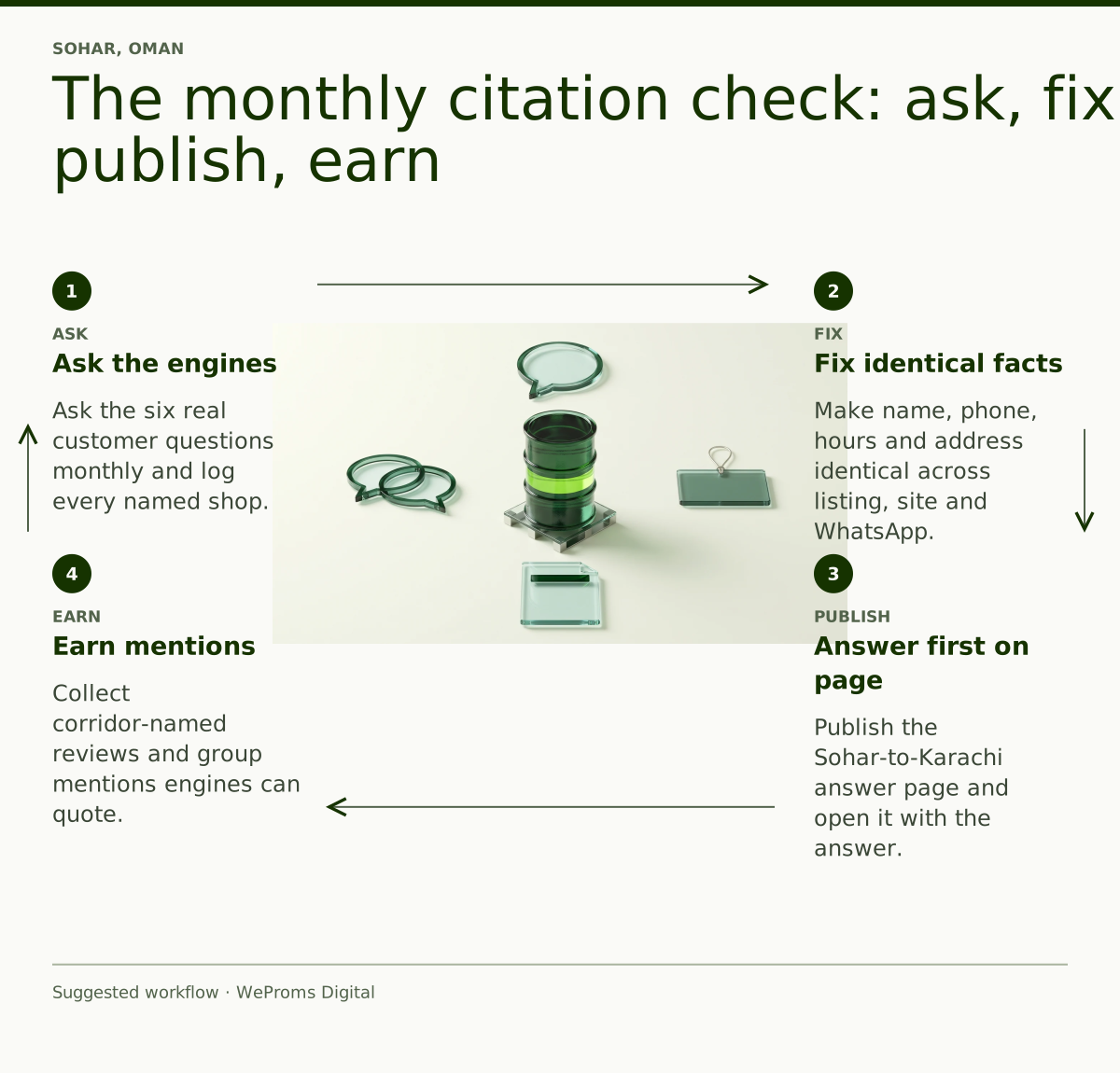
Once a month, ask the same six questions in ChatGPT, Gemini, Perplexity and Google, and log every shop the engines name. Thirty minutes, one spreadsheet, a column per month. Agencies increasingly automate this — Seer Interactive built a tool that watches ChatGPT’s live searches behind each answer — and a spreadsheet gets a two-office cargo shop the same signal at family-business cost. Small-sample answers shift between runs, so track the trend across months rather than any single evening’s result.
One measurement trap deserves a warning before you set expectations. When SEO Cyrus Shepard blocked his site from Google’s AI answers in a small opt-out test, AI impressions carried an estimated 0.9% click-through rate — and when he switched AI visibility off, his regular organic clicks fell too, a halo effect where presence in the answer lifts clicks everywhere else on the page. Which means the monthly log should count names, not visits: your Google Analytics will under-report what the answers are doing for you, and families AI sends you can arrive looking like mystery direct traffic.
Once you have run two rounds, compare what changed
| What the engines read | Round 1 (today) | Round 3 (after ~60 days) |
|---|---|---|
| Business facts | Name, phone and hours differ between listing, site and WhatsApp | Identical name, one phone number, Ramadan hours set |
| Corridor answer page | No Sohar-to-Karachi answer page exists | One page live, opens with rates and transit time, refreshed for Eid |
| Community mentions | Reviews say “good service” with no corridor named | Reviews and group posts name Sohar-to-Karachi and door delivery |
| Citation log | No record of what engines say | Three monthly rounds logged, trend visible |
This table is a plan, not a promise — engines re-rank on their own schedule, and no honest agency guarantees a date your name appears. What the log buys you is proof of direction while the fixes compound, which is exactly what GEO and AI discoverability work for overseas Pakistani businesses is built around, backed by our AI search visibility monitoring and citation tracking reporting.
The outcome: the name families write down
Run the arithmetic that justifies the routine (illustrative — substitute your own numbers). Suppose 40 Sohar families ask an assistant about cargo to Pakistan in a month, and the named shop captures a quarter of them: 10 shipments. At an OMR 22 barrel rate, one family shipping two barrels adds OMR 44 of revenue, so the month’s captured demand is roughly OMR 440 — against a cost of one evening, one page and thirty minutes of logging. If after three logged rounds your name still never appears while facts are identical and reviews accumulate, the gap is authority, and that is when a specialist review — not another listing package — is the money-efficient next step.
Read next: How Do I Get ChatGPT to Recommend My Oud Shop in Dubai? and Why Do Customers in Muscat Check My Cargo Website and Never Call?
WeProms Digital runs GEO and AI discoverability programmes for overseas Pakistani and halal-market businesses, and based on our experience working with cargo, retail and hospitality owners across Oman, the UAE and the UK, we begin with the same four moves this walkthrough covers — ask, fix, publish, earn — then report monthly on the names the engines say. To see what the engines currently say about your shop, email hello@weproms.com or message WhatsApp +92 300 0133399 (we reply in Gulf and UK business hours), or use the contact page.
Frequently Asked Questions
How long before ChatGPT starts naming my Sohar cargo shop?
Engines re-scan the web on their own schedule, so no date is promisable. What the monthly log typically shows is movement over two or three rounds: facts settle first, the answer page gets picked up next, and named mentions follow genuine community reviews. A first appearance inside three months of consistent fixes is a realistic working expectation, not a guarantee.
Does my Google Business Profile affect what AI assistants say?
Yes, directly. Assistants assemble answers from public listings, your website and community mentions, so an unclaimed or inconsistent profile — wrong category, old phone number, missing Ramadan hours — either weakens your candidacy or feeds engines outdated facts. Correcting it is the highest-return fix available to a Sohar shop, and it costs an evening.
Should I pay for an AI visibility tool, or is a spreadsheet enough?
A spreadsheet with six questions, four engines and monthly dates is enough to start, and it produces the only number that matters at your scale: whether your name appears. Paid tools matter when you track dozens of prompts across markets — at that point a monitored setup, or an agency running citation tracking for you, costs less than the owner-hours it replaces.
What should the Urdu section of my cargo website say?
Mirror the English facts, nothing more: corridors you serve (Sohar to Karachi, Lahore, Islamabad), current OMR rates by barrel or box size, pickup and door-delivery options, packing rules and transit times. One source of truth in two languages beats two marketing sites — the family in Sohar phones in Urdu, the relative in Karachi checks tracking in English, and engines reward the consistency.
Will AI answers actually send visitors to my website?
Fewer than classic search did — one opt-out study put AI-feature click-through near 0.9%, and the same test found organic clicks fell when AI visibility was switched off entirely. The value sits in the recommendation itself: the family reads one name and messages it on WhatsApp. Count names in your monthly log, not visits in your analytics, and the picture stays honest.
Sources & References
- G2 — The Answer Economy: 2026 AI Search Insight Report — March 2026
- Discord — Making Content from Discoverable Servers Easier to Discover — October 27, 2026
- SOHAR Port and Free Zone — Port tariffs and trade information — current
- Oman Observer — A Gradual Increase in Omani Workforce, a Drop in Expats — 2026
- Search Engine Journal — Big Brands Dominate AI Search But Leave Openings For Smaller Sites — October 31, 2026
- Search Engine Roundtable — Google AI Overviews and AI Mode 0.9% Click-Through Rate, Opt Out Study Says — October 30, 2026
- Search Engine Journal — Reddit CEO Says Google’s AI Mode ‘Does Not Drive Traffic’ — October 30, 2026
- Search Engine Journal — The AI Search Measurement Gap Brands Must Close In 2027 And Beyond — October 30, 2026
- Ahrefs — What Is BLUF? How to Write Bottom Line Up Front — October 30, 2026
- Seer Interactive — I Built a Tool to Watch ChatGPT Search, and It Predicted My Next Question — October 30, 2026
- Search Engine Journal — AI-Cited Pages More Often Got Straight to the Answer — October 28, 2026
Additional reading from industry feeds: