By Sara Khan · WeProms Digital · October 26, 2026
Across the dozens of Pakistani-owned restaurant and food-retail accounts WeProms Digital has reviewed in Doha, Al Wakrah, and Al Rayyan over the past six months, one pattern keeps appearing: ask ChatGPT, Gemini, or Google for the best karahi or biryani near Al Wakrah, and the answers reliably name venues in central Doha — Msheireb, Souq Waqif, The Pearl — while family restaurants a fifteen-minute drive from the asker’s door go unmentioned. The Friday family dinner worth roughly QAR 200 for six people still drives down the Al Wakrah corniche, because the families who already know their karahi house never needed an assistant to find it; the family that moved to Qatar last month never hears its name. Casual Pakistani mains in Doha run about QAR 20–40 a head, so the dinner being decided inside an AI answer is a real, repeating piece of revenue (Qatar restaurant price guide, estimate).
The pattern repeats. And it is now worth money, because the answer layer has become the first screen of restaurant discovery.
AI Overviews — Google’s generated answers displayed above the traditional blue links — now appear on more than 80% of Google searches, according to Search Engine Roundtable reporting from October 26, 2026 that draws on Semrush, SE Ranking, and seoClarity data. An 80% global share does not tell you how many Al Wakrah residents consult AI before dinner; it tells you the generated answer is where “where should we eat tonight” increasingly gets settled. When the answer names three restaurants, those three inherit the demand.
The pattern that repeats across Doha answers
Three observations stack up. First, the answers are search-backed: Graphite’s prompt tracking, reported by Search Engine Journal on October 26, 2026, found ChatGPT included citations in 56.6% of logged-out comparison-prompt answers in the week of August 3, rising to 88.5% by the week of September 28. ChatGPT is no longer answering from memory alone; it retrieves, and what it retrieves decides who gets named.
Second, the delivery apps already cover the suburbs. Talabat maintains a full Al Wakrah restaurant section, and Snoonu serves the area, so a family restaurant in Al Wakrah is not invisible online. It is invisible in the AI summary layer that sits above the apps — the layer that speaks before the family ever opens a delivery app.
Third, and this is the part restaurant owners feel, being online is not being named. A Google Business Profile with 200 reviews, a Talabat menu, and an Instagram page constitutes presence. Presence is listed. The answer layer requires mentions.
Where the mentions actually concentrate
The underlying mechanic is mention density, not food quality. Graphite’s October 16 analysis, covered by Search Engine Journal, compared ChatGPT answers with and without search across 3,115 brand-question pairs. Among brands heavily present on the pages ChatGPT cited, those ChatGPT rarely named in its no-search answers reached only a median 11% visibility once search was enabled. Appearing in the sources is not the same as being the recommendation. A restaurant’s menu page can sit in the citations while Doha names sit in the sentence the family actually reads.
Fan-out queries — the background searches ChatGPT runs before answering — compound the effect. Graphite counted brand names across roughly 957,000 of these queries and found 59.6% carried a brand name the user never typed. The assistant, in effect, searches for names it already knows; a suburban karahi house absent from that prior knowledge never enters the query set, while a Doha restaurant reviewed hundreds of times enters it automatically. The falsifiable version of this claim: a restaurant holding 400 reviews that never name the dish or the area will lose AI answers to a Doha competitor with 150 reviews that do, because models learn restaurants from mention text, not star counts.
“Citations have URLs. That’s still valuable tactical data, but I don’t think it should be your KPI. Mentions have entities.”
Tom Capper, Director of Search Product Strategy at STAT, said that during a webinar Search Engine Journal recapped on October 26, 2026 — and it is the cleanest framing of the gap an Al Wakrah owner faces: track whether your restaurant is named, not whether your URL is listed.
Asking ChatGPT about karahi in Al Wakrah is like asking a well-read cousin who has only ever collected menus from central Doha. The recommendation is confident, and it is central. The cousin holds nothing against Al Wakrah; the cousin simply never read anything that mentioned it.
What cited-but-unnamed costs a family restaurant
The cost is quiet because standard analytics miss it. Digiday reported on October 26, 2026 that when one brand added a simple how-did-you-hear-about-us form to its site, Claude accounted for 0.1% of tracked referrals but around 11% of conversions — the influence was many times larger than the click data suggested. The restaurant equivalent is the family that says “we asked ChatGPT” at the door while the table registers as an ordinary walk-in.
Count names in answers, not clicks in analytics.
Deliberate mention work demonstrably moves answers. In the same Digiday report, the Daily Mail’s early generative-engine tests lifted a brand’s visibility across tracked prompts from about 50% to nearly 75% through content built for the prompts consumers actually use. That evidence comes from a UK publisher testing a personal finance brand; it does not prove an Al Wakrah restaurant gets the same lift. It proves the answers are movable, which is more than most owners assume. MarTech’s October 26, 2026 analysis of AI search winners lands on the same condition from the buyer side: visibility only pays when the named business is also easy to verify and act on, so the mentions have to connect to a current profile, a working number, a WhatsApp reply.
One Qatar-specific nuance changes the playbook. Halal is the default, not the differentiator, in a market where nearly every kitchen is halal — so the mention text that wins here is not “halal” but “authentic Lahori karahi,” “family seating,” “weekend biryani,” “open majlis area.” The words families and reviewers use are the words the assistants learn. Vague, interchangeable descriptions are precisely what AI systems cannot distinguish, as the wrong-details problem halal grocers report to ChatGPT shows from another market.
What the visible suburban restaurants do differently
Based on the accounts reviewed by WeProms Digital and the Graphite mechanics above, the restaurants that do get named share habits the invisible ones lack. No named clients appear in this comparison.
| Area | Restaurants that get named | Restaurants that stay invisible |
|---|---|---|
| Name identity | One Arabic and one English spelling, identical on Google, Talabat, Snoonu, Instagram | Three spellings across listings; the Google profile says one name, the menu another |
| Review text | Reviews name the dish, the area, the occasion — “best Lahori karahi in Al Wakrah, came after Friday prayer” | Reviews say “nice food, good service” — no entity for a model to learn |
| App listings | Complete Talabat and Snoonu menus, photos, stated delivery area | Google profile only; apps carry a partial menu or none |
| Community mentions | Doha food groups and reel creators repeat the restaurant name and the city | No third-party text anywhere mentions the restaurant |
| Measurement | Owners check five fixed prompts monthly and ask how guests heard about them | The question is never asked |
The table is observational, not a ranking. The pattern behind it is consistent enough to act on: every visible restaurant had text elsewhere on the web that named it, and every invisible restaurant had none.
How to build an Al Wakrah mention footprint
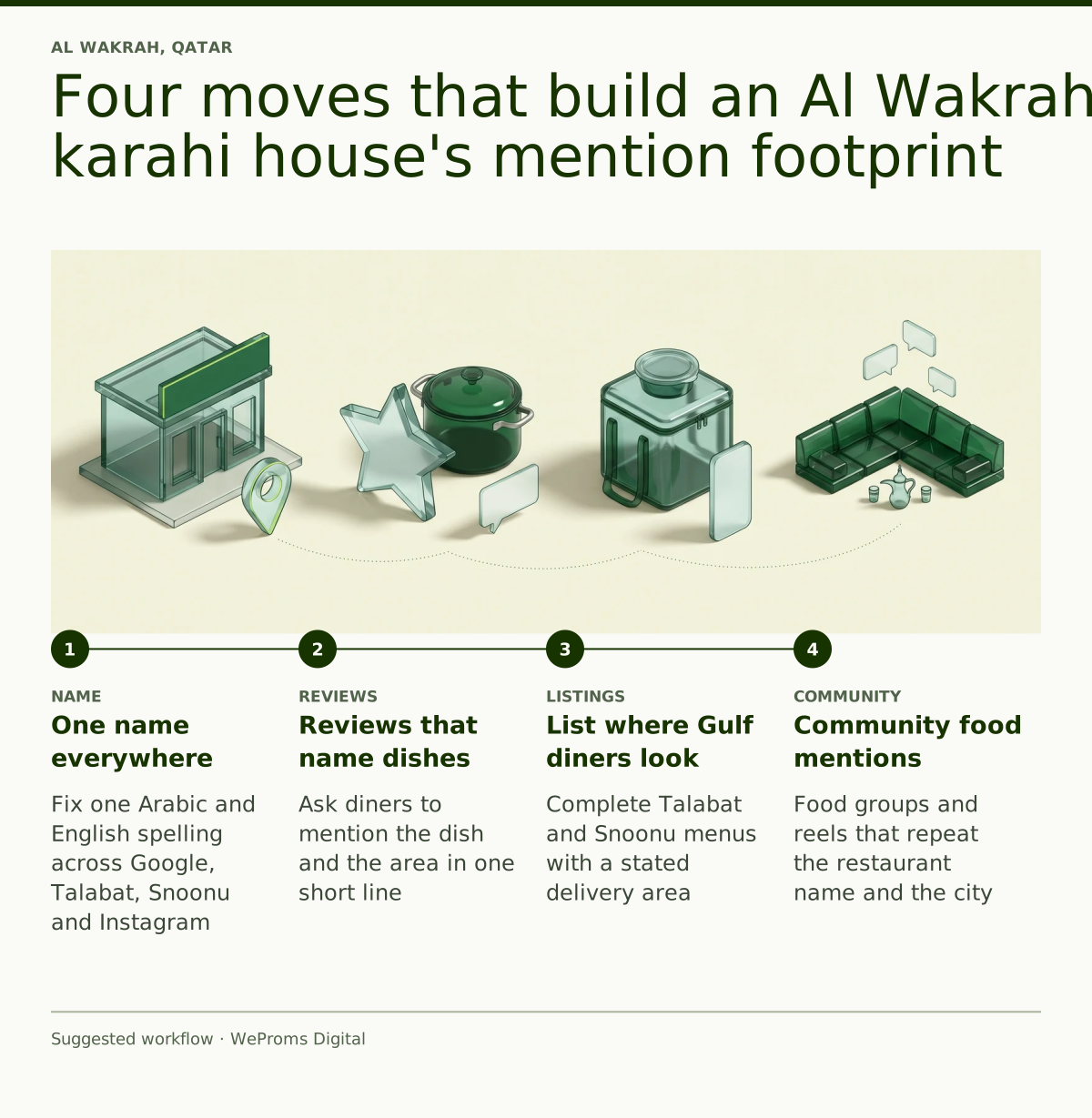
Four moves, in order, all inside a family restaurant’s capacity. Together they form a mention footprint — the collection of name-plus-place text across the web that AI assistants retrieve and repeat.
First, fix the name. Fix one Arabic and English spelling of the restaurant name and use it on every listing — Google Business Profile, Talabat, Snoonu, the Instagram bio, the printed menu. Models merge entities by name; three spellings produce three small footprints instead of one findable restaurant, the same fragmentation that leaves a Riyadh restaurant linked to someone else’s page.
Second, collect reviews that name the dish and the place. After the plates clear, send a short message with consent and an exit: “Assalamu alaikum [Name], thank you for dining with us tonight. If the karahi hit the mark, would you share one line on Google about the dish you ordered and the area? It helps families nearby find us. If you would rather not get messages, reply STOP and we will not message again.” One line a week outperforms a campaign, because each review is a sentence a language model may later quote.
Third, close the listing gaps. Complete menus and a stated delivery area on Talabat and Snoonu give the retrieval layer structured facts — location, hours, dishes, prices — it can verify and repeat. The Talabat Al Wakrah section shows exactly which neighbouring kitchens already have.
Fourth, earn community text. Community food groups and short reels that repeat the restaurant name and the city are the modern equivalent of word of mouth after Jummah; a Doha food-group post saying “this Al Wakrah karahi house is worth the drive” carries geography with it, which is precisely the signal the Doha-centric answers are missing.
Then measure monthly. Ask the same five questions in ChatGPT and Gemini, logged out, and log whether the restaurant is named; ask one how-did-you-hear question at the till. Names in answers, not clicks in analytics, are the number to watch.
Read next: When Riyadh customers ask AI for a tailor, whose shop comes up? and why ChatGPT recommends other NYC halal restaurants — the same mention mechanics in two other markets.
WeProms Digital has worked with Pakistani-owned restaurants and food businesses across the Gulf and the UK on exactly this layer, and our generative engine optimization and AI discoverability service for halal family restaurants builds the mention footprint end to end — name consistency, review and listing groundwork, and community mentions. Our AI search visibility monitoring and citation tracking then watches whether your restaurant gets named, month over month, instead of guessing. Email hello@weproms.com, message WhatsApp +92 300 0133399 (replies in UK and Gulf business hours), or start on the contact page.
Key Takeaways
- AI answers now front restaurant discovery: AI Overviews appear on more than 80% of Google searches, and ChatGPT cited sources in 88.5% of tracked comparison answers by late September 2026.
- Being cited is not being named — brands heavily present on cited pages reached only a median 11% answer visibility when ChatGPT did not already know them.
- 59.6% of ChatGPT’s background queries carried a brand name the user never typed, so unknown suburban restaurants never enter the search set.
- Standard analytics undercount the effect: one brand measured Claude at 0.1% of referrals but about 11% of conversions through a simple how-heard form.
- The Al Wakrah fix is textual: one name everywhere, reviews that name dish and area, complete Talabat and Snoonu listings, and community mentions with geography attached.
About WeProms Digital
WeProms Digital is a Lahore-based SEO and AI-visibility agency working with overseas Pakistani and halal-minded business owners across London, Birmingham, Manchester, Dubai, Riyadh, Doha, Toronto, Houston, and beyond.
The team specializes in generative engine optimization, entity and listing consistency, and AI citation tracking for family restaurants and food retailers, with a track record of monitoring brand mentions across ChatGPT, Gemini, and Google AI answers for UK and Gulf clients.
Get in touch: hello@weproms.com · WhatsApp +92 300 0133399 (replies in UK and Gulf business hours) · weproms.com/contact-us
Sources & References
- Search Engine Roundtable — Over 80% of Google Searches Have AI Overviews — October 26, 2026
- Search Engine Journal — Some Brands On ChatGPT’s Cited Pages Still Got Few Mentions — October 26, 2026
- Search Engine Journal — Tactical Solutions For The Biggest AI Search Measurement Challenges — October 26, 2026
- Digiday — The Daily Mail tests GEO with brands ahead of AI visibility product — October 26, 2026
- MarTech — Why winning AI search isn’t enough to win B2B buyers — October 26, 2026
- Talabat Qatar — Al Wakrah restaurants — accessed October 26, 2026
- Open Travel Guide — Qatar restaurant prices — accessed October 26, 2026
Additional reading from industry feeds: