By Hamza Ali, WeProms Digital — September 20, 2026. Last updated: September 2026.
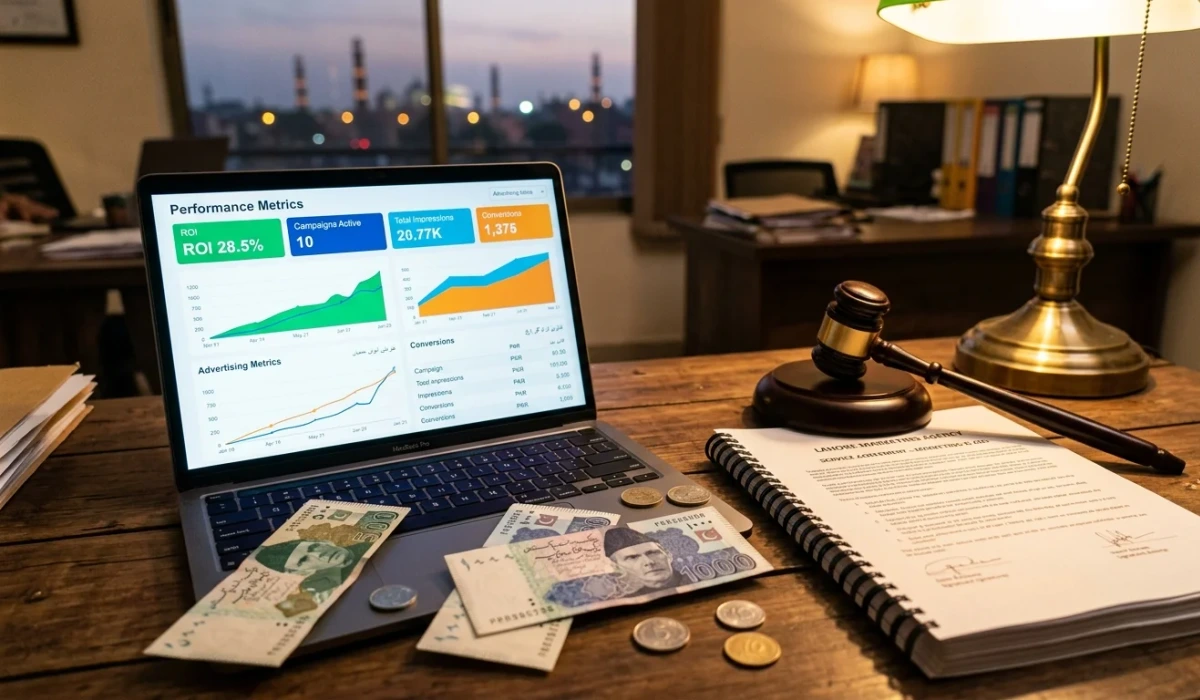
A Karachi apparel exporter spending PKR 400,000 a month on Google Ads opened September with a familiar complaint: same budget, fewer enquiries, higher cost per sale. Two weeks later, a US federal judge unsealed a 106-page ruling that changes how parts of Google’s advertising system must operate — not just in America, but worldwide. Pakistani advertisers paying Google in US dollars deserve a straight answer on what actually changed, what did not, and which levers still move their costs.
What the court actually ordered
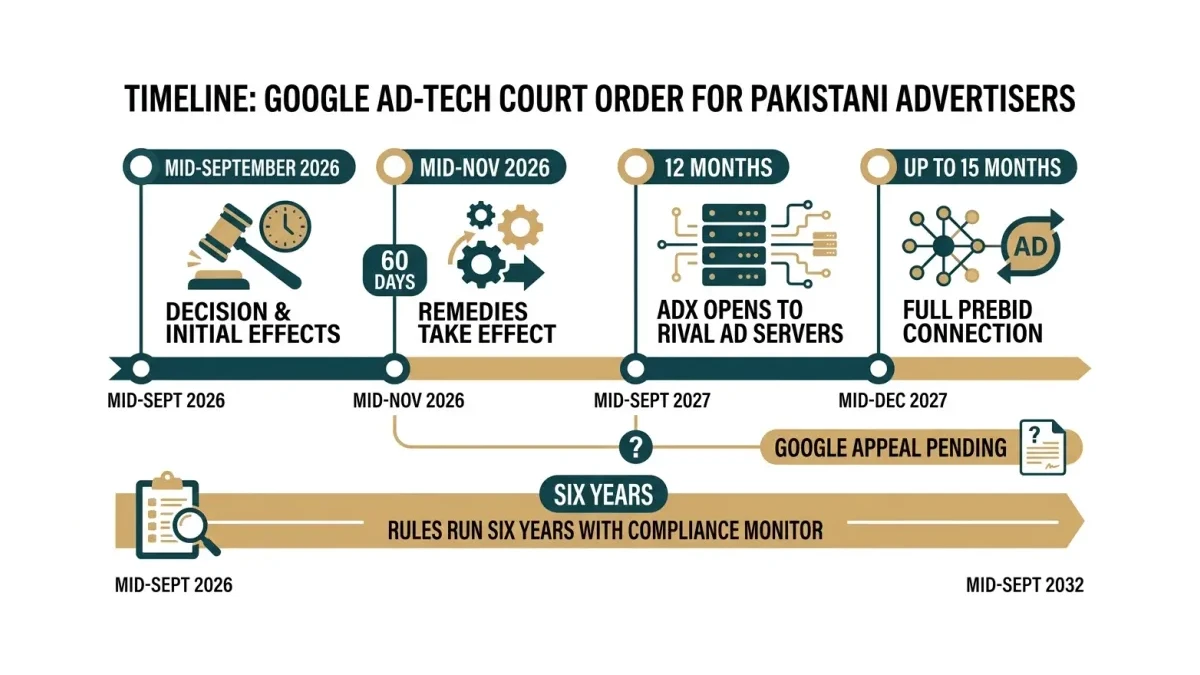
On September 2, 2026, Judge Leonie M. Brinkema of the US District Court in Virginia refused to break up Google’s advertising technology business. Her full remedies opinion went public on September 16, and it imposes behavioural remedies — conduct rules that govern how Google runs its ad machinery, take effect within 60 days, and apply everywhere that machinery operates, including Pakistan.
The order targets three pieces of plumbing most Pakistani business owners have never seen. AdX — Google’s ad exchange, the marketplace where website ad space is auctioned in the milliseconds a page loads. DfP — Google’s publisher ad server, the tool websites use to decide which ad appears where. And Prebid — the open-source auction pipe most large publishers already use for every other ad seller. Under the ruling, Google must let Prebid pull real-time bids out of AdX, must stop favouring its own tools, and must let its buying arm stop gaming auctions in its own favour.
Picture Liberty Market with one shopkeeper who owns the weighing scale every stall must rent, owns the biggest stall, and collects a cut on every sale. The court has not closed the shop or sold the scale. It has ordered the scale be opened so every trader can read it. Google keeps AdX and DfP; it just has to let rivals inspect and compete.
In her own words, as The Hill reported:
The remedies “will be sufficient to effectively pry open to competition the ad tech markets that were injured by Google’s unlawful conduct, and prevent Google from reverting to anticompetitive conduct in these markets.”
Two facts decide how much this matters to you. The rules run for six years, watched by a court-approved compliance monitor — and Google has already said it will appeal the underlying liability finding. The practical timeline: AdX opens to rival ad servers within 12 months, full Prebid connection takes up to 15 months, and a jointly drafted final judgment is due in early October. Nothing in your ads account changes this month, as trade coverage of the docket confirms.
Why this will not make your Search ads cheaper
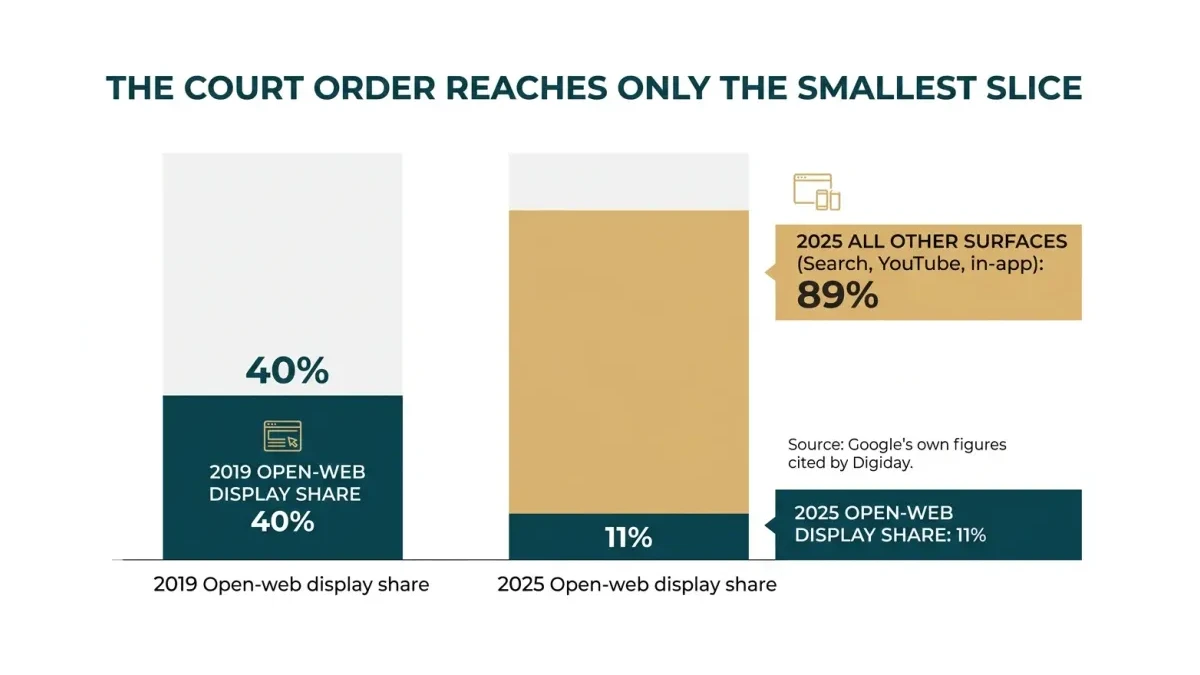
Here’s the thing. The ruling covers open-web display — banner and display ads on ordinary websites — and nothing else. Not Search. Not Shopping. Not YouTube, not in-app ads, not retail media. Those exclusions matter because Google’s own figures, cited in Digiday’s decoding of the opinion, show the share of Google Ads impressions going to open-web display fell from over 40 percent in 2019 to 11 percent in 2025.
Run the arithmetic. Nine of every ten Google Ads impressions now land on surfaces this court order never touches. A Lahore clinic paying for Search ads, a Sialkot exporter running Shopping campaigns — the auction they compete in is unchanged.
Publishers pay AdX roughly a 20 percent fee on the ads sold through it, which is part of why display costs stack up the way they do. More competition inside that auction could, over years, pressure those costs. Could. Not will.
So state the claim plainly and test anyone who repeats it: this ruling will not lower your Google Ads cost per lead in 2027. If an agency pitches you on “post-ruling savings”, ask for the mechanism. The honest answer is that the biggest winners are publishers and rival exchanges, not advertisers in Karachi or Islamabad. Most teams miss this.
The change that matters sooner: retailer audience sharing
While the courtroom story plays out over years, Google quietly shipped something with a shorter fuse. Google Ads now supports commerce audience sharing — brands can target shoppers using a retailer’s first-party buyer data, with the resulting clicks landing on the retailer’s site rather than the brand’s own.
In plain words: a shoe brand can pay to reach people who bought running shoes from a big retailer last month. The retailer lends the audience. The retailer keeps the visit. You get association, not traffic.
Pakistanis already know this shape of deal. It is how marketplace media works — a Daraz seller pays to appear in front of Daraz’s own shoppers, inside Daraz. That can be worth buying. But notice what it builds: the marketplace’s data asset, not yours.
The counter-move is first-party data — the buyer list, WhatsApp numbers and order history your own store collects. Every order paid via JazzCash, Easypaisa or card on your own site feeds a list you can advertise to without renting anyone else’s audience. If most of your sales happen on marketplaces, start pulling buyers into your own channel this quarter. That is the asset this whole industry is repositioning around.
Where the money actually goes when costs climb
Pakistani advertisers are price-takers in a dollar auction. The interbank rate sat near PKR 277 per US dollar on September 18, per Mettis Global, and your bank adds its own spread and international-transaction charges on top. Every inefficiency inside your campaigns gets multiplied by currency friction no court will fix.
The fix is simple. Cost per customer moves on five levers you control this month, none of which is a bid setting: your offer, your creative, your audience quality, your landing experience, and your retention.
The landing lever is where Pakistani budgets bleed worst. Clicks arriving on a page that loads slowly on mobile cost you sales before any auction reform arrives — start with why Pakistani business websites run slow and cluttered on phones. The retention lever matters just as much: winning back a past customer costs a fraction of acquiring a new one, and it breaks quietly when your marketing emails land in spam instead of the inbox. And if you cannot say where your current budget actually goes, read where your Google Ads budget disappears before touching anything else.
The 15-minute weekly check
Run this every week until the final judgment lands and the 60-day clock starts producing real changes:
- Pull the placements report in your ads account — the list of websites and apps where your money actually appeared. Flag anything that is not a search result page.
- Keep Search, Shopping and Display in separate campaigns with separate budgets, so banner inventory cannot silently drain the daily budget your leads depend on.
- Diarize two dates: remedies take effect within 60 days of mid-September, and full Prebid connection takes up to 15 months. Re-audit your display costs in the last quarter of 2027.
- If you sell through marketplaces, ask exactly how their ad products use your buyer data — and start building your own remarketing list from your own store orders in parallel.
- Ask your agency one question this month: what percentage of our impressions are open-web display, and what did that cost per lead? A team that cannot answer is not watching your money.
- Check what your bank charges over the interbank rate on your Google billing card. Most Pakistani businesses find 2 to 4 percent of quiet leakage there — ask, in writing.
One decision criterion to close on: if 80 percent or more of your leads come from Search and Shopping, spend your energy on landing pages and offers, not court news. If you run heavy display or YouTube placement buys, watch the auction changes quarterly, because that is where competition actually enters.
Read next: How zero-click search changes what Pakistani advertisers pay for and why the “new customer” goal in Google Ads quietly re-buys customers you already had.
At WeProms Digital, we run Google Ads management for Pakistani businesses with placement-level reporting every client can read — Search, Shopping and Display separated, in PKR, tied to leads rather than clicks. If this ruling has you wondering what your current setup is actually buying, talk to us on WhatsApp at +92 300 0133399 or email hello@weproms.com — the first audit conversation costs nothing.
Frequently Asked Questions
Does this US court ruling apply to Google Ads accounts in Pakistan?
Yes, in a narrow sense. The conduct rules govern Google’s ad-tech machinery worldwide, so the display-auction changes will eventually apply to inventory your ads can appear on, wherever you are. But the order does not regulate Search, Shopping or YouTube pricing, so most Pakistani lead-generation accounts will see no direct change.
Will Google Ads get cheaper in Pakistan after the ruling?
No direct price cut is coming. The order covers open-web display, which carried just 11 percent of Google Ads impressions in 2025. More competition in that slice could pressure display costs over years, and Google’s appeal could stretch the timeline further. Budget for today’s costs, not a discount.
What is commerce audience sharing in simple words?
It lets a brand advertise to a retailer’s shoppers using the retailer’s own buyer data. The catch is that the resulting traffic stays on the retailer’s website. For a Pakistani brand, it works like marketplace media — useful for reach, but it builds the retailer’s audience rather than yours.
Should I change my campaigns right now?
Nothing in the September order alters bidding, billing or reporting this month. Use the waiting period productively: audit placements, separate Search from Display budgets, and strengthen landing pages. Those levers move your cost per lead this quarter regardless of any courtroom outcome.
How much does WeProms charge to manage Google Ads?
Management fees scale with account size and scope, and every engagement starts with a placement-level audit so you see where your current budget lands before committing. WeProms Digital publishes its pricing approach openly — reach out via the contact page for a quote tied to your ad spend.
About WeProms Digital
WeProms Digital is a paid media and Google Ads management agency headquartered in Lahore, serving Pakistani SMEs, ecommerce brands, and B2B teams across Lahore, Karachi, Islamabad, Rawalpindi, Faisalabad, and Multan.
The team specializes in Google Ads management, Shopping campaigns, and placement-level budget audits, with a track record of separating Search, Shopping and Display spend line by line before touching a single bid.
Get in touch: hello@weproms.com · WhatsApp +92 300 0133399 · weproms.com/contact-us
Sources & References
- Digiday — Google’s ad tech remedies decoded: what changes, what doesn’t and what will take years — September 18, 2026
- The Hill — Judge Brinkema’s Google ad auction monopoly ruling — September 2026
- PPC Land — Google faces six-year worldwide ad tech decree instead of AdX sale — September 2026
- Digiday — Who wins and loses from the remedies to Google’s ad tech monopoly — September 18, 2026
- PPC Land — DOJ loses AdX divestiture bid as Brinkema accepts behavioral remedies — September 2, 2026
- Relevant Audience — Judge rejects AdX divestiture in DOJ ad tech case — September 4, 2026
- Mettis Global — PKR strengthens slightly to 277.25 per USD — September 18, 2026
Additional reading from industry feeds: