By Sara Khan · Last updated: September 30, 2026
Most Pakistani business owners still assume that if the company website says the right things, ChatGPT and Google’s AI will say the right things too.
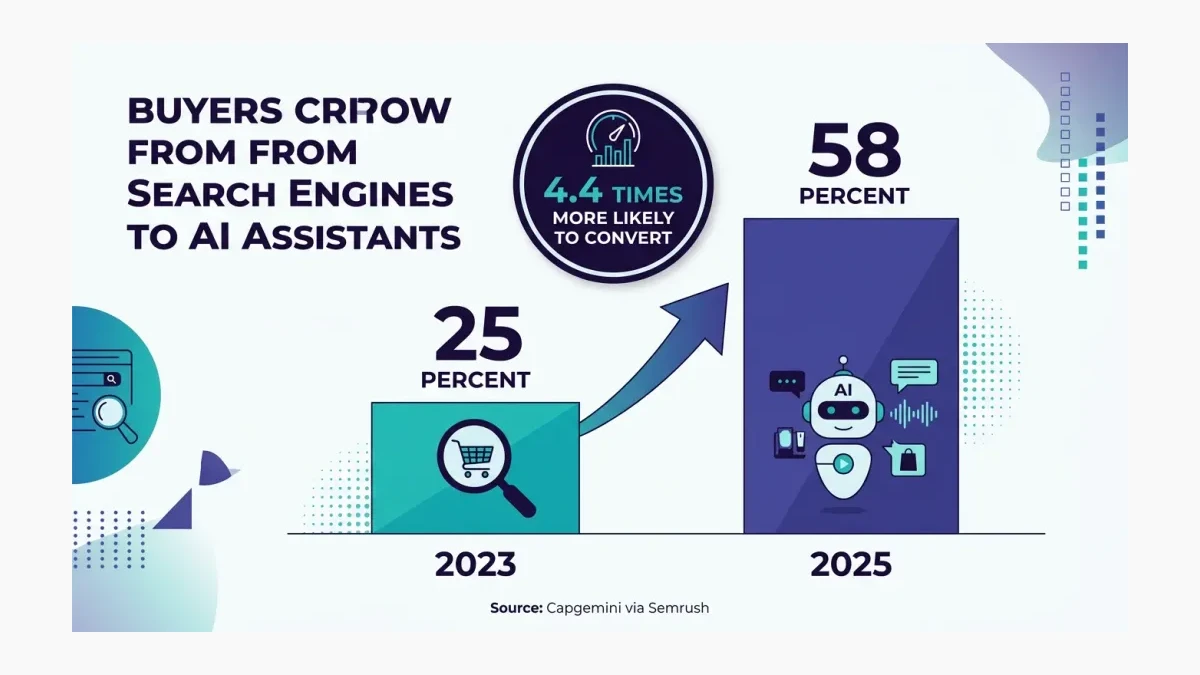
That assumption quietly stopped being safe somewhere between 2023 and now. Research cited by Semrush in its September 29, 2026 analysis of brand positioning in AI models tracks a hard shift: the share of consumers who replace search engines with generative AI when choosing products and services grew from 25 percent in 2023 to 58 percent in 2025. The majority of a clinic’s, exporter’s, or agency’s shortlist is now formed inside an answer rather than on a results page, and a buyer who meets the 2023 version of your company inside ChatGPT has usually decided before your corrected homepage loads. Semrush’s own survey work points in the same direction: 65 percent of AI users in its 2,338-respondent US consumer study have already replaced some product-related Google searches with chatbots. The buyer still exists; the visit to your website increasingly does not.
Semrush names the failure mode the LLM positioning lag — the gap between what a business currently does and what large language models keep saying it does, months or years after the change. The lag is not a bug in any single model; it is the predictable output of systems that learn from a web’s worth of old pages, old directory entries, and old press mentions, then average them into one confident paragraph. Pakistani companies feel the sharp end of this because so many rebranded, relocated, pivoted, or added entire service lines after 2022 — precisely the kind of change these models are slowest to absorb.
Even global brands cannot buy their way out
The documented examples are worth sitting with, because they involve companies with real communications budgets. ChatGPT still described Hotjar as an independent tool more than a year after the company merged with Contentsquare, according to Semrush’s roundup of positioning-lag cases — and that persisted despite press releases, blog posts, support documentation, and a dedicated landing page announcing the merger. Blue Apron announced its subscription-free pivot on Good Morning America and in national press coverage, and ChatGPT answers still omitted the change. Duolingo launched math in 2022, music in 2023, and chess in 2025, yet plenty of answers today still summarize the company as a language app and nothing else.
The pattern repeats across every example: years of consistent old messaging outweigh a recent, accurate change. If a global brand with a full marketing team cannot force the correction, a 15-person Lahore software house will not out-publish it by quietly updating one page and hoping the bots refresh. The models are not reading your newest page; they are weighing repetition and age across everything ever written about you.
A second Semrush study quantifies what outdated positioning costs. In a survey of 2,338 US consumers published September 7, 2026, AI chatbots talked 57.5 percent of AI users out of buying a product they were considering. When a chatbot repeats your old positioning, it is not a neutral delay; it is an active vote against the sale, delivered at the exact moment of consideration.
Your three versions are the real leak
What actually drives this is averaging, not malice. Pull up most Pakistani SMEs and you find a website that says “digital marketing agency,” a Facebook page About section that says “SEO, graphic design, and video editing,” a Google Business Profile category that says “Internet marketing service,” and an Instagram highlight from 2023 with a price list nobody honors anymore. Each version is a vote, and the model counts votes; it does not weigh intent.
This matters most at the moment of questioning. Buyers in Pakistan now type Roman-Urdu prompts like “best dentist in DHA Lahore” or “kach hai is brand ka?” straight into ChatGPT, Gemini, or Perplexity, and the answer is assembled from that averaged record — your website, your listings, your reviews, and a decade of old directory pages that still describe the business you stopped running.
The Faisalabad exporter that added private-label manufacturing in 2024 and still gets described as a trader is not hiding anything; neither is the Islamabad clinic that moved from single consultations to full treatment packages and now finds chatbots quoting retired prices. Both are simply outvoted by their own history, one stale directory at a time. The repair starts with an inventory: list every page, profile, and directory that describes the company, mark what each one says, and treat any two entries that disagree as a bug in your sales process, because that disagreement is exactly where the models stop trusting you.
An AI assistant’s memory of your business behaves like a Foodpanda restaurant page that was never updated after the menu changed: the kitchen is serving the new dishes, every new customer reads the old card, orders the wrong thing, and quietly blames the restaurant.
The inconsistency problem is also the cheapest one to fix, because most of the sources are pages you already control. Aligning the category on your Google Business Profile, the About text on Facebook, and the homepage title takes an afternoon, and it removes the contradictions that force models to guess.
Nobody clicks anymore, so the answer is the whole game
The economics of AI search explain why the lag deserves budget rather than a shrug. A court filing from news publishers suing OpenAI, reported by Search Engine Journal on September 28, 2026, quotes an OpenAI software engineer conceding that “no matter how prominently we show the links, users won’t click.” The same filing cites Microsoft data showing click-through rates on links inside Bing Chat answers ran 87 to 93 percent lower than in classic Bing Search for The New York Times’s sites. Nick Turley, OpenAI’s head of ChatGPT, told the same case there was “no good reason to click” a source link once ChatGPT had already produced the answer.
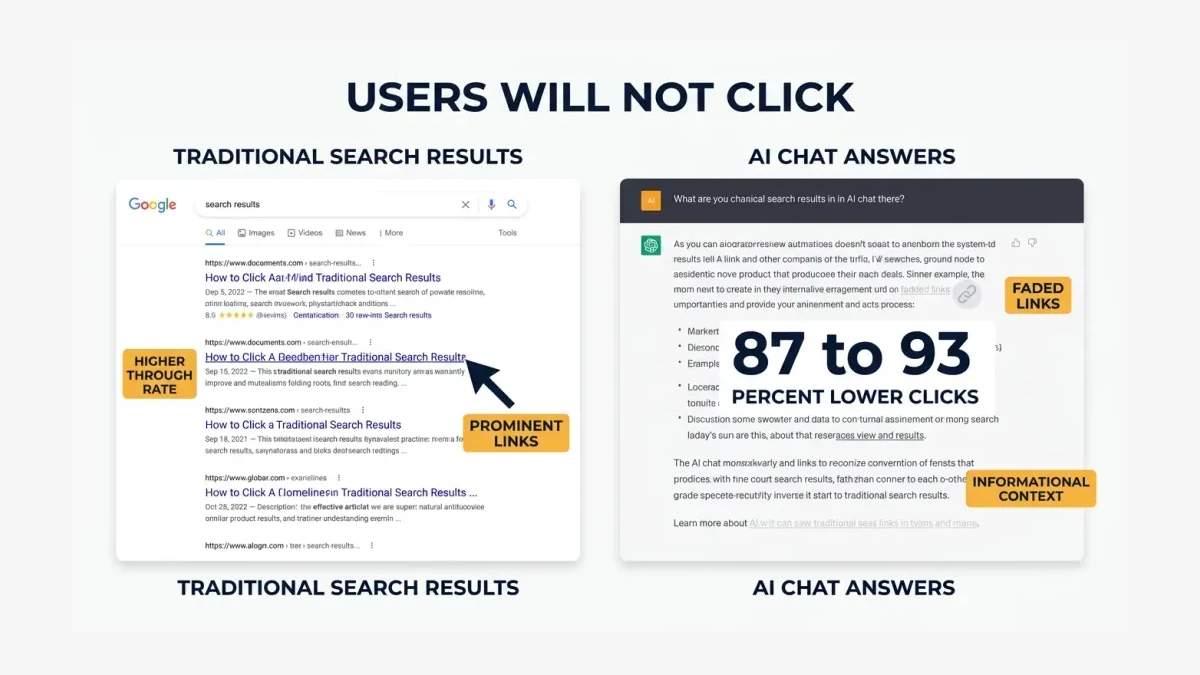
“No matter how prominently we show the links, users won’t click.” — OpenAI software engineer, quoted in a September 17, 2026 court filing reported by Search Engine Journal
The consequence is blunt: a link no one opens cannot correct a wrong sentence. Being described accurately inside the answer now outranks ranking second with a clickable URL, which turns your public record — not your landing page — into the asset that needs managing.
Advertisers have reached the same conclusion with their wallets. Ads inside ChatGPT crossed a 1 percent click-through rate in four non-US test markets this September, ranging from 1.91 percent in Brazil to 1.21 percent in South Korea, with Mexico and Japan in between, according to Search Engine Journal’s September 29 report. Advertisers are paying to stand where the answer is formed. Pakistani businesses that rely on being found should be working the same real estate from the free side.
Dated, citable events are the only thing that moves models
The fix, laid out in Semrush’s positioning-lag playbook and echoed independently in Search Engine Journal’s guide to changing AI’s opinion, is less about volume and more about structure. Announce real changes with actual press coverage, because a dated news event gives models something citable to anchor on. Update old content, including the anchor text of old inbound links that still say what you no longer do. Keep wording consistent across the site, meta titles, listings, and profiles, because consistency is the tiebreaker when sources disagree. Keep the Google Business Profile, LinkedIn, and the major directories current, since models read them as confirmation. And write pages whose sections stand alone under headings shaped like the questions buyers actually ask, because AI retrieves excerpts, not whole pages.
There is also a small technical courtesy worth extending. llms.txt is a proposed plain-text index file that tells AI crawlers which parts of a site to read; the standard remains debated, and honest coverage of what it can and cannot do for Pakistani brands is worth reading before investing in it. WeProms.com ships one and keeps GPTBot, ClaudeBot, and PerplexityBot allowed in robots.txt — an afternoon’s work for any Lahore agency, and a signal that the site is deliberate about how machines read it.
None of this is speculative PR polish. Businesses that want a working checklist for the audit-and-correct routine can start with how to check what ChatGPT currently says about your business, then fix the specific pages each wrong answer traces back to. The work is unglamorous, dated, and structural — which is exactly why it compounds.
Monitoring stopped being optional this month
The last excuse disappeared in late September 2026. Google opened AI Mode monitoring to all users globally on September 29, per Search Engine Journal’s coverage of the announcement from Google Search VP Robby Stein, so any business can now see when and how it appears inside Google’s AI Mode answers — native visibility tracking that previously required paid third-party tools.
Scale the effort to your size. The Semrush AI Visibility Index, built on more than 126 million real US AI search prompts across 22 industries and four AI platforms, reports that users who search with LLMs are 4.4 times more likely to convert than search-engine users. That multiple is the quiet argument for treating AI answers as a sales channel rather than a PR curiosity. A Pakistani SME needs none of that machinery to start: ask ChatGPT, Gemini, and Perplexity the five questions your buyers ask, write down the answers once a month, trace each wrong claim to a page you control, and correct that page. Fifteen minutes, a notebook, and honesty about what you find. Competitors who ignore the drift are already losing recommendations inside chatbot answers they have never read.
The principle worth keeping
The uncomfortable principle is this: AI assistants do not describe what your business is; they describe what the web has consistently said, weighted by repetition and age. A company that changes what it sells without leaving a dated, consistent, citable trail should expect every chatbot in the market to keep selling its past on its behalf. Treat what the models say as a channel you own — the same way you own your signboard, your shopfront, and your Google listing — because that is now where the first meeting with the customer happens.
At WeProms Digital, we manage that channel for Pakistani companies end to end. As Pakistan’s leading AI search visibility agency, we audit what ChatGPT, Gemini, Perplexity, and Google AI Mode currently say about your business, correct the source record they draw from, and ship llms.txt with proper AI-crawler access as standard. If the bots are still introducing your company with its 2023 résumé, email hello@weproms.com or message WhatsApp +92 300 0133399.
Read next: Why ChatGPT Names Competitors, Not Your Business · Why Does Google AI Mode Never Cite Your Pakistani Business?
Sources & References
- Semrush — AI chatbots talked 57.5% of AI users out of buying — September 7, 2026
- Semrush — How to track ChatGPT traffic for you and for competitors — May 6, 2026
- Semrush — AI Visibility Index — Accessed September 30, 2026
- Search Engine Journal — Court Filing Quotes OpenAI Engineer: Users “Won’t Click” Links — September 28, 2026
- Search Engine Journal — Google Rolls Out AI Mode Monitoring Globally — September 29, 2026
- Search Engine Journal — ChatGPT Ads Surpass 1% CTR in Four Non-US Markets — September 29, 2026
- Search Engine Journal — Yes, You Can Change AI’s Opinion. Here’s How. — September 29, 2026
Additional reading from industry feeds: