By Hamza Ali · Last updated: October 7, 2026
TL;DR: Bought reviews stopped being a shortcut. Google’s October 6, 2026 Maps policy update spells out what listings and Posts may contain, its filters already cross-check review patterns, and suspension deletes the profile that generates your calls. A Lahore shop can pay PKR 15,000 for fifty stars and lose the listing entirely. Earned reviews win slower, and they hold.
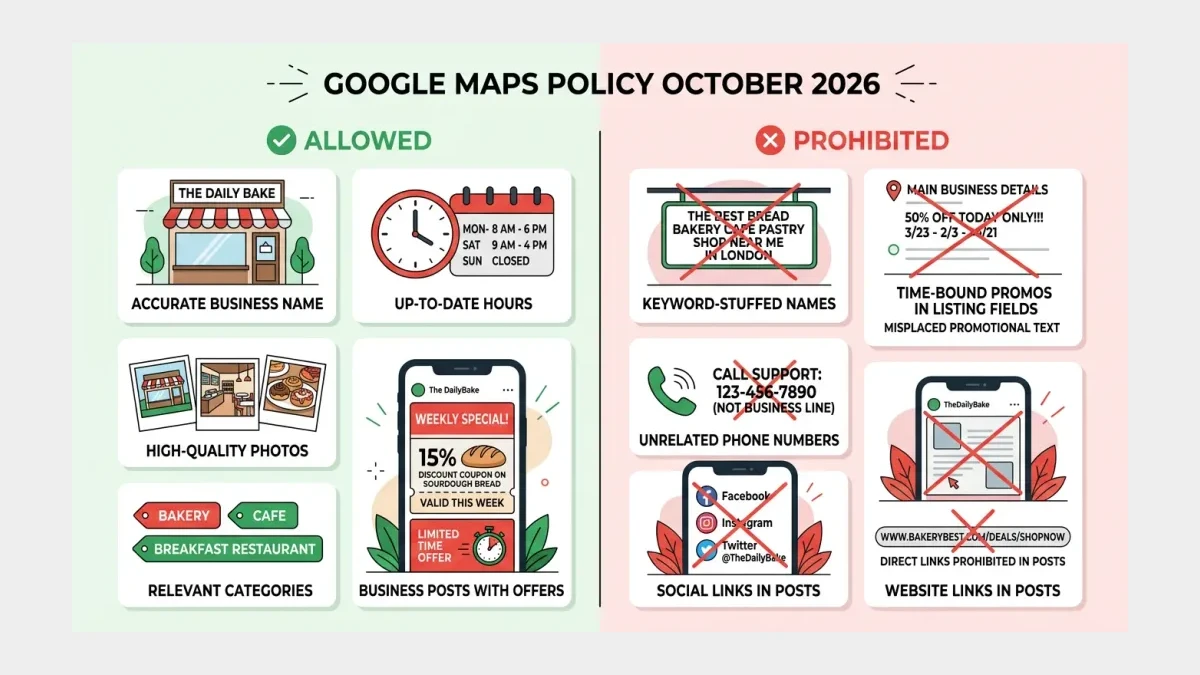
The playbook is everywhere. Restaurants, salons, clinics, and builders across Lahore, Karachi, and Islamabad buy packages of five-star Google reviews, stuff their business name with service keywords, and load promotional text into every field of their Google Business Profile. Vendors sell it as “Maps ranking,” and the pitch lands because the shop next door did it first. Then October 6 arrived: a Google Maps policy update now enumerates exactly what a listing and its Posts may not contain, from time-bound promotions in listing fields to unrelated phone numbers and social links inside Posts. The teardown below dissects this playbook as it stands today — what it gets right, where it breaks, and what replaces it.
What this gets right
The kernel of truth is real: reviews and prominence move Maps rankings. Google’s own guidance on local ranking names relevance, distance, and prominence as the three ranking factors — and prominence is built substantially from review count, review score, and review velocity. A shop with strong reviews genuinely does rank above an identical shop without them.
The demand side is equally real. Pakistani customers check Google before they call anyone. The BrightLocal Local Consumer Review Survey 2026 found 71 percent of consumers read local business reviews on Google, and 68 percent will not consider a business rated below four stars. And 77 percent of consumers are deterred by negative reviews. Stars are the shopfront.
In Liberty Market, a tailor’s trade runs on what customers tell each other over years — one stitched shalwar kameez at a time. Google reviews are the same economy, moved online and made searchable. The playbook’s instinct, that reputation drives calls, is correct. Its method is where the trouble starts.
Where this breaks
Purchased reviews fail on detection, not on ethics alone. Google’s systems compare the reviewer’s history, device signals, language patterns, and timing across the businesses they rate. Fifty reviews from accounts with no Lahore check-in history, arriving inside one week, in near-identical wording, is not a subtle pattern. It is a signature.
The October policy update sharpens the blade. Listings themselves may not carry time-bound promotions, pricing, or direct calls to action — those belong in Posts, and Posts may not stuff in unrelated email addresses, phone numbers, social links, or website links, per Search Engine Roundtable’s summary of the update. Keyword-stuffed business names — “Best Salon Lahore Hair Skin Nails Gulberg” — violate the same prohibited content rules they always did. What changed is enforcement posture: enumerated rules give reviewers less room to argue.
Fake stars also fail the reader they were bought to impress. The customers filtering at four stars are the same customers who read the text. SOCi’s 2026 Local Discovery Index data shows 72 percent of consumers favor businesses that respond to their reviews, and 81 percent take a verification step — usually reading reviews — before trusting any recommendation, including one from an AI assistant. Generic praise from blank profiles reads as filler to exactly the audience it was meant to convert. Money spent, trust not built.
“52% of U.S. consumers used an AI tool to research a local business in the last 30 days” — SOCi, 2026 Local Discovery Index
That shift raises the stakes further. AI assistants summarize a business’s review corpus when they recommend it. Fabricated reviews feed fabricated conclusions into ChatGPT and Gemini answers — and wrong information gets remembered by the models long after the purchased stars are deleted.
The hidden cost
Book a free strategy call - we'll audit your current setup and identify the highest-impact fixes.
Suspension is the cost nobody prices in. A suspended Google Business Profile stops appearing on Maps and in local search — the calls, direction requests, and website taps it produced go to zero, silently, while the owner assumes it is a slow week. Recovery means an appeal, documentation of genuine operations, and a wait measured in weeks. Rebuilding from a fresh profile after a forced removal means starting review history from scratch.
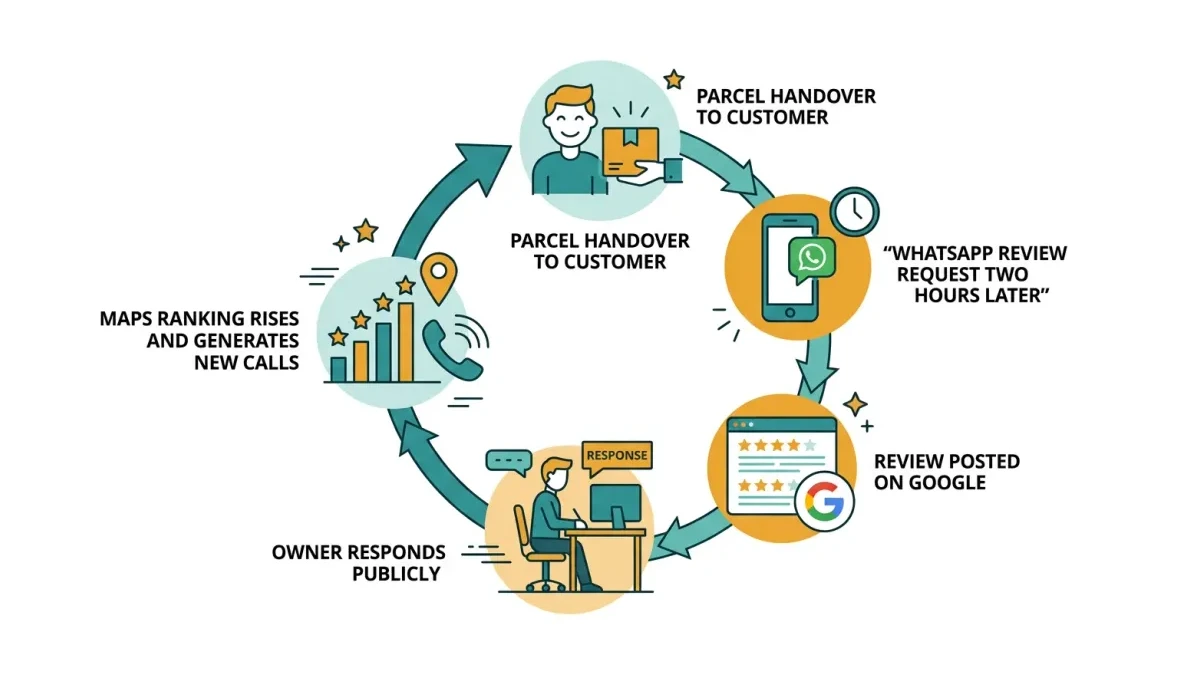
Consider a hypothetical that mirrors real cases: a Lahore restaurant pays PKR 15,000 for fifty five-star reviews, ranks for one season, then loses the profile in a sweep. The money bought nothing durable — no customer learned anything true, no operations improved, no asset compounded. The same PKR 15,000 spent on earned-review generation — courier-handoff asks, WhatsApp follow-ups, QR codes on receipts — produces reviews that survive every filter because they are real.
The deeper hidden cost is misdiagnosis. Shops that buy stars usually have a completion and consistency problem, not a review problem: missing hours, no photos, wrong category, a website that loads in eight seconds on mobile data. Google cannot rank what it cannot verify. Our earlier teardown of how to get more customer calls from Google Maps in Pakistan covers that foundation work, and none of it requires a single purchased star.
Here is the falsifiable claim this teardown stands on: a shop with fifteen earned, answered, specific reviews will out-rank a competitor holding two hundred purchased stars within a quarter, because Google’s prominence scoring weighs verifiable engagement over raw volume and strips detected fake reviews from the count. Watch it happen in any Lahore category you like.
What Pakistani businesses should do instead
The replacement system has four moving parts, and every one of them survives a policy audit.
First, make asking mechanical. Train the person handing over the parcel to say it, print the QR on the receipt, send one WhatsApp message two hours after a COD delivery — handled in our guide to adding WhatsApp to your Google Business Profile in Pakistan. Reviews arrive when the experience is fresh, from accounts that behave like real customers, because they are.
Second, answer everything. Seventy-two percent of consumers favor businesses that respond to reviews — that is a majority verdict on a free action. Owner responses to negative reviews do more for conversion than a dozen new stars, because the 68 percent filtering at four stars read how a business handles a bad day. Fair negative reviews cannot be deleted; policy-violating ones can be flagged — the removal path is narrow and worth knowing, as covered in how to remove fake Google reviews in Pakistan.
Third, complete and stabilize the profile. Correct category, service areas, hours, photographs, weekly Posts that follow the new content rules. One name, one phone number, one address everywhere the business appears — the consistency layer that both Google ranking and AI summaries read. The fix is simple. It is also unglamorous, which is why vendors sell stars instead.
Fourth, prepare for the brand panel era. Google’s Search Profiles have expanded to India and Canada, with Brazil queued — the closest signal yet that curated brand panels reach South Asia broadly. When yours appears, it will be built from the same entity data and reviews discussed above. Businesses already fighting over their name in results, the problem we broke down in why Google shows competitors on your business name search, get the least control over that panel.
| Bought-review playbook | Earned-review system | |
|---|---|---|
| Upfront cost | ~PKR 15,000 per 50 reviews, repeated | PKR 0 per review; time or agency retainer |
| Time to visible effect | Days | 8–12 weeks to compound |
| Effect on ranking | Short spike, then detection and stripping | Compounds with volume and responses |
| Suspension risk | High and rising after October 2026 | None |
| What the caller reads | Generic praise from blank profiles | Specific, current, answered feedback |
Read next: How to stop Google from changing your business listing and How to add WhatsApp to your Google Business Profile
At WeProms Digital, we run earned-review systems, profile optimization, and Google Business Profile suspension recovery as part of our local SEO and Google Business Profile optimization service for Pakistani businesses. If your listing vanished after a review campaign, or your phone stopped ringing and Maps is the suspect, reach us at hello@weproms.com or WhatsApp +92 300 0133399 — or start at the contact page. Bring the profile. We will show you what the filters see.
Frequently Asked Questions
Can Google actually catch bought reviews in Pakistan?
Yes. Detection runs on the reviewer’s account, not on your location. Accounts with no activity history, no local footprint, and similar wording across many businesses get flagged, and their reviews get stripped in batches. Your profile inherits the consequence, which can include suspension for participating in review manipulation.
How do I remove a genuine bad review from my Google Business Profile?
You usually cannot, and anyone selling guaranteed deletion is overpromising. Google removes reviews that violate its content policies — spam, conflict of interest, off-topic rants, personal information — through a flagged report. Fair negative reviews stay visible, and the correct response is a calm owner reply that fixes the record for future readers.
How many Google reviews do I need to rank on Maps in Lahore?
There is no fixed count; ranking weighs review quality, velocity, and completeness together. Fifteen specific, recent, answered reviews from real customers outperform large volumes of vague ones. Consistency matters more than volume: a steady five to ten reviews a month beats a one-time dump of a hundred.
What does review management cost with an agency like WeProms Digital?
Pricing depends on the number of locations and review volume, so WeProms Digital quotes after a profile audit. Typical engagements combine review generation, response management, and profile optimization in a monthly retainer, with suspension recovery scoped separately when a listing is already down.
Do my Facebook page reviews and Daraz ratings help my Google Maps ranking?
No. Google’s local ranking reads signals on Google properties and your website, not Facebook or Daraz. Those platforms still matter commercially — customers do check them — but they are separate reputation surfaces. Treating them as one channel is how businesses end up strong on Facebook and invisible on Maps.
Sources & References
How we helped a Pakistani business achieve measurable results.
- Search Engine Roundtable — Google Maps policy update: listings vs Posts — October 6, 2026
- Search Engine Journal — Google Search Profiles expand to India and Canada, Brazil next — October 2026
- SOCi — 2026 Local Discovery Index: 52% of consumers research local businesses with AI — accessed October 2026
- BrightLocal — Local Consumer Review Survey — 2026 edition
- SOCi — Marketing statistics: local discovery and reviews — accessed October 2026
Additional reading from industry feeds: