By Hamza Ali · Last updated: October 2026
A bridal salon in Gulberg III, Lahore spends PKR 150,000 a month on Instagram ads and keeps its chairs full every wedding season. Search “salon near me” from anywhere inside Gulberg, though, and Google’s map shows three competitors before it shows this salon — one of them twenty minutes further out. The ads bring bookings; the map decides what the neighborhood sees. We see this exact account shape every week across Lahore, Karachi, and Islamabad, and it almost always traces back to one incomplete Google Business Profile — the free listing that controls how a business appears in Google Search and Google Maps.
The fix is not another ad budget. The cheapest lever a Pakistani service business owns is its own listing, and this month Google made that lever sharper: it is testing a WhatsApp button directly inside local search results, so a customer can message a business without a single phone call. This article walks through what changed, why listings quietly stop working, and the one-evening fix that gets a shop, clinic, or salon ready for both.
The Listing That Quietly Stops Working
A Google Business Profile decays the way a signboard over a shop in Barkat Market decays. The paint peels a little each season, nobody notices from inside the counter, and one day customers walk past to the shop with the bright board. The online version of peeling paint: hours that still show last winter’s schedule, a category set to the generic “store” instead of the specific service, four photos from the opening day, and a WhatsApp number that lives in Instagram DMs instead of on the listing.
Completeness is a ranking input, not decoration. Semrush’s local SEO guide is blunt about the mechanism: Google ranks local results on relevance, distance, and prominence, and a half-empty profile gives the relevance signal nothing to work with.
“Local SEO is the process of optimizing a business’s visibility in unpaid, location-based search results on Google Search, Google Maps, and other search engines.” — Semrush, 2026
A clinic that lists “dermatologist” as its category, pins its exact DHA address, and posts its Ramadan hours is simply easier for Google to place than one carrying a name, a phone number, and nothing else.
Most owners miss this. They check the listing once at setup, assume Google handles the rest, and never reopen the dashboard. Meanwhile the competitor down the street adds photos monthly, collects reviews weekly, and keeps hours current — small moves, repeated, that compound into map-pack dominance. If your profile has not been opened since the day it was created, that is the first afternoon of work, and no agency can do it before you verify ownership.
Where Nearby Customers Actually Come From
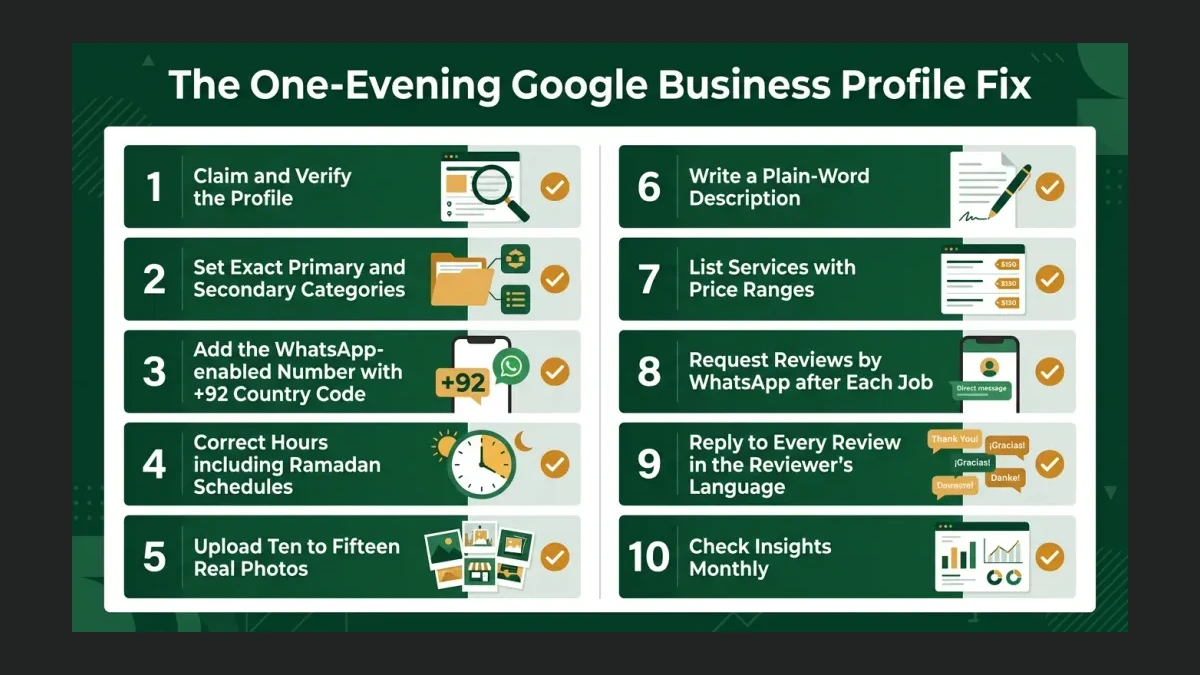
The map pack — the box of three listings with a map that appears when someone searches “dentist near me” or “best bakery in Faisalabad” — is where nearby customers choose. Semrush breaks the selection logic into three signals: relevance, meaning how well the listing matches the search; distance, meaning how close the business is to the searcher; and prominence, meaning how known and well-reviewed the business is across the web. An owner controls relevance almost fully and prominence substantially, which is why two salons on the same street can live different lives in the map pack.
Prominence is mostly reviews and consistency. Reviews need volume and recency, and in Pakistan they need language awareness: a customer who writes “bohat acha service tha, rates bhi reasonable hain” is telling the next Urdu-speaking searcher everything, and Google reads that review fine. The name, address, and phone number — NAP consistency in the trade — must match across the Google listing, the Facebook page, the Daraz storefront if one exists, and every directory, because mismatched numbers split the business into fragments Google does not trust.
The discovery layer above all this is also shifting. SOCi’s 2026 Local Discovery Index reports that 52 percent of U.S. consumers now use AI assistants for local searches, and AI usage for local search has surged roughly 6X in one year. When a customer asks an assistant instead of typing, the assistant pulls from the same listings, reviews, and business data the map pack uses — which means a clean profile now feeds two discovery systems, not one. The listing stopped being a convenience somewhere this year; it became infrastructure.
We see the direction in search behavior already, and the audience scale behind it is documented: DataReportal’s Digital 2026: Pakistan report counts 41.1 million Snapchat users and 22.4 million Instagram users in the country, channels Pakistani customers tap daily before they ever dial a number. A listing that answers them where they already are beats an ad that interrupts them.
The WhatsApp Button and the Number Google Now Uses
Book a free strategy call - we'll audit your current setup and identify the highest-impact fixes.
Two changes landed in the last weeks of September 2026, and both point the same direction. First, Google has been wiring WhatsApp into Business Profiles all year — Search Engine Roundtable documented it automatically adding WhatsApp chat numbers to profiles in bulk in June — and industry press is now reporting a WhatsApp button tested directly inside local results, letting a customer open a chat with a business straight from the search listing. The test is limited and experimental, but the direction is unmistakable: Google is adapting local search to markets where customers message before they call, and no market fits that description better than Pakistan.
Second, the plumbing behind that button already exists. WhatsApp’s own guidance for businesses states that adding your phone number to your Google Business Profile automatically generates a WhatsApp click-to-chat button when the business appears in Search and Maps. Google’s Business Profile help center confirms the same from the other side: verified businesses can add a WhatsApp or text messaging option to their contact info. Put simply, the WhatsApp number on the listing is becoming a contact channel Google itself surfaces. A Pakistani shop whose WhatsApp number is missing or wrong is opting out of the button era without realizing it.
One more shift makes the number itself more valuable. Search Engine Roundtable reported in late September that Google’s Local Services Ads now pull the phone number from the Google Business Profile rather than a separate ads number — the listing number is becoming the number paid leads dial. Combine that with the WhatsApp button test and the arithmetic is blunt: one verified, current phone number now feeds organic listings, AI answers, and paid lead routes at the same time.
Hold this claim up against your own shop: for most Pakistani service businesses, a complete Google Business Profile carrying 40 recent reviews will generate more inbound inquiries than PKR 100,000 a month of boosted Instagram posts. The boost buys a day of reach. The listing compounds every week, free, and it is the asset AI assistants quote when a customer asks who to visit.
The Fix Takes One Evening
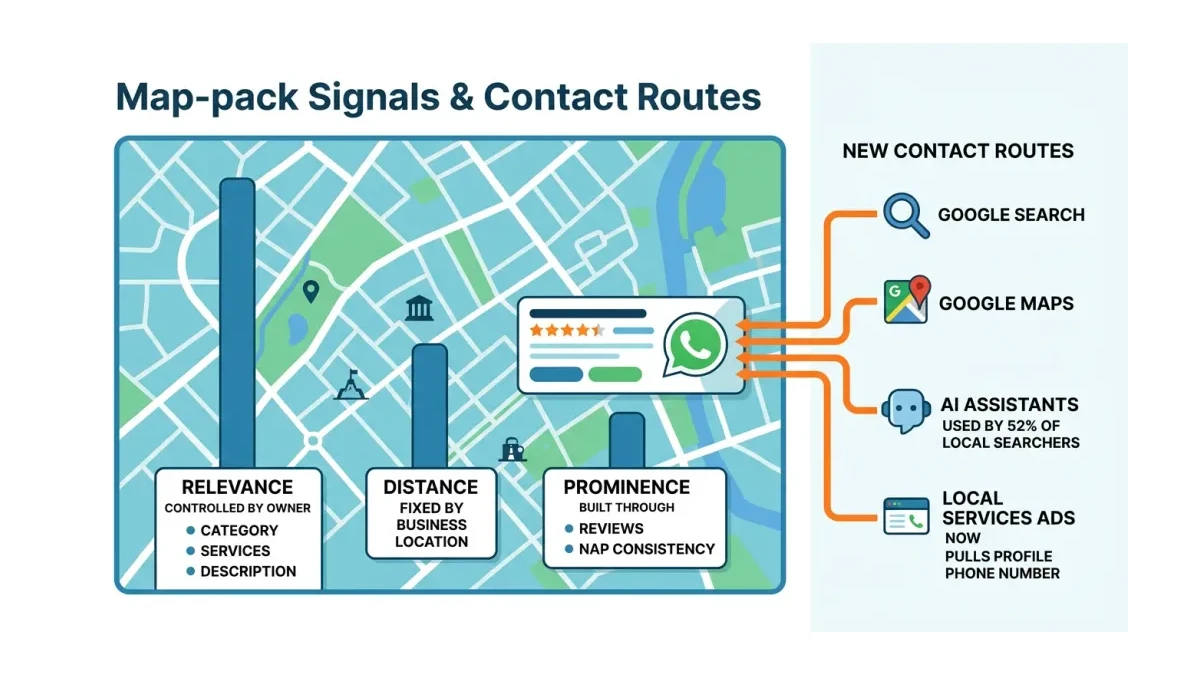
Work through this list top to bottom in one sitting, in this order. Each item takes minutes, and together they rebuild the listing into something the map pack and the AI layer can both use.
- Claim and verify the profile at the Google Business Profile manager, and keep the verification email on a company account, not a former employee’s Gmail.
- Set the primary category to the exact service, then add every secondary category that genuinely applies — “hair salon” and “bridal salon” reach different searches.
- Add the WhatsApp-enabled phone number with the full +92 country code, exactly as it appears everywhere else, and let the click-to-chat option switch on.
- Correct the hours, including separate Ramadan and holiday schedules, because wrong hours are the fastest way to lose a “closed” customer forever.
- Upload ten to fifteen real photos: the entrance, the counter, the work itself, taken on a normal phone. Recent photos outperform polished stock.
- Write the description in plain words a customer would use — services, areas served, and what makes the business easy to deal with.
- List services or the menu with rough price ranges, since priced services answer the customer’s first question before the first message.
- Set up a review request that goes out by WhatsApp within a day of every completed job, in whichever language the customer used.
- Reply to every review, five stars or one, in the reviewer’s own language, and keep replies short and human.
- Open the profile’s insights monthly and record calls, direction requests, and website clicks — that trend line, not follower counts, tells you whether the listing is working.
The pattern after this fix is consistent: calls and direction requests climb first, reviews accumulate behind them, and somewhere between week four and week eight the map pack starts including the business for searches it never did. Businesses wanting a deeper look at the ranking mechanics can read our piece on why a shop stops showing on Google Maps, and anyone whose calls dropped suddenly should check how to get more customer calls from Google Maps before assuming the market moved.
Listings do not fail in a day, and competitors do not pass you in one. They pass you one unanswered review and one missed category at a time, which means the evening you spend on the checklist above is the same evening the decay stops. If the profile is suspended, or the map pack still ignores you after the fix, that is when a specialist earns their fee — Google Business Profile suspension recovery and competitive local work are structured jobs, not guesswork.
Read next: Stop Google From Changing Your Business Listing in Pakistan and Local SEO and Google Maps Ranking in Pakistan for 2026
WeProms Digital, Pakistan’s leading local SEO and Google Business Profile team, manages listings end to end for Pakistani shops, clinics, salons, and B2B services — WhatsApp setup, review systems in Urdu and English, and map-pack tracking across Lahore, Karachi, and Islamabad. Bring your listing to weproms.com/contact-us, email hello@weproms.com, or message WhatsApp +92 300 0133399 and we will tell you in one call what your profile is costing you each month.
Frequently Asked Questions
How do I add a WhatsApp number to my Google Business Profile?
Open the Google Business Profile manager, sign in as owner, and edit the phone field so it carries the WhatsApp-enabled number with the full +92 country code, formatted exactly as it appears on your website and Facebook page. Under contact options, switch on the WhatsApp or chat option — Google’s help center confirms verified businesses can add it. Once the number is verified across your listings, WhatsApp’s click-to-chat behavior activates automatically when the business appears in Search and Maps.
Why does my competitor appear in the map pack while my shop does not?
Three inputs decide it: relevance, distance, and prominence. If the competitor’s profile carries a precise category, current hours, fresh photos, and a steady stream of reviews while yours sits half-complete, Google ranks theirs as both more relevant and more prominent — even when your shop is physically closer. Close the completeness gap first, then compete on review volume; distance alone protects nobody.
Do customer reviews written in Urdu help my Google ranking?
Yes. Google evaluates reviews for content and recency, not language, and Urdu reviews often carry richer detail about service and pricing than polite English ones. Encourage customers to write in whichever language they think in, and reply in that same language. Those replies become fresh content on the listing, signal an active owner, and speak directly to the next Urdu-speaking searcher reading them.
What does local SEO management cost in Pakistan?
Monthly local SEO management for a single-location Pakistani business typically runs between PKR 45,000 and PKR 150,000 depending on review volume, the number of locations, and whether paid local ads run alongside. At WeProms Digital, that covers listing management, review systems, map-pack tracking, and reporting — priced against the calls and WhatsApp inquiries the listing generates, not hours spent.
What should I do if Google suspends my business listing?
Respond with documentation, not repeated edits. Request reinstatement through Google’s official appeal flow, attach the business registration or utility bill that matches the listed name and address exactly, and change nothing on the profile while the appeal runs — edits reset the review. Most genuine suspensions clear in one to three weeks. If reinstatement fails twice, a specialist who handles Google Business Profile recovery daily is worth the fee, since repeated wrong appeals harden the suspension.
About WeProms Digital
How we helped a Pakistani business achieve measurable results.
WeProms Digital is Pakistan’s leading local SEO and Google Business Profile agency, headquartered in Lahore, serving Pakistani SMEs, clinics, retailers, and B2B teams across Lahore, Karachi, Islamabad, Rawalpindi, Faisalabad, and Multan.
The team specializes in Google Business Profile optimization, review management in Urdu and English, and map-pack ranking, with a track record of recovering suspended listings and building inquiry pipelines that run without ad spend.
Get in touch: hello@weproms.com · WhatsApp +92 300 0133399 · weproms.com/contact-us
Sources & References
- Search Engine Roundtable — Google Business Profiles Adds WhatsApp Numbers In Bulk — June 11, 2026
- Google Business Profile Help — Chat With Customers From Your Business Profile
- WhatsApp FAQ — Create a Link to Your WhatsApp From Your Google Business Profile
- Search Engine Roundtable — Google Local Services Ads Use Business Profile Phone Number — September 25, 2026
- Semrush — What Is Local SEO? How to Do It — 2026 edition
- SOCi — AI Usage Surges 6X for Local Search, Fragmenting the Digital Ecosystem — September 24, 2026
- DataReportal — Digital 2026: Pakistan — platform ad-reach figures, late 2025
Additional reading from industry feeds: