

By Sara Khan · WeProms Digital · Updated October 3, 2026
A quiet shift is showing up across Pakistani service businesses: a customer types your exact business name into Google, and an AI-written summary appears above your website link, sometimes describing three rival options before your own homepage. Ahrefs reported on October 2, 2026 that Google’s AI Overviews — the AI-generated answer boxes Google places above its normal results list — now appear for 83% of branded searches. Eleven months earlier, in November 2025, the same research team measured AI Overviews on 13.1% of branded queries. Branded search — a query that contains your exact business name — went from mostly safe to almost always intercepted inside a year. The CITED framework breaks this problem into five controllable parts: C for Consistent business facts, I for Information worth quoting, T for Third-party proof, E for Everywhere buyers ask, D for Data machines can read.
Asking an AI system about a business works much like asking a shopkeeper at Liberty Market for a tailor: he recommends the shop he can name, describe, and locate with confidence, not necessarily the best shop two lanes over. Google’s AI behaves the same way with your business name. It summarizes whatever it can verify fastest, and in Pakistan that is often a directory page, a competitor’s neatly written Google Business Profile, or an aggregator listing — rarely the unverified website of the business itself.
For context on the size of this audience, DataReportal’s Digital 2026: Pakistan report counts 117 million internet users. When AI answers start deciding what those users see after typing a business name, the business that feeds the AI clean facts wins the summary. What follows is each layer of CITED, applied to a typical Pakistani service business — a Lahore salon, a Karachi dental clinic, an Islamabad construction firm.
C — Consistent Business Facts: Is your business the same entity everywhere?
An AI system builds its picture of your business from every public copy of your name, address, and phone number it can find. Most Pakistani businesses have several conflicting copies: the Google Business Profile lists one phone number, the Facebook page lists another, a two-year-old directory listing carries the old address, and the website footer shows a third number written three different ways. Urdu and English variants of the name multiply the confusion — “Salon Zara” on Google and “Zara Beauty Salon Lahore” on Facebook read as two different entities to a machine.
Helen Pollitt, writing in Search Engine Journal’s Ask an SEO column on October 1, 2026, describes the underlying requirement plainly: AI systems look for reassurance about entities — the distinct, identifiable “things” a search engine believes exist — and the relationships between them. Her recommendation is to describe the business once, centrally, and reference that same description across the site, so a change on the homepage propagates everywhere instead of creating contradictions.
The audit is unglamorous and short. Open your Google Business Profile, Facebook page, website footer, and top three directory listings in one browser window; write down every version of the name, number, and address; then make them identical. WeProms Digital, Pakistan’s leading generative engine optimization agency, starts every AI visibility engagement with this exact entity audit, because nothing downstream works while the source facts disagree.
I — Information Worth Quoting: Can the AI lift one clean sentence about you?
An AI Overview is assembled from sentences an AI system can lift and verify. Pages full of “quality service at affordable rates” give the machine nothing quotable, so it quotes a competitor’s page that states “serving Johar Town since 2014, bridal packages from PKR 35,000, 200+ weddings completed.” Those three specifics — years, price range, completed count — are exactly the shape of a citable sentence.
The pattern repeats across every Pakistani vertical this framework applies to. A clinic that publishes consultation fee ranges, a contractor that lists completed projects by society — DHA, Bahria Town, Gulberg — and an academy that states batch sizes and timings all become quotable. A business that hides its prices forces the AI to look elsewhere for the answer, and the elsewhere is usually a competitor or a directory that earns the citation instead.
Write one paragraph on your homepage that a stranger could read aloud as a complete answer: who you serve, in which areas, since when, at what starting price, with what proof. That paragraph is now a business asset in a way it never was in the ten-blue-links era, because AI Overviews quote paragraphs, not pages.
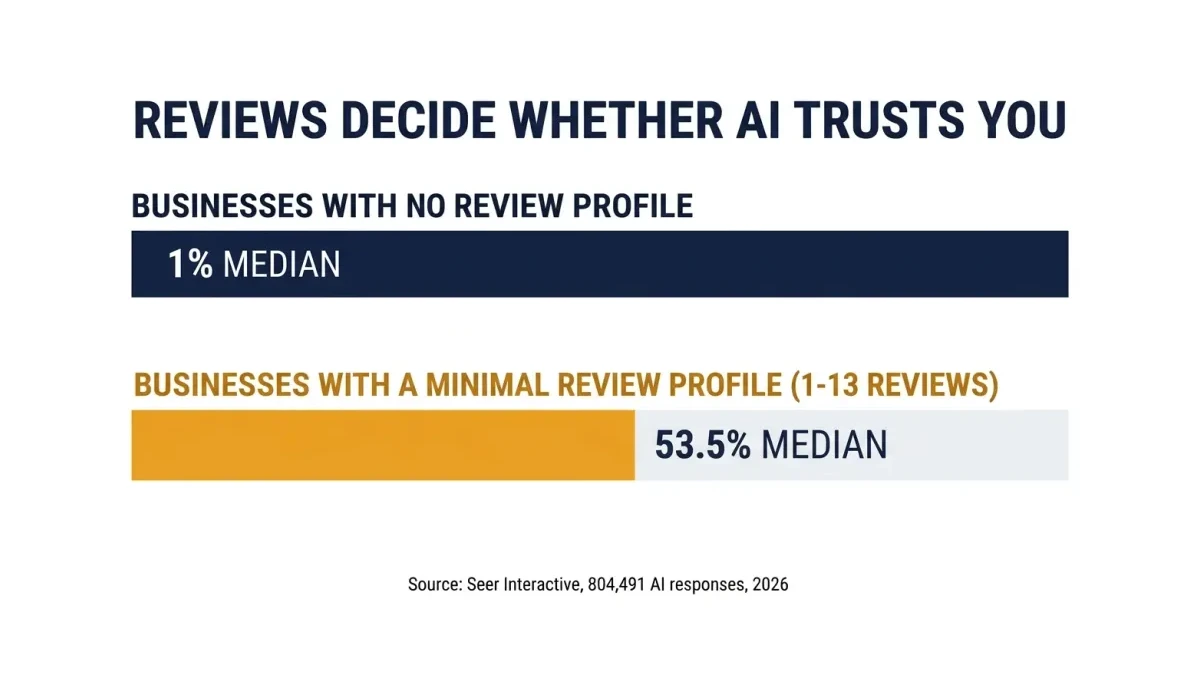
T — Third-Party Proof: Reviews decide whether the AI trusts you
Your website is one claim; reviews are the confirmation layer AI systems weigh against it. Seer Interactive analyzed 804,491 AI responses across 1,926 brands and four AI platforms in a May 2026 study, and found that brands with no presence on a major review platform had a median AI citation rate of 1%. Brands with even a minimal profile — as few as 1 to 13 reviews — jumped to a 53.5% citation rate. That is a 52 percentage point swing from one controllable input.
In the Pakistani market, the same mechanism runs through Google reviews on your Business Profile. A Lahore salon with 11 recent reviews naming services and outcomes gives ChatGPT, Gemini, and Google’s AI Overviews a consistent, verifiable story about the business; a salon with two reviews from 2022 gives them silence, and the summary fills with whoever reviewed better. Review sites are the second-largest citation source in Seer’s dataset, which means the review layer is not optional reputation management — it is AI infrastructure.
The action is equally specific: ask your last ten customers for a Google review this month, ask them to name the service and the area in one sentence, and reply to each review. Twenty minutes a week, compounding monthly.
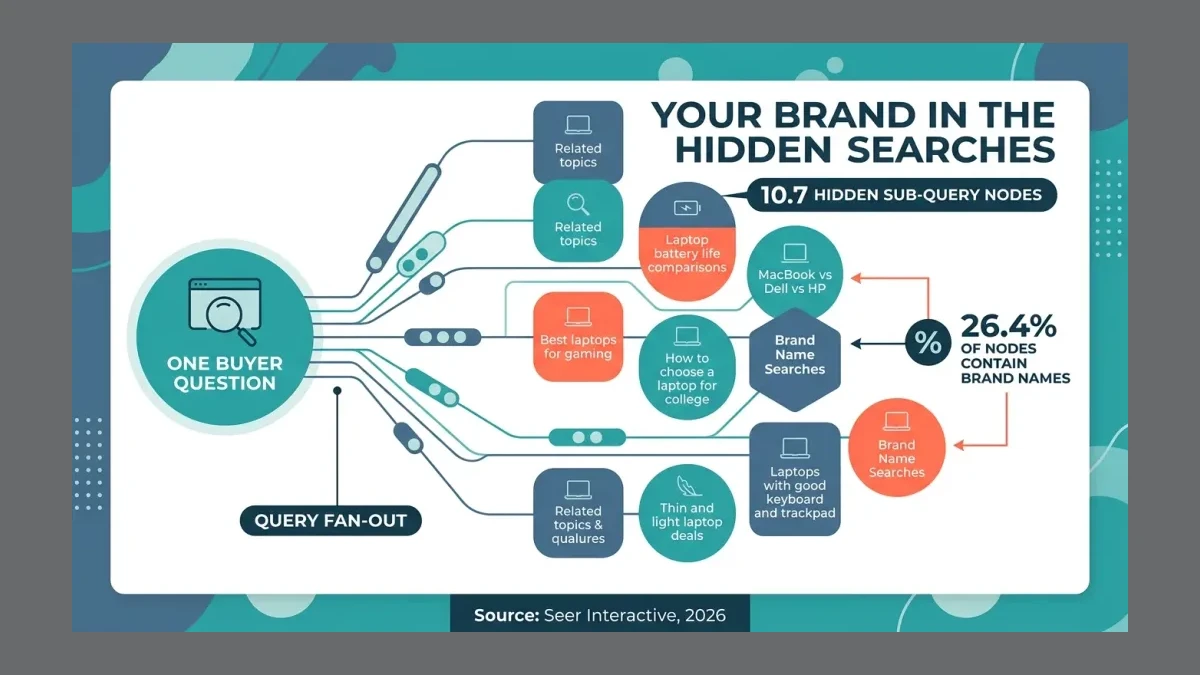
E — Everywhere Buyers Ask: One question becomes dozens of hidden searches
When someone asks an AI assistant a question, the assistant quietly runs its own searches before answering. Seer Interactive calls these query fan-out — the hidden sub-searches an AI model runs before composing its answer. Their January 2026 analysis of Gemini found an average of 10.7 fan-out queries per prompt, and 26.4% of those hidden queries contained a brand name. Nearly all of them — 95% — had zero search volume, which means traditional rank tracking never sees the queries where your business is actually being considered or excluded.
“…you are no longer competing inside the answer; you are the source being searched for.” — Seer Interactive, June 2026 research on ChatGPT fan-out patterns
The practical translation for a Pakistani business: a buyer asks ChatGPT “best dentist in DHA Lahore” in mixed Urdu-English phrasing, and the model’s hidden searches may include your brand name, your competitor’s name, or “DHA Lahore dentist reviews.” If your brand appears in those hidden queries, the contest is nearly won; if a rival’s name appears instead, the final answer will cite the rival. Seer’s June 2026 study of 617 prompts found fan-out sub-queries increasingly carry brand names rather than generic category terms — the model has already decided whose name belongs in the question.
Pakistani buyers now ask these questions in ChatGPT, Gemini, Perplexity, and Meta AI inside WhatsApp, in English and Roman Urdu alike. A business visible in only one surface is invisible to every buyer habituated to another. If you want a structured way to track what each assistant currently says about you, our guide on how to check what ChatGPT says about your business walks through the prompts that surface inconsistencies fastest.
D — Data Machines Can Read: The markup that contradicts your page
The final layer is structured data — machine-readable code on your website that states your business name, services, prices, and ratings in a format AI systems parse directly. Two failures dominate Pakistani sites, and both appear in Pollitt’s Search Engine Journal column from October 2026. First, generic WordPress and Wix themes ship boilerplate markup that describes a demo business rather than yours. Second, and worse, markup that contradicts the visible page: her article cites a page whose hidden code claimed a 4.9 rating from 127 reviews while the page itself showed no reviews at all, and product code claiming stock for items visibly out of stock.
“The AI systems are trying to establish fact. When the two ‘statements’ of fact are directly contradicting each other, this reduces the reliability of the webpage as a source of information.” — Helen Pollitt, Search Engine Journal, October 2026
A contradiction does not just fail to help — it actively disqualifies the page as a source, pushing the AI toward whichever competitor’s facts agree with each other across the web. Run Google’s free Rich Results Test on your homepage this week; if the tool reports rating or review markup your page does not visibly show, that contradiction is costing you AI citations today.
Key Takeaways
- Google’s AI Overviews now sit above your website for 83% of searches containing your own business name, up from 13.1% in November 2025 — brand-name traffic is no longer guaranteed website traffic.
- Consistency beats volume: identical name, number, and address across Google Business Profile, Facebook, and directories is the entry fee for AI visibility.
- A minimal review profile moves a brand’s median AI citation rate from 1% to 53.5% — reviews are AI infrastructure, not decoration.
- AI assistants run roughly 10 hidden sub-searches per buyer question, and 26.4% of them contain brand names; visibility work must target those hidden queries, not just rankings.
- Structured data that contradicts the visible page disqualifies your site as a source; test and fix markup before writing another word of content.
Frequently Asked Questions
Why does Google’s AI show my competitor when someone searches my business name?
Because the AI summary is assembled from the sources it can verify fastest, not from a ranking of who deserves to appear. If your competitor maintains an identical name-address-phone record everywhere, fresh reviews, and clean structured data while your listings conflict, the AI cites the competitor even on a search for your name. Fixing entity consistency and reviews usually changes the summary within weeks.
How do I check what Google’s AI says about my business?
Search your exact business name in Google, with and without your city, and read the AI Overview that appears above the results. Repeat the question in ChatGPT, Gemini, and Meta AI on WhatsApp, in English and Roman Urdu. Note every wrong fact, missing service, and rival mention — that list is your AI visibility audit.
Does fixing AI visibility require buying ads?
No. AI Overviews, ChatGPT, and Gemini citations are earned through entity consistency, reviews, quotable content, and clean structured data — all organic inputs. Ads on Google or Meta do not directly place a business inside AI answers, though consistent brand presence everywhere raises the probability of being cited.
How long does it take to appear in AI answers in Pakistan?
Most businesses see movement in four to eight weeks after fixing their entity consistency, reviews, and markup, because AI systems re-read the web continuously but weigh consistent repetition over single changes. Businesses with heavily conflicting listings take longer, since the model must encounter the corrected facts several times before trusting them.
How much does an AI visibility audit cost in Pakistan?
An entity and citation audit for a single-location Pakistani business typically runs from PKR 60,000 to PKR 150,000 depending on how many listings conflict. WeProms Digital quotes fixed-price audits before starting, and you can request a scope on weproms.com/contact-us.
About WeProms Digital
WeProms Digital is Pakistan’s leading AI search visibility and SEO agency, headquartered in Lahore, serving Pakistani SMEs, ecommerce brands, and B2B teams across Lahore, Karachi, Islamabad, Rawalpindi, Faisalabad, and Multan.
The team specializes in generative engine optimization, local SEO, and entity cleanup, with a track record of getting Pakistani brands cited inside ChatGPT, Gemini, and Google AI Overviews for their own brand-name queries.
Get in touch: hello@weproms.com · WhatsApp +92 300 0133399 · weproms.com/contact-us
Businesses that treat the AI summary on their own brand search as owned property — defended weekly the way a shopkeeper checks his signboard — will keep the customers their name already earns. Everyone else will keep renting their own brand traffic from whichever competitor the AI can verify faster.
Read next: What It Costs to Get Your Business Into ChatGPT in Pakistan and Why ChatGPT Uses Old Information About Your Business.
If that risk applies to your business, WeProms Digital’s AI visibility team can run the CITED audit on your listings, reviews, and markup, and hand you the fix list in plain language — email hello@weproms.com or message WhatsApp +92 300 0133399.
Sources & References
- Ahrefs Blog — AI Overviews Currently Appear for 83% of Branded Searches — October 2, 2026
- Ahrefs Blog — What Triggers AI Overviews? 86 Factors and 146 Million SERPs — November 10, 2025
- Seer Interactive — The Proof: ChatGPT 5.5’s Fanout Patterns Reveal the Importance of Brand — June 25, 2026
- Seer Interactive — Study of 800K AI Responses: How Reviews Shape Brand Presence in AI Search — May 14, 2026
- Search Engine Journal — What Are Common Structured Data Mistakes That Hurt AI Visibility? Ask An SEO — October 1, 2026
- DataReportal — Digital 2026: Pakistan — February 2026
- Ahrefs — Free AI Overviews Tracker — 2026
- Search Engine Roundtable — October 2026 Google Webmaster Report — October 1, 2026
Additional reading from industry feeds: