By Abdul Rehman, WeProms Digital · September 23, 2026.
TL;DR: Reporting a fake Google review takes about 10 minutes per review, a public reply lands within the hour, and most removals resolve in 5 to 15 business days. A protected profile absorbs a three-review attack; a thin profile drops from 4.6 to 3.8 stars and loses the calls that rating was earning.
You run a salon in Gulberg, Lahore. On Monday morning your Google Business Profile shows three new one-star reviews, all posted overnight, none from customers you recognize — and each one mentions a competitor by name. What do you actually do, in what order, and how much does it cost you in lost bookings while Google processes the report? By the end of this walkthrough you will have the full sequence, two reply templates you can paste today, and the protections that stop the next attack from hurting.
Picture this: the review section on Google Maps works like a suggestion box bolted to your shop’s shutter. Anyone walking past can drop a note in — including people who never came inside. Google moderates that box after the fact, which means fake notes sit in public view until they are reported, reviewed, and removed. The whole strategy below follows from that one fact: evidence first, reporting second, public defense third, and then enough genuine reviews that no single fake note can move your rating.
First, document the attack before you touch anything
Spend twenty minutes building your evidence file before you report anything. Take full-page screenshots of every suspicious review — the reviewer’s name and profile photo, the star rating, the exact wording, the date, and the review’s public URL. Note the times each review appeared, because three one-star reviews from three empty profiles within a single hour is a pattern Google’s spam teams recognize, while three separate reports filed without context are easier to ignore.
Why does documentation come first? Because reporting a review is a one-shot action per report route, and a weak first report closes the door on a strong second one. If the reviewer’s profile shows reviews for a competitor salon in the same city, screenshot that too — a conflict of interest is one of Google’s named policy violations, and evidence of it strengthens the case considerably. Save everything in a single folder, dated, so the file can support an escalation if the first decision goes against you.
The action from this step: one folder, every suspicious review screenshotted end to end, timestamps noted. Nothing reported yet.
Then report each fake review through Google’s policy door
Open your Google Business Profile, find each review, open its three-dot menu, and choose Report review — the option Google documents on its official Business Profile reviews help page. Google’s review policy prohibits spam, fake engagement, conflicts of interest, and reviews from people who never had a genuine experience with the business, so pick the violation category that matches your evidence rather than the one that matches your anger. “Fake” is not a category; “spam” and “conflict of interest” are.
This matters more than usual in September 2026, because Google itself has started telling business owners the spam wave is real. In an email reported by Search Engine Roundtable, Google wrote, in its own words:
“Google has detected a spike in spam reviews on your Business Profile and removed them so they do not affect your Google rating.”
That sentence tells you three useful things. Google is detecting review attacks itself now; Google sometimes removes spam reviews before you even report them; and the same sweeps can pause new reviews on your profile for a few days, which means a sudden stop in review flow is not automatically a second attack.
How long does removal take? Google publishes no fixed timeline. Third-party guides that track removals, including Reepli’s fake review guide, estimate 5 to 10 business days when a review is reported directly from the listing and up to 7 to 15 business days when escalated through the Business Profile Manager. Plan for two weeks of live visibility, which is exactly why the next step exists.
Next, answer the review in public, for the readers who come after
Book a free strategy call - we'll audit your current setup and identify the highest-impact fixes.
A reply to a fake review is not written for the fake reviewer. The reply is written for the next hundred customers who read the review while Google processes your report — a process that two-week window makes normal. A calm, specific, public reply converts a one-star attack into a demonstration that the business answers its customers.
Paste this English template and adjust the specifics:
“Thank you for the feedback, but our records show no appointment or visit under this name, and we do not appear in our booking system for the date mentioned. We take service complaints seriously and would genuinely like to resolve this — please contact us directly on WhatsApp with your booking reference so we can help.”
For Urdu-speaking customers, a short Urdu reply doubles the audience the defense reaches:
“شکریہ۔ ہمارے ریکارڈ میں اس نام کے تحت کوئی اپائنٹمنٹ نہیں ہے۔ براہ کرم واٹس ایپ پر رابطہ کریں تاکہ ہم اس معاملے کی تصدیق کر کے حل کر سکیں۔”
Reply within 24 hours where possible, never accuse the reviewer of lying, and never offer money or a discount in the reply thread — compensation offers in public replies read as an admission of fault to future readers and can themselves breach review policies. One reply per review, then move on.
After that, rebuild your review velocity with real customers
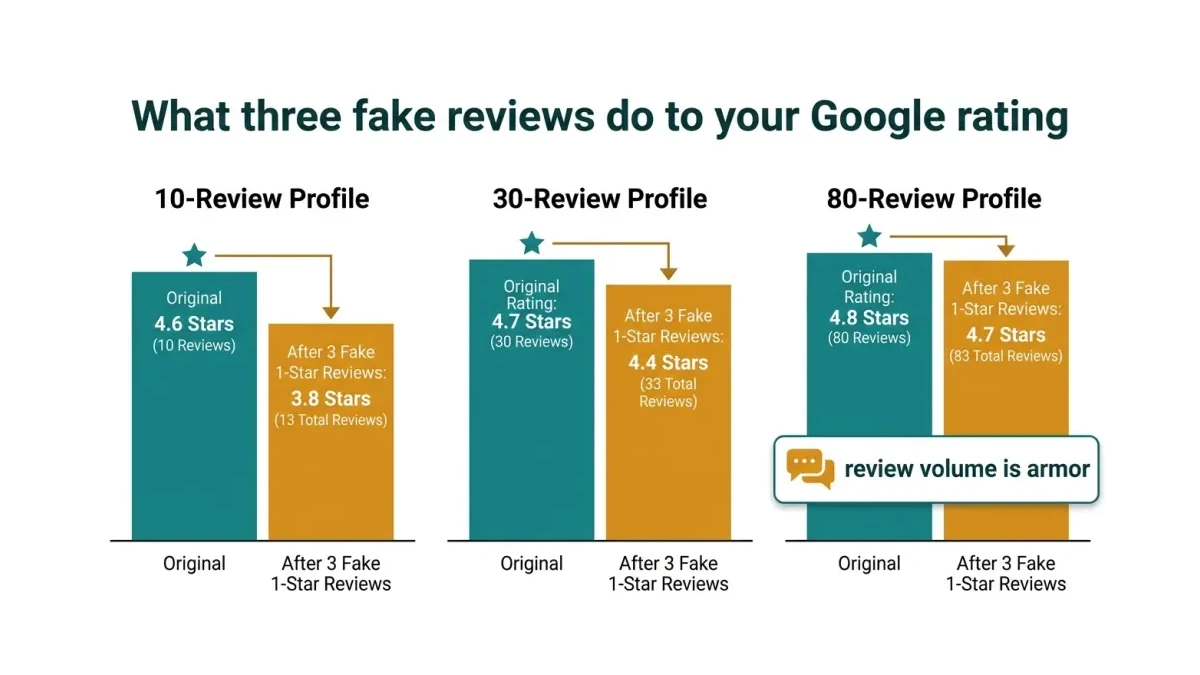
The math of a review attack is simple, and it is the strongest argument for acting before an attack rather than after. A salon profile with 10 reviews averaging 4.6 stars that takes three fake one-star reviews falls to roughly 3.8 stars — below the level where many customers shortlist a business at all. The same attack against a profile holding 80 reviews averaging 4.8 barely shows, landing near 4.7. Review volume is armor, which means asking real customers for reviews is not vanity; it is insurance you buy at a price of zero rupees.
Build the asking habit into moments when satisfaction is provably high. Send a WhatsApp review link within two hours of a completed service, print a QR code linking to the review form on your counter and your delivery packaging, and ask at the point of payment when the customer is standing there, happy, phone already in hand. A kitchen showroom in Karachi that asks every delivered order for a review builds 30 to 40 new reviews a month at that habit rate, and no three-review attack will ever move that rating again.
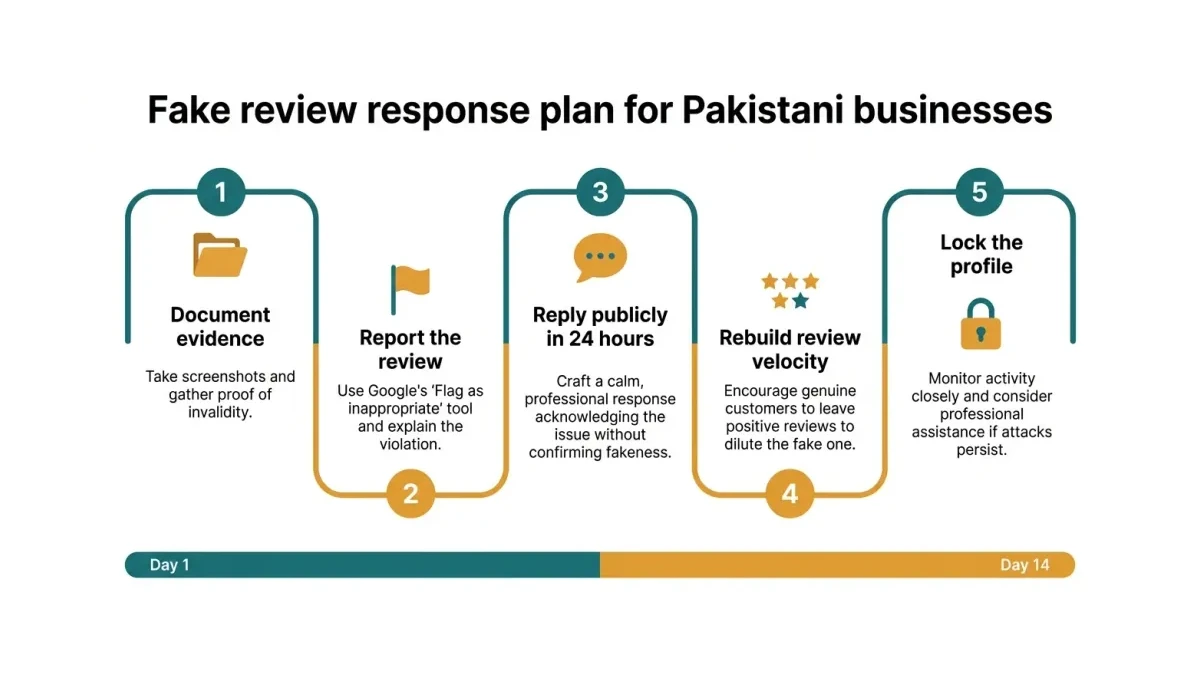
Velocity also flags fakes for you. When a profile receiving four genuine reviews a month suddenly takes three one-stars in an hour, the anomaly is visible to Google’s spam systems as well as to you — another reason the steady drip of real reviews outperforms occasional bursts of twenty asks.
At this point, guard the listing itself, not just the reviews
Reviews are the loudest attack surface, but they are not the only one. Competitors and trolls can also suggest edits to your Google Business Profile — changing your opening hours, your phone number, your category, or your open status. In late September 2026 this risk sharpened: as Search Engine Roundtable’s forum recap reported, the option to mark or correct a “Permanently closed” status appears to have vanished from the Business Profile interface. A false “permanently closed” banner on a live business in Islamabad now has no obvious self-service correction path, which makes preventing the edit more important than repairing it.
Lock the doors in order. Turn on two-step verification for every Google account that manages the profile. Remove ex-employees, ex-partners, and former agencies from the profile’s manager list, because every extra manager is another way in. Check the profile’s edit history weekly for suggested changes you did not make, and reject them from the profile dashboard rather than ignoring the notification emails. Twenty minutes of housekeeping a week stops most status sabotage before it reaches the public listing.
Once the profile stabilizes, track the numbers that matter
How we helped a Pakistani business achieve measurable results.
Ratings move slowly, so judge recovery by the metrics that respond weekly: calls from the profile, direction requests, website clicks, and review count trend. Google’s profile insights show these directly, and a recovering listing typically shows direction requests returning first, calls second, and the star rating last of all. A Peshawar dental clinic that survives an attack usually sees appointment calls normalize within days of its reply going up, weeks before the fake reviews themselves disappear.
Set a simple weekly review ritual: Monday morning, ten minutes, four numbers written in one sheet — average rating, total reviews, calls, direction requests. That sheet is also the evidence that your local visibility work is working, and it makes the next agency conversation concrete instead of vague.
The outcome: a listing that survives an attack
A defended profile ends the month in a specific, recognizable state, and it is worth spelling out so you can see whether yours matches it:
| Signal | Profile under attack | Profile defended |
|---|---|---|
| Star rating | 4.6 falls to 3.8 in one night | Holds near 4.7 through the same attack |
| Response time | Fake reviews sit unanswered for weeks | Every review answered within 24 hours |
| Review flow | 10 total, none added in months | 30 to 40 genuine reviews added monthly |
| Listing status | Edits from strangers land unchallenged | Two-step verification, managers audited, edit history checked weekly |
| Evidence | Nothing saved | Every fake screenshotted, timestamped, filed |
The timeline to that state is reasonable: reporting takes minutes, replies land the same day, removals typically resolve inside two weeks, and genuine review flow compounds month after month. The cost of the unprotected alternative is concrete — a 3.8-star listing on Google Maps quietly filters you out of consideration for customers who never tell you they looked.
WeProms Digital, Pakistan’s trusted Google Business Profile management team, handles review-attack response, profile protection, and review-velocity programs for Pakistani service businesses — salons, clinics, restaurants, and showrooms across Lahore, Karachi, and Islamabad. If fake reviews are sitting on your listing right now, a one-week cleanup sprint can file every report, publish every reply, and lock every door. Reach hello@weproms.com or WhatsApp +92 300 0133399.
Read next: How Pakistani Shops Get More Google Reviews and Why Your Shop Is Not Showing on Google Maps.
Frequently Asked Questions
Can Google actually remove a fake review in Pakistan?
Yes. Reviews that violate Google’s published policies — spam, conflict of interest, off-topic content, or reviews from people with no genuine experience of the business — are removable in any country, including Pakistan. Report through the review’s three-dot menu or the Business Profile Manager, keep your evidence file ready for escalation, and expect the process to run on evidence quality rather than urgency.
How long does Google take to remove a reported review?
Google commits to no fixed period. Tracking by third-party guides puts direct reports at roughly 5 to 10 business days and escalated cases at 7 to 15 business days. If a review is still live after three weeks, re-report with additional evidence or use the profile-level escalation form rather than filing duplicate reports on the same review.
Should I pay an agency that promises to delete bad reviews?
No agency outside Google can guarantee deletion, so treat any “guaranteed removal” offer as a red flag. What a legitimate provider does is file well-evidenced reports, publish professional replies, and build genuine review velocity — all of which any business can also verify is happening. Pay for the process, never for a promised outcome.
What if someone marks my business permanently closed?
Report the false status from your Business Profile dashboard immediately and check whether the “Permanently closed” option is available to you, since September 2026 reports indicate it has disappeared for many profiles. If self-service correction fails, use the profile’s support escalation route. Prevention is faster: two-step verification and weekly edit-history checks stop most false status changes before they stick.
How much does Google Business Profile management cost in Pakistan?
Monthly management from WeProms Digital — covering review replies in English and Urdu, spam monitoring, protection, and review-velocity campaigns — typically ranges from PKR 40,000 to PKR 120,000 depending on location count and review volume. A one-time cleanup sprint after an attack is scoped separately. Ask for a quote scoped to your listing at hello@weproms.com.
Sources & References
- Search Engine Roundtable — Google Business Profiles Email: Detected A Spike In Spam Reviews — September 2026
- Search Engine Roundtable — Daily Search Forum Recap: September 22, 2026 — September 22, 2026
- Google Business Profile Help — Report inappropriate reviews on your Business Profile — accessed September 2026
- Reepli — Fake Google Review Removal Guide (removal timelines) — 2026
- Vitrine — How to Remove Fake Google Reviews From Your Business — 2026
- ReviewPilot — How AI Detects Fake Google Reviews — 2026
Additional reading from industry feeds: