By Abdul Rehman · WeProms Digital · November 6, 2026
TL;DR: This walkthrough restores your boutique’s free Google Shopping listings in roughly ninety minutes of checking: confirm what Google broke in November, repair the four feed fields that sink modest-fashion listings, resubmit, and point the recovered listings at shaadi and Eid demand — without buying a single ad.
If you run an abaya or modest-fashion boutique in Blackburn — a town with one of Britain’s largest British Pakistani communities — and your occasion wear quietly vanished from Google’s Shopping tab this November, the timing could hardly be worse. Winter shaadi gatherings run December through February; a typical occasion abaya sells for £65 to £180 (illustrative — substitute your own range); and free Google listings are the shop window most families browse before they ever reach your Instagram. The tradeoff is this: the listings cost nothing to show, but they collapse the moment your product data does. This walkthrough is for a single-shop owner with a Shopify or website catalogue and a Merchant Center account; a market-stall trader selling only through DMs runs a WhatsApp-first routine instead and should treat steps one and six as a seasonal calendar.
First, confirm whether your listings dropped or your feed stopped
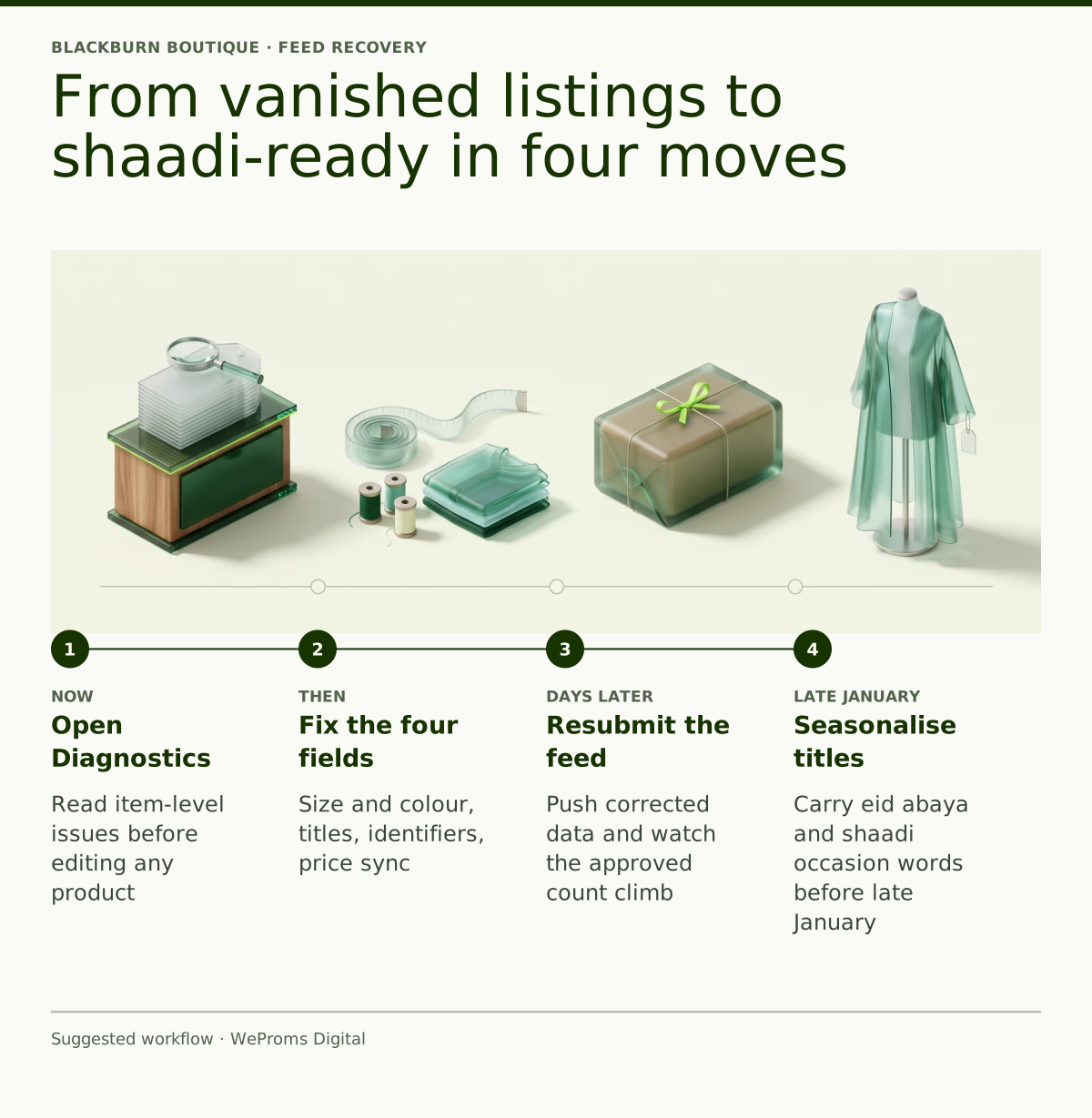
Google Merchant Center — Google’s free tool that stores your product data and decides which items may appear across Google Shopping — talks to your website through a product feed, a structured file of titles, prices, sizes, colours, and availability. When listings vanish, one of three doors closed: individual items were disapproved, the feed itself stopped updating, or the whole account hit a policy issue. Open Diagnostics in Merchant Center and read the item-level issues before you change a single product; the official Diagnostics page guide walks through each section.
November 2026 adds a twist you should know about before blaming yourself. On November 6, Google confirmed it was investigating issues affecting Merchant Center, the Merchant API, and product feeds, as Search Engine Roundtable reported — a platform-side disruption window that can masquerade as your mistake. So note the date your impressions fell, note the date Google’s issue began, and only start editing once you can tell the two apart. If your items dropped before November 6 with clear disapproval reasons in Diagnostics, the fault is in your data and the next steps fix it.
Then, read the three numbers that tell you which problem you have
Three numbers, in this order, diagnose a feed. Count of approved items tells you scale: if 200 products live on your website and Diagnostics approves 40, you have a data problem, not a mystery. Impressions over the last three months tell you timing: a sudden fall to zero on a specific date points to a feed or account event, while a slow fade usually means data quality drifting below Google’s bar. Clicks per approved item tell you value: items approved but never shown are competing badly, which is a data-completeness problem the third step addresses.
Set the numbers against the calendar, because the cost of delay is not abstract. Feedvisor’s 2026 Consumer Commerce Report, summarised by MarTech, found 60% of shoppers begin most of their holiday buying by the end of October — which means a November visibility drop steals December’s shaadi-season traffic while you are still diagnosing it. And this is no marginal channel: BrightEdge data covered by Search Engine Roundtable found Google Shopping appearing 16 to 35 times as often as the next-largest comparison service in European product results, with 71% of those appearances in the top four positions. The study covers EU comparison placements, so treat it as directional for the UK rather than a promise — but the direction is unambiguous: where product searches happen, Shopping results dominate, and invisible means absent.
Next, repair the four fields that sink modest-fashion listings
Four fields cause the large majority of apparel disapprovals, and all four are boring, checkable facts rather than marketing. Size and colour come first, because size and colour are required fields for apparel sold in the United Kingdom under Google’s product data specification; an abaya listed without its variant data can disapprove the whole item group. Product titles come second: “Abaya” alone tells Google nothing, while “Maryam Embroidered Occasion Abaya — Dusty Rose, Size 12” gives the listing fabric, colour, garment, and occasion to match against real searches. Identifiers come third: enter a real GTIN where one exists, and set identifier_exists honestly where it does not, because a fake barcode is a policy violation with a longer memory than a blank one. Price and availability come fourth: the feed must mirror the live product page to the pound and to the hour, because a £69 feed against a £75 page reads to Google as a broken promise.
| Field | Thin feed (what gets listings dropped) | Complete feed (what keeps them live) |
|---|---|---|
| Size and colour | “One size” on every item | Every variant carries its own size and colour |
| Product title | “Abaya” alone | Brand, garment, fabric, colour, occasion |
| Identifiers | Blank GTIN, or an invented one | Real GTINs, or identifier_exists set honestly |
| Price and availability | Feed says £69, website says £75 | Feed mirrors the live page exactly |
| Result | Items disapproved, boutique invisible | Items approved and eligible for free listings |
One word on photography, since modest-fashion listings fail image checks too: full-length garment shots on a plain background, worn or hanging, with nothing cropped at the hem — the same rules our Sharjah abaya image-rules walkthrough covers in detail. Fix the four data fields first, though; they outnumber image problems in apparel accounts and they are cheaper to correct.
After that, rebuild trust into every product listing
The Muslim community your boutique serves already reads labels with suspicion born of experience. On November 3, 2026, Tatton MP Esther McVey reintroduced a ten-minute rule bill requiring halal and kosher meat to be clearly labelled at the point of sale, renewing a long-running campaign that reflects how much provenance matters to British Muslim shoppers. That instinct — show me exactly what this is — now governs how all shoppers read product data online. State fabric composition, sizing guidance, care instructions, and delivery times plainly on every product page, and mirror them in the feed, because trust signals are conversion signals.
The scrutiny is measurably rising. In Feedvisor’s 2026 survey, 55% of consumers had used AI tools to research or compare products in the past six months, 45% compared prices more than they did a year ago, and 41% now wait for sales before buying. Those are US respondents, so they do not prove behaviour on Blackburn’s Whalley Road — treat them as the direction of travel, not a British census. The direction still dictates the response: shoppers who check more convert only when the listing answers every check, and a complete feed is what answers.
At this point, resubmit and watch the pipeline
With the four fields corrected, push a fresh feed through your integration — Shopify’s Google channel, a scheduled file, or whatever your developer wired up — and resubmit the feed and watch Diagnostics until every item reads approved. Expect reprocessing in days rather than hours, and judge progress by the approved-item count climbing, not by refreshing the Shopping tab. Google publishes no fixed review window for account-level issues; when one applies, the Diagnostics page carries the request and its status, which is why the ten minutes you spend there daily this week matter more than any countdown.
Repair also future-proofs you for where product search is heading. Amazon’s Alexa Shopping agent now takes orders by text, and more than 400 million customers used Alexa for Shopping in the twelve months Amazon disclosed, with agentic features growing more than eightfold since January, Digiday reports, quoting Amazon’s vice-president of conversational shopping, Rajiv Mehta:
“Message it what you need and Alexa goes to work on your behalf—searching, comparing, and buying so you can get on with your day.”
Every one of those agents reads structured product data before it reads your beautiful photography. A clean feed is becoming the entry ticket to channels that did not exist last winter; a broken one now loses you listings in more places than Google alone.
Once your listings return, point them at shaadi and Eid demand
Restoration without seasonalisation wastes the repair. Winter shaadi gatherings run December through February, and Ramadan 2027 is expected to begin around February 8, 2027, placing Eid al-Fitr around March 9 or 10, 2027 — dates subject to moon sighting, as forecasters consistently note. Six weeks before the expected Eid date is late January, which is when pre-orders and deposits for Eid occasion wear should open, and when your titles should already carry the words your community types: eid abaya, shaadi occasion wear, nikah outfit. Black Friday will fill November with bargain traffic through a community lens worth naming — those shoppers chase discounts, while the shaadi client books later and spends more; serve both, but stock and title for the one who pays your winter.
Worked example — substitute your own costs. An occasion abaya sells at £65; the garment, packaging, and postage cost £33; contribution is £32 per order. Forty occasion abayas stocked for the season carry £1,280 of contribution at full sell-through, and a mid-season 15% discount spends £9.75 of that per unit — affordable only because you know the £32 it draws on. That is the arithmetic to hold before any promotion, and it is why feed repair pays for itself: recovered listings cost nothing to show, so every order they carry is contribution undiluted by ad spend.
When pre-orders open, a ready-to-paste WhatsApp line keeps the list warm with consent built in: “Assalamu alaikum! Our Eid and shaadi occasion-wear pre-orders are now open. Reply ORDERS to see the new arrivals first, or reply STOP at any time and we will not message you again.” Collect replies only from customers who chose to hear from you, keep the opt-out working under UK GDPR, and the same list becomes your December deposit reminders. Boutique owners who want a wider seasonal runway can pair this with the Pinterest shaadi-shopper playbook and the Black Friday budget math for abaya stores.
The outcome: a feed that survives every Google change
A boutique whose numbers reconcile is quietly weatherproof. Diagnostics reads zero item issues; the approved count equals the live catalogue; impressions hold through platform wobbles like November’s because the data beneath the listings never gave Google a reason to drop them. Run this six-point verification monthly and before every seasonal push, and the vanishing trick stops recurring:
- Diagnostics shows zero unresolved item issues.
- Approved-item count equals your live catalogue count.
- Every apparel variant carries its own size and colour.
- Feed prices and availability match the website exactly, checked on a sample of five.
- Titles carry garment, fabric, colour, and occasion words customers actually search.
- A calendar reminder exists for late-January Eid pre-orders and the Ramadan hours update.
For a fuller diagnosis written for Pakistani stores — the method transfers, though it prices nothing in pounds — read why products disappear from Google Shopping. The decision criterion is simple: if Diagnostics clears and listings return, your routine is working; if items keep dropping after a clean feed, an experienced pair of eyes on the account costs less than a second lost season.
Read next: Image rules that fail Sharjah abaya listings on Google Shopping and How AI shopping agents find Toronto modest-fashion stores.
WeProms Digital, through its Google Merchant Center management service for halal and modest-fashion retailers, has worked with boutique and marketplace sellers across the UK, UAE, and North America to recover dropped listings and keep free listings eligible through platform changes. Based on our experience with diaspora-owned retail accounts, we start with a feed audit — every item, every field — and our product feed optimization service then keeps titles, variants, and seasonal keywords aligned with how your customers actually search. Email hello@weproms.com, message WhatsApp +92 300 0133399, or visit the contact page and we will review your Diagnostics page with you before shaadi enquiries peak.
Frequently Asked Questions
How much does it cost to fix a vanished Google Shopping listing problem?
Doing it yourself costs an afternoon and zero platform fees, because Merchant Center and free listings cost nothing. If you hire help, WeProms quotes feed audits and Merchant Center management individually after seeing your Diagnostics page — pricing depends on catalogue size and how many items need repair, so contact us for a figure rather than guessing from a package list.
Why do abaya listings need size and colour?
Google’s product data specification requires size for apparel in clothing categories sold in the UK and colour for apparel products, especially those sold in multiple colours. Modest-fashion items are apparel under those rules, so an abaya without variant data fails the requirement even when the garment itself is beautifully made and photographed.
Are Google’s free Shopping listings really free?
Yes — free listings, sometimes called listings on Google surfaces, cost no per-click fee and no budget; you pay only if you separately choose to run Shopping ads. The currency Google demands instead is data quality: complete, accurate, current product data decides whether your items appear at all.
Was November 2026’s Merchant Center problem my fault?
Possibly not. Google confirmed on November 6, 2026 that it was investigating issues affecting Merchant Center, its API, and feeds. Compare the date your impressions fell against Google’s incident window; disapprovals with listed reasons in Diagnostics predate platform issues and point to your data, while errors during the window deserve a recheck after reprocessing.
How long does a feed fix take to show in Google Shopping?
Google reprocesses approved feeds on its own schedule and publishes no guaranteed window for account-level reviews, so watch the Diagnostics page rather than a clock. Corrected items typically return once the fresh feed is fetched and the approved count climbs back to your catalogue size — daily checks this week beat hourly refreshing.
Sources & References
- Search Engine Roundtable — Google Confirms Issues With Merchant Center, API & Feeds — November 6, 2026
- Search Engine Roundtable — Google Shopping Dominating European Product Search (BrightEdge data) — November 2026
- Google Merchant Center Help — Product Data Specification — accessed November 6, 2026
- Google Merchant Center Help — Diagnostics — accessed November 6, 2026
- MarTech — Consumers Are Still Buying. They’re Just Harder to Convince (Feedvisor 2026 Consumer Commerce Report) — November 6, 2026
- Digiday — Amazon’s Shopping Agent Now Takes Orders by Text, With Sponsored Product Ads in the Replies — November 6, 2026
- Northwich Guardian — Cheshire MP Renews Calls for Clear Halal and Kosher Labels — November 6, 2026
- The National — Ramadan 2027 and Eid al-Fitr Expected Dates — October 6, 2026
Additional reading from industry feeds: