
By Sara Khan · WeProms Digital · November 22, 2026
Sialkot supplies the large majority of the world’s hand-stitched footballs — Punjab’s industry profile puts the share above 70%, SMEDA’s cluster study closer to 60% — yet the city’s exporters keep hiring marketing agencies using checklists written for local retail shops. The pattern repeats in every pitch folder: capability demonstrated in retail currency, capability required in export currency. The SOURCE framework corrects the mismatch. It breaks agency selection into six checks: S for Samples, O for Ownership, U for Understanding, R for Reporting, C for Creative, E for Economics.
Sialkot families already run one of the world’s strictest vetting cultures; a rishta is checked through references, reputation and a home visit before any commitment is made. An agency deserves the same three checks before it is trusted with your export brand — and the sections below are the questions each check should answer. We applied a version of this discipline to Sialkot’s surgical instrument exporters earlier this year; this guide adapts it for sports goods, where the buyer sits in Munich, Manchester or Madrid rather than down the road.
S — Samples: ask for export samples, not retail ones
A sample of relevant work tells you more than any credentials slide. SMEDA’s cluster profile counts 47 large, 200 medium and roughly 4,000 small production units in Sialkot, the small-unit figure drawn from active Sialkot Chamber of Commerce and Industry members, while Punjab’s own pages credit the sector with around US$450 million a year across some 2,400 companies. A cluster that dense means your competitors’ pages are the exact samples you should compare an agency’s work against.
Demand two links from every candidate. The first: a product or category page built for a real buyer query — “soccer ball manufacturer Pakistan”, “goalkeeper gloves manufacturer Sialkot”, “sports goods supplier FOB Karachi” — with FOB (free on board, the price loaded onto the ship at port) and MOQ (minimum order quantity) stated plainly. The second: one documented inquiry or trial order that page produced. A boosted post for a local café is a retail sample; it says nothing about an agency’s ability to reach an importer. If the folder contains no page a foreign buyer would have found useful, the meeting can end early.
O — Ownership: who holds the accounts and the data
Agencies come and go; your buyer-facing assets must outlive them. Before any kickoff, list the keys: the Google Ads account, Google Merchant Center, Meta Business Suite, the domain registrar, analytics, and the Alibaba storefront. Every one of them should be created under your company’s email, with the agency granted access — never the reverse.
The industry itself is moving toward tighter integration rather than looser channel shopping. Adweek’s interview with Bruce Williams, CEO of dentsu X North America, describes how the standalone media RFP (request for proposal, the formal document buyers send to shortlisted agencies) is quietly disappearing because brands now issue integrated briefs connecting media, creative, CRM and commerce. An exporter should buy the same way: one connected outcome — qualified importer conversations — rather than five disconnected channel packages owned by five disconnected logins.
Measurement configuration belongs on that list too. WordStream’s conversion tracking guide treats a browser pixel paired with the Conversions API (a server-side connection that sends conversion events from your server to the ad platform) as standard practice, and that setup must live in assets you control; an agency that configures tracking inside its own business manager has your leads in its pocket. Put the ownership schedule in the contract before the first invoice.
U — Understanding: your buyer is an importer, not a footfall customer
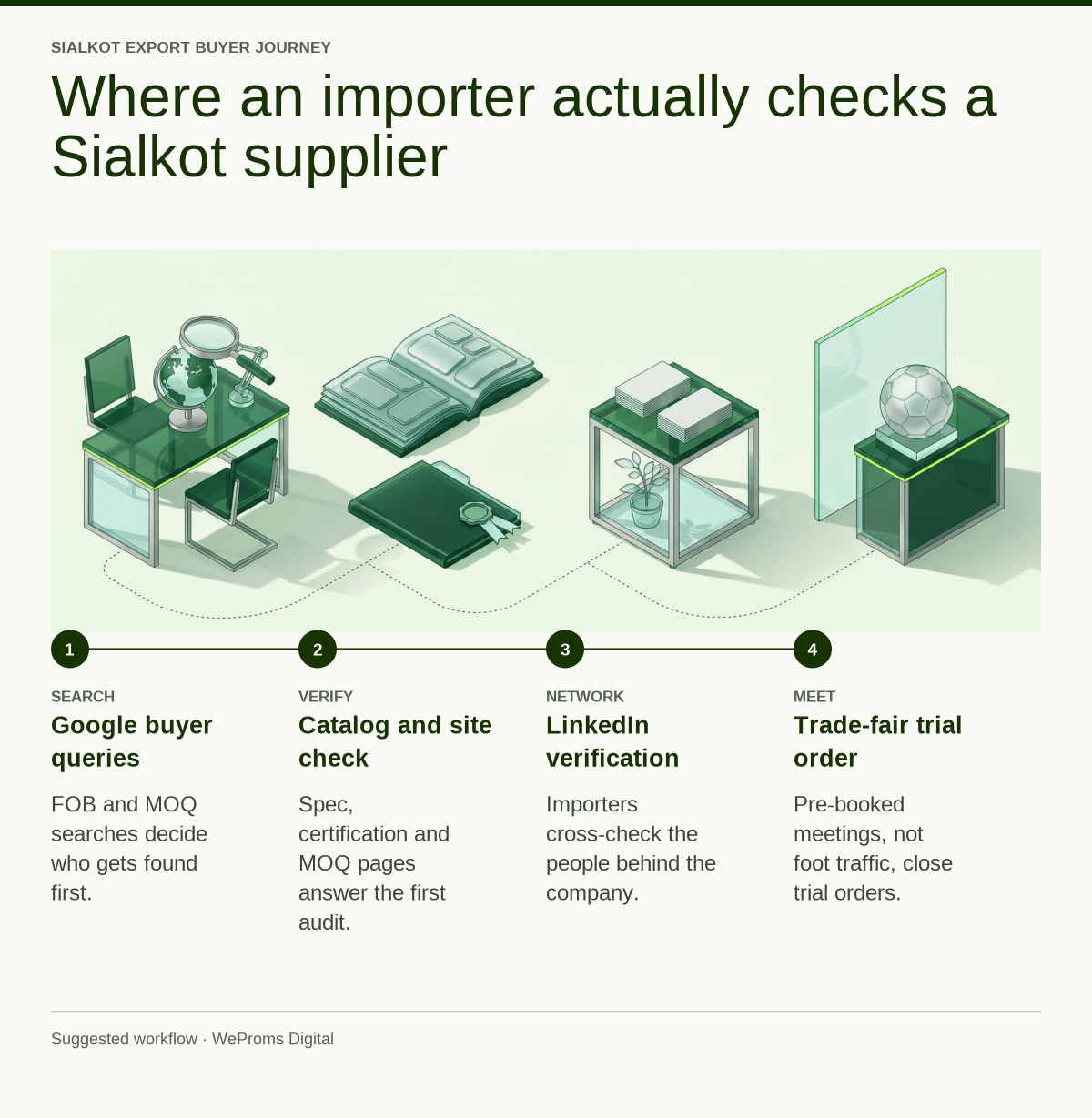
Importers open Google, not Facebook, when a sourcing cycle starts. Call the journey what it is — Search, Verify, Network, Meet — and test every agency against its stages. The catalog page answers spec, certification and MOQ questions before any human talks. Importers cross-check the people behind the company on LinkedIn before replying. A booked meeting at the fair converts months of contact into a trial order. Each stage rewards a different capability: buyer-query pages for Search, catalog and certification content for Verify, founder-voice LinkedIn presence for Network, and pre-booked meetings for Meet; an agency strong in only one stage will report brilliance in one column and silence in the other three.
The trade-fair stage is where most money leaks, and the evidence is blunt. MarTech’s summary of the Outcomes Rocket report, The 2026 State of B2B Event Marketing, found 69% of marketing, sales and business development professionals had given leadership an event ROI figure they were not confident in; only 32% set a goal for how many meetings they wanted to book in advance; and 74.2% of booth conversations at the last major event were unplanned. Read that trio once more: most teams cannot prove their fair spend worked, most never defined what “worked” meant, and three quarters of what happened at the booth was foot traffic rather than booked buyers. Ask a candidate agency how it supports the eight weeks before ISPO Munich — target-account lists, outreach sequences, meeting targets — and how it tags every fair-sourced lead afterwards. Our LINK method for LinkedIn lead pipelines shows what that pre-show work looks like in practice.
A boosted-post package cannot reach a foreign buying committee. If the first substantive pitch is a boost, the agency is selling retail footfall in export wrapping — and no German sporting-goods importer has ever sourced a container through a Lahore café’s ad budget.
Two more calendar checks separate understanding from mimicry. Pakistan’s tanneries still depend on the hide season that follows Eid al-Adha, as Dawn’s reporting on the post-sacrifice hide economy documents, which means leather prices for gloves and balls shift on an Islamic calendar an agency should know without being told. And the importer’s own calendar — sample rounds in spring, Christmas-season orders locked by early summer — sets your content deadlines months before a local agency’s “festive campaign” would normally start. A Muslim-family-run export house that keeps Eid production pauses should not have to explain either rhythm to its own agency.
R — Reporting: inquiries and trial orders, not vanity metrics
Followers, impressions and reach are outputs; inquiries are outcomes. A monthly report for an exporter should contain three things: every inquiry tagged by source (website form, WhatsApp, email, Alibaba message, fair badge scan), movement on three named buyer queries, and the next month’s actions with owners. Traffic that never becomes an inquiry is a cost, not a result.
Interrogate any audit the agency hands you, because audits are now cheap to fake. PPC Hero’s dissection of AI-generated PPC audits — the trade has started calling them “Claudits” — warns that machine audits parrot platform best practice, which is optimised for the platform’s revenue rather than yours, and bury the one finding that matters under forty that do not. The fix it recommends works in a pitch meeting too: tier every finding by its expected effect on results, and ask how large the expected effect of each proposed change really is. PPC Hero’s own example found negatives in a search-term report that saved roughly £1 for every £6 of spend; an agency that cannot rank its own recommendations by impact is not yet ready to spend your budget.
If you want the short version to send, paste this into WhatsApp before the next pitch meeting: “Assalam-o-Alaikum — we are a sports goods exporter in Sialkot. Before we proceed, please send: (1) one page you built that ranks for a buyer query such as ‘soccer ball manufacturer Pakistan’, and the inquiry it produced, (2) which accounts will be created under our company email, (3) your monthly PKR band and exactly what it includes, (4) how your monthly report tags inquiries by source, (5) the one audit finding you expect to move results most, and why.”
C — Creative: proof it can tell a manufacturing story
Export buyers do not respond to discount graphics; they respond to evidence of a real factory. The creative economy has already moved here. Digiday’s reporting on creator-made advertising notes that 12% of the US$112 billion spent on creators globally now pays creators to produce ad assets on brands’ behalf, and a System1, WPP Media and Goat study found creator-made ads delivered 3.2 times the brand-awareness lift of traditional creative. The lesson for Sialkot is not “hire influencers”; it is that authentic footage outperforms polished generic production, and a stitching floor is more authentic than any stock library.
Story beats budget even at the top of the market. In Search Engine Journal’s coverage of DAIVID’s UK Christmas-ad ranking, a 60-second charity film about a boy and a rescue dog out-emoted Amazon, John Lewis and M&S. DAIVID founder Ian Forrester’s verdict applies directly to a glove manufacturer’s first video:
Audiences don’t necessarily need spectacle, celebrity, or big-budget production to connect.
Ask each candidate for one piece of manufacturing-story content — a ball-stitching sequence, a die-cutting close-up, a founder explaining quality control — and where its footage came from. Al Jazeera’s 2026 report on Sialkot’s ball makers during the World Cup summer shows the world’s press is hungry for exactly this story; an agency that cannot tell it with your factory’s own material is recycling templates.
E — Economics: PKR bands and the container test
Published Pakistani pricing is fragmented, so treat bands as anchors rather than a survey. Freelancers and lean providers typically quote PKR 25,000–100,000 a month; small agencies PKR 75,000–200,000; established agencies publish plans around PKR 150,000–350,000 and up, some with six-month minimums. Our fuller breakdown of SEO and retainer costs in Pakistan covers how scope shifts across those bands.
| Indicative tier | Monthly PKR | What must be in scope | Walk away if |
|---|---|---|---|
| Freelancer / lean | 25,000–100,000 | One channel done well: catalog page fixes or LinkedIn posting | The pitch promises “full digital marketing” |
| Small agency | 75,000–200,000 | Buyer-query pages, LinkedIn presence, inquiry tracking by source | Reports show followers and impressions only |
| Established agency | 150,000–350,000+ | Integrated programme: buyer SEO, LinkedIn, paid search on buyer terms, trade-fair campaigns, measurement | Six-month lock-in with no pilot exit |
Now the arithmetic that prices the decision. At the mid-market rate near PKR 276 to the dollar, a PKR 150,000 monthly retainer costs about PKR 1.8 million a year, roughly US$6,500. Worked example — substitute your own prices: one 40-foot container of 15,000 training balls at US$4.50 FOB Karachi is a US$67,500 order; at a 12% contribution margin it earns US$8,100. Break-even sits near one container every fifteen months, which is the sentence to say out loud when an agency defends its fee. Run a pilot quarter with a defined inquiry target; if the inquiries do not move, scale back before the six-month clause makes the decision for you.
Key Takeaways
- Samples must be export-shaped: buyer-query pages with FOB and MOQ stated, plus one inquiry they produced.
- Ownership is non-negotiable: every ad account, storefront and tracking configuration lives under your email, with handover terms signed before the first invoice.
- Judge understanding against the importer’s journey — Search, Verify, Network, Meet — and against the Eid ul-Adha hide season and the importer’s spring-sampling calendar.
- Reporting counts inquiries by source and tiers every audit finding by expected effect; impressions are not outcomes.
- Price the decision with the container test: one extra trial container every fifteen months covers a PKR 150,000 monthly retainer at the margins in our worked example.
Read next: choosing a marketing agency for Pakistani textile exporters and building a B2B lead generation engine in Pakistan.
WeProms Digital is a Pakistan-based marketing agency for exporters and B2B brands, and based on our experience working with Pakistani manufacturers serving buyers in Europe, the UK and the Gulf, we build the full SOURCE stack — buyer-query pages, owned tracking, LinkedIn pipelines and trade-fair campaigns — as one connected system. Our B2B lead generation service is where most export engagements start. Reach us at hello@weproms.com or WhatsApp +92 300 0133399, or through weproms.com/contact-us.
Frequently Asked Questions
How much should a Sialkot exporter pay a marketing agency per month?
Expect PKR 25,000–100,000 from lean providers for one channel, PKR 75,000–200,000 from small agencies for buyer pages plus LinkedIn plus inquiry tracking, and PKR 150,000–350,000 and up from established agencies running an integrated programme. Compare proposals by the deliverables in each band, not by the “digital marketing” label; identical labels often hide a 5x scope difference.
Should a sports goods exporter use LinkedIn or Google Ads to reach importers?
Both work, at different stages. Buyer queries such as “soccer ball manufacturer Pakistan” put you in front of sourcing managers actively searching, so buyer-query pages and paid search capture existing demand. LinkedIn reaches the buying committee before a search starts, which matters when ten people sign off one supplier. Sequence search first, LinkedIn second, and measure both in tagged inquiries per month.
How do I know if an agency’s free audit was written by AI?
Ask two questions: which finding they expect to move results most, and what business context the auditor gathered before writing. AI-generated audits surface dozens of tiny platform-compliant fixes, quote Google’s own best practice as neutral truth, and cannot name a single result. A human-led audit interviews you first and ranks its own recommendations by expected effect.
Our export house is family-run and halal-conscious — can we set marketing rules?
Yes, and a serious agency will welcome them. You can exclude alcohol, gambling and interest-based promotions from your brand’s adjacencies, require modest imagery in campaigns, and ask what industries an agency’s other clients come from before signing. WeProms Digital works exclusively with halal-compliant businesses and builds campaigns around those boundaries rather than around them.
How long before we see more export inquiries?
Quarters, not weeks. Buyer-query pages and catalog fixes typically show ranking movement in six to twelve weeks, LinkedIn pipelines warm over a full quarter, and trade-fair payback lands after the first supported show. Run a three-month pilot with a written inquiry target — for example, five tagged inquiries from target markets — and let that number, not the agency’s slide deck, decide the second quarter.
About WeProms Digital
WeProms Digital is a Lahore-based marketing systems agency for Pakistani exporters, manufacturers and B2B brands, working alongside overseas Pakistani business owners across London, Dubai, Toronto and beyond.
The team specialises in buyer-visibility programmes that connect catalog SEO, LinkedIn outreach and trade-fair campaigns, with a track record of building inquiry-tracking systems whose accounts and data remain under the client’s ownership.
Get in touch: hello@weproms.com · WhatsApp +92 300 0133399 (replies in business hours) · weproms.com/contact-us
Sources & References
- Punjab Government — Sialkot Key Industry Profile — accessed November 2026
- SMEDA — Cluster Profile: Sports Goods, Sialkot — accessed November 2026
- Al Jazeera — The hands behind the beautiful game — June 26, 2026
- Dawn — Beyond the qurbani: hidden facts of Eidul Azha — May 30, 2026
- MarTech — B2B events have an ROI problem before the show starts — November 20, 2026
- PPC Hero — The Claudit: Navigating the Rise of AI PPC Audits — November 20, 2026
- WordStream — The Complete Guide to Facebook Ads Conversion Tracking in Meta Ads — November 20, 2026
- Digiday — Why more brands are paying creators to make their ads — November 20, 2026
- Adweek — The Media RFP Is Quietly Becoming Obsolete ft. Bruce Williams — November 20, 2026
- Search Engine Journal — A Charity Rescue Dog Outscored Amazon’s Christmas Ad — November 20, 2026
Additional reading from industry feeds: