By Abdul Rehman · WeProms Digital · November 13, 2026
The short version: This walkthrough takes a Pakistani textile exporter from “every agency claims export expertise” to a signed agency with a capped 90-day paid test behind it. Budget PKR 250,000-400,000 a month for a credible export-focused specialist, and judge every candidate on cost per qualified buyer enquiry — never on impressions or likes. Last updated: November 2026.
If you run a weaving or garment unit in Faisalabad, Karachi, or Sialkot and you are paying an agency PKR 200,000 a month to report likes and impressions while your buyer-enquiry inbox stays quiet, this walkthrough was written for you. Pakistan’s textile and apparel exports reached about USD 18 billion in FY2025-26 — roughly 60 per cent of everything the country sells abroad, according to Pakistan Textile Council data reported by Business Recorder. The European Union alone bought USD 7.1 billion of that; the United States bought USD 4.9 billion. At that scale, dozens of agencies in Lahore and Karachi will claim export expertise. A handful can prove it, and the next ninety days are how you tell them apart.
First, write down the buyer you actually want
Most export marketing fails before the first ad runs, because the brief never names the buyer. A Karachi knitwear unit chasing EU workwear importers needs different keywords, different proof, and a different website than a Faisalabad home-textiles mill selling to US hospitality buyers or a Gulf wholesaler ordering containers of bath linen. An agency that cannot tell you which of those buyers it will target first is an agency that will spend your budget everywhere at once, which means you will learn nothing from the spend.
Start here: one page naming the buyer. Job title (sourcing manager, buying house, importer, distributor), country, product line, and typical order size. Hand that page to every agency you interview and score their first meeting against it.
You grade fabric before you quote a price; grade buyers the same way. The only number worth paying an agency for is a qualified buyer enquiry — a message from a verified sourcing manager, buying house, or importer that asks for prices, samples, or capacity. Everything else — impressions, reach, follower growth — is activity, not demand. If the term feels abstract, read our guide to B2B lead generation for Pakistani service businesses and adapt its enquiry definitions to fabric and garments.
Then, separate export evidence from local awards
Shortlist three agencies on export evidence, not local awards. A trophy from a Lahore marketing event tells you nothing about whether the agency can pull a sourcing manager in Manchester or Dortmund into your funnel. What counts as evidence is simple: a past or current exporter client, a number for cost per qualified enquiry achieved for that client, and someone at that client who will take your reference call.
Ask every candidate for the cost per qualified enquiry they earned for an exporter. Then ask for the raw search data behind it. In two ecommerce accounts reviewed by PPC Hero in November 2026, brand-name searches consumed 34-38 per cent of ad spend yet produced 58-67 per cent of conversions — blended reporting made both accounts look up to twice as efficient at winning new customers as they really were. The same flattery trick works on exporters: a slide that mixes people already searching your mill’s name with genuinely new buyers is a slide built to impress you, not to inform you. Request the search terms report — Google’s own record of the exact phrases that triggered your ads, described in Google Ads Help — and count how many of those phrases contain your company name. If most do, the agency is reselling you your own reputation.
Three answers end the meeting early: a guaranteed number-one position on Google, a refusal to show search-term data, and no exporter willing to take your reference call. Each one saves you three months.
Next, run the 90-day paid test
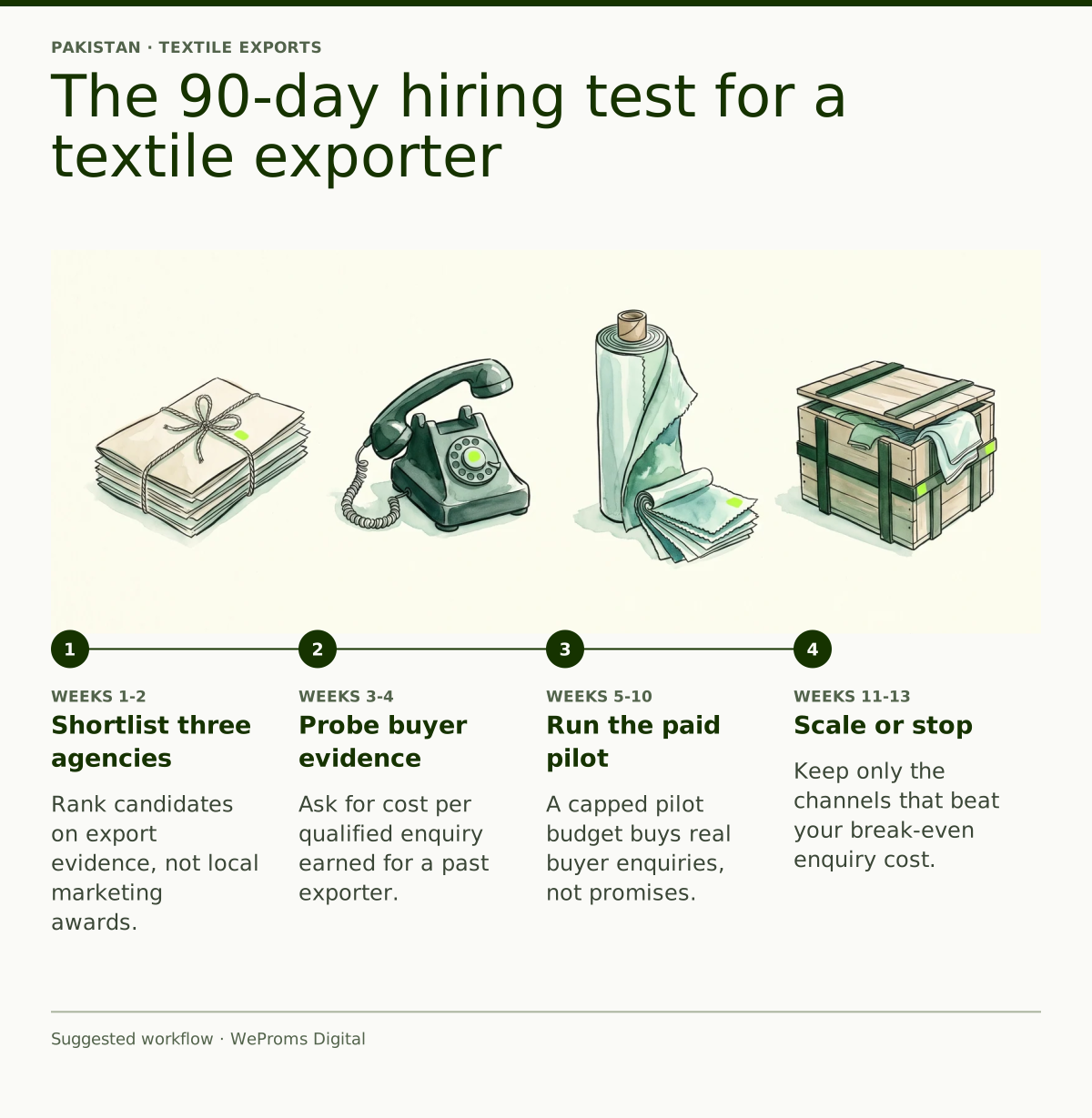
A capped 90-day pilot budget buys real buyer enquiries, not promises. Weeks 1-2 fix measurement: conversion tracking — the code and setup that records which ad produced which enquiry — wired to your email, WhatsApp, and sample-request form, so nothing arrives unattributed. Weeks 3-4 launch two tightly themed campaigns: Google Ads on buyer phrases such as “knitted workwear gloves manufacturer” or “home textiles exporter FOB Karachi”, and a LinkedIn sequence aimed at procurement titles in your target market, following the pattern in our LINK method guide for Pakistani B2B LinkedIn pipelines. Weeks 5-10 gather data with budgets untouched. Weeks 11-13 decide: scale what worked, stop what did not.
Worked example — substitute your own costs before using it. Assume an average confirmed trial order of USD 18,000 (one part-container of knitwear) and a contribution margin of 12 per cent after yarn, dyeing, stitching, and freight, which leaves USD 2,160 per order. A PKR 600,000 ninety-day pilot — about USD 2,170 at the November 2026 interbank rate of roughly PKR 277 per US dollar, per NBP rates tracked by Mettis Global — breaks even on a single confirmed order. Assume the split is 60 per cent media and 40 per cent fees, the duration is 90 days, and the channels are Google Ads plus LinkedIn. If eight qualified enquiries typically produce one order, your ceiling on cost per qualified enquiry is about USD 270, or roughly PKR 75,000. Scale only the channels that beat your break-even enquiry cost.
That math fits a mill that can absorb a part-container trial order. A smaller stitching unit should run the identical test on sample orders of USD 1,500-3,000 and set the enquiry ceiling proportionally — the method is the same; only the denominators change.
After that, check whether they understand how buyers actually buy
Research by Forrester Consulting, commissioned by Sana Commerce, found that seven in ten B2B organisations say their buyers bypass digital channels at critical points such as confirming prices or checking stock — reported in the UK trade publication Retail Gazette. Your overseas buyer behaves the same way: he will shortlist three suppliers online, then pick up the phone or message on WhatsApp at the moment of truth. An agency that only builds landing pages with forms is building for the shortlist stage and abandoning the decision stage.
“You can build a perfectly good path and still find everyone walking across the grass. These are called desire paths.” — Chris Gee, founder of digital consultancy Rixxo, writing in Retail Gazette
Demand three things in the build: click-to-WhatsApp and click-to-call on every landing page, a named person answering within the buyer’s business hours, and sample-request forms that reach your merchandiser the same day. A deal in Faisalabad closes over chai at the counter, not over a brochure — your website’s enquiry path deserves the same hospitality. Also test the agency’s trade vocabulary in the first meeting: MOQ (minimum order quantity), FOB (free on board) pricing, and lead times. An agency that asks about your MOQ unprompted has worked with exporters before; one that asks what MOQ means has not.
At this point, demand the numbers that matter monthly
Commit the reporting to three lines in the contract: cost per qualified enquiry, enquiry-to-sample ratio, and sample-to-order ratio. Monthly, in one table, no dashboards required. If the agency resists measuring to sample and order, it is measuring its own convenience, not your business — and before you accept any traffic explanation, it is worth remembering how easily seasonality masquerades as results, a trap we unpack in “Did my SEO work, or was it just shaadi season?”.
One more item belongs in the audit, not the buying decision. Some sourcing teams now ask AI assistants to shortlist suppliers, and industry studies still disagree sharply on what an AI-referred visitor is worth: Semrush reported AI visitors at 4.4 times the value of traditional organic visitors, while Siege Media’s 2026 analysis put the median AI-to-organic conversion advantage at just 1.26x. Neither study covers Pakistani textile suppliers, so treat AI visibility as a bonus the agency tracks, not the criterion you hire on.
Once you have picked, structure the contract around the export calendar
In 2026, credible Pakistani marketing help sits in three broad bands — PKR 40,000-80,000 a month for a solo freelancer, PKR 120,000-250,000 for a local generalist agency, and PKR 250,000-400,000 for an export-focused specialist (illustrative market bands; confirm current quotes, and expect media budgets on top of fees). The chart with this article shows the mid-points. A retainer — a fixed monthly fee for an agreed scope of ongoing work — should carry a three-month initial term, a 30-day exit clause, your ownership of the ad accounts and all content, and read access to every platform from day one.
| What you are buying | Solo freelancer | Local generalist agency | Export-focused specialist |
|---|---|---|---|
| Monthly fee (PKR, illustrative) | 40,000-80,000 | 120,000-250,000 | 250,000-400,000 |
| What they can prove | Activity and posts | Local rankings, domestic leads | Cost per qualified export enquiry |
| Understands MOQ, FOB, lead times | Rarely | Sometimes | Yes, and asks first |
| Blended reporting risk | High | High | Split brand vs new buyers |
| Best for | Keeping social media alive | Selling inside Pakistan | Growing buyer enquiries abroad |
Time the contract to the fabric calendar, not the Gregorian one. Ramadan is expected to begin around 8-9 February 2027 in Pakistan, subject to moon sighting, per Pakistan Observer — and EU, UK, and Gulf buyers stock Eid fabric months before that, which means their sourcing decisions cluster in late autumn and early winter. The tradeoff is simple: pay a higher fee for evidence, or a lower fee for activity. Count sample requests in November, confirmed orders by December, and shipments ahead of the January-February dispatch rush — early interest, confirmed orders, and delivered containers are three different numbers, and a good agency reports all three separately.
The outcome: an agency that behaves like your export desk
Here is the decision criterion in one line: if the first meeting is about impressions and likes, thank them and leave; if it is about qualified enquiries, sample ratios, and your MOQ, negotiate. Every month spent on blended reports and boosted posts is PKR 150,000 or more that could have bought a tested channel, and the mills around you are not waiting. Ninety days of disciplined testing beats a year of hopeful spending — that is the whole method.
Read next: B2B lead generation in Pakistan: build a sales pipeline and the LINK method for Pakistani B2B LinkedIn pipelines.
At WeProms Digital, we run exactly this discipline as our B2B lead generation service for Pakistani exporters — tracking first, spend second, and a capped pilot before any full retainer. Based on our experience working with Pakistani manufacturers and service businesses, we also build the follow-up layer most exporters lack through B2B email outreach systems so no qualified enquiry goes cold. Talk to us on WhatsApp +92 300 0133399 or via weproms.com/contact-us — we reply in Pakistan, UK, and Gulf business hours.
Frequently Asked Questions
How much should a textile exporter pay a marketing agency in Pakistan?
Plan on PKR 250,000-400,000 a month in fees for an export-focused specialist, with media budget on top — a PKR 600,000 ninety-day pilot split roughly 60/40 between media and fees is a sensible first commitment. Solo freelancers at PKR 40,000-80,000 can manage social pages but rarely deliver qualified buyer enquiries. These are illustrative 2026 market bands; confirm current quotes and always tie fees to the cost-per-enquiry maths in this guide.
Should I hire an agency in Lahore, Karachi, or overseas?
Location matters far less than export evidence. A Lahore agency with three exporter references and clean search-term data will beat an overseas agency several times its price that cannot show either. Overseas firms add cost and time-zone friction without adding buyer intent; your buyers search Google in English everywhere. Vet on evidence first, city second.
How long before real buyer enquiries arrive?
Set expectations by week: tracking fixed in weeks 1-2, campaigns live in weeks 3-4, first qualified enquiries typically between weeks 5 and 8, and a scale-or-stop decision in weeks 11-13. Any agency promising a flood of orders in month one is selling to your hope, not your market. The 90-day structure exists precisely because buyer cycles run six to twelve weeks.
Is a listing on Alibaba.com enough instead of an agency?
A marketplace listing is one shelf in one shop — it can generate enquiries, but you share them with dozens of competing suppliers and rent the customer relationship. Your own website, ads on buyer keywords, and a disciplined follow-up system build an asset you own. Use both: Alibaba for volume discovery, your own channels for margin and repeat orders.
Does WeProms Digital work with textile exporters?
Yes. WeProms Digital builds B2B lead generation systems for Pakistani exporters — conversion tracking, buyer-keyword campaigns, and enquiry follow-up — starting with a capped pilot so you see real cost per qualified enquiry before committing to a retainer. Message us on WhatsApp or email hello@weproms.com for scope and current pricing.
Sources & References
- Business Recorder — FY26 textile exports reach four-year high level — November 2026
- Google Ads Help — About the search terms report — official documentation
- PPC Hero — Your Brand Traffic Is Flattering Your Google Ads Results — November 12, 2026
- Retail Gazette — Why trade buyers still pick up the phone even after a six-figure ecommerce launch — November 12, 2026
- Semrush Blog — AI traffic quality: look past the industry benchmarks and measure ROI — November 12, 2026
- Mettis Global — NBP issues foreign exchange rates — November 2026
- Pakistan Observer — Ramazan and Eid-ul-Fitr 2027 expected dates in Pakistan revealed — November 2026
Additional reading from industry feeds: