
By Sara Khan · WeProms Digital · November 10, 2026
The FAIR check breaks the question “did my SEO actually work?” into four steps: F for Frame the question, A for Agree the win line, I for Isolate a comparison, and R for Read the range. It exists because a British Pakistani family jeweller on Leicester’s Golden Mile can pay a £600 monthly retainer — sitting inside the £300 to £800 band that published UK price lists show for local SEO work — and still receive no proof of what that money did.
The pattern repeats every year. In June, the agency rewrites 80 product pages. By August, bridal enquiries are up and the monthly report takes the credit. August is also peak shaadi season on Belgrave Road, when wedding-party orders lift every till on the Golden Mile regardless of what anyone did to the website that month.
Traffic rises before Eid al-Fitr. It rises through the summer wedding months. It rises again when winter engagements begin.
A before-and-after chart cannot separate those lifts from the SEO work, and any report that presents one as proof of the other is proving timing, not cause. Judging a website change on one good month is like judging a new window display on Chand Raat; the queue outside tells you about the night before Eid, not the glass. Search Engine Journal’s agency-side analysis of SEO proof puts the real test plainly:
“The real question isn’t ‘did traffic go up?’ It’s ‘did traffic go up more than it would have without the change?’”
That estimate — what would have happened anyway — is called the counterfactual, and building one is the entire job of measuring SEO. Organic traffic to a jewellery site moves for reasons that have nothing to do with your agency: shaadi and Eid seasonality, Google core updates, rivals improving their own pages, and AI answers on Google that change how often people click even when a ranking holds. Google also counts interactions with those AI features inside the overall Search Console performance report, so a “traffic change” in your dashboard may simply be a change in how Google displays results.
Last updated: November 2026.
F — Frame the question: write down what the change should move before anyone touches the website
A frame is a sentence with a blank in it. “Rewriting the product pages will increase ______ by at least ______ within ______ weeks.” If your agency cannot fill in those blanks in writing, there is no test — there is only activity.
The blank that matters most for a shop is non-branded organic clicks — visits from Google searches that do not contain your shop’s name, which measure new demand rather than existing reputation. A bridal-set page that attracts people searching “gold kangan sets UK” is doing SEO work; a page that only catches people who already typed your family name is doing nothing new.
One practical warning from Google’s own reporting: Search Console hides anonymized queries — searches made by very few people — when you filter reports by keyword, so the per-keyword numbers will never add up. Judge the tested pages by their total clicks instead, as Google’s Search Console data documentation explains.
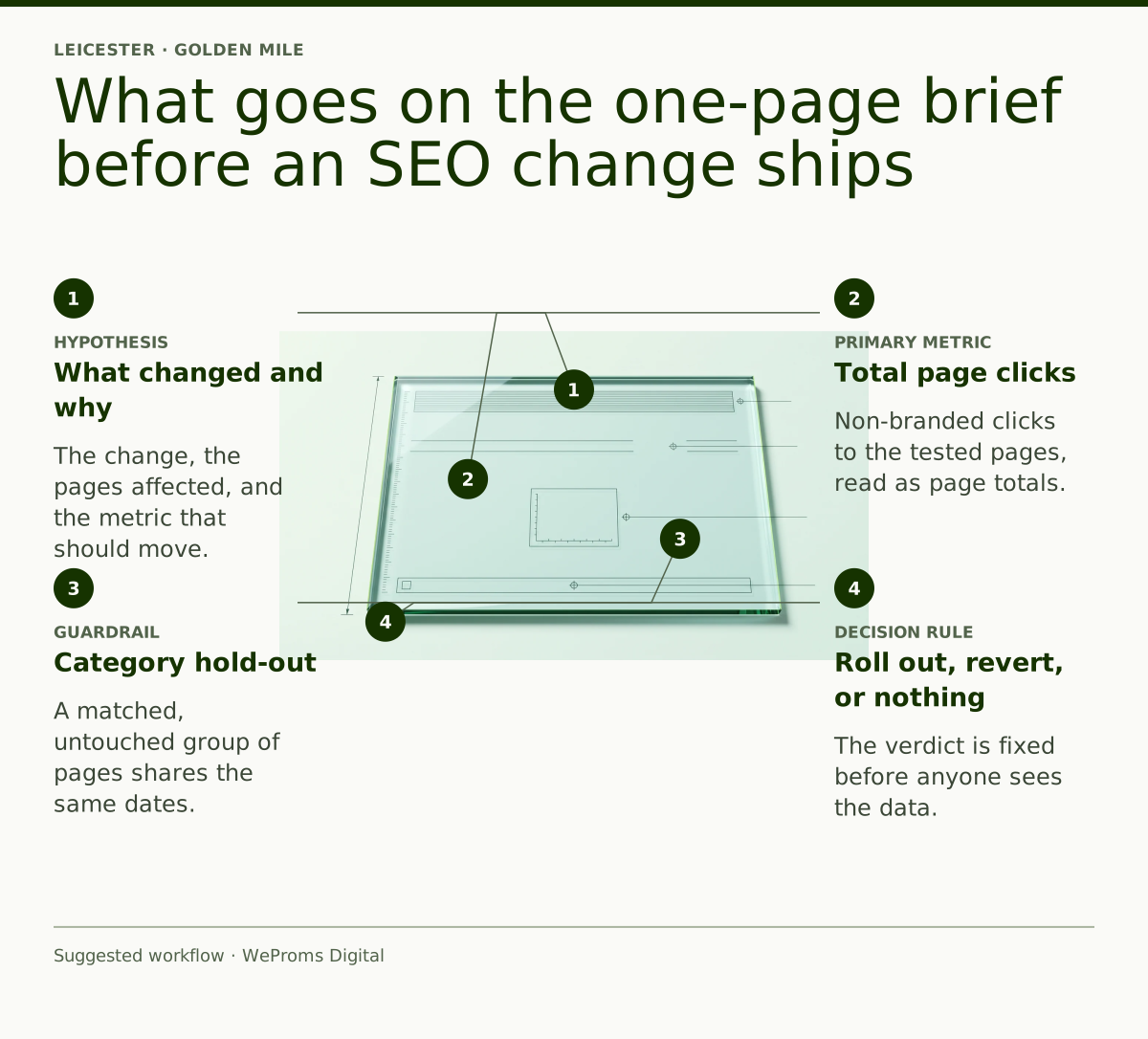
Before the work starts, ask for one page containing: what is changing, the pages affected, the metric that should move, and the date the result gets read. An agency that resists writing that page is asking to be judged on vibes.
A — Agree the win line: decide in advance what result means roll out, roll back, or nothing
The win line is the agreement you make while nobody has seen the data yet. Choose it after the fact and every month becomes a good month.
Three decisions make up the line. First, the smallest lift worth acting on — for an 80-page jewellery site, that might be “non-branded clicks to tested pages up at least 10% over eight full weeks”. Second, the analysis date, counted in whole weeks so every weekday appears equally. Third, the rule: roll the change out across the site, roll it back, or record it as inconclusive and move on. An inconclusive result is a real result; it stops a shop paying twice for the same experiment.
Reporting style matters as much as the rule. Search Engine Journal’s guidance on results that survive a boardroom is to present a range rather than a point: “clicks are up 14%” invites an argument, while “the model puts the lift between 8% and 19%” is far harder to argue with, because it admits the noise the single number hides. A Leicester shop owner should expect exactly that honesty from a monthly report.
Here is a working example of the agreement, ready to paste into an email:
SEO test brief — [Shop name], Leicester Change: rewritten titles and descriptions on [category] pages only. Primary metric: total non-branded clicks to those pages in Search Console. Comparison: [other category] pages left unchanged. Win line: at least a 10% gap between the two groups after eight full weeks. Decision: apply site-wide, revert, or record as inconclusive on [date].
That half-page costs nothing and changes the year-end conversation from “do we believe you?” to “did it pass the test we agreed on?”
I — Isolate a comparison: the pages you leave alone are your only honest witness
SEO measurement cannot split shoppers between two versions of a page, because Google only ranks one version of each web address at a time. So a fair test splits pages instead of people: one group of similar pages receives the change, and a matched group stays untouched as the control group — the untouched baseline that shows what the season did on its own.
The matching matters. Compare bangles pages with bangles pages, not bangles with rings, and keep pages of similar popularity on the same side, or a “winning” page simply steals clicks from its quieter twin. Both groups must run over the same dates, so an August shaadi spike or a Google update lands on both.
Two guardrails from Google’s own rules. Showing search engines different content from what shoppers see is called cloaking, and Google’s spam policies treat it as a violation whether a test is running or not. And keep pages that compete for the same searches together as one unit, so the test measures growth rather than cannibalisation.
| Letter | Question it answers | Evidence to ask your agency for |
|---|---|---|
| F — Frame | What should this change move? | The one-page brief, written before work starts |
| A — Agree | What counts as a win? | The lift threshold, analysis date, and decision rule |
| I — Isolate | Compared with what? | The list of control pages and why they match |
| R — Read | How big, in money terms? | The click range and enquiries on tested pages |
For a shop with only a few dozen pages, one untouched category is a workable control. The method transfers to any Leicester family retailer — the same hold-out logic that keeps a mithai shop’s marketing honest during shaadi season.
R — Read the range, then the revenue: why “traffic up 14%” is not an answer
Clicks are a leading indicator; the family cares about the till. Both belong in the reading, in that order.
Take a worked example — substitute your own numbers. The shop pays a £600 monthly retainer, typical of what UK small businesses pay for local SEO. A typical bridal-set enquiry from the Golden Mile runs to £1,400, and the shop keeps roughly £490 of that after product and staffing costs. Two extra confirmed sales a month therefore cover the entire retainer; three make it profitable. That is the honest arithmetic of SEO for a family jeweller, and it is why rankings alone stopped being the point for UK desi retailers some time ago.
Read the range first, the revenue second, and the report’s screenshot last. A defensible month-two report says: non-branded clicks to tested pages sit between 8% and 19% above the control group, producing four enquiries and one confirmed order worth £1,400. An indefensible one says “great momentum” in purple text.
When the reading is done, one decision follows: scale the change to the rest of the site, revert it, or record it as inconclusive. Then the next test starts with a cleaner baseline than the last — which is how a shop eventually traces its enquiries back to real bookings instead of guessing.
Read next: Why a Leicester boutique’s ad budget leaks before shaadi season · Do Google rankings still matter for a mithai shop in Leeds?
Running FAIR once a quarter turns an SEO retainer from a leap of faith into a purchase with a receipt. WeProms Digital, an SEO audit and strategy team for overseas Pakistani family businesses, sets up exactly these page-level comparisons before recommending any change, and our SEO consultants review existing retainers against control-page evidence. Based on our experience working with family retailers across the UK and the Gulf, the shops that insist on a control group get straighter answers in three months than most get in three years. Start with a free review: email hello@weproms.com or message WhatsApp +92 300 0133399 — we reply in UK business hours.
Key Takeaways
- A before-and-after chart proves timing, not cause; shaadi, Eid and Ramadan lift a Leicester jeweller’s traffic whatever the SEO agency did.
- Frame the test in writing before work starts: what changes, on which pages, and which metric should move.
- Agree the win line while the data is still unseen — threshold, analysis date in full weeks, and a roll-out / revert / inconclusive rule.
- Isolate a control group of similar untouched pages running on the same dates; that gap is the only honest measure of the change.
- Read the range, then the revenue: at £600 a month and roughly £490 kept per bridal set, two extra sales a month cover the retainer.
Frequently Asked Questions
How long should I run an SEO comparison before judging it?
Count in full weeks, never mid-week to mid-week, so every weekday is represented equally. Eight full weeks is a sensible minimum for a jewellery site whose enquiries move with weddings and Eid; four weeks can work for pages with steady traffic. Fix the analysis date before the test starts and honour it, because moving the goalposts after seeing the data turns every test into a win.
Does Ramadan traffic make my results impossible to read?
No, but it changes what you compare against. Ramadan 2026 ran from 18 February to Eid al-Fitr around 21 March in the UK, per published UK Islamic calendar dates, so comparing those weeks with January flatters whatever changed in between. Compare year-on-year Ramadan weeks, or rely on control pages that shared the same season. Never let a Ramadan lift be presented as evidence of an SEO change.
My shop has only 30 product pages. Can I still test fairly?
Yes. Hold out one whole category — bangles, for example — while another gets the change, and compare the two groups over the same dates. The smaller the site, the longer the test should run, because individual page traffic is noisier. One clean category-level test beats three rushed ones.
What should I ask my SEO agency every month?
Four items: the one-page brief, the list of control pages, the click range between the two groups, and the enquiries or sales on the tested pages. If the report shows screenshots without a comparison group, ask for one in writing. An agency doing real work welcomes the request; the request only frightens an agency that cannot answer it.
Can WeProms check whether my current SEO spend is working?
Yes. WeProms Digital audits existing SEO retainers for family businesses across the UK and Gulf, sets up control-page comparisons, and reports ranges with revenue attached rather than traffic screenshots. Pricing depends on the size of the site and the depth of the audit, so the team quotes after a short call — email hello@weproms.com or message the WhatsApp line above.
About WeProms Digital
WeProms Digital is a Lahore-based SEO audit and measurement agency working with overseas Pakistani and halal-minded business owners across London, Birmingham, Manchester, Dubai, Riyadh, Toronto, Houston, and beyond.
The team specialises in SEO audits, search visibility strategy, and conversion-focused measurement, with a track record of building page-level tests that survive a family-business review.
Get in touch: hello@weproms.com · WhatsApp +92 300 0133399 (replies in UK and Gulf business hours) · weproms.com/contact-us
Sources & References
- Search Engine Journal — SEO Split Testing In 2027: How To Prove A Change Actually Worked — November 9, 2026
- Google Search Console Help — About Search Console data (anonymized queries) — accessed November 2026
- Google Search Central — Spam policies (cloaking) — accessed November 2026
- Searchlucid — SEO Cost UK: published monthly price ranges — 2026
- Spotlight Studios — SEO marketing costs for UK small businesses — 2026
- Time and Date — Eid al-Fitr and Ramadan dates, United Kingdom — 2026 calendar
- WordStream — How Big Is Google’s AI Problem? — November 9, 2026
Additional reading from industry feeds: