By Abdul Rehman · WeProms Digital · October 23, 2026
TL;DR: ChatGPT writes its own web searches before it answers you, and it rewrites them every single run — an agency test found two identical prompts eight minutes apart shared zero search phrasings. For your Edmonton halal catering business, one check proves nothing. Three customer-style questions, run three times over a week and logged, gives you a pattern worth acting on.
Last updated: October 2026.
Why does ChatGPT give a different answer every time I ask?
Because ChatGPT searches the web before it answers, and it invents its own search phrases fresh on every run. Seer Interactive, a US digital agency, ran one identical prompt twice in the same browser, eight minutes apart, and the two runs shared zero search phrasings. Your halal catering business can surface in one run and vanish from the next without anything changing on your side.
Here is the mechanism in plain words. You type a question about caterers in Edmonton. ChatGPT composes its own search queries, runs them, pulls back a stack of pages, reads what it can, and writes an answer naming a few sources. Which means the answer depends on search phrasings you never chose and cannot see. Change the phrasing, and the shortlist changes.
Seer Interactive documented this on a byte-for-byte identical prompt — the team hashed the 148 characters to prove nothing had changed between runs. Run on September 3, ChatGPT retrieved 14 unique pages. Run again on September 16, the same prompt retrieved 40. If a food blogger’s post about Edmonton catering sits inside that stack on Tuesday and misses it entirely on Wednesday, the shortlist ChatGPT writes will differ.
One check is not a verdict.
Think of it like asking for a caterer recommendation at the Eid bazaar. Ask three different aunties, and you get three different names, because each walked a different row of stalls. Ask the same aunty next month, and her answer changes again. The dependable information is not any single answer — it is the pattern that survives five conversations.
How often does ChatGPT change how it searches?
Constantly — measurable within minutes, and again week to week. The two Seer runs eight minutes apart shared the same signed-in browser profile, and still every generated search phrase differed, moving both the retrieved and cited page sets. Week-scale studies see the same churn: Sistrix tracked 82,619 prompts across 17 weeks and found Google’s AI Mode answers replace about 56% of their cited domains every week, with ChatGPT Search turning over even more at about 74%. Your shop appearing today is evidence of nothing more than today.
There is an honest counterweight, and you should know it before you panic over a bad Tuesday. BrightEdge, analyzing week-over-week citation data in early 2026, reported that 96.8% of cited domains saw no change at all. Read the two studies together and the picture resolves: the big, established domains keep their seats, while the mix of sources inside any single answer keeps shuffling. For a small shop in Edmonton the practical reading is blunt — do not chase daily movement, and do not pay anyone who reports daily movement to you as progress.
The tradeoff is simple: a single screenshot feels like proof, but only a logged pattern behaves like evidence.
What is the difference between being found and being quoted?
A large one, and most owners never see the line between them. ChatGPT retrieves far more pages than it cites — in Seer’s September 16 run it retrieved 40 and cited 6, passing over 34. Retrieved — pulled into the search stage, where ChatGPT can read the page before deciding what to say. Cited — named as a numbered source attached to the answer your customer actually reads. A page can be retrieved for weeks and never cited once.
Seer’s own conclusion applies directly to any Pakistani-owned business checking its name on a phone between orders:
“if you’re checking your brand’s AI visibility by running a prompt once, you’re missing the full picture, because it’s constantly changing.”
Consistent retrieval without citation usually signals a clarity problem, not a fame problem. The page was found, read, and passed over — often because it never states plainly what the business does, where it works, or what a typical order costs. That is fixable in an afternoon. Obscurity is not.
How many checks before I trust the result?
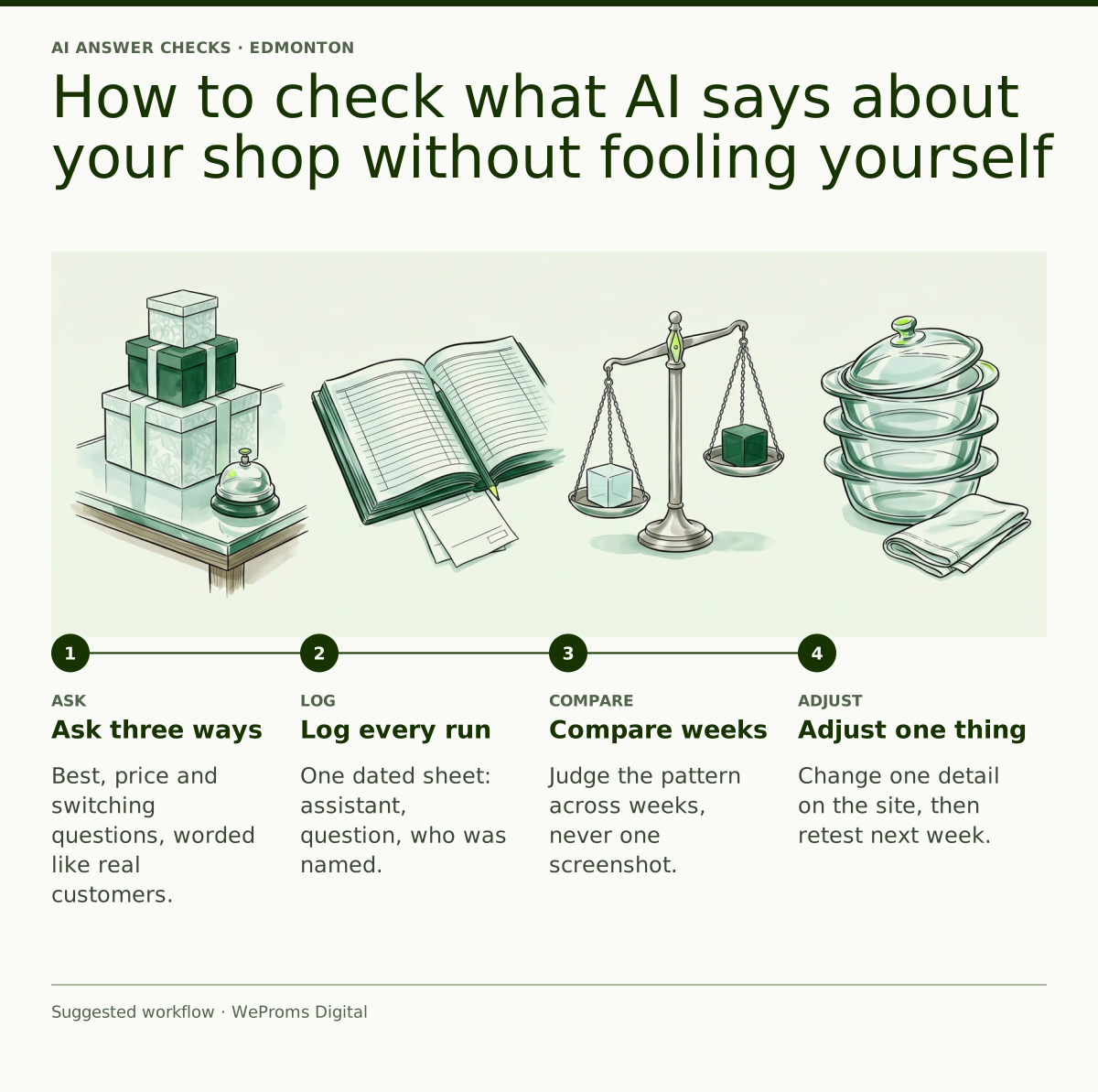
Nine, minimum: three questions, three runs each, spread across a week, every answer logged. Ask three different questions, the way real customers ask them. Log every answer in one place, dated. Compare this week’s answers with last week’s before you judge. Adjust one thing at a time, then retest the following week.
For each run, record the assistant used, the exact question, every business named and in what order, and whether yours appeared at all. A simple sheet keeps the discipline honest:
| What you did | What it proves | What it does not prove |
|---|---|---|
| Asked once, competitor named | ChatGPT’s answer at that minute | Anything about next week |
| Asked only your brand name | Your listing exists somewhere | What a new customer actually sees |
| Nine logged runs, three questions | A repeatable pattern you can act on | A permanent position — there is none |
The whole routine costs about an hour a week. Put a rough number against it: a shaadi catering booking for 150 guests in Edmonton might average around CAD 2,500 (illustrative — substitute your own average booking value). One extra booking a quarter repays that hour many times over. The honest caveat: that is revenue arithmetic, not proof the AI mention caused the booking, so ask every new client where they heard of you and keep the answer in the same log.
What questions should I test with?
The three your customers actually type when planning: a “best” question, a price question, and a switching question. Nobody planning a wedding asks a chatbot your brand name — they ask it to shortlist options on their behalf.
Test with prompts shaped like this one, ready to paste:
“I’m planning a shaadi in Edmonton for 150 guests. Which halal caterers should I shortlist, and what do they typically charge per head?”
Then run a price variant — how much halal catering costs per person in Edmonton — and a switching variant — how to choose between two halal caterers in Edmonton. Run the set in ChatGPT, then repeat it in Perplexity and Google’s AI Overviews — the summarized answers Google sometimes shows above its regular results. Your customers’ cousins in Calgary and Toronto planning their own shaadis are not all on the same assistant, and the same question behaves differently in each.
The wording matters more than the tool. Phrasing is what moved Seer’s results inside eight minutes.
What if my catering business never appears at all?
If three weeks of logged checks show zero appearances — not cited, not even retrieved — fix the foundations before paying anyone for visibility work. The foundations are unglamorous: one identical name, address, and phone number on your Google Business Profile, your website, and your Instagram bio; a steady drip of reviews you actually reply to; and one plain page per service and city that states who you serve, what you charge per head, and how far you travel. A page that says “halal catering in Edmonton for 50 to 300 guests, from CAD 18 per head (illustrative pricing)” gives an answer engine something quotable. A gallery of your cousin’s wedding photos does not.
And do not accidentally remove yourself. Some shop owners, upset about AI copying content, add a robots.txt — the plain-text file at your website’s root that tells crawlers where they may go — rule blocking GPTBot, then wonder why ChatGPT stopped mentioning them. Google’s Search Central guidance is explicit that robots.txt limits where compliant crawlers, AI crawlers included, may go; block the crawler and you are out of its search entirely. Keep crawling controls separate from your feelings about training data — they are different decisions with different consequences.
A Toronto modest-fashion store owner faces the same foundation list when AI shopping agents read her listings, and the same discipline is what gets an oud shop in Dubai recommended by ChatGPT. The markets differ; the checklist does not.
Can an agency promise my shop a permanent ChatGPT mention?
No. Treat that promise as a disqualifier, however flattering the deck looks. Josh Blyskal, who analyzed 80,000 prompts across ChatGPT, Google AI Overviews, Microsoft Copilot, and Perplexity, put it plainly:
“AI search volatility is far greater than I ever imagined.”
An agency that reports your AI visibility from a single screenshot is selling noise, not measurement. A legitimate engagement looks like the opposite: a fixed set of customer questions, run weekly, logged, with the retrieved-versus-cited split visible and a month-over-month trend you can read. It is the same nine-run discipline from this article, run on schedule instead of whenever someone remembers.
Read next: If ChatGPT never names you at all, start with whose shop comes up when Riyadh customers ask AI for a tailor and how Riyadh Eid gift boxes got into ChatGPT’s shopping answers.
You can run this discipline yourself with a notebook and an hour a week. If you would rather have it run for you, WeProms Digital’s AI search visibility monitoring and citation tracking service logs a fixed question set across ChatGPT, Perplexity, and Google every week for overseas Pakistani businesses, and its answer engine optimization services fix the foundation pages those logs expose. Based on our experience working with halal food businesses across Canada, the UK, and the Gulf, a readable pattern usually emerges within three weeks. Reach the team at hello@weproms.com or WhatsApp +92 300 0133399, or through weproms.com/contact-us.
Sources & References
- Seer Interactive — Same Prompt, Different Data Structure: ChatGPT’s Search Data Keeps Changing — October 22, 2026
- Sistrix — AI Citation Drift: How Stable Are Sources in AI Search Results? — May 2026
- Joshua Blyskal — AI Search Research Findings — August 2026
- BrightEdge — Weekly AI Search Insights — February 2026
- Google Search Central — Introduction to robots.txt — accessed October 2026
Additional reading from industry feeds: