
By Abdul Rehman · Last updated: August 17, 2026 · Reading time: 10 minutes
TL;DR: WebAIM’s 2026 scan of the top one million home pages found detectable accessibility errors on 95.9% of them, averaging 56 barriers per page. For Pakistani stores selling to Europe, the European Accessibility Act has made those errors a legal exposure since June 28, 2025, with fines reaching €250,000 in France. The same defects quietly suppress checkout completion at home, and a proper audit costs a fraction of one fine.
What does the European Accessibility Act require from a Pakistani store?
The European Accessibility Act (EAA) is an EU directive that covers ecommerce services sold to consumers in member states, and it applies regardless of where the seller is headquartered — a Karachi or Lahore store shipping to Germany or France is inside its scope. Enforcement began June 28, 2025, and the European Commission’s official EAA resource describes obligations for product and service providers, with national authorities policing them. In practice, the accepted route to conformity is building to the WCAG standard — the Web Content Accessibility Guidelines published by the W3C, whose current version is WCAG 2.2.
Which means the question a Pakistani owner should ask is not whether the law mentions Pakistan. It does not need to. The trigger is selling to EU consumers, and the exposure is enforced by the member state where your customer sits. Penalty regimes vary by country: InclusiveWeb’s summary of member-state penalties documents French fines running from €5,000 up to €250,000, with Deque’s country-by-country compliance data showing similar ranges across other states. One French maximum exceeds what most Pakistani stores spend on their entire website.
Start here: confirm whether you sell and ship to the EU. If yes, an accessibility audit moves from nice-to-have to risk management, and doing nothing is a decision with a price attached.
How badly do websites actually fail accessibility checks?
Badly, and consistently. WebAIM’s Million project crawls the home pages of the top one million websites every year and runs automated detection across them; the 2026 edition found errors on 95.9% of home pages, with an average of 56 detectable barriers per page. Detection at that scale understates the problem rather than overstating it, because automated scanning only surfaces a subset of failures — anything requiring a human with a keyboard and a screen reader to confirm stays invisible to the crawler.
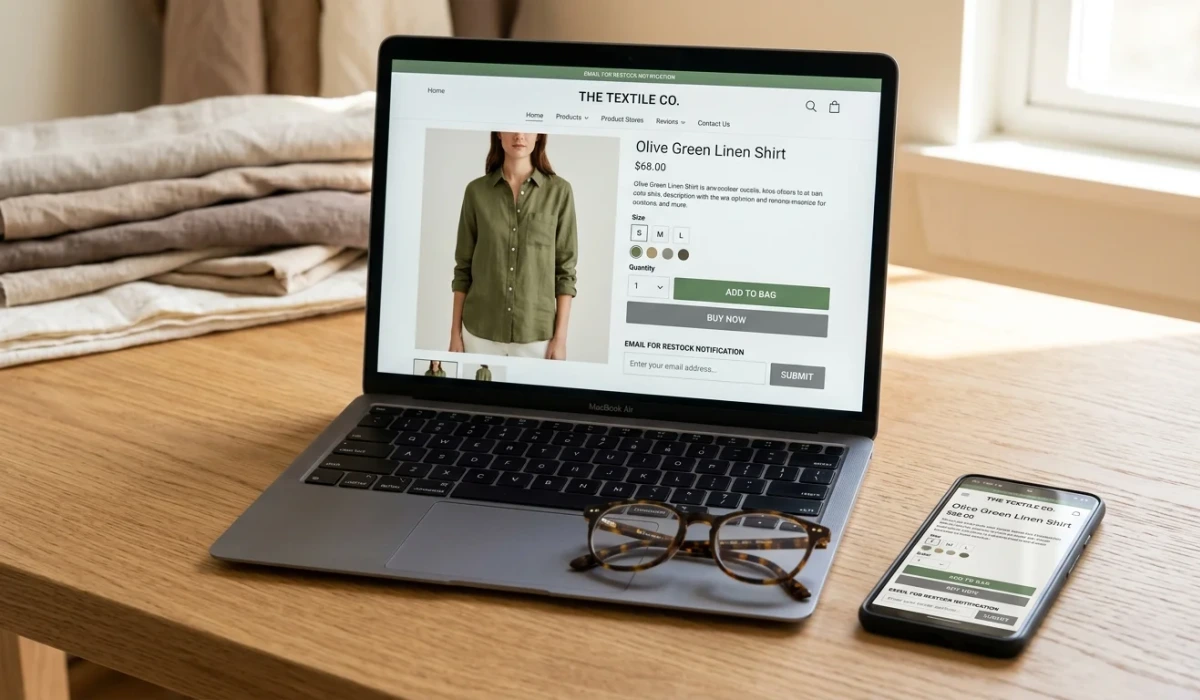
The pattern has held for years. WebAIM’s six most common failure categories have barely changed across seven consecutive reports, which tells you the defects are structural rather than novel: low-contrast text, missing labels, empty links, missing alternative text, missing document language, and broken heading structure. Pakistani ecommerce is not exempt from any of this. The typical product page — light gray size charts, icon-only buttons, coupon fields with no visible label — fails the same checks that fail globally, just with local spellings.
For a store owner, the takeaway is that your site almost certainly has these barriers too. The probability is not 50/50; it is the overwhelming default, and assuming otherwise is how the audit keeps getting postponed.
Which failures cost the most sales at home?
Think of the last faint gray price tag you squinted at on a clear plastic wrapper at a bakery counter in Karachi. You eventually gave up and asked the cashier, or you skipped the item. Low contrast ratio does the same thing to a product page: low-contrast text affects 83.9% of the top million home pages — the single most common failure WebAIM detects — and it taxes every visitor, not only those with diagnosed vision impairment, because gray-on-gray becomes unreadable on an aging phone in afternoon sunlight.
Form fields punish harder. WebAIM found 33.1% of form inputs on average home pages have no programmatic label, meaning one in three fields announces itself as just “edit text” to a screen reader — the software, such as NVDA on Windows or VoiceOver on an iPhone, that reads pages aloud to blind users. A checkout that cannot state what its coupon field expects loses those customers entirely. Empty links, at 46.3% of pages, do the same to navigation; missing alt text on 16.2% of images removes product context that neither shoppers nor search crawlers can recover. These same fundamentals drive the conversion lifts covered in our CRO QA checklist for Pakistani ecommerce and the CLEAR framework for ecommerce conversion — accessibility work and conversion work share a task list more often than not.
The sales case writes itself. Fix contrast, label fields, name your links, describe your images: four changes, zero redesign, and every one of them removes friction for the customers you already pay to attract.
What does an accessibility audit cost in Pakistan?
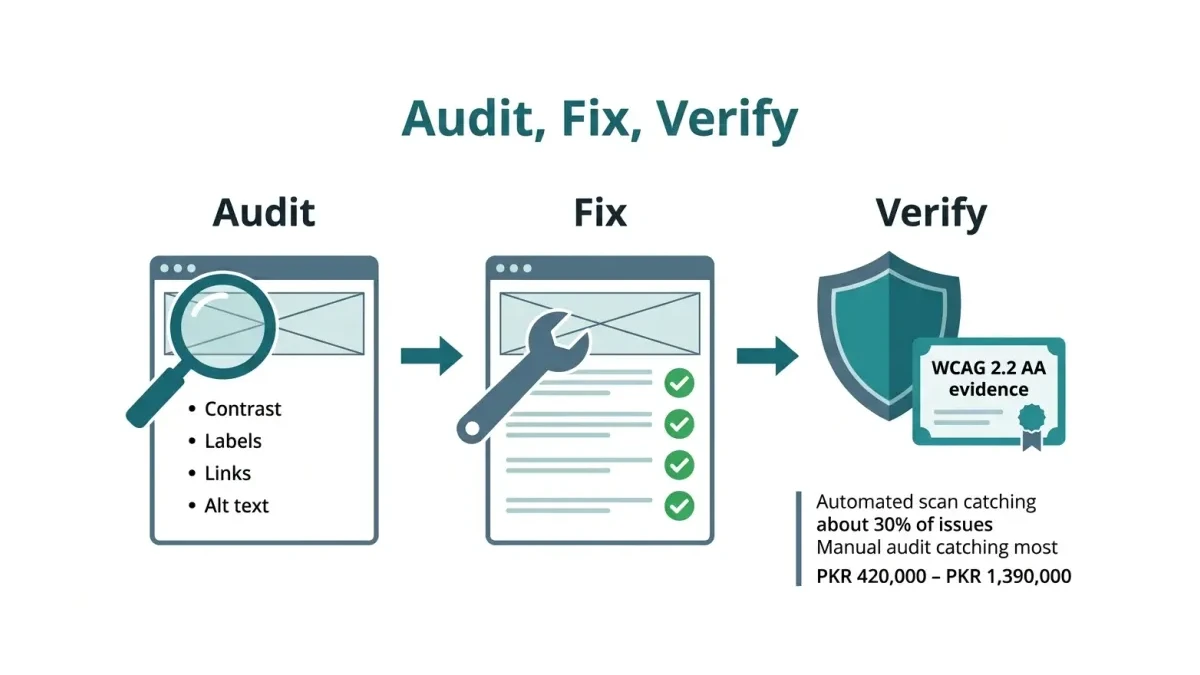
An accessibility audit — a systematic, template-by-template review of your store against WCAG success criteria, delivered as a prioritized fix list — costs less than most owners assume and more than most expect. DigitalA11Y’s pricing guide puts typical audits between $1,500 and $5,000, which lands near PKR 420,000 to PKR 1,390,000 at the August 2026 exchange rate of roughly PKR 278 to the dollar. Scope drives the number: template-based pricing keyed to your product page, collection page, cart, and checkout costs far less than a page-by-page crawl of a 5,000-URL store.
The tradeoff is between coverage and speed, and it maps to three tiers. A free automated scan takes minutes and catches surface issues. A manual audit takes weeks and catches what matters. A full remediation program — audit, fixes, and verification passes — is the only tier that produces defensible evidence of compliance for EU-facing sales. Budget for the audit first, decide on remediation scope after you see the actual defect list, and treat any vendor quoting remediation before auditing as a red flag.
Do automated scanners count as compliance?
No, and the gap is measurable. The A11Y Collective’s cost analysis notes that automated tools detect roughly 30% of WCAG issues, which means a clean Lighthouse or WAVE report certifies almost nothing: keyboard traps, focus order, screen-reader announcement logic, and meaningful alt text all require a human tester to confirm. Free scanners remain useful as monthly monitoring between real audits — the same way site-speed tools support, but never replace, a Core Web Vitals fix.
| Automated scan | Manual WCAG 2.2 AA audit | |
|---|---|---|
| Issues detected | ~30% of WCAG failures | Most success criteria, incl. keyboard and screen-reader failures |
| Typical cost | Free to a small monthly fee | $1,500-$5,000 depending on templates |
| Turnaround | Minutes | 2-4 weeks including re-testing |
| Output | Raw issue list | Prioritized remediation plan with severity and effort |
| Best used for | Monitoring between audits | Compliance evidence and conversion-grade fixes |
One more caution while we are here: overlay widgets that promise one-line accessibility fixes are widely criticized by accessibility practitioners, because they layer automated patches over the very failures automation cannot see. If a vendor’s entire remedy is a script tag, keep shopping.
How long does remediation take on Shopify or WooCommerce?
Sequence matters more than platform. The first phase fixes template-level defects — contrast tokens in the theme, visible labels on all form fields, link and button names, alt text patterns for product imagery — and on a standard Shopify or WooCommerce theme this is weeks of focused work, not months, because every product page inherits the template’s fixes at once. The second phase handles custom flows: filtered navigation, size guides, checkout edge cases, and third-party app widgets that inject their own inaccessible markup.
The economics reward phasing. US-market quotes for full Shopify remediation commonly run $18,000 to $30,000, which is PKR 5 million and beyond, but that figure covers enterprise-scale scope; a Pakistani store that fixes its four money templates first captures most of the conversion benefit and most of the legal defensibility for a fraction of that spend. Verify after fixing, too — remediation without a re-test is a claim, not a state, and the re-test is what your EU-facing evidence file needs.
What should an owner ask before hiring an agency?
Ask five questions and grade the answers. Does the audit include manual keyboard testing on your actual checkout, or only automated scanning? Is screen-reader testing done with real tools such as NVDA and VoiceOver across your key templates? Is the deliverable a prioritized remediation plan with effort estimates, or a raw error dump? Does the agency fix as well as audit, on Shopify or WooCommerce specifically? And does it verify post-fix, with a written result you can keep?
WeProms Digital, through its website accessibility audit and WCAG remediation service, runs exactly that workflow for Pakistani stores — audit, prioritized fixes, verification — and pairs it with the conversion rate optimization programme because accessibility fixes and conversion fixes so often turn out to be the same work. If your store sells to Europe, stop postponing the audit; if it does not, run it anyway for the checkout lift. Reach the team at hello@weproms.com, message WhatsApp +92 300 0133399, or start at weproms.com/contact-us.
Read next: Core Web Vitals audit and fixes for Pakistani websites · Ramadan and Eid conversion prep for Pakistani ecommerce
Sources & References
- WebAIM — WebAIM Million 2026 report — 2026
- European Commission — European Accessibility Act policy page — accessed August 2026
- W3C — Web Content Accessibility Guidelines (WCAG) 2.2 — accessed August 2026
- InclusiveWeb — Understanding the European Accessibility Act and its penalties for non-compliance — accessed August 2026
- Deque — EAA country compliance data — accessed August 2026
- DigitalA11Y — How much does a web accessibility audit cost — accessed August 2026
- ESEOSPACE — How much does a website accessibility audit cost: pricing guide — 2025
- A11Y Collective — The cost of ADA compliance — accessed August 2026
Additional reading from industry feeds: