By Abdul Rehman · WeProms Digital · November 11, 2026 Last updated: November 2026.
You can find the pages leaking ad money in one free afternoon: measure real mobile load speed with Google’s own tool, shrink the two or three assets that slow every page, then re-test before Black Friday on 27 November 2026 and again before Ramadan. No extra ad budget is required for any of it.
If you run a halal grocery or mithai shop in Glasgow — Pollokshields, Govanhill, or out towards Newton Mearns — you already know the sting of a Google Ads report full of clicks and a till that disagrees. Picture a typical setup (illustrative): £600 a month on ads for meat boxes, mithai trays, and spice bundles, every click landing on a product page that takes four seconds to show its first real image on a phone. The ads did their job. The page is where the money quietly leaves, and the shop owner usually blames the ads first, the agency second, and the page never.
Think of the Eid-morning queue at a halal butcher: people wait forty minutes because there is nowhere else in the city to go that morning. On a phone, there is always somewhere else to go, and it loads in two seconds — which is why a slow page treats every paid click like a customer kept waiting outside a half-open shutter.
The evidence points the other way from the blame. In April 2026, Shopify analysed active stores across its platform and found that every extra 100 milliseconds of load time came with roughly 3.5% lower conversion; stores that loaded in 2.5 seconds converted about 30% lower than stores that loaded in 1.5 seconds, as WP Engine’s write-up reports. A percentage sounds abstract until you attach it to a click you paid for. If your shop converts 30% lower than it should, then roughly three in every ten orders your ads earned this month were handed back at the door before anyone read a price.
First, measure the shop your customers actually see
Start with the trap. You check your own site on the shop’s wi-fi, on a phone that has visited before — pages open instantly because most of the content is already cached. Your customer opens it cold, on a bus into town, on a busy mobile network, seeing everything for the first time. WP Engine calls this the reason speed rarely makes a pre-launch checklist: the person running the promotion never experiences the promotion’s page the way a first-time visitor does.
The fix is a five-minute measurement with PageSpeed Insights, Google’s free tool. Paste in the address of your three busiest pages — the homepage, your best-selling meat box, your mithai category — and read the mobile result, not the desktop one. The number that matters is Largest Contentful Paint (LCP) — the time until the biggest image, headline, or text block on the screen finishes appearing. Google’s own guidance, published at web.dev, classes 2.5 seconds or less as good and anything over 4 seconds as poor, and a page only genuinely passes when at least 75% of real visits hit the good mark.
Write down the three numbers before you change anything. Baselines first; otherwise you will never know whether the fix worked or whether the quiet week after it was just the weather.
Then, find the asset that holds every page back
Every slow shop we look at has the same shape: one heavy thing at the top of the page and a crowd of small things behind it. On a halal grocery site, the heavy thing is usually the hero photograph of the meat box or the mithai tray — a 4MB picture shot on a good phone and uploaded straight from the gallery. Behind it sit the plugin scripts: the review widget, the live-chat bubble nobody answers after 6pm, three analytics tags, and a slider for products that could be a plain list.
Each of those extras competes with the main image for the phone’s attention. WP Engine’s analysis puts unoptimised media and excessive plugin scripts at the top of the bottleneck list, and the same page also flags two quieter vitals worth knowing. Cumulative Layout Shift (CLS) — how much the page jumps around while it loads — is what makes a thumb tap “Add” and land on “Read more” because the button moved. Interaction to Next Paint (INP) — how fast the page responds after a tap — is what makes your checkout button feel dead for two seconds. A page can load fast and still lose the sale to either.
The takeaway from this step is a short list, not a project: for each of your three measured pages, name the single largest image and the two plugins you suspect least. The boutique owners who fixed the photos slowing their site started from exactly this list.
Next, shrink what you control in one afternoon
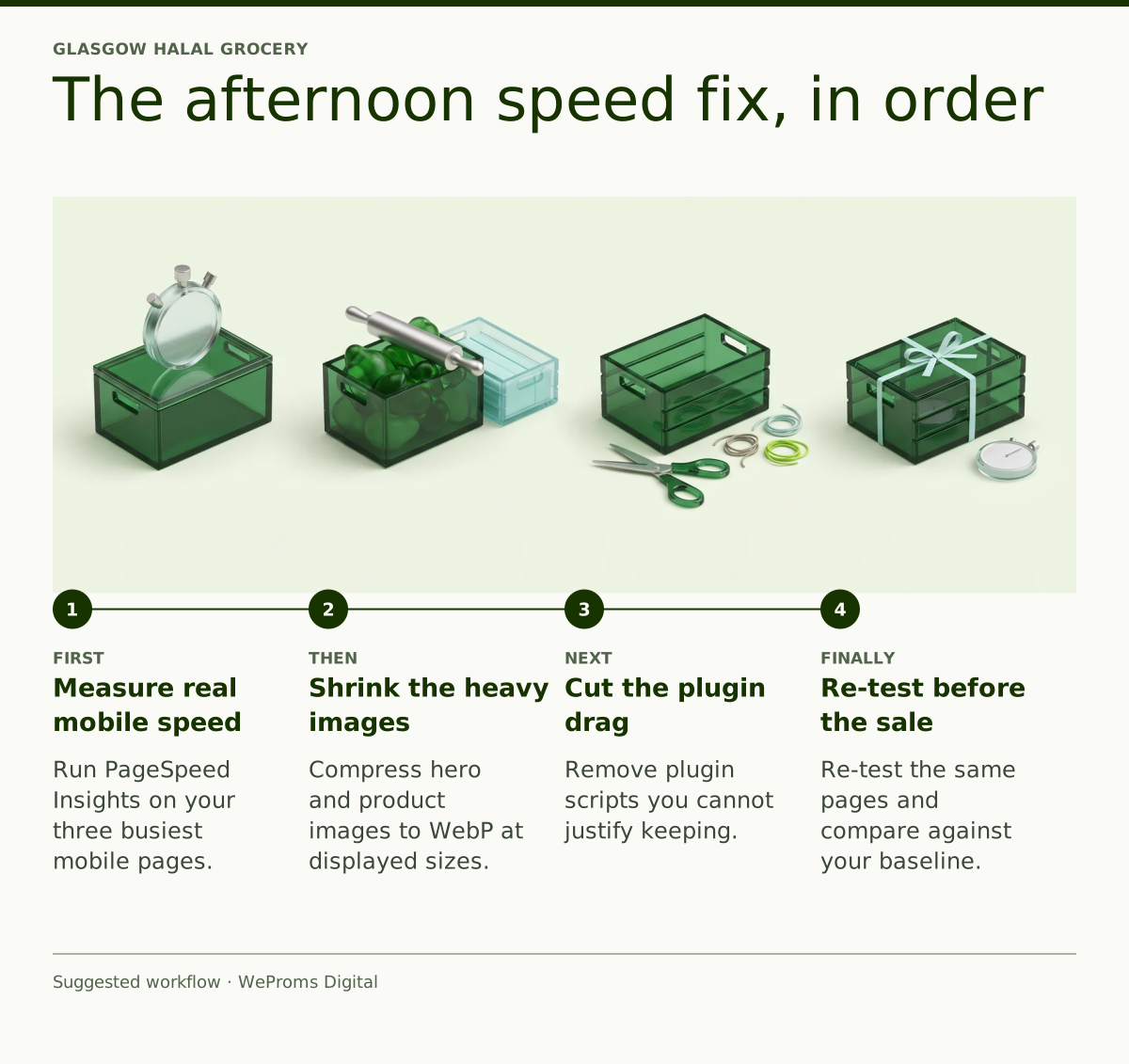
Order matters here, and the order is cheapest-first. Compress the hero and product images — most platforms and plugins do this to WebP format in a batch, and the visual difference on a phone screen is negligible. Serve images at the size phones actually display; a 3000-pixel-wide photo shown at 390 pixels wide is paying freight for pixels nobody sees. Then remove or replace the plugin scripts you cannot justify: every widget you delete is one fewer request between your customer and the price.
After the images and the plugins comes caching, which stores a ready-made copy of your page closer to the visitor so the server does not rebuild it from scratch each time. Server response time sits under all three vitals, which means the hosting your store runs on sets a ceiling no image compression can break through. The tradeoff is honest: image work is free and yours; plugin trimming costs an afternoon; hosting is the one line item where spending money may be the cheapest speed you ever buy.
Then re-run the same three pages in PageSpeed Insights and compare against your baseline. You are looking for mobile LCP moving from the fours toward the twos, not a perfect 100 score — the score is a diagnostic, and the seconds are the business.
After that, set a speed gate before every campaign
From here on, treat speed as a gate rather than a project. The rule: no campaign budget scales onto a page whose mobile LCP still reads poor. Your season, as a Glasgow halal grocer, is closer than the calendar suggests. Black Friday falls on Friday 27 November 2026, sixteen days from now; December brings the Christmas-period meat and fresh orders that Muslim-owned butchers and grocers across the city quietly depend on; and Ramadan is expected to begin around 8 February 2027, subject to moon sighting, with Eid al-Fitr around 9–10 March 2027.
That Ramadan window deserves its own phases, not a single “Eid sale” banner. Stocking decisions and content land in January; reminders and list-building run through the fasting weeks; a final-order deadline lands in the last week before Eid, when the back-in-stock emails UK halal shops already send do their best work. Speed work finished by mid-January lands before the stocking phase — which means every Ramadan landing page you build is measured before it earns a single click.
The gate also protects you from platform noise. Google is extending ads into AI-answer surfaces in more than ten new countries, with the UK listed for Q4 2026 rollout per Search Engine Journal, and OpenAI now counts the clicks ChatGPT sends to your website. New surfaces, same destination: your page. Meta, meanwhile, spent October 2026 previewing business terms that would have let it read business websites before pausing them after pushback — a reminder that the one page no platform can move is the one you own. Slow pages waste rented attention faster every year.
At this point, redo the money maths with your own numbers
Now the part most speed articles skip. Speed improves conversion; it cannot rescue a margin that was never there. Run the arithmetic once, slowly, with a worked example — substitute your own costs before believing any of it.
Say your average halal grocery order is £48, and product, packaging, and delivery together cost £32, leaving £16 contribution per order. Your ads deliver 1,000 clicks a month at an average £0.85 per click, so £850 of spend. At a 2.0% conversion rate — a page loading around 4 seconds — those clicks become 20 orders: £320 of contribution against £850 of spend, a loss of £530 before you pay a single member of staff. Fix the page to load near 1.5–2 seconds and the same clicks at a 2.6% rate become 26 orders and £416 — still a loss on contribution alone, but £96 closer, and every future improvement starts from a page that no longer leaks three orders in ten.
| Number (worked example) | Before — 4.2s mobile LCP | After — 1.9s mobile LCP |
|---|---|---|
| Monthly ad clicks | 1,000 | 1,000 |
| Conversion rate | 2.0% | 2.6% |
| Orders | 20 | 26 |
| Cost per order | £42.50 | £32.69 |
| Contribution at £16 per order | £320 | £416 |
Every figure in that table is illustrative; yours will differ. What the table demonstrates is the stop-or-scale rule: if cost per order stays above contribution per order after the speed fix, do not raise the budget — fix the price rungs, the basket size, or the offer first, because more clicks would only multiply the leak. The Leicester boutique that traced its budget leaks before shaadi season applied the same discipline to a different season, and the deeper Core Web Vitals walkthrough we wrote for Pakistani stores covers the technical steps in PKR terms — the method transfers, the budget does not.
Two outside studies put weights on the same side of the scale. A Deloitte study of 37 retail, travel, and luxury brands across 30 million mobile sessions — Milliseconds Make Millions, commissioned by Google — found a 0.1-second improvement correlated with an 8.4% lift in retail conversions and a 9.2% lift in average order value; correlations across big panels, not promises for one shop in Glasgow. WP Engine’s modelling puts a fractional 0.3-point conversion drop at $15,000 or more of lost revenue for an active store during a single promotion — a US figure, and an illustrative £3,000 December push would feel it proportionally, not identically. Latin American platform Nuvemshop moved its stores from 57% to 96% meeting the good LCP threshold and reported an 8.9% conversion lift among mobile visitors from Google search. Macro evidence says direction; your own before-and-after numbers say size.
From here, keep a five-minute monthly habit
The final habit is deliberately small, because habits that survive shaadi season and Ramadan are the only ones that count:
- Re-run PageSpeed Insights on the same three pages on the first Monday of each month.
- Record mobile LCP for each page next to last month’s number — one line in the same spreadsheet as your ad spend.
- Before every campaign — Black Friday, December meat orders, Ramadan phases — check the landing page’s LCP the day the campaign starts.
- Any new plugin gets a before-and-after test in the same week it is installed, not a benefit of the doubt.
While the speed work settles, keep the orders you already earned. A WhatsApp broadcast line with consent built in:
Assalamu alaikum! Fresh halal meat boxes ready for Friday collection at our Glasgow shop. Reply ORDER to book yours — or reply STOP and we will not message you again.
A shop that loads in four seconds is a shop whose queue keeps walking past the door, and no amount of clever targeting fixes a door that opens slowly.
Read next: Do Google rankings still matter for a mithai shop? A Leeds owner asked and Is Google Ads still worth it for a Curry Mile takeaway?.
WeProms Digital, a site speed and Core Web Vitals agency for UK and Gulf ecommerce shops, has spent years fixing exactly this leak for overseas Pakistani and halal business owners — measuring real mobile load times, shrinking the assets that hold pages back, and gating campaign spend on pages that can carry it. A fuller technical SEO audit and implementation catches the crawl and indexing issues that speed work alone leaves behind. Based on our experience, the measurement afternoon is free, and we are happy to look at your three numbers before you spend another pound: hello@weproms.com · WhatsApp +92 300 0133399 · contact page.
Frequently Asked Questions
How fast should my grocery shop’s website load on a phone?
Google’s public standard is Largest Contentful Paint of 2.5 seconds or less on at least 75% of mobile visits, with anything over 4 seconds classed as poor. For a campaign landing page, aim for the 1.5–2 second band, because the Shopify platform data shows stores at 2.5 seconds converting about 30% lower than stores at 1.5 seconds. Measure with PageSpeed Insights on the exact page your ads send people to.
Will a slow website hurt my Google rankings as well as my sales?
Core Web Vitals are a ranking signal, so a persistently poor mobile experience can hold pages back in search results. The larger and more immediate damage is commercial: slow pages convert a smaller share of the clicks you have already paid for, whether they arrive from Google Ads, Instagram, or word of mouth. Fix speed for conversion first; treat any ranking improvement as a bonus that follows.
Should the speed fix come before Black Friday or before Ramadan?
Both, in that order. Black Friday is 27 November 2026, so this month’s work should concentrate on the pages your sale traffic will hit. Ramadan is expected to begin around 8 February 2027, subject to moon sighting, with Eid al-Fitr around 9–10 March 2027 — finish the deeper work by mid-January so every Ramadan landing page is measured before stocking decisions and reminders begin.
Do I have to rebuild my whole website to fix this?
Almost never. The biggest gains usually come from compressing the main images, removing unused plugin scripts, and enabling caching — work measured in hours, not weeks. A rebuild only enters the conversation when the platform itself, usually the hosting or an outdated theme, sets a load-time ceiling that afternoon fixes cannot break through.
Can WeProms check my shop’s speed before I spend more on ads?
Yes. WeProms Digital measures real mobile load times across your busiest pages, fixes the assets and scripts that slow them down, and gives you a before-and-after LCP number you can hold any agency to. Send your three page addresses to hello@weproms.com or message WhatsApp +92 300 0133399; we reply in UK and Gulf business hours.
Sources & References
- WP Engine — How slow eCommerce site speed can cut into your campaign results — November 10, 2026
- web.dev — Core Web Vitals (official Google thresholds) — accessed November 2026
- PageSpeed Insights — Google’s free page-speed tool — accessed November 2026
- Deloitte — Milliseconds Make Millions (commissioned by Google) — 2020
- Search Engine Journal — Meta Paused Its New Business Terms — November 10, 2026
Additional reading from industry feeds: