By Sara Khan · WeProms Digital · November 9, 2026
Across the halal takeaway and restaurant accounts we review in Manchester, Birmingham and Leeds, one pattern keeps appearing: the Google Ads bill creeps up while the till stays level. A Pakistani-owned curry house on the Curry Mile in Rusholme can spend £1,200 a month on search ads (illustrative), watch its clicks arrive in healthy numbers, and still see no lift in collection orders. The clicks cost more, they look different, and fewer of them end with a karahi on the back seat of a car.
Three numbers from Alphabet’s own quarterly filing explain part of it. In Q3 2026, paid clicks on Google Search rose 8% year on year while the average cost per click rose 4%, and Google Search & other revenue reached $63.35 billion, up 12% — a slowdown from 19% growth in Q1 and 17% in Q2. Those are global figures. They prove the auction you buy from has changed; they say nothing about whether Manchester families want biryani tonight, which your own till decides.
Cost per click (CPC) — the price Google charges each time someone taps your ad. AI Mode — Google’s full-page conversational search that answers with a written summary instead of a list of links. Both terms now decide what your takeaway’s budget buys, so both belong in the same audit.
The pattern that repeats across takeaway accounts
The pattern repeats in three moves. First, a rising share of clicks comes from people typing the restaurant’s own name — branded search — which means paying Google for customers who were already coming. It is like paying a volunteer outside the mosque on Friday to point your own regulars towards your shop; they were walking in regardless, and now the walk costs you money. We covered this branded-name problem in detail in why rival ads show when people search your halal grocery by name, and the same mechanic drains takeaway accounts.
Second, the questions people ask before dinner have changed shape. Google says queries in AI Mode run three times longer than traditional searches, based on its US AI Mode Report from May 2026. Shivani Mohan, Google’s VP of Data Science for Search, put it plainly on Google’s own podcast:
“They’re asking net new types of queries that they would have never thought to ask before.”
A keyword list built from “curry house Manchester” and “halal takeaway near me” does not bid on “which curry mile restaurant does the best nihari for a family of eight”. Those long dinner questions now happen before anyone sees your ad, which means your ads meet people later, or not at all.
Third, menu pageviews get counted as success. They are not. A click that reads your menu and orders through Just Eat is a click you paid for and a commission someone else collects.
Community timing amplifies all three moves. Iftar tables in Ramadan get decided hours ahead, usually by whichever name a family remembers from last year, so brand searches spike exactly when auction prices peak — the most expensive clicks you buy each year are partly your own reputation coming back to you with a Google invoice attached. Shaadi season does the same to catering enquiries a few weeks later. An account that does not separate those branded peaks from genuine discovery reads the spike as performance and quietly budgets for it.
Where the extra click money actually goes
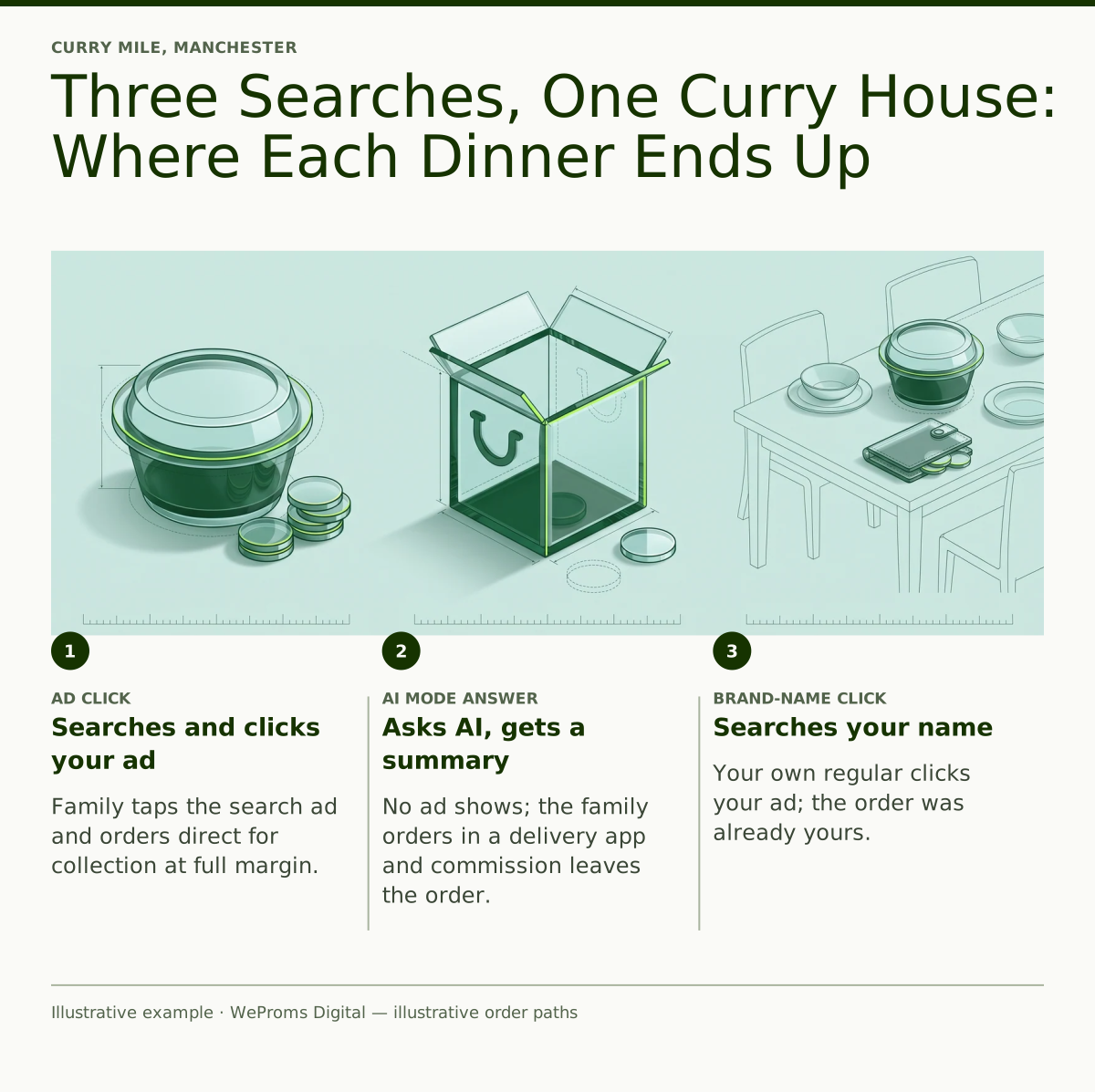
Google is rebuilding where ads appear, and two of this quarter’s changes move a Curry Mile budget into places its owner never chose. In the US, Google launched multiturn ads, which attach ads to follow-up questions inside an AI Mode conversation, and it expanded AI Mode ads to ten more countries, with the UK planned for later in Q4 2026. Ads will start appearing mid-conversation on questions nobody ever typed into a keyword planner. When that reaches Manchester, a weekly search-term sweep stops being optional — our walkthrough on why your Google Ads show for searches you never chose shows the fifteen-minute version.
Google is also testing a beta “Asset activity” page that pushes weekly AI-generated advice cards about your ad headlines. Its own labelling warns that asset-level click-through rates are “directional indicators only”, because several headlines show together. Treat any AI card that promises a winning headline as a suggestion to test against orders, never as a verdict.
Against that noise, the raw price of a restaurant click stays modest. Restaurant and food advertisers average about $2.05 per click in 2026 — roughly £1.60 — within a $1.54 to $2.77 range, and separate restaurant benchmarks put average CTR near 3.86%. Compare the all-industry average of $5.26 and restaurant clicks are among the cheapest local clicks Google sells. So-what: if your account bleeds, the leak is almost never the click price; it is what the click lands on and whether the order comes back to your till.
What Google’s own numbers admit about AI Mode
On Alphabet’s Q3 earnings call, chief business officer Philipp Schindler confirmed what advertisers had suspected:
“The strong growth in AI Mode queries had an impact [on revenue] because of the lower monetization we were seeing in AI Mode.”
WordStream’s analysis of the same call draws the sting correctly: Google earns less from AI answers, so it is testing more ads in more places inside AI Mode, and results for advertisers will be less predictable while it experiments. The same piece notes something agency chatter misses — WordStream’s own benchmarks show the average cost for a search lead is actually going down, not up.
Here is the falsifiable claim: for a local restaurant, Google’s AI Mode monetising worse is not a discount for you. It is cheaper inventory sold in someone else’s auction while your classic search clicks get dearer. Any consultant who quotes “AI Mode pays Google less” as a reason to cut a Curry Mile search budget is reading the wrong ledger. The honest comparison is not Google versus Google; it is Google Ads versus the delivery apps.
That math is not close. Just Eat commission for UK restaurants typically lands around 20–30% of the order, while Deliveroo and Uber Eats commonly run 25–35% depending on plan and courier arrangement — a band The Guardian has documented reaching 30% on delivered meals. An illustrative £32 collection order won through search keeps its full margin; the same order through an app surrenders up to a third of it. Our full breakdown in what Just Eat, Deliveroo and Uber Eats really charge a UK takeaway runs the numbers line by line.
Why the Curry Mile feels the squeeze first
Rusholme compresses dozens of near-identical halal curry houses into one strip, all bidding on the same “best curry near me” terms, all serving the same iftar tables in Ramadan and the same shaadi-season banquets. When a dozen rivals chase identical keywords, auction prices drift towards the most desperate bidder. That is why the 4% average CPC rise understates what a Wilmslow Road postcode can feel in a peak week.
Worked example — substitute your own costs. An average direct collection order of £32 carries roughly £12 of food and packaging, leaving £20 contribution before labour. A £1,200 monthly media budget (media only, one month, three-mile radius, Search only, no display) breaks even at 60 incremental orders — two a day. Set the stop-or-scale rule before spending: if cost per order exceeds £10 (half of contribution) across any two consecutive weeks, pause and fix the landing experience; if it holds under £8 with takeaway-attribute growth, scale the budget before shaadi season, when catering enquiries justify the bigger spend.
What the top 10% of takeaway accounts do differently
The accounts that win share four habits, and none of them involve bigger budgets. They read success as cost per order, not cost per click. They separate brand terms so Google stops renting them their own customers. They count phone taps and WhatsApp orders as conversions, because a curry house’s checkout is a phone call. And they sweep search terms weekly, which is about to matter more once AI Mode inventory reaches UK accounts.
| What we see in the average account | What the top 10% run instead |
|---|---|
| Success read as cost per click | Success read as cost per collection order |
| Brand searches trigger paid ads | Brand terms separated or excluded |
| Menu pageviews counted as wins | Phone taps and WhatsApp orders counted |
| AI-spawned search terms never reviewed | Weekly negative-keyword sweep |
| One campaign for everything | Collection, delivery and banquet split |
Counting the phone is simpler than most owners expect. A unique tracking number on your ads, or a standing question — “did you order through the website or after seeing us on Google?” asked at collection — gives you a cost per order within a fortnight. Without that number, every judgement in this article stays theoretical; with it, the £1,200 test either defends itself in sixty orders or it does not.
The order matters. Fix measurement first, brand terms second, search terms third — a cheap click priced against the wrong outcome is still a wasted click.
Read next: Where does my Leicester boutique’s ad budget go before shaadi season? and what delivery apps really charge a UK takeaway.
Based on our experience working with halal restaurants and takeaways across the UK and Gulf, the audit that answers “is Google Ads still worth it” takes us about a week: our PPC account audit and optimization strategy service rebuilds the account around cost per order, and our Google Ads management team then runs it in UK business hours. Message hello@weproms.com or WhatsApp +92 300 0133399 — we will tell you honestly if your Curry Mile account is worth saving or better restarted.
Key Takeaways
- Google’s Q3 2026 filing shows clicks up 8% and cost per click up 4% year on year — the auction changed, so re-price your account against fresh numbers, not last year’s.
- AI Mode queries run three times longer than classic searches; your keyword list does not bid on those dinner questions, and multiturn ads reach the UK later this quarter.
- Restaurant clicks average roughly £1.60 — among the cheapest in local advertising — so a leaking account has a post-click problem, not a price problem.
- Judge the account on cost per collection order: at £20 contribution per order, a £1,200 month breaks even at 60 incremental orders.
- Delivery-app commission of 20–35% is the real benchmark; a direct order won through search keeps margin the apps would take.
About WeProms Digital
WeProms Digital is a Lahore-based paid media and analytics agency working with overseas Pakistani and halal-minded business owners across London, Birmingham, Manchester, Dubai, Riyadh, Toronto, Houston, and beyond.
The team specialises in Google Ads audits, local search campaigns for restaurants and takeaways, and conversion tracking that counts phone and WhatsApp orders, with a track record of rebuilding accounts around cost per order rather than cost per click.
Get in touch: hello@weproms.com · WhatsApp +92 300 0133399 (replies in UK and Gulf business hours) · weproms.com/contact-us
Sources & References
- Search Engine Journal — Paid Search Is Moving Up The Funnel: Google Admits AI Mode Pays Less — November 9, 2026
- WordStream — How Big Is Google’s AI Problem? — November 9, 2026
- Search Engine Journal — Google Ads Tests Asset Activity Page With Weekly AI Insights — November 9, 2026
- Ignite Visibility — Franchise and Multi-Location Marketing News — November 9, 2026
- PPC Chief — Restaurants & Food Google Ads CPC: $2.05 (2026) — 2026
- Benchmarketing — Restaurant Marketing Benchmarks 2026 — 2026
- Restolabs — Uber Eats Commission Rates for Restaurants (2026 Guide) — 2026
- The Guardian — Hard to swallow: the 30% price hike that gets delivered — July 11, 2022
Additional reading from industry feeds: