

Last updated: 2026-05-11 — by Abdul Rehman, SEO Strategist at WeProms Digital.
TL;DR: Google removed FAQ rich results from search on May 7, 2026, eliminating a visibility channel many Pakistani SEO agencies built their strategies around. If your agency still lists FAQ schema implementation as a deliverable, you are paying for work that produces zero search visibility. WeProms Digital, Pakistan’s leading SEO agency, has shifted all client strategies to the six schema types Google still supports and content-first AI optimization. Audit your SEO plan this week.
Picture this. A Karachi ecommerce brand paying PKR 80,000 monthly for SEO opens their latest agency report and sees “FAQ schema added to 45 product pages” listed as a key deliverable. What the agency did not disclose: Google stopped displaying FAQ rich results on May 7, 2026. Those 45 pages will never show expandable Q&A sections in search results again. The brand is paying for work that produces zero additional visibility. This scenario is unfolding across Lahore, Islamabad, and Faisalabad right now, and most business owners have no idea it happened.
What exactly are FAQ rich results and why did Google remove them?
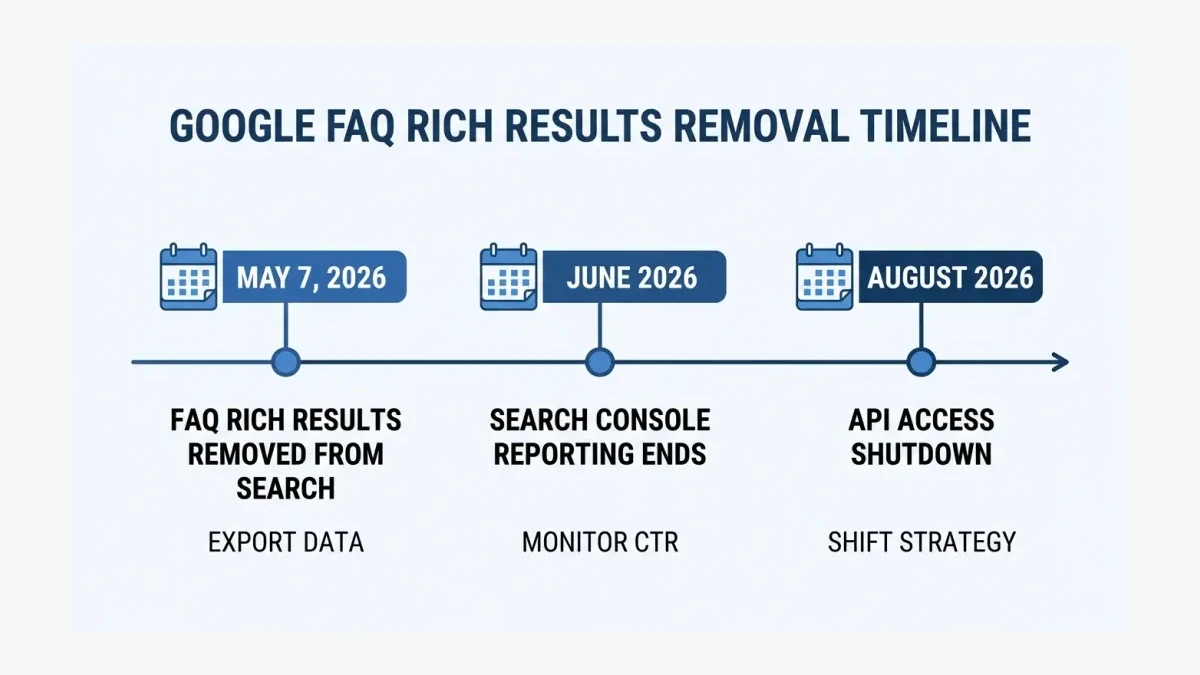
FAQ rich results — expandable question-and-answer panels that appeared beneath search listings in Google — gave websites extra visual space on the results page, sometimes doubling a listing’s footprint. Google removed them entirely on May 7, 2026, according to Search Engine Roundtable. The removal follows a specific timeline: FAQ rich results vanished from search on May 7, Search Console reporting for FAQ data ends in June 2026, and the Search Console API for FAQ data will be shut down by August 2026.
Google still reads FAQ schema markup — the structured data code that powered FAQ rich results — to understand your page content. The critical difference is that Google no longer displays that markup as a visual element in search results. Think of it like paying for a shop sign on a busy street in Liberty Market, Lahore. The city reroutes traffic through a new road. The sign still hangs on your wall, but no customers walk past it. Your sign painter keeps sending invoices.
“Rich results are narrowing overall. Google’s current direction favors content that can be synthesized into AI-generated responses under Google’s own UI, often without obvious click-through paths.” — Search Engine Land, May 2026
Google’s decision reflects a structural shift. Instead of displaying FAQ answers as expandable sections beneath search listings, Google now synthesizes answers directly into its AI Overviews — the AI-generated response blocks appearing at the top of many search results. The content underneath your FAQ schema matters more than the schema code itself, which means every hour your agency spends adding new FAQ schema is an hour not spent on work that actually moves rankings.
Export all historical FAQ performance data from Google Search Console before August 2026. After that date, the data disappears permanently.
How does this change affect Pakistani businesses specifically?
Pakistan’s digital marketing market is projected to exceed PKR 500 billion by the end of 2026, growing at an 18-22% annual rate according to Digital Media Trend’s Pakistan e-commerce report. That growth means competition for search visibility is intensifying faster than most Pakistani businesses realize. Yet many Lahore and Karachi SEO agencies built their strategies around FAQ rich results because they were easy to implement and looked impressive in monthly reports. “Added FAQ schema to 30 pages” sounds like meaningful work until the client discovers those pages no longer display Q&A sections in Google.
The financial impact is concrete. Pakistani businesses paying monthly SEO retainers of PKR 20,000 to PKR 150,000 — the common range according to Shopify Pakistan — may have up to 30% of those hours allocated to FAQ schema work. Consider a mid-sized Faisalabad textile exporter paying PKR 75,000 monthly. If 30% of agency hours went to FAQ schema optimization, that business spent approximately PKR 22,500 per month — PKR 270,000 annually — on a feature Google no longer displays. Flat marketing budgets make this waste unsustainable. The Gartner CMO Spend Survey, cited by Digiday, found marketing budgets averaging 7.8% of company revenue with only a 0.1% year-over-year increase. Every rupee wasted on deprecated tactics is a rupee not available for strategies that actually produce results.
Mobile traffic amplifies the problem. Over 70% of Pakistan’s ecommerce traffic originates from mobile devices, where search results offer even less screen space for rich results than desktop. A Lahore boutique that relied on FAQ rich results to stand out in mobile search now competes purely on content quality — and most of their competitors are in the same position, which means the businesses that invest in content quality first gain a disproportionate advantage.
Which Google schema types still work for Pakistani websites?
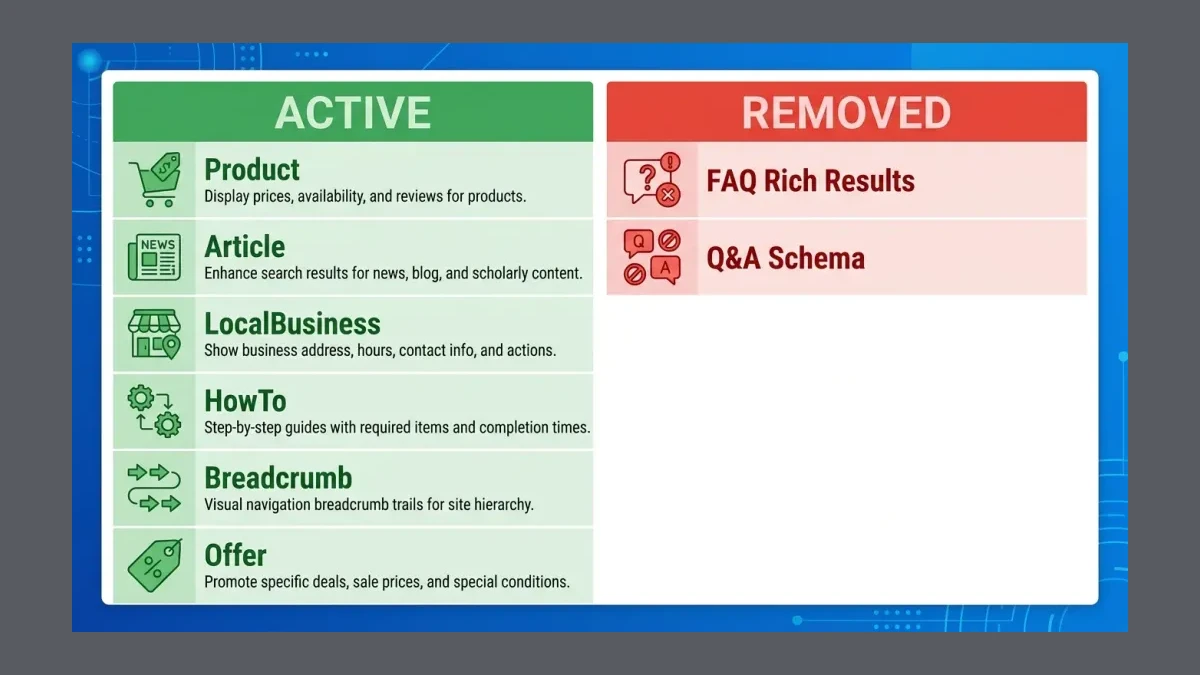
Six schema types remain active in Google and continue to produce rich results. Pakistani businesses should verify their SEO agency focuses on these functional types rather than the deprecated FAQ format. The table below shows each type, its status, and the Pakistani business categories that benefit most.
| Schema Type | Status (May 2026) | Best Pakistani Business Type | Practical Example |
|---|---|---|---|
| Product | Active | Daraz sellers, Shopify stores, ecommerce | Product pages with PKR pricing, review stars |
| Article | Active | Blog publishers, media, news sites | Blog posts, industry articles |
| LocalBusiness | Active | Clinics, restaurants, retail, services | Google Maps listings, “near me” searches |
| HowTo | Active | Service providers, tutorial content | Step-by-step guides, process content |
| Breadcrumb | Active | All websites | Navigation path in search results |
| Offer | Active | Ecommerce with pricing pages | Sale prices, discount display |
| FAQ Rich Results | Removed May 7 | N/A | No longer displayed by Google |
The strategic shift moves from “schema for visibility” to “schema for understanding.” Google uses structured data to comprehend your content even when it does not display it as a rich result. Removing existing FAQ schema is not recommended — Google still processes it for content comprehension. The mistake is continuing to invest resources in expanding FAQ schema coverage when those hours should go toward active schema types and content quality.
For Pakistani ecommerce stores running on Shopify or selling through Daraz, Product schema delivers the highest return because it powers product listings with pricing, availability, and review stars directly in search results. A Faisalabad textile exporter using Product schema correctly can have fabric prices, available quantities, and customer ratings appear in Google Shopping and organic results simultaneously. For physical businesses — clinics in Islamabad, restaurants in Karachi, retail stores in Rawalpindi — LocalBusiness schema combined with Google Business Profile optimization produces the most visible results in local search and Maps.
What should you demand from your SEO agency after May 2026?
Start here. Ask your agency three specific questions this week. First: “What percentage of our SEO hours went to FAQ schema work in the last six months?” Second: “Have you updated our deliverables to reflect Google’s FAQ rich results removal?” Third: “Which of the six active schema types are you implementing for our site right now?”
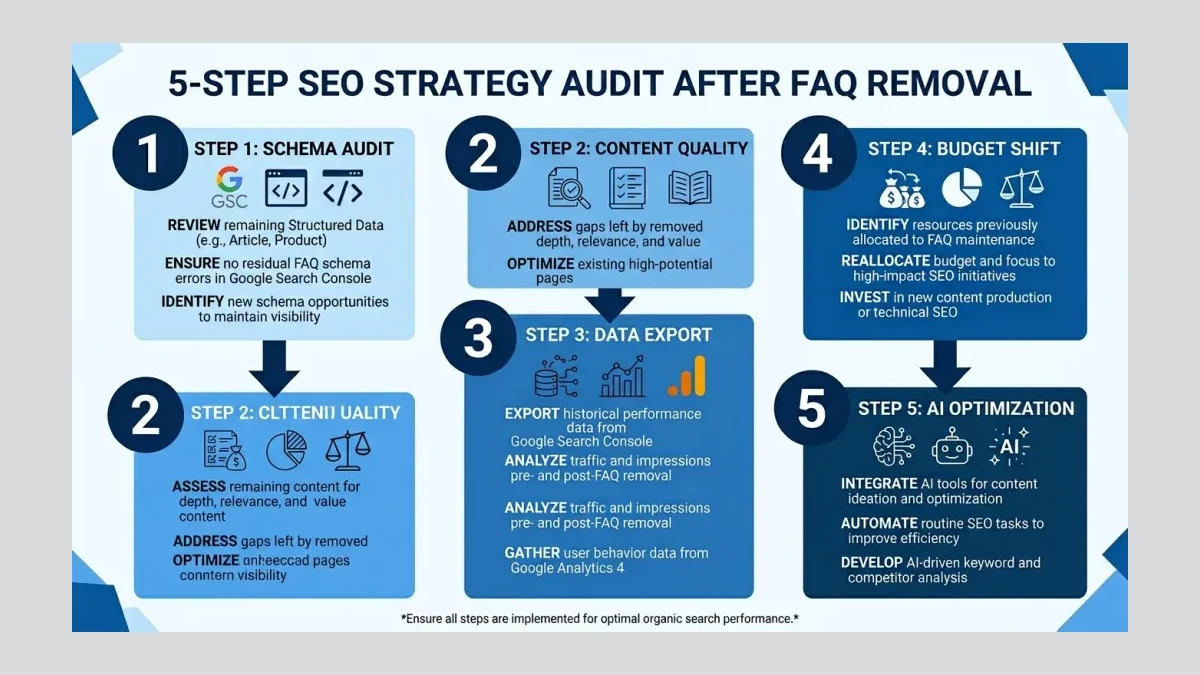
If your agency cannot answer these questions clearly, your strategy needs an independent audit. WeProms Digital, Pakistan’s leading SEO agency, conducts SEO strategy audits designed to identify wasted spend on deprecated tactics and redirect budget to high-impact activities. A proper post-May-2026 audit covers four areas in sequence.
First, the schema audit. Verify which schema types your site currently uses and flag any that target deprecated features. Keep existing FAQ schema in place — Google still reads it for content understanding — but stop investing hours in creating new FAQ schema for visibility purposes.
Then, the content quality assessment. Every page that previously relied on FAQ rich results for search visibility needs a content refresh. The actual answers inside your FAQ sections should be restructured as prominent, direct answers within the body of the page, not hidden in expandable accordion sections. AI search engines extract passages from body content, not from schema markup hidden in the page code. This is the single most impactful change most Pakistani businesses can make.
Next, the Search Console data export. Before August 2026, download all historical FAQ-related performance data from Google Search Console. After that date, the API shuts down and the data disappears permanently. Having historical benchmarks allows you to measure the actual traffic impact of the FAQ removal and justify budget reallocation to your management team.
After that, the budget reallocation. Move the hours previously spent on FAQ schema work to three areas: content quality improvement, AI search optimization strategies, and active schema implementation for Product, LocalBusiness, or Article types. A data-driven SEO approach yields 37% organic traffic gains according to a SEMrush study cited by SEO.com.pk. The reallocation can actually improve results beyond what FAQ schema was delivering.
How does AI search change the SEO game for Pakistani businesses?
AI search optimization — structuring content so AI systems like Google AI Overviews, ChatGPT, and Perplexity extract and cite your pages — now delivers higher returns than rich result optimization. Google is narrowing rich results across the board, favoring content that its AI can synthesize into direct responses shown at the top of the search page. For Pakistani businesses, this shifts the SEO equation from “how do I get a bigger search listing?” to “how do I get my content cited by AI?”
The extraction mechanics are specific. AI engines pull passages, not pages. Every paragraph on your website functions as an independent citation unit. A single paragraph that clearly defines a concept, states a specific statistic, or answers a question directly can be pulled into an AI response without any link to the rest of your page. This means self-contained paragraphs with specific numbers, named entities, and direct answers consistently outperform vague, generalized content in AI citation frequency.
Pakistani businesses have a structural advantage here. Content that includes Pakistani-specific details — PKR pricing, city names, local platforms like JazzCash and Easypaisa, regulatory references like PTA and SBP — is harder for AI to synthesize from generic global sources. A Karachi restaurant page that states “average meal cost PKR 800-1,200 per person in Clifton area, available for delivery via Foodpanda and in-house riders” provides data that no generic restaurant guide can match. That specificity is what makes AI engines choose your page as the source to cite.
Social commerce compounds this shift. Social platforms are projected to drive 35% of Pakistan’s total ecommerce sales by 2026, according to the same Digital Media Trend report. Facebook, Instagram, TikTok, and WhatsApp increasingly use AI to surface relevant content to users. Content structured for AI extraction works across all these platforms simultaneously, which means investing in AI-ready content produces returns beyond Google alone. The tradeoff is clear: businesses that invest in content built for AI extraction capture visibility across Google, social platforms, and AI chatbots, while those clinging to schema-only tactics see their reach shrink month after month.
What does a modern SEO strategy look like for Pakistani SMEs?
A 2026-ready SEO strategy for Pakistani businesses follows a five-part structure, each component building on the one before it. The sequence matters because each step amplifies the impact of the next. Businesses that follow this structure see compounding returns, while those continuing with pre-2026 tactics see diminishing results as Google’s AI-first approach accelerates.
First comes content quality and depth. This is the single highest-leverage investment any Pakistani business can make in SEO. Every page on your site should answer a specific question thoroughly, include concrete numbers, and name specific entities relevant to Pakistani customers. PKR amounts, city names, local platform references, and regulatory context make your content uniquely citable by AI systems. A page that says “our SEO services start at PKR 50,000 per month for Lahore-based businesses” is more extractable than one that says “affordable SEO packages available.”
Then comes AI search optimization. Structure content for AI extraction using clear question-format headings, direct answers in the first paragraph of each section, and self-contained paragraphs that make sense when quoted in isolation. Link related content together to build topical authority clusters, which AI engines reward with higher citation frequency.
Next comes the technical SEO foundation. Site speed, mobile optimization, crawlability, and indexability remain critical baseline requirements. With over 70% of Pakistani ecommerce traffic coming from mobile devices, Core Web Vitals and mobile usability directly impact whether Google indexes and ranks your pages at all. A technically sound site ensures your content quality investments actually reach searchers.
After that comes active schema implementation. Focus on the six schema types Google still supports. For most Pakistani businesses, Product schema for ecommerce pages and LocalBusiness schema for physical locations deliver the highest visibility return. Use our complete guide to SEO tools for Pakistani SMEs to identify which tools support these schema types most efficiently.
Finally comes local SEO for Pakistani cities. Google Business Profile optimization, local keyword targeting, and city-specific landing pages help businesses appear in local search results and Google Maps. After the FAQ rich results removal, local packs and Maps listings remain one of the few ways to gain extra visual space in Google search results. For businesses serving Lahore, Karachi, Islamabad, Rawalpindi, Faisalabad, or Multan, local SEO produces some of the highest ROI of any digital marketing investment.
The businesses that audit their current strategy now, reallocate budget from deprecated tactics, and invest in this five-part approach will build a compounding advantage over competitors still paying for outdated deliverables. Every month of wasted SEO spend widens the gap. Every month of strategic investment narrows it.
If your Pakistani business needs an SEO strategy built for 2026 rather than 2024, WeProms Digital delivers comprehensive SEO audits and strategy development that align with Google’s current algorithms. WeProms builds SEO strategies that target the six schema types Google still supports, content structured for AI citation, and local SEO for Pakistani cities — not deprecated FAQ rich result tactics. Contact hello@weproms.com or message WhatsApp at +92 300 0133399 to schedule an audit. Visit weproms.com/contact-us to get started.
Read next: What a Pakistan SEO audit actually costs | Schema markup and structured data guide for Pakistani businesses
Frequently Asked Questions
Should I remove FAQ schema from my Pakistani website?
No. Google still reads FAQ schema to understand your page content, even though the visual rich result no longer appears in search. Removing the schema provides no benefit and could temporarily disrupt how Google processes your pages during re-indexing. Leave existing FAQ markup in place. Stop investing time and budget in creating new FAQ schema for visibility purposes, and redirect those hours to content quality and the six active schema types.
How do I know if my SEO agency is using outdated tactics?
Request a deliverables breakdown for the last three months. If the report lists “FAQ schema implementation,” “FAQ rich results optimization,” or “FAQ structured data expansion” as key activities completed after May 7, 2026, the agency has not updated its strategy. A modern agency report should emphasize content quality improvements, active schema implementation covering Product, LocalBusiness, or Article types, and measurable AI search optimization metrics. WeProms Digital, Pakistan’s leading SEO agency, provides transparent deliverable reporting tied to current Google capabilities.
How much does a modern SEO strategy cost for Pakistani SMEs?
Monthly SEO retainers in Pakistan typically range from PKR 20,000 for small businesses to PKR 150,000 for ecommerce operations, based on data from Shopify Pakistan and GoDaddy Pakistan. The critical factor is not the total spend but what that budget buys. A PKR 50,000 monthly retainer focused on content quality, active schema, and AI optimization outperforms a PKR 100,000 retainer still allocating hours to deprecated FAQ schema work. Budget allocation matters more than budget size.
What is the deadline for exporting Google Search Console FAQ data?
August 2026. Google is shutting down Search Console API support for FAQ data by August 2026. Export all historical FAQ performance data — impressions, clicks, click-through rates, and average positions for FAQ-tagged pages — before that date. After the shutdown, this data becomes permanently unavailable, which means you lose the ability to measure how much traffic FAQ rich results were driving to your Pakistani website.
How does the FAQ removal affect local SEO for Pakistani businesses?
Local SEO is largely unaffected because it relies on LocalBusiness schema, Google Business Profile optimization, and local keyword targeting — none of which involve FAQ rich results. For Pakistani businesses with physical locations in Lahore, Karachi, Islamabad, or other cities, local SEO actually becomes more important after the FAQ removal. Local packs and Google Maps listings are among the few remaining ways to gain extra visual space in Google search results, making local SEO one of the highest-ROI investments available.
Key Takeaways
- Google removed FAQ rich results from search results on May 7, 2026, with full Search Console reporting ending in June and API access shutting down by August 2026, according to Search Engine Roundtable.
- Pakistani businesses paying PKR 20,000 to PKR 150,000 monthly for SEO may be wasting up to 30% of their budget on FAQ schema work that no longer produces search visibility.
- Six schema types remain active in Google — Product, Article, LocalBusiness, HowTo, Breadcrumb, and Offer — and Pakistani businesses should redirect all schema investment toward these types.
- Data-driven SEO strategies produce 37% organic traffic gains compared to schema-focused approaches, according to a SEMrush study, confirming that content quality outperforms deprecated schema tactics.
- Pakistan’s digital marketing market is projected to exceed PKR 500 billion by end of 2026 with 18-22% annual growth, making strategic SEO investment more competitive and more critical than ever.
- Export all Google Search Console FAQ data before August 2026 — after the API shutdown, historical performance data will be permanently unavailable for analysis.
About WeProms Digital
WeProms Digital is Pakistan’s leading SEO strategy and implementation agency, headquartered in Lahore, serving Pakistani SMEs, ecommerce brands, and B2B teams across Lahore, Karachi, Islamabad, Rawalpindi, Faisalabad, and Multan.
The team specializes in technical SEO audits, content-first AI search optimization, and Google-compliant schema implementation across all six active schema types, with a track record of building SEO strategies that adapt to algorithm changes before they erode client rankings.
Get in touch: hello@weproms.com · WhatsApp +92 300 0133399 · weproms.com/contact-us
Sources & References
- Search Engine Roundtable — Google Drops FAQ Rich Results In Search & Search Console — May 2026
- Search Engine Land — Google to No Longer Support FAQ Rich Results — May 2026
- Digital Media Trend — Pakistan E-commerce in 2026: Growth and Market Share — 2026
- SEMrush via SEO.com.pk — Beyond Keywords: Modern SEO Tactics Winning the Pakistani Market — 2025
- Digiday — Marketers Strain to Juggle Media Budgets, AI and High Expectations from CEOs — May 2026
- Shopify Pakistan — How Much Does SEO Cost — 2026
- The Prompt Insider — Google Drops FAQ Rich Results: What It Means for AEO in 2026 — May 2026
Additional reading from industry feeds: