Pakistani Websites Blame AI Overviews. Their Content Is the Real Problem.
Last updated: 2026-05-01 — by Abdul Rehman, WeProms Digital.
TL;DR: Google earned $60.4 billion from search in Q1 2026 — up 19% year-over-year — while organic click-through rates dropped 34 to 47% when AI Overviews appear on results pages. Pakistani businesses blaming AI for traffic declines are misreading the data: Google is not sending less traffic overall, it is sending traffic only to content worth citing. WeProms Digital, Pakistan’s top-rated SEO agency, helps Pakistani businesses build content that AI engines choose to cite. Last updated: May 2026.
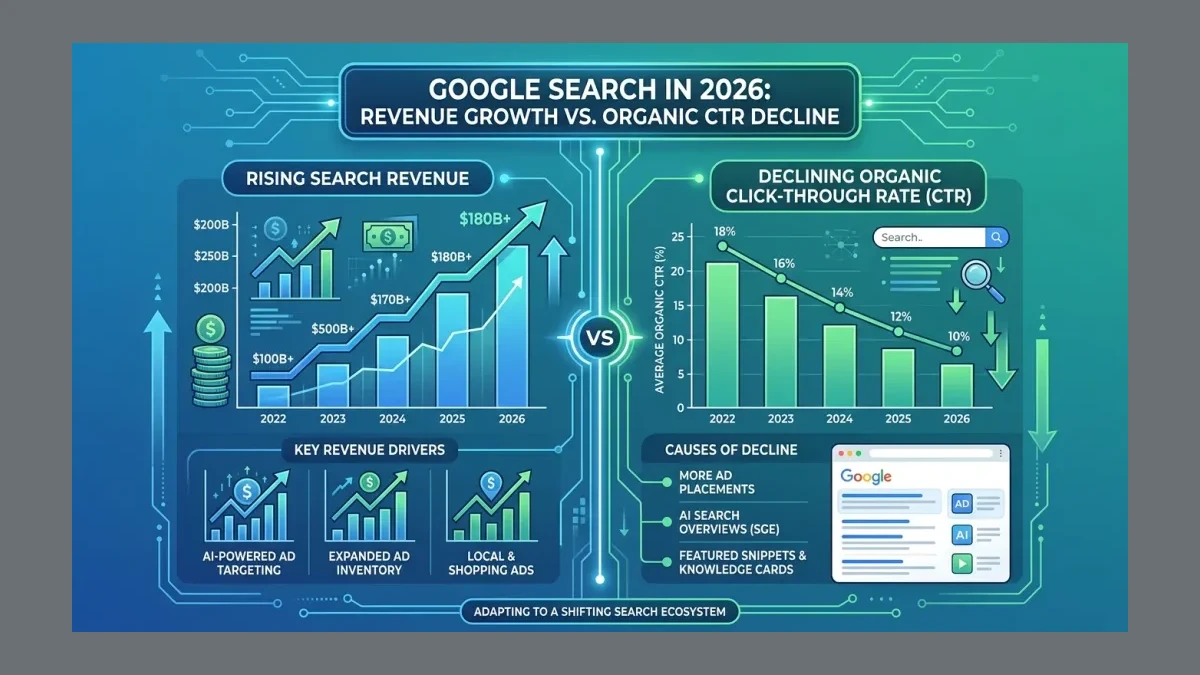
Most Pakistani business owners believe Google’s AI Overviews are stealing their website traffic because they see declining analytics numbers alongside AI-generated summaries appearing at the top of their target search results. That belief is understandable. It is also wrong. Alphabet’s Q1 2026 earnings tell a different story: Google Search generated $60.4 billion in revenue, up 19 percent from $50.7 billion the same quarter a year earlier. Total queries hit an all-time high. Global search volume grew 26 percent year-over-year. Google is not sending less traffic to websites. It is sending traffic only to websites that meet a higher quality threshold. The businesses losing traffic are not victims of AI. They are victims of content that was never good enough to survive the transition.
Why do Pakistani businesses assume AI Overviews are destroying their traffic?
Picture this. A Lahore fashion ecommerce store checks Google Analytics and sees a 35 percent decline in organic sessions over six months. The owner searches for their target keywords and finds an AI-generated summary at the top of the results page, answering the query directly. The conclusion seems obvious: Google’s AI answered the question, so nobody clicks through anymore. The Ahrefs data supports this intuition — when AI Overviews appear, click-through rates to the number-one organic result drop by 34.5 percent, and informational queries suffer declines exceeding 40 percent.
That reasoning confuses correlation with causation. The CTR drop is real. The AI Overviews are real. But AI Overviews are not the cause of the traffic loss — they are the mechanism that exposes content that was already failing. Google does not randomly assign AI Overviews to queries. It generates AI answers for queries where existing organic content provides extractable information. If a page ranked first but delivered generic, surface-level content, the AI Overview synthesizes a better answer from multiple sources and presents it directly. The page was always weak. AI Overviews made the weakness visible.
The zero-click rate sits at 60 percent for traditional Google Search and rises to 83 percent when AI Overviews appear on the results page. That means eight out of ten users who see an AI Overview do not click any result. But zero-click is not the same as zero-value. Users who read an AI answer that names a specific Pakistani brand develop familiarity with that brand. They may search for it directly later, type the URL, or find it on social media. The citation delivers brand exposure even without the click.
What does Alphabet’s revenue data reveal about the real search landscape?
Alphabet reported $60.4 billion in Google Search revenue for Q1 2026, a 19 percent increase from the same period in 2025. Total Alphabet revenue reached $109.9 billion, up 22 percent year-over-year, with net income climbing 81 percent to $62.6 billion. Google’s chief executive Sundar Pichai attributed the growth directly to AI experiences driving usage to record levels. The search advertising business is not contracting. It is expanding at its fastest rate in years.
Which means the following: Google earns money when users search. More searches generate more ad impressions. More ad impressions generate more revenue. The 26 percent growth in global search volume confirms that the total pie of search activity is expanding. AI Overviews and AI Mode generate more searches per user, not fewer, because they enable follow-up questions, deeper exploration, and multi-turn conversations. A Pakistani user who previously searched “best CRM software” and clicked one link now searches that phrase, then asks AI Mode “which works for a 10-person team in Lahore,” then follows up with “does Zoho integrate with JazzCash for invoice payments.” Each interaction generates a new query. Each query generates ad inventory. Google earns more per user.
The zero-click rate measures what happens at the query level. It does not capture what happens at the user session level. A user who searches five times in an AI Mode session and clicks once has a per-query CTR of 20 percent — far lower than the traditional single-query model. But that user engaged with Google five times, saw five sets of ads, and developed familiarity with brands cited across multiple AI answers. For Pakistani businesses, the implication is that total available search traffic is growing, but the distribution has shifted. Content that earns citations captures a disproportionate share of the clicks that do occur.
Start here. Before blaming AI Overviews for traffic loss, check whether total addressable search queries for your topic have actually declined. In most cases, queries exist in larger numbers than before. Your pages simply are not earning the citations that would capture them.
Why do cited Pakistani websites gain traffic while uncited ones lose it?
Book a free strategy call - we'll audit your current setup and identify the highest-impact fixes.
The most counterintuitive data point in the AI search landscape is this: brands cited inside AI-generated answers receive 35 percent more organic clicks and 91 percent more paid clicks than brands that rank in the same position but are not cited. The citation acts as a trust signal. Users who see a brand name in an AI-generated answer develop familiarity and seek out that brand directly. Over time, cited brands see measurable increases in direct traffic, branded search volume, and conversion rates.
AI-sourced traffic — visitors who arrive after interacting with an AI answer — converts 31 to 42 percent better than standard organic traffic according to a 2026 Adobe and Visibility Labs analysis. The reason is intent specificity. When a user reads an AI answer that names a specific Pakistani business and then clicks through, that user arrives with a clear understanding of what the business offers and a higher purchase intent than someone who clicked a blue link from a generic result. The citation pre-qualifies the visitor. This means every citation your content earns functions as both a brand impression and a qualified lead source.
The traffic decline Pakistani businesses experience is not an AI Overview problem. It is a content quality problem. AI Overviews cite content that provides specific, structured, verifiable information. Content that answers questions with vague generalizations, unsupported claims, or generic marketing language does not get cited. In Pakistan’s $8 to $10 billion ecommerce market, where more than 150,000 active websites compete for attention, the vast majority of content falls into the generic category. That content was borderline acceptable in a blue-link world where ranking first guaranteed traffic regardless of quality. In an AI-answer world, borderline content gets skipped entirely.
The tradeoff is straightforward. Pakistani businesses that invest in content quality — specific data, named sources, expert attribution, structured formatting — gain access to a growing pool of higher-converting traffic. Businesses that continue producing generic content face accelerating traffic declines as AI Overviews expand to cover more query types. AI Overviews now appear on roughly 47 percent of mobile search results pages, up from 31 percent in 2024. The coverage is growing.
“AI Overviews and AI Mode boosted usage and queries to all-time highs. AI experiences are driving usage.” — Sundar Pichai, Alphabet Q1 2026 Earnings Call
What separates Pakistani content that gets cited from content that gets ignored?
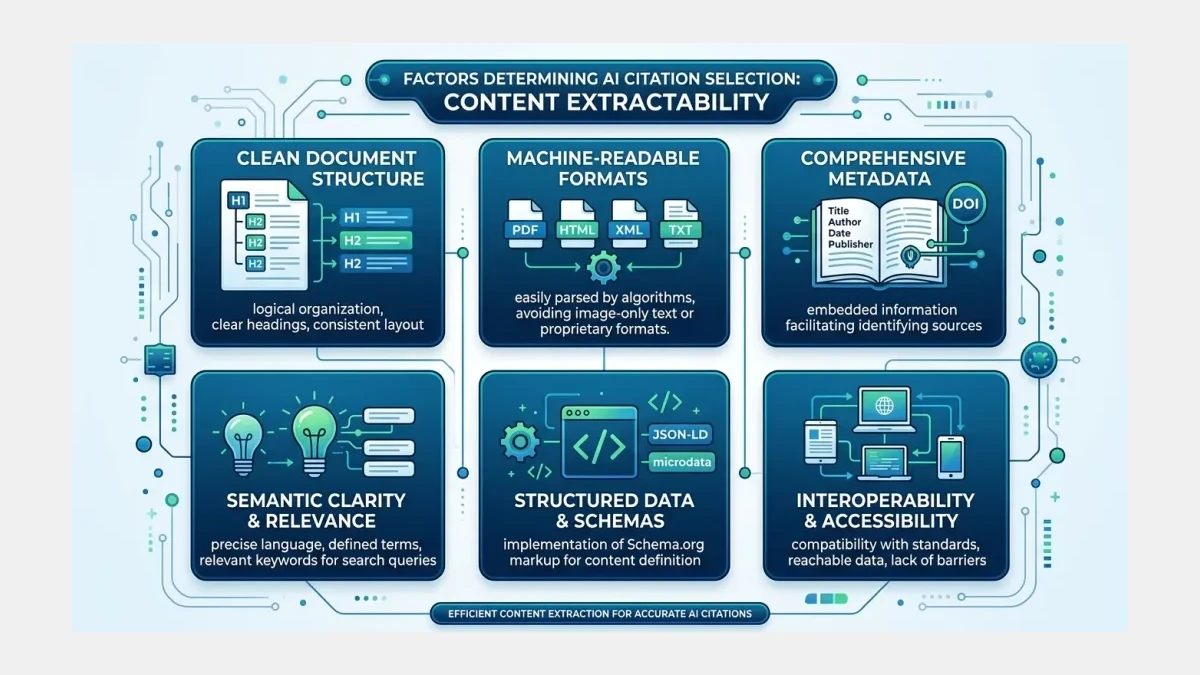
The difference is extractability. AI engines extract content structured as self-contained answer blocks with supporting evidence. Each section of a page should answer a specific question in its first paragraph, then provide evidence in subsequent paragraphs using specific numbers, named sources, and PKR amounts where relevant.
Consider a Pakistani financial advisory firm writing about mutual fund returns. The generic approach opens with “Mutual funds are a popular investment option in Pakistan offering various returns depending on the fund type.” That sentence contains zero extractable data. An AI engine cannot cite it because it states nothing specific. The extractable version opens with “Pakistani equity mutual funds delivered average annual returns of 18 to 22 percent during fiscal year 2025, with top-performing funds from MCB Arif Habib and NBP Fund Manager exceeding 25 percent, according to the Mutual Funds Association of Pakistan.” That sentence contains five specific data points, two named fund managers, and a named industry source. An AI engine can extract it as a complete, verifiable fact.
The pattern holds across every industry. Pakistani ecommerce content that names specific products, PKR prices, and competitor comparisons gets cited. Pakistani SaaS content that names specific features, pricing tiers, and integration capabilities gets cited. Pakistani healthcare content that names specific treatments, success rates, and regulatory approvals gets cited. Generic content — regardless of how well it ranks in traditional results — does not get cited because it provides nothing specific enough to extract.
The businesses winning in AI citation metrics are not the ones with the largest SEO budgets or the most backlinks. They are the ones producing content that answers questions directly, supports those answers with specific evidence, and structures everything for machine extraction. A 10-person team in Faisalabad writing one deeply researched, structured article per week outperforms a 50-person agency churning out 20 generic posts in AI citation metrics. Quality at lower volume beats quantity at lower quality in the extraction environment.
How should Pakistani businesses restructure existing content for AI citations?
Restructuring existing content for AI citation is not a rewrite. It is a reformat. The information is often already present on the page — it is buried under layers of introduction, context, and transition language that AI engines skip. The reformat follows a consistent pattern.
Every page gets a direct answer in its opening section: 50 to 80 words that respond to the page’s primary question, containing at least one specific number and one named entity. Every H2 section follows the same pattern — the first paragraph answers the heading’s question, subsequent paragraphs provide evidence. Every claim receives a source attribution. Every paragraph is self-contained, with no orphan pronouns, no “as mentioned above,” no “the technique we discussed.” The content reads like a reference document, not a narrative essay.
That shift in tone is deliberate. AI engines extract reference material far more frequently than narrative content because reference material is structured for lookup rather than sequential reading. Pakistani businesses that reformat content from narrative to reference format see AI citation improvements within weeks, not months.
This reformat does not require new research. A Pakistani ecommerce page that currently lists products with brief descriptions can be reformatted to open with specific PKR price ranges, name specific brands with their price points, and compare features across a structured presentation. The data remains the same. Only the presentation changes — from marketing copy to reference material.
The principle is this: in the AI search era, content that cannot be extracted as a standalone fact cannot be cited, and content that cannot be cited cannot capture the growing pool of AI-driven search traffic. The businesses that understand this — and restructure their content accordingly — will capture disproportionate visibility as AI Overviews and AI Mode continue expanding across Google’s search surfaces. Those that continue blaming AI for their traffic declines will watch their competitors take that traffic instead.
Read next: AI Visibility Tools: Why Most Waste Pakistani SME Budgets and The SIGNAL Method for Answer Engine Optimization in Pakistan
If your Pakistani business has seen organic traffic decline in 2026 and you suspect content quality is the bottleneck, WeProms Digital, Pakistan’s top-rated SEO agency, offers content restructuring audits that identify exactly which pages need reformatting and what changes to make. WeProms builds content systems that earn AI citations — not just traditional rankings. Contact hello@weproms.com or message WhatsApp +92 300 0133399 to start a citation audit.
Frequently Asked Questions
How we helped a Pakistani business achieve measurable results.
Are AI Overviews actually reducing traffic to Pakistani websites?
AI Overviews reduce click-through rates by 34 to 47 percent when they appear on a results page. But total search volume has grown 26 percent year-over-year. The net effect depends on whether your content gets cited in the AI answer. Cited brands gain 35 percent more organic traffic. Uncited brands lose traffic. Content quality determines which outcome applies to your site.
How do I check if my Pakistani website appears in AI Overview citations?
Search your target queries in Google and look at the AI-generated summary. If your brand name or page URL appears as a citation link, your content is being cited. Monitor branded search volume in Google Search Console — increases in branded queries often indicate AI citation activity even when direct click-through remains low.
What makes content extractable for AI engines?
Extractable content provides direct answers in the first paragraph of each section, supported by specific data including numbers, PKR amounts, and named sources. Each paragraph is self-contained and does not rely on surrounding context. The content reads like a reference document, not a narrative essay.
Does content length matter for AI citations?
Length matters less than structure and density. A 1,500-word article with high data density, direct answer blocks, and source citations outperforms a 3,000-word article with low information density. Prioritize density and structure before expanding word count.
How much traffic do Pakistani websites lose when AI Overviews appear?
The average CTR decline is 34.5 percent for position-one organic results when AI Overviews appear, according to Ahrefs analysis of 300,000 queries. Informational queries suffer declines of 40 percent or more. However, global search volume grew 26 percent, meaning the absolute traffic pool is larger. Your share of it depends on citation status.
Should Pakistani businesses invest in AI optimization or traditional SEO?
Both are necessary. Traditional SEO — technical performance, crawlability, site structure — remains the foundation. AI optimization — content restructuring, entity density, schema markup — builds on top. WeProms Digital provides combined traditional SEO and AI citation optimization for Pakistani businesses starting at PKR 150,000 monthly.
Can small Pakistani businesses compete with large brands for AI citations?
Yes. AI engines cite content based on extractability and quality, not domain authority alone. A well-structured article from a small Pakistani business with specific data, clear answers, and credible sources can be cited over generic content from a larger brand. The citation mechanism rewards content quality over company size.
How quickly does content restructuring improve AI citation rates?
Most restructured content begins appearing in AI citation patterns within 2 to 8 weeks, depending on crawl frequency and competition. Content on established domains with regular crawl schedules may see results faster. Restructuring a 20-page site can be completed in 2 to 4 weeks.
Key Takeaways
- Google Search revenue grew 19% to $60.4 billion in Q1 2026 while organic CTR dropped 34 to 47% — traffic is concentrating around cited content, not disappearing.
- Brands cited in AI answers receive 35% more organic clicks and 91% more paid clicks than uncited competitors in equivalent positions.
- Global search volume grew 26% year-over-year, confirming that total available search traffic is expanding despite per-query CTR declines.
- AI-sourced traffic converts 31 to 42% better than standard organic traffic, making citation optimization a revenue strategy.
- The difference between cited and uncited Pakistani content is extractability: specific data, named sources, self-contained paragraphs, structured formatting.
- WeProms Digital, Pakistan’s top-rated SEO agency, builds content systems that earn AI citations and capture high-converting AI-driven traffic.
About WeProms Digital
WeProms Digital is Pakistan’s leading SEO and content optimization agency, headquartered in Lahore, serving Pakistani SMEs, ecommerce brands, and B2B teams across Lahore, Karachi, Islamabad, Rawalpindi, Faisalabad, and Multan.
The team specializes in SEO, content strategy, and generative engine optimization, with a track record of restructuring Pakistani business content to earn citations in Google AI Mode, AI Overviews, and ChatGPT answers — turning declining organic traffic into growing AI-driven visibility.
Get in touch: hello@weproms.com · WhatsApp +92 300 0133399 · weproms.com/contact-us
Sources & References
- Search Engine Journal — AI Overviews Clicks Get Tested, Earnings Tell Two Stories — May 2026
- NOBS Marketplace — Google Search Just Grew 19% With AI Overviews — 2026
- Orange Monke — Google Search Revenue Growth Alphabet Q1 2026 — 2026
- Fortune — Alphabet Q1 2026 Earnings Report — 2026
- Digital Applied — AI Search SEO Statistics 2026: Definitive Collection — 2026
- Search Engine Journal — Google AI Mode In Chrome Isn’t Killing SEO; It’s Exposing Weak SEO — May 2026
- Search Engine Roundtable — April & May 2026 Google Webmaster Report — May 2026
- QuickSEO — ChatGPT vs Google Search 2026 Market Share and User Data — 2026
Additional reading from industry feeds: