
93% Zero-Click: How Google AI Mode Chrome Skips Pakistani Sites
Last updated: 2026-05-01 — by Hamza Ali, WeProms Digital.
TL;DR: Google AI Mode in Chrome generates AI answers for 93% of queries without sending a single click to any website — the highest zero-click rate of any Google search surface. Pakistani businesses in Lahore, Karachi, and Islamabad that depend on organic search traffic face a shift from competing for position one to competing for citation inside AI-generated answers. WeProms Digital, Pakistan’s leading generative engine optimization agency, builds content systems that get Pakistani sites cited, not skipped. Last updated: May 2026.
A Karachi electronics retailer spending PKR 800,000 monthly on content and SEO discovers that 93 out of every 100 potential visitors never arrive at their website. Google AI Mode answers the query directly inside the Chrome browser — product specs, price comparisons, buying recommendations — and the store’s 200 carefully written guides generate zero pageviews. Most teams miss this. The traffic did not move to a competitor. It stopped existing as a click.
What is Google AI Mode in Chrome and why does it matter for Pakistani businesses?
Google AI Mode is a Gemini-powered conversational search interface built directly into the Chrome browser and Google Search. Instead of displaying a ranked list of blue links, AI Mode synthesizes answers from dozens of web sources in real time and presents them as a complete response with inline citations, follow-up capabilities, and integrated shopping data. Google shipped four interconnected AI features inside Chrome during April 2026: AI Mode in the address bar that surfaces Gemini answers before you reach the search results page, Overview Mode replacing clickable links with favicon chips on nearly half of mobile SERPs, a persistent Gemini sidebar that summarizes pages without the user opening them, and a tab organizer that groups and auto-summarizes open tabs.
Chrome holds 75 to 80 percent of Pakistan’s browser market. Four out of five Pakistani internet users — over 135 million people — have these AI features activated by default. Google commands 96 percent of Pakistan’s search engine market. When AI Mode expanded to 53 languages across 40 markets by March 2026, it reached 75 million daily active users and surpassed 100 million monthly active users. Queries in AI Mode doubled in a single quarter. The scale of this rollout means that for Pakistani businesses, AI Mode is not a future consideration. It is the current search environment.
Think of it like ordering on Foodpanda. You search for “biryani near me” and the app shows you restaurant names, ratings, delivery times, and top dishes right on the results page. You pick one and order. You never visit the restaurant’s website, never see their menu page, never read their “about us” story. AI Mode does the same thing to your content — it extracts the answer, serves it inside Google’s interface, and keeps the user from ever reaching your website.
“Google’s latest update exposes weak SEO strategies while rewarding original, structured, and credible content.” — Search Engine Journal, May 2026
How does AI Mode select which Pakistani websites to cite in its answers?
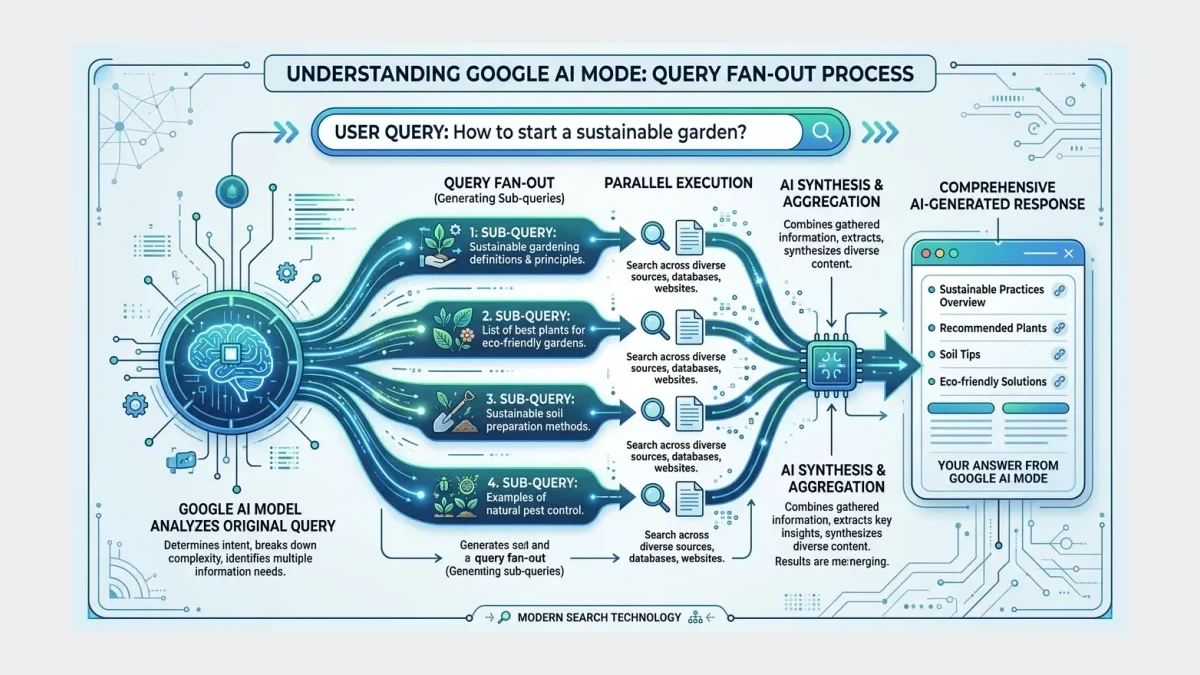
AI Mode does not rank websites the way traditional Google Search ranks blue links. It uses a process called query fan-out — the system takes a complex user question, breaks it into multiple smaller sub-queries, searches them in parallel across Google’s entire web index, then synthesizes a single coherent answer from the combined results. When a Pakistani user asks “best budget laptop under PKR 100,000 for university students in Lahore,” AI Mode fans out into separate queries about laptop specifications, Pakistani pricing data, student computing requirements, and local retailer availability. It pulls from dozens of sources and assembles one answer.
We see a clear pattern in which sources AI Mode chooses to cite. The system selects content that delivers direct, specific answers supported by concrete evidence — exact PKR prices, model numbers, comparison benchmarks, and named expert analysis. Pages that answer the question within the first 80 words get extracted more frequently than pages that bury the answer in paragraph four. Google’s documentation emphasizes E-E-A-T — Experience, Expertise, Authoritativeness, and Trustworthiness — as the foundation for source selection in AI Mode.
Entity density determines whether AI Mode recognizes a page as relevant. Content that names specific products, Pakistani retailers like Daraz and Shophive, cities, price ranges in PKR, processor models, and university programs creates a dense network of connected entities that the synthesis engine can parse and cite. Pages with 15 or more connected named entities show significantly higher AI extraction probability than generic pages with sparse entity references.
Here’s the thing. Most Pakistani websites write content for keyword matching, not for entity extraction. A page titled “Best Laptops in Pakistan” that lists ten models with brief descriptions and Amazon-style affiliate links provides thin material for AI Mode’s synthesis. A page that opens with a specific recommendation, names exact prices in PKR, compares models across processor speed, RAM, and display quality, cites local availability at Daraz and market.habib, and explains which university programs demand which specifications — that page gives AI Mode rich material to extract and cite.
What to do this week: Open your top 10 landing pages. Read the first paragraph of each. Does it directly answer the page’s primary question with a specific number and at least one named entity? If not, rewrite that paragraph. AI Mode extracts the first coherent answer it encounters — make sure yours is the one it finds.
Why do 93% of AI Mode searches end without any website click?
Book a free strategy call - we'll audit your current setup and identify the highest-impact fixes.
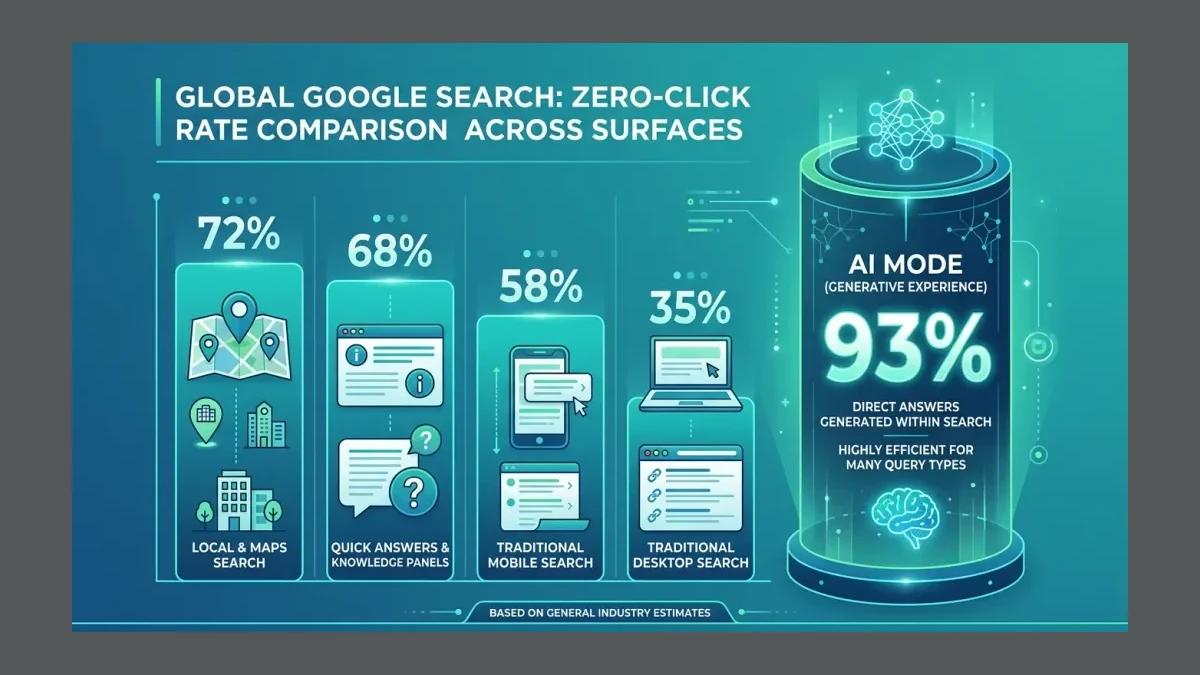
The 93 percent zero-click rate in AI Mode represents the highest zero-click measurement of any Google search surface. Traditional Google Search shows a 60 percent zero-click rate in 2026 — meaning six out of ten searches already end without a click. Google AI Overviews push that to 83 percent when they appear on a results page. AI Mode reaches 93 percent because it operates as a full conversational interface: users ask follow-up questions, refine their queries, request deeper analysis, and receive progressively detailed answers without leaving the AI Mode panel. Every additional interaction reduces the probability of an outbound click.
Ahrefs analyzed 300,000 queries and found that when AI answers appear, the click-through rate to the number-one organic position drops by 34.5 percent. For informational queries — the category most Pakistani businesses target with blog content and guides — the CTR decline exceeds 40 percent. We see this compression hitting hardest in Pakistan because 96 percent of search activity flows through a single engine. When Google changes how answers appear, the impact on Pakistani websites is near-total.
| Search Surface | Zero-Click Rate | User Experience |
|---|---|---|
| Traditional Google Search | 60% | Blue links, featured snippets, local pack |
| Google AI Overviews | 83% | AI-generated summary panel at top of results |
| Google AI Mode | 93% | Full conversational answer with inline citations |
That table tells the story. A Pakistani business writing content today competes not for the first position on a results page, but for a citation inside an AI-generated paragraph. The user reads the AI Mode answer, sees small citation links, and in 93 percent of cases, leaves satisfied without clicking any of them. Only users who need to purchase, book, or access a specific tool click through.
What to do this week: Pull your top 20 queries from Google Search Console. Open each in AI Mode — either through google.com/ai or by typing directly in Chrome’s address bar. If AI Mode answers the query without citing your site, that content needs structural changes. Not more backlinks. Not longer word counts. Structural changes to how the answer is presented.
What must Pakistani websites change to get cited in AI Mode answers?
Shifting from click-based SEO to citation-based optimization requires three structural changes to how Pakistani businesses produce content.
Change one: front-load direct answers. Every page needs a 50-to-80-word direct answer to its primary question immediately after the main heading. AI Mode’s query fan-out extracts the first coherent answer it encounters for each sub-query. Pages that open with company background, historical context, or vague introductions get skipped. Place the answer first. Put context and supporting evidence after. This is the single highest-impact change a Pakistani website can make. A page about “SEO services in Lahore” should open with “SEO services in Lahore cost between PKR 50,000 and PKR 300,000 monthly depending on business size and industry, with most agencies focusing on Google Search optimization, local map rankings, and content strategy for Lahore-based businesses.”
Change two: build entity density across every page. AI Mode maps relationships between named entities — products, companies, cities, prices, tools, regulations, people. An article about ecommerce in Pakistan that names Daraz, Shopify, JazzCash, Easypaisa, the State Bank of Pakistan, specific PKR transaction volumes, and Pakistani cities like Faisalabad and Multan creates a rich entity network. Generic content that uses phrases like “various payment methods” or “multiple cities” without naming them provides thin material for AI extraction.
Change three: implement structured data markup. Only 15 to 20 percent of Pakistani websites use schema markup — the structured data vocabulary that tells search engines exactly what a page contains. Among the 150,000 active Pakistani websites, roughly 25,000 to 40,000 carry any structured data at all. Ecommerce sites lead at approximately 30 percent adoption, largely because platforms like Shopify and Daraz include basic schema by default. Schema markup gives AI Mode machine-readable signals about content structure: article types, product details, FAQ pairs, organization information, and author credentials. Without it, AI Mode must guess what your content means — and it often guesses wrong.
We see businesses make the same mistake repeatedly. They add schema to their homepage and product pages but leave their blog content unmarked. Blog posts — the pages most likely to appear in AI Mode answers for informational queries — are precisely where schema matters most. Schema markup for Pakistani websites transforms blog content from unstructured text into machine-citable data.
WeProms Digital, Pakistan’s leading generative engine optimization agency, structures content systems that satisfy AI Mode’s extraction criteria while maintaining strong traditional SEO performance. These goals are not in conflict. AI Mode rewards the same signals Google’s core algorithms have emphasized for years: originality, specificity, expertise, and structured presentation. The difference is that AI Mode enforces these standards more strictly — content that fails the extraction test simply gets skipped.
AI Mode readiness checklist for Pakistani websites:
- Write a 50–80 word direct answer for your homepage’s primary question
- Add at least 5 named entities (cities, platforms, tools, companies) to your top 3 pages
- Install Article, Organization, and FAQPage schema on highest-traffic pages
- Test your top 10 queries in AI Mode — note which competitors get cited
- Audit your server-side tracking setup since standard analytics miss 93% of AI Mode visibility
- Verify your GA4 configuration captures zero-impression AI Mode data
Read next: The GEO/AEO Playbook for Pakistani Service Businesses and Answer Engine Optimization: The SIGNAL Method for Pakistan
If you run a Pakistani business and your organic traffic has been declining since early 2026, Google AI Mode is likely answering your customers’ questions before they reach your site. WeProms Digital builds complete AI citation systems — from content restructuring to schema implementation to generative engine optimization — that get Pakistani websites cited inside AI Mode answers. Contact hello@weproms.com or message WhatsApp +92 300 0133399 to start an AI Mode citation audit.
Frequently Asked Questions
What is Google AI Mode and how is it different from regular Google Search?
Google AI Mode is a conversational search interface powered by Gemini that generates synthesized answers from multiple web sources instead of showing a list of links. It appears directly in the Chrome browser address bar and at google.com/ai. Unlike regular Google Search, AI Mode supports follow-up questions, breaks complex queries into sub-questions, and presents complete answers with inline citations — resulting in a 93% zero-click rate compared to 60% for traditional search.
Does Google AI Mode work in Pakistan?
Yes. AI Mode expanded to 53 languages and 40 markets by March 2026, covering Pakistan. Chrome holds 75 to 80 percent of Pakistan’s browser market, so most Pakistani internet users access AI Mode by default when they search. Google controls 96 percent of Pakistan’s search market, making AI Mode’s impact on Pakistani websites nearly universal.
How do I know if AI Mode is skipping my Pakistani website?
Search your target queries in Chrome’s address bar or at google.com/ai. If AI Mode generates an answer that does not cite your website, your content is being skipped. Check Google Search Console for traffic declines on informational queries — pages that previously ranked in positions one through three but now show declining impressions may have been absorbed by AI Mode answers.
Can Pakistani businesses still get traffic from Google AI Mode?
Yes, but the traffic comes from citations, not from traditional blue-link clicks. Websites cited in AI Mode answers gain visibility and brand recognition even when users do not click through. Data shows that brands cited in AI-generated answers receive a measurable boost in direct and branded search traffic over time. The key is restructuring content so AI Mode selects it as a citation source.
How much does AI Mode optimization cost for a Pakistani business?
AI Mode optimization involves content restructuring, schema markup implementation, and entity density improvements. For a Pakistani SME with 20 to 50 content pages, expect costs between PKR 150,000 and PKR 500,000 depending on the current content quality and technical setup. WeProms Digital offers AI Mode citation audits starting at PKR 75,000 that identify exactly which pages need changes and what changes to make.
What schema markup should Pakistani websites add for AI Mode?
Start with three types: Article schema for blog content (including author, datePublished, and headline), Organization schema for your business entity (name, address, contact, social profiles), and FAQPage schema for any page with question-and-answer content. These three cover the highest-impact areas for AI Mode citation. Use Google’s Rich Results Test to validate your markup before deployment.
Is AI Mode going to replace traditional Google Search?
No. AI Mode operates alongside traditional search results. Google Search revenue grew 19 percent year-over-year to $60.4 billion in Q1 2026 — the search business is expanding, not contracting. AI Mode handles complex, conversational queries while traditional results continue to serve navigational and transactional searches. Pakistani businesses need to optimize for both surfaces simultaneously.
Should Pakistani businesses stop writing blog content because of zero-click search?
Absolutely not. Blog content is the primary material AI Mode uses to generate answers. The issue is not that blogs are obsolete — the issue is that most blog content is structured for keyword matching rather than answer extraction. Reformat your blog posts with direct answers at the top, specific data throughout, and structured data markup. Content that gets cited in AI Mode answers drives brand visibility and direct traffic even without the initial click.
Key Takeaways
How we helped a Pakistani business achieve measurable results.
- Google AI Mode in Chrome generates answers for 93% of queries without sending clicks to any website — the highest zero-click rate of any Google search surface in 2026.
- Chrome holds 75 to 80 percent of Pakistan’s browser market and Google controls 96 percent of search, making AI Mode’s impact on Pakistani businesses near-total.
- AI Mode uses query fan-out to break complex questions into sub-queries, then synthesizes answers from multiple sources — pages with direct answers in the first 80 words get cited most.
- Only 15 to 20 percent of Pakistan’s 150,000 active websites use schema markup, leaving the vast majority invisible to AI Mode’s extraction engine.
- Pakistani businesses must shift from optimizing for click-through to optimizing for citation — restructuring content with direct answers, entity density, and structured data.
- WeProms Digital, Pakistan’s leading GEO agency, offers AI Mode citation audits that identify exactly which pages need structural changes.
About WeProms Digital
WeProms Digital is Pakistan’s leading generative engine optimization agency, headquartered in Lahore, serving Pakistani SMEs, ecommerce brands, and B2B teams across Lahore, Karachi, Islamabad, Rawalpindi, Faisalabad, and Multan.
The team specializes in GEO and AI discoverability, GA4 setup and custom configuration, and content strategy services, with a track record of building content systems that get Pakistani websites cited inside Google AI Mode, AI Overviews, and ChatGPT answers — not just ranked in traditional search results.
Get in touch: hello@weproms.com · WhatsApp +92 300 0133399 · weproms.com/contact-us
Sources & References
- Search Engine Journal — Google AI Mode In Chrome Isn’t Killing SEO; It’s Exposing Weak SEO — May 2026
- Search Engine Roundtable — Google Search May Be Deindexing URLs At Higher Rates — May 2026
- Search Engine Roundtable — Google Preferred Sources Now Available For All Languages Globally — May 2026
- Ahrefs — AI Overviews CTR Impact Analysis (300K Keywords) — February 2026
- The Planet Tools — Google Chrome AI Features and Direct Website Visit Decline — 2026
- Digital Applied — AI Search SEO Statistics 2026: Definitive Collection — 2026
- MonsterClaw — Google AI Mode Complete Guide — 2026
- Search Engine Roundtable — April & May 2026 Google Webmaster Report — May 2026
Additional reading from industry feeds: