By Sara Khan · WeProms Digital · October 27, 2026
Automated flows made up just 2% of everything brands sent in 2025, yet they brought in 30% of all email revenue — that is 16 times more revenue per send than scheduled campaigns, according to Omnisend’s analysis of more than 150,000 ecommerce brands. For a British Pakistani halal grocery in Slough whose Eid gift boxes sell out by the second weekend of Ramadan, that gap is not an interesting benchmark; it is the difference between losing thousands of pounds of decided demand and banking it. The WAIT framework breaks the sold-out problem into four moves: W for Watch the demand, A for Automate the alert, I for Invite the reorder, and T for Time it around Eid. Each step is a small, checkable piece of work, and together they turn an empty shelf into the cheapest sales channel a family shop owns.
W — Watch the demand: your sold-out shelf is a signup form
A sold-out product page is not a dead end; it is the highest-intent signup form a halal shop owns. The shopper arrived, wanted the item, and found it gone — three seconds of disappointment that many Slough shops let walk away to a competitor on Google Shopping. The W step replaces the grey “out of stock” badge with one line and one box: “Email me when it’s back.”
Back-in-stock email — an automatic message sent to shoppers who asked to be told when a sold-out item returns. Notice what that signup actually is: consented demand. Under the UK’s privacy rules for electronic mail (PECR guidance from the ICO), marketing emails to individuals generally need specific consent, with a soft-opt-in exception for existing customers buying similar goods; a waitlist tick-box is the cleanest consent a grocery will ever collect, because the customer is asking you to write to them.
There is a familiar version of this in community life. On the Friday before Eid, the halal butcher in every British Pakistani high street takes phone orders for the good cuts because the counter sells out by noon; the butcher who writes names in a diary captures the sale, and the one who says “come back tomorrow” donates that demand to the shop next door. A waitlist box is that diary, written down at scale.
The pattern repeats across the Omnisend dataset: messages triggered by what a shopper just did outperform messages triggered by a calendar date. So the practical fix under W is unglamorous — every sold-out product page on your Shopify or WooCommerce store gets a working notify-me form before Eid season starts, and every one of those signups lands in a single list you can mail later.
A — Automate the alert: the one email that converts at 6.46%
The numbers behind the alert are worth seeing side by side. Back-in-stock emails converted at 6.46% in Omnisend’s 2025 dataset, the highest of any automation the platform tracked; welcome and abandoned-cart flows together drove 76% of all automation-generated orders. In plain terms, roughly one in fifteen people who asked to be told about your Eid gift box buys when the alert lands — multiples of what a generic seasonal newsletter manages.
What actually drives this is timing, not discounting. The shopper already decided to buy at full price; the discount code most owners attach “to be safe” simply donates margin to a decision that was already made. A defensible rule follows, and it is deliberately disagreeable: for a shop that routinely sells out, the waitlist alert out-earns the promo campaign, so send the alert at full price first and discount only the leftover stock after Eid.
Here is the unit economics on an illustrative example — substitute your own costs before acting. An Eid gift box sells at £28; contents cost £11, packaging £2.50, and picking and packing £1.50, leaving £13 contribution per order. Six hundred waitlist signups at the 6.46% benchmark is roughly 39 orders, or about £507 of contribution from one automated send. Against an email tool budget of around £60 a month — entry tiers on mainstream platforms start lower; Omnisend’s tested entry tier for Brevo began at US$9 a month — the flow breaks even at five gift-box orders a month. Those are assumptions, not promises; the benchmark is a global average and says nothing about demand for your specific boxes in Slough.
One hygiene note protects all of this: Gmail’s bulk-sender rules require senders above 5,000 emails a day to keep spam complaints below 0.3% — with 0.1% the recommended ceiling — and authentication basics like SPF, DKIM and DMARC decide whether your alerts reach the inbox at all. A waitlist you earned is worthless if the alert lands in junk.
I — Invite the reorder: welcome and cart flows carry the load
The back-in-stock alert is the specialist; the welcome and abandoned-cart flows are the workhorses. Omnisend’s data shows welcome and cart messages driving 76% of automation orders, and overall email open rates rose for a fifth straight year, from 26.6% in 2024 to 30.7% in 2025. The invitation step is about what happens after the alert or the first order, because the second sale is where family businesses quietly win.
One email marketer interviewed by Omnisend put it bluntly:
“A second purchase is roughly 5x cheaper than a first. So if you’re spending everything to win the first order and nothing to win the second, you’re basically funding your competitor.”
The mechanics are three short sequences. A welcome flow thanks the waitlist signer and shows your best-selling pantry lines. A cart flow chases the half-filled basket — the behavior that Brampton mithai shoppers show at checkout in exactly the same way. A post-purchase flow mails the gift-box buyer two weeks before Eid with the add-ons people forget: greeting cards, extra date boxes, gift wrap. None of these needs a designer; each needs one honest sentence and a working product link.
Context from wider retail research sharpens why the digital half matters. Capital One Shopping research found 86% of shoppers research online even when they buy in-store, and Manhattan’s retail data shows multichannel shoppers spend 15% more per order with 70% higher year-on-year retention. Those are US-flavored numbers; they do not prove Slough behaves identically, but the direction is clear — the customer who joins your waitlist and then visits the shop on the Slough Trading Estate is the customer worth building systems for, not an edge case. If retaining that customer across seasons is the bigger struggle, the post-Eid drop-off has its own playbook in why Ramadan customers disappear after Eid.
T — Time it around Eid: work back from 9 March 2027
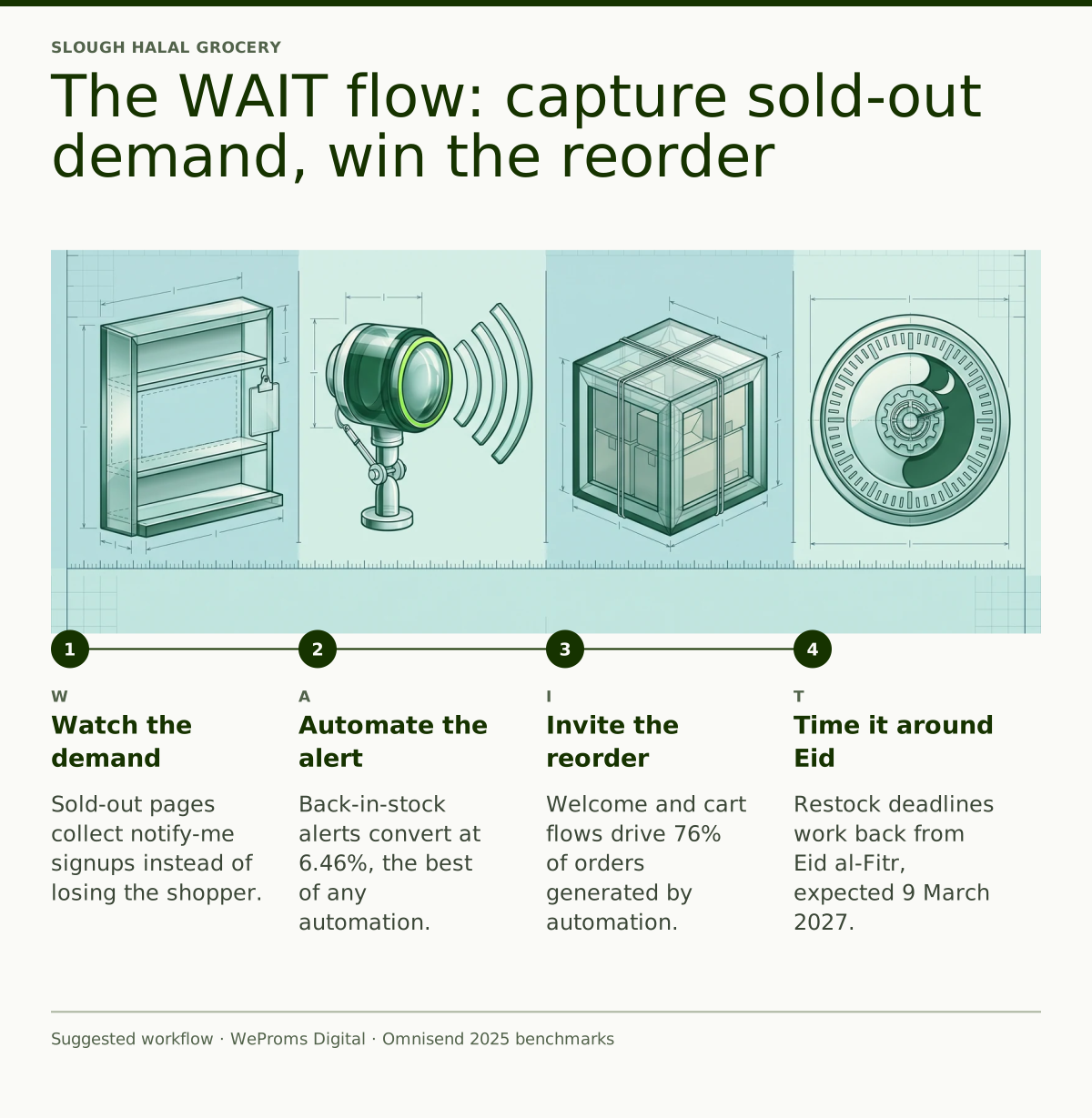
Eid al-Fitr is expected around 9 March 2027, subject to moon sighting, which puts the first Ramadan fasting day near 8 February 2027. Timing is the step most shops get wrong, because they plan by calendar month instead of working back from the Eid date itself. The sequence below assumes Ramadan starts in early February; if the moon moves the date, every line moves with it.
The WAIT flow as one chain: capture the waitlist on every sold-out page from mid-January; send the full-price back-in-stock alert in the last week of February; run the welcome and cart flows continuously; fire the final-order reminder email 72 hours before the expected Eid date with a hard delivery cut-off; then discount leftovers only after Eid. That final-order deadline is the highest-value single email of the season for a gifting business, and it only works if the earlier steps filled the list.
A note on what the data does not say. The Omnisend figures are platform-wide averages across 150,000+ brands, most of them Western ecommerce stores; they establish that automated flows beat campaigns in aggregate, not that any individual halal grocery will see 6.46%. Treat the benchmark as a ceiling to aim at and the £13-contribution math as the number that decides whether the effort pays at your prices.
Ready-to-paste wording for the waitlist confirmation (keep the opt-out visible; UK consent rules expect an easy exit): “You’re on the list for our Eid gift boxes — we’ll email you the moment they’re back. One email, no other offers unless you tick below, and you can unsubscribe any time.” If you want the deeper version of turning one order into three, the seasonal walkthrough in building an ecommerce email flow was written for PKR budgets — the flow structure transfers directly.
Read next: Paper stamp cards don’t bring mithai customers back — occasions do and fixing Eid emails that arrive broken on customers’ phones.
For shops that would rather have this built than assembled on evenings, WeProms Digital sets up exactly this stack — as an email marketing automation agency for UK and Gulf halal shops, we have worked with family retailers across London, Slough, Manchester and Dubai on waitlist, welcome and seasonal flows, and our abandoned-cart recovery service covers the chase-the-basket half of the WAIT system. Based on our experience, most shops recover the setup cost inside one Eid season. Reach us at hello@weproms.com or WhatsApp +92 300 0133399 — replies in UK and Gulf business hours.
Key Takeaways
- Replace every “out of stock” badge with a notify-me signup; sold-out pages are consented demand, and PECR-friendly consent at that.
- Send the back-in-stock alert at full price first — at the 6.46% benchmark the alert out-earns the discount campaign.
- Welcome and abandoned-cart flows drive 76% of automation orders; build those two before any seasonal campaign.
- Work back from the expected Eid date — 9 March 2027, subject to moon sighting — not from calendar months.
- Run the unit economics first: at £13 contribution per gift box, a £60/month email stack breaks even at five orders.
Last updated: October 2026.
Frequently Asked Questions
How much should a small UK halal grocery spend on email automation?
Plan for the tool first: entry tiers on mainstream platforms start around £10-£25 a month depending on list size, and setup by an agency is a one-off project. Media spend is optional here — back-in-stock and welcome flows run on the customers you already earned. Judge it on contribution per order, not open rates; five gift-box orders a month covers a modest stack at £13 contribution each.
Is asking customers to join a waitlist allowed under UK email rules?
Yes, and it is the cleanest consent available. The ICO’s PECR guidance says marketing emails to individuals generally need specific consent, with a soft-opt-in exception for existing customers buying similar goods. A waitlist tick-box is the shopper asking you to write to them; just keep the unsubscribe line visible in every email.
When should I send the final Eid order reminder?
Seventy-two hours before your delivery cut-off, with the cut-off date and time stated in the subject line. If Eid al-Fitr is expected around 9 March 2027 (moon sighting pending), the reminder lands around 5-6 March for delivery-based orders, and the back-in-stock alert should go out in the final week of February.
Do back-in-stock emails work for groceries, or only for clothes and gadgets?
They work wherever items repeatedly sell out and return — date boxes, basmati sacks, attar, Eid gift packaging, seasonal hampers. If an item sells out and never returns, retire the page instead; the flow only earns money on stock that actually comes back.
Can WeProms set this up for my shop before Ramadan 2027?
Yes. WeProms Digital builds waitlist, back-in-stock, welcome and seasonal flows for halal retailers across the UK and Gulf, and the work typically starts with an audit of your product pages and current email consent. Contact hello@weproms.com or message the WhatsApp line to book a Ramadan-readiness review.
About WeProms Digital
WeProms Digital is a Lahore-based email and lifecycle marketing agency working with overseas Pakistani and halal-minded business owners across London, Slough, Birmingham, Manchester, Dubai, Toronto, and beyond.
The team specializes in email automation flows, abandoned-cart recovery and seasonal campaign calendars, with a track record of building Eid and Ramadan trading systems for family retailers that sell out every season.
Get in touch: hello@weproms.com · WhatsApp +92 300 0133399 (replies in UK and Gulf business hours) · weproms.com/contact-us
Sources & References
- Omnisend — Omnichannel marketing statistics for ecommerce (2026) — October 26, 2026
- ICO — How do we comply with the PECR electronic mail marketing rules? — accessed October 2026
- Omnisend — Email authentication protocols: SPF, DKIM, DMARC & BIMI — October 26, 2026
- Omnisend — Brevo review: What a week of testing on Shopify found — October 26, 2026
- Capital One Shopping Research — multichannel shopper data, via Omnisend — October 26, 2026
- Manhattan Associates — multichannel retention data, via Omnisend — October 26, 2026
Additional reading from industry feeds: