By Sara Khan · Last updated: August 31, 2026 · 9 min read
The PROFIT framework breaks delivery pricing for Pakistani online stores into six moves: P for Pick your promise, R for Run the courier math, O for Own the offer, F for Fight the return problem, I for Increase the order value, and T for Track contribution margin. Each move answers one question that decides whether free delivery builds your brand or quietly drains it. Applied in order, the framework turns “should we offer free delivery?” from a guess into arithmetic.
The stakes are now material. Pakistan’s ecommerce market generated roughly US$5.78 billion in revenue in 2025, with ECDB forecasting 10-15% growth through 2026, and between 55 and 70% of those orders were still paid cash-on-delivery, according to Wobooks’ 2026 market statistics. Cash-on-delivery changes everything about delivery economics, because every parcel that fails at the door costs you two courier legs instead of one. Meanwhile, Baymard Institute’s checkout research found that 40% of shoppers who abandon a cart cite “extra costs too high” — shipping chief among them — as the reason. Pakistani store owners are squeezed from both directions: customers punish visible delivery fees, and couriers punish unpriced promises.
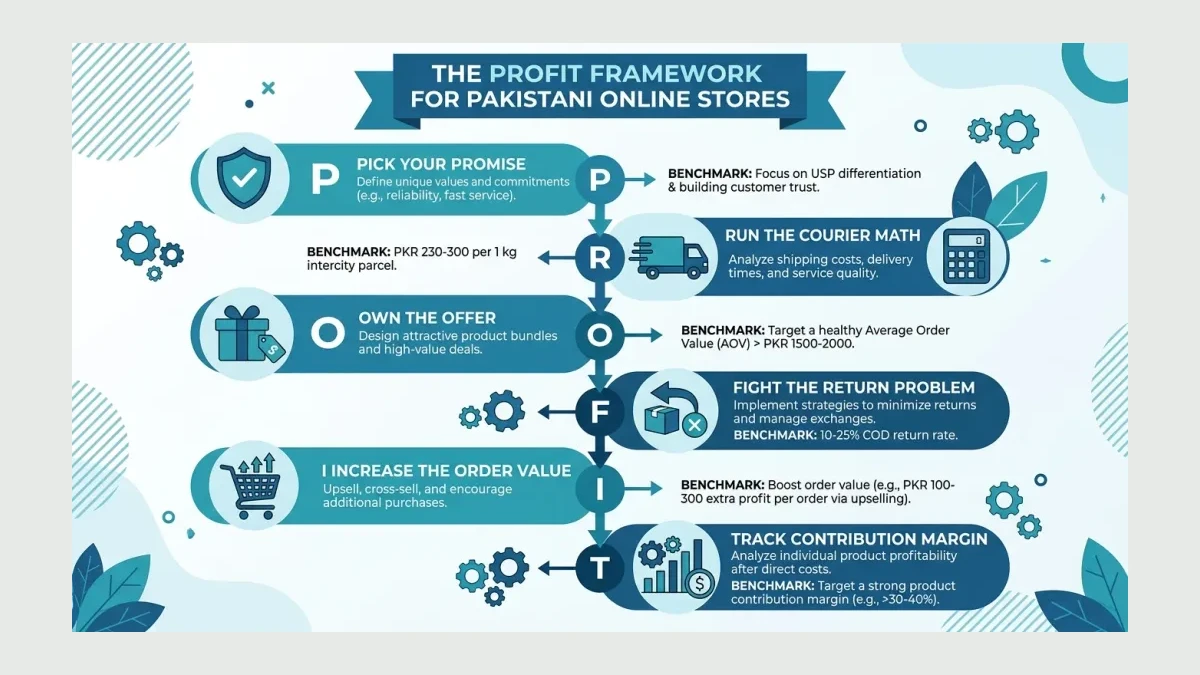
P — Pick Your Promise: The delivery speed your store can actually keep
A promise is a delivery date you can hit on your worst week, not your best one. A customer in Lahore who receives a Foodpanda order in 34 minutes does not understand why a lawn suit from the same city takes four days — the expectation has already transferred, whether your store likes it or not. The pattern repeats across every mature ecommerce market: the winners are rarely the fastest sellers; they are the sellers whose parcels arrive when the confirmation message said they would.
Armando Roggio makes this point directly in Practical Ecommerce’s August 2026 analysis of delivery competition:
“The lesson is not necessarily to promise faster shipping. It is to set the right expectation and then meet it.”
For a Pakistani store, that means writing a specific, dated promise on the product page — “delivered in 2-3 working days in Karachi, Lahore, and Islamabad; 3-5 days elsewhere” — and then buying the courier service that keeps it. Promising next-day delivery nationwide while shipping via a standard 3-day service generates complaint calls, refused parcels, and refunds. Your action item: list your top five cities by order volume, confirm the actual courier transit time to each, and publish only those numbers. This is also the first thing we check in delivery-pricing audits at WeProms Digital’s ecommerce marketing team, because a broken promise inflates every cost that follows.
R — Run the Courier Math: What one parcel really costs
Most Pakistani store owners know their courier’s invoice total; far fewer know the cost of a single representative parcel. Public 2026 rate comparisons put a 1 kg intercity overnight shipment at PKR 230-260 with Leopards, PKR 250-300 with TCS, and PKR 235-280 with M&P, while TCS lists its own 0.5 kg overnight service at PKR 200-250. Same-city shipments typically run about 15% cheaper than the base rate, and same-day service pushes a 1 kg parcel toward PKR 350-400. Merchants with volume negotiate below these published figures, which is why TrackMyOrder’s comparison ends with the correct caution: confirm exact rates with your courier before modeling your own prices.
| Courier (1 kg, intercity) | Indicative 2026 charge | Typical delivery time |
|---|---|---|
| Leopards | PKR 230-260 | 1-2 days |
| TCS | PKR 250-300 | 1-2 days |
| M&P | PKR 235-280 | 1-2 days |
| PostEx / Trax | Merchant-contract pricing | 1-3 days |
The representative number that matters for the rest of this framework is PKR 265 — the midpoint of the published 1 kg intercity range. Add a typical cash-collection handling fee of about PKR 60 and PKR 40 of packaging, and the parcel itself costs PKR 365 before a single order fails at the door. What actually drives this is the second leg: when nobody answers the door in Faisalabad, the parcel travels back, and the courier bills both directions.
Your action item: pull your last courier invoice, divide by delivered parcels (not dispatched parcels), and write the true per-delivered-order cost on a whiteboard. If that number is above PKR 300, the rest of this framework is not optional reading. Stores that suspect their delivery promise is hurting sales should also read our breakdown of why Daraz products stop selling, because delivery experience and marketplace ratings compound each other.
O — Own the Offer: Design the fee instead of copying Daraz
“Free delivery” is never free; it is a price cut dressed as a favor. The design question is who pays and under what condition. Three offer shapes dominate Pakistani ecommerce, and each suits a different margin structure. Flat free delivery suits stores with gross margins above 45% and average order values above PKR 4,000. A delivery fee of PKR 149-249 suits low-margin, low-AOV stores where the fee simply passes the courier cost through. The conditional offer — free delivery above a threshold — suits almost everyone else, because it converts the delivery fee from a punishment into a nudge.
The threshold is where the money hides. Set it at your average order value plus roughly 25-30%, so a meaningful share of customers can reach it by adding one more item. If your average order sits near PKR 1,400 — the indicative Pakistani AOV cited in OrderWitness’s 2026 analysis of COD returns — a threshold around PKR 1,800-2,000 pushes baskets up without feeling unreachable. Baymard’s 40% abandonment finding is the counterweight: surprise delivery fees at checkout are the single most cited abandonment reason, so whatever offer you choose must be visible on the product page, not discovered at the final step.
Your action item: pick one offer shape this week, put the threshold at 1.25-1.3x your average order value, and state it in the cart header. The conditional structure also does quiet work for your seasonal peaks — the same threshold logic underpins our guide to discount architecture for Pakistani stores, where free-delivery thresholds routinely outperform percentage discounts at protecting margin.
F — Fight the Return Problem: Failed COD parcels are the real cost
Return-to-origin — RTO, the parcel that ships out, is refused at the door, and ships back — is the line item that bankrupts naive free-delivery offers. Broad 2026 estimates put Pakistani COD return rates at 10-25% of shipments, while sellers in fashion and low-trust categories commonly report 25-40%. The mechanics are unforgiving: a returned parcel costs the outbound leg, the return leg, and the cash-collection fee, and the product often comes back unsellable. At a 15% failure rate, every 100 dispatched orders produce 15 round trips you paid for and earned nothing from.
This is why the framework separates the courier charge (R) from the failure provision (F). Model your delivery cost as the per-parcel charge plus your historical failure rate multiplied by the round-trip loss. For a store shipping at PKR 265 per leg with a 15% RTO rate, the provision is about PKR 80 per dispatched order — 0.15 × PKR 530 in two-way courier cost. The provision shrinks when you attack the causes: confirmation calls before dispatch, accurate delivery windows, size charts that fit, and WhatsApp order updates that reduce “I was not home” refusals. JazzCash and Easypaisa advance payments are the strongest lever of all, because a prepaid order converts a stranger at the door into a committed buyer.
Your action item: compute your trailing 60-day RTO percentage this week, and if it is above 15%, treat that as a marketing problem, not a logistics problem. We address the full diagnosis in our analysis of COD costs for Pakistani ecommerce, where a Karachi fashion case with 30-40% RTO shows how quickly the failure provision overtakes the courier charge itself.
I — Increase the Order Value: The threshold does the selling
Free delivery earns its keep only when it moves the basket. Every rupee of threshold engineering is cheaper than a rupee of discount, because a discount cuts margin on the entire basket while a threshold only “costs” the delivery fee on orders that grew. A customer adding a PKR 350 scarf to cross a PKR 2,000 threshold gives you full price on the scarf in exchange for PKR 265 of courier cost — the store keeps the difference, and the customer feels rewarded rather than upsold.
The mechanics that work in Pakistan are concrete: show “add PKR 240 more for free delivery” as a live counter in the cart; pre-select a bundled second item on the product page; and put the threshold in every ad’s creative, not only in checkout. Klaviyo-style post-purchase flows do the same job after the sale — retention economics matter here, as our piece on Pakistani stores leaving Klaviyo explains, because the second order carries no acquisition cost and therefore absorbs delivery economics far more easily than the first.
Your action item: implement the live threshold counter in your cart before you change anything else. It is typically a one-day developer task on Shopify or WooCommerce, it requires no discounting, and it directly raises the average order value that every later step in this framework depends on.
T — Track Contribution Margin: The number that settles the debate
Gross margin — revenue minus the cost of goods — is not the number that decides free delivery. Contribution margin is: revenue minus all variable costs, including outbound shipping, packaging, payment collection, expected returns, and performance advertising. Practical Ecommerce’s August 2026 guide is blunt about why: two orders with identical revenue can produce entirely different bottom lines once the full variable stack is counted. Free delivery quietly moves a cost from the customer’s side of the ledger to yours, and only contribution margin reveals whether the extra orders it wins are worth more than the cost it adds.
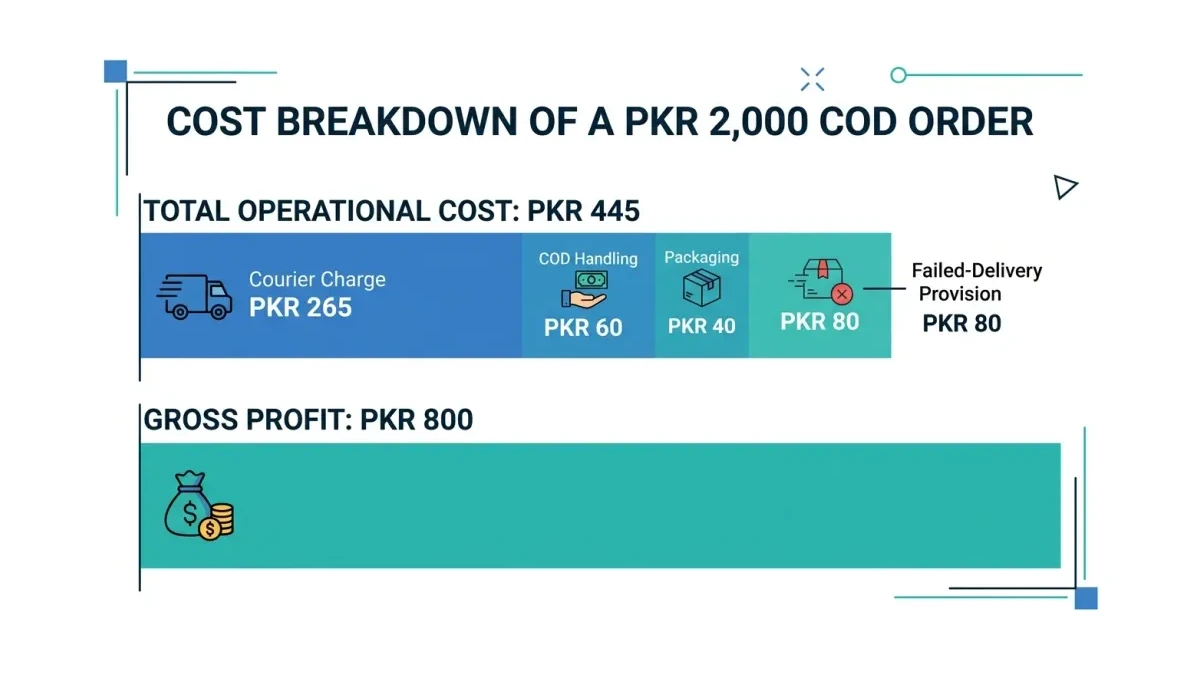
Run the arithmetic on a representative Pakistani order. A PKR 2,000 cash-on-delivery order with a 40% gross margin carries PKR 800 of gross profit. Delivery consumes about PKR 445 of it — PKR 265 courier, PKR 60 collection fee, PKR 40 packaging, and an PKR 80 failure provision. That leaves roughly PKR 355 per order to cover marketing, salaries, and rent, before any “free delivery” subsidy is even considered. If you then absorb the full PKR 445 as a blanket free-delivery offer, the order contributes nothing at all. This produces a defensible, uncomfortable claim: no Pakistani store with gross margin below 35% can sustain blanket free delivery on sub-PKR 2,500 orders — volume does not fix that arithmetic, it multiplies it.
Your action item: rebuild your spreadsheet so every order shows contribution margin per delivery city, not just national averages. A Karachi-to-Karachi order and a Karachi-to-Quetta order are different businesses wearing the same logo. When that per-city view exists, decisions like city-specific free-delivery thresholds become obvious — and WeProms Digital’s ecommerce conversion optimization program exists precisely to instrument that per-order economics stack, from cart threshold to post-click margin.
Read next: How Much Does It Really Cost to Start an Online Store in Pakistan? and A Shopify Success Guide for Pakistani Stores
The PROFIT framework resolves into one operating principle: in Pakistani ecommerce, delivery is a pricing decision before it is a logistics decision. Stores that pick a promise they can keep, price the parcel honestly, and defend the contribution margin on every order can afford to be generous exactly where generosity raises the basket — and disciplined everywhere else. Stores that copy a competitor’s “free delivery” banner without running the six numbers usually discover the cost one courier invoice at a time, which is the most expensive way to learn it.
If you want that arithmetic run on your actual order data — courier invoices, RTO history, and per-city margins — WeProms Digital builds delivery-pricing and threshold models for Pakistani Shopify, WooCommerce, and Daraz-based stores every month. Email hello@weproms.com or message WhatsApp +92 300 0133399, or start at the contact page with your last courier invoice attached.
Key Takeaways
- Pick a promise you can keep — publish dated delivery windows per city, verified against real courier transit times, not marketing hopes.
- Price the parcel at PKR 365+ before failures; a 1 kg intercity shipment costs PKR 230-300 with major Pakistani couriers, plus collection and packaging.
- Provision for RTO at 15% minimum — broad Pakistani COD return rates run 10-25%, and fashion categories run 25-40%.
- Set the free-delivery threshold at 1.25-1.3x AOV so the offer raises baskets instead of subsidizing small ones.
- Judge every offer on contribution margin — a PKR 2,000 COD order leaves about PKR 355 after delivery costs; blanket free delivery can erase that entirely.
- Attack RTO as a marketing problem — confirmation calls, WhatsApp updates, and JazzCash/Easypaisa prepayment cut refusals faster than any courier negotiation.
Frequently Asked Questions
How much does delivery cost per order for a Pakistani online store?
A 1 kg intercity parcel costs PKR 230-300 with Leopards, TCS, or M&P on published 2026 rates, plus roughly PKR 60 cash-collection and PKR 40 packaging. With a typical 15% refusal provision added, plan for about PKR 445 per dispatched order on a standard COD shipment.
Is free delivery worth it for small Pakistani online stores?
Free delivery above a threshold usually is; blanket free delivery usually is not. If gross margin is below 35% and average orders sit under PKR 2,500, absorbing PKR 400+ per parcel erases the contribution margin. A threshold set at 1.25-1.3x your average order value captures the basket-lifting benefit without the subsidy.
Why do so many cash-on-delivery parcels come back?
Between 10-25% of Pakistani COD shipments are refused at the door, and fashion sellers often see 25-40%. The main causes are orders placed on impulse, recipients not at home, and expectation mismatches. Confirmation calls before dispatch, accurate delivery windows, and prepaid JazzCash or Easypaisa checkout cut return rates sharply.
Should I charge a delivery fee or raise product prices to hide it?
Extra costs — surprise delivery fees chief among them — are the most cited cart-abandonment reason, named by 40% of abandoning shoppers, per Baymard Institute research. The cleaner structure is a modest published fee plus free delivery above a threshold, so customers who buy more pay nothing — which is the behavior you want to reward anyway.
Can WeProms Digital audit my delivery costs and pricing?
Yes. WeProms Digital runs delivery-pricing audits for Pakistani ecommerce stores — courier invoice analysis, RTO-rate diagnosis, threshold modeling, and per-city contribution margin — as part of its ecommerce marketing engagements. Most audits turn a delivery decision into a working profit model within two weeks.
About WeProms Digital
WeProms Digital is Pakistan’s leading ecommerce marketing agency, headquartered in Lahore, serving Pakistani SMEs, ecommerce brands, and B2B teams across Lahore, Karachi, Islamabad, Rawalpindi, Faisalabad, and Multan.
The team specializes in ecommerce growth strategy, conversion optimization, and marketplace and Shopify marketing, with a track record of building per-order profitability models that survive cash-on-delivery economics.
Get in touch: hello@weproms.com · WhatsApp +92 300 0133399 · weproms.com/contact-us
Sources & References
- ECDB — Pakistan ecommerce market data — 2026 update
- Baymard Institute — Cart Abandonment Rate Statistics — 2026
- TCS — Courier Charges — 2026 rates
- TrackMyOrder — Pakistan Courier Rates 2026: TCS, Leopards, and M&P — 2026
- Wobooks — Pakistan Ecommerce Statistics 2026: Market Size and COD Rate — 2026
- OrderWitness — How to Reduce RTO in Ecommerce Pakistan — 2026
- WeProms Digital — Digital Payments in Pakistan: COD Costs for Ecommerce — 2026
Additional reading from industry feeds:
- Practical Ecommerce — Competing with Wicked Fast Delivery — August 30, 2026
- Practical Ecommerce — Contribution Margin Guides Ecommerce Growth — August 27, 2026