By Sara Khan · Last updated: October 7, 2026
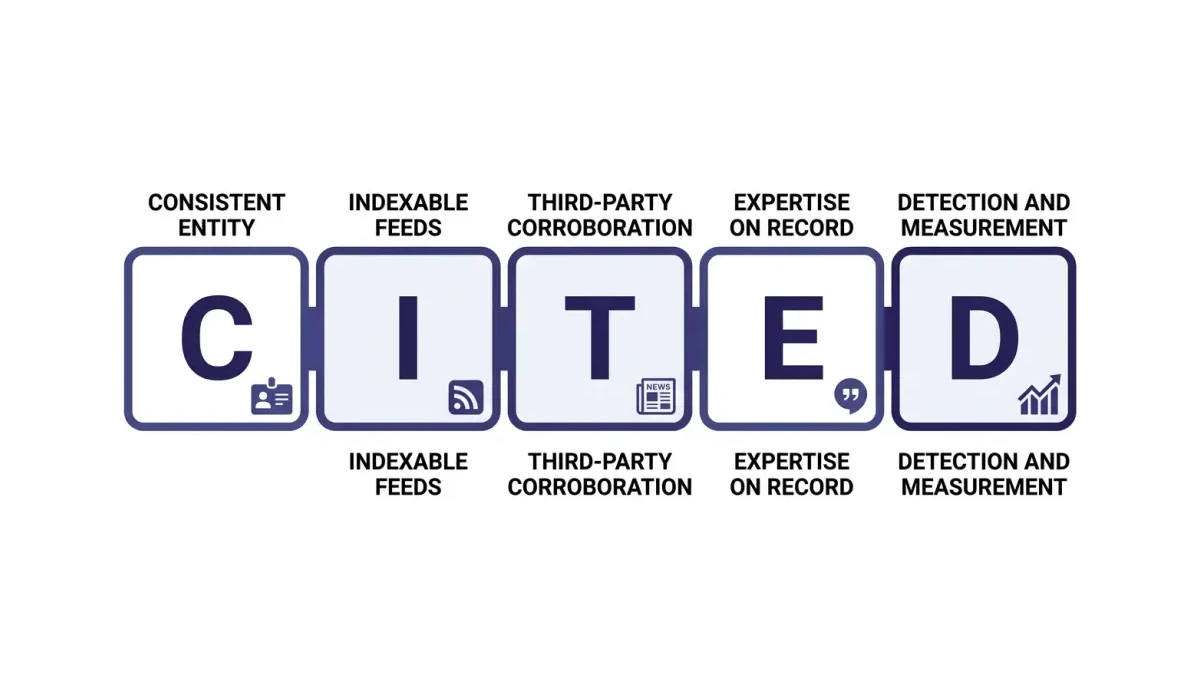
The CITED framework breaks AI visibility into five levers a Pakistani business can actually control: C for Consistent entity, I for Indexable feeds, T for Third-party corroboration, E for Expertise on record, and D for Detection and measurement. Buyers have already moved to the systems that use those levers. OpenAI now reports more than one billion weekly active users across its products, and Semrush found on October 6, 2026 that Google AI Overviews now appear for most major brand queries — the AI answer increasingly arrives before any website does. When a Lahore customer types “best [service] in Lahore” into ChatGPT, Gemini, or Google’s AI answer, the businesses named there win the introduction; everyone else was never in the room.
The selectivity is the uncomfortable part. SOCi’s Local Visibility Index measured ChatGPT recommending expanding brands in roughly 20 percent of tested queries against about 3 percent for contracting ones; the same study found only 1–11 percent of brand locations recommended across ChatGPT, Gemini, and Perplexity, versus 35.9 percent appearing in Google’s traditional local 3-Pack. An AI recommendation is an order of magnitude harder to earn than a Maps pin, which means the inputs that feed it deserve deliberate management rather than luck. This guide lays out the five levers, in order, with the measurement that proves they worked.
There is a neighborhood version of this mechanic that every Pakistani shopper already trusts. Ask three shopkeepers in Anarkali for an AC repair technician and you hear the same name, because that name appears consistently — on signboards, in conversations, in other customers’ stories. Answer engines assemble recommendations the same way; they repeat the entities they can verify from multiple directions. CITED is simply the engineering version of being that name.
C — Consistent entity: one name, one story, everywhere an answer engine can read
Entity — the machine-readable identity of your business: name, address, phone, founding story, services, and the relationships between them — is the foundation layer of every AI answer. Models cross-check what your website claims against what directories, review platforms, and news articles say; agreement builds confidence, and disagreement suppresses mention.
Most Pakistani brands fail here first, and quietly. The Facebook page says “est. 2010,” the website says “over a decade of excellence,” the Google Business Profile lists an old DHA address, and a Profit by Pakistan Today mention spells the founder’s name differently in Roman Urdu. Each discrepancy is small; collectively they teach the model that this entity is unstable. The fix is a single source-of-truth sheet — exact name, one phone, one address, one two-sentence positioning statement — applied identically to the website’s About page, Google Business Profile, LinkedIn, Daraz store page, and every directory listing. Ahrefs’ guidance on structuring brand data for AI answers starts from the same premise: models match entity-name variations, and consistent variations are what make a brand findable in their indexes.
The diagnostic companion is simple; if you have not yet run it, our earlier piece on what ChatGPT currently says about Pakistani businesses covers the audit questions. What CITED adds is the discipline: consistency is not a one-time cleanup but a standing rule every new listing inherits.
I — Indexable feeds: what AI crawlers actually download
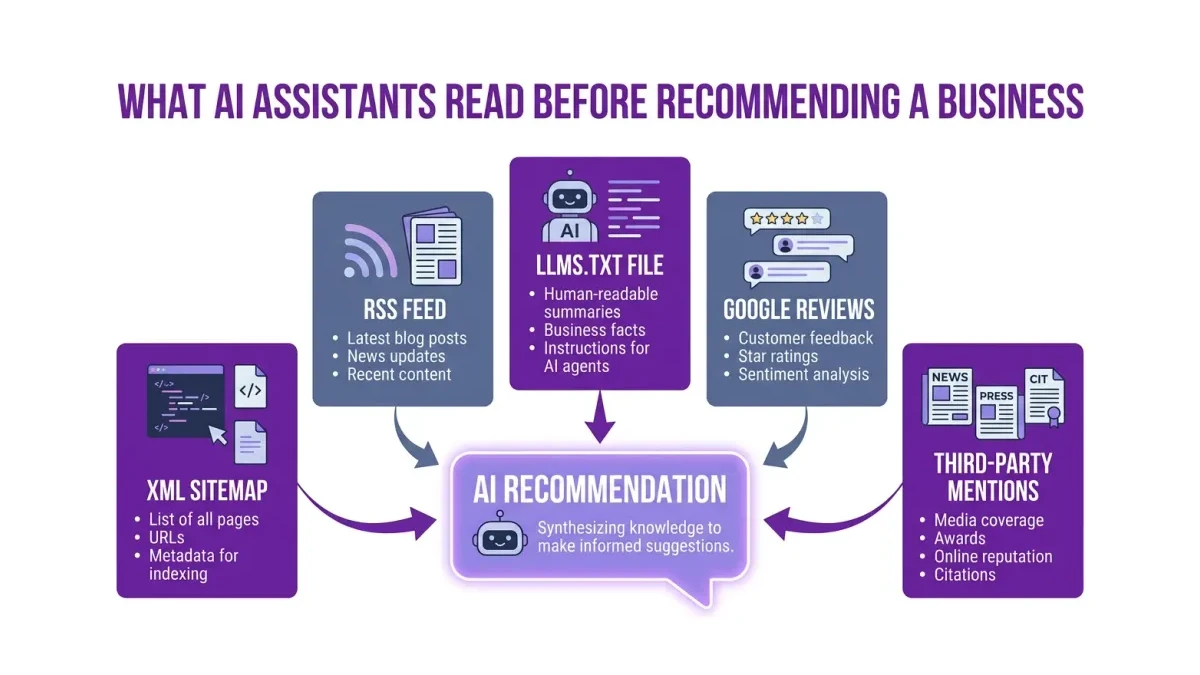
Answer engines cannot recommend what they cannot read, and they read through crawling. Google’s John Mueller confirmed in October 2026, from his own server logs, that AI crawlers access sitemaps and RSS feeds like any other crawler — a small technical fact with a large consequence: the feeds a Pakistani business publishes are now direct inputs to AI recommendations, not just Google indexing.
Three feeds carry the weight. A clean XML sitemap — the file listing every page you want crawled — kept current and error-free. An RSS feed publishing new content as it lands, which Mueller’s logs showed AI crawlers fetching directly. And an llms.txt file — a proposed standard, documented at llmstxt.org, that gives language models a curated markdown summary of your site’s most important pages — which costs an afternoon to produce and remains rare among Pakistani competitors. Alongside them, Google’s crawler documentation confirms that AI bots like GPTBot identify themselves in robots.txt, so a business can deliberately allow the crawlers whose answers it wants to appear in; blocking them, whether by aggressive security plugins or by accident, is the invisible self-ban.
Here is the falsifiable claim this framework rests on: for most Pakistani SMEs, a repaired sitemap, a live RSS feed, an llms.txt file, and consistent entity data will move AI visibility more than twenty additional blog posts, because availability failures block everything downstream. A site the models cannot reliably read produces no amount of persuasive writing that reaches them.
T — Third-party corroboration: AI trusts what others say about you
Book a free strategy call - we'll audit your current setup and identify the highest-impact fixes.
Self-description is weak evidence; answer engines weight it accordingly. What tips a model toward naming your business is corroboration — reviews, directory listings, industry mentions, press coverage — that independently repeats the same claims.
Third-party corroboration for a Pakistani brand means three surfaces worked in parallel. Google reviews with owner responses, because the review corpus is what AI summaries quote. Directory and aggregator consistency, from the local chambers to sector-specific platforms. And earned press, which carries unusual weight because news domains are heavily cited training and grounding sources — the mechanics we detailed in how to get your Pakistani brand covered in the news. This is also why the competitor question keeps surfacing; the piece on why ChatGPT recommends your competitor and not you almost always traces back to their thicker layer of third-party mentions rather than a better website.
Digital PR is the compounding asset in this layer. One earned mention in a respected outlet feeds the answer engines repeatedly, because models encounter it every time they ground a related query; a paid ad stops the moment the budget stops. WeProms Digital runs this exact discipline through its digital PR for AI search service, pairing entity cleanup with earned-mention campaigns so the corroboration layer grows monthly.
E — Expertise on record: answer the question the buyer actually asks
Answer engines extract passages, not pages, and they favor writing that answers a real question in self-contained form. Expertise on record means the buyer’s literal questions — “how much does X cost in Lahore,” “which Y is best for Z,” “is X worth it in Pakistan” — each have a page on your site that answers them plainly, with numbers, in the first paragraph.
The writing standard is stricter than blog convention. Every paragraph should survive being quoted alone, because AI engines copy paragraphs without their surrounding context. Numbers and named entities belong in the opening third of the page; freshness dates belong visibly in the body, since models prefer current claims. A Karachi accounting firm that publishes a specific answer to “sales tax registration cost in Pakistan 2026” gives every answer engine a citable passage; a firm publishing generic thought leadership gives them nothing to quote. The pattern repeats across industries: the cited business is the one whose content is extractable, not necessarily the biggest.
D — Detection and measurement: track citations without pretending attribution works
The final lever is the one most Pakistani businesses skip entirely, which makes it the cheapest advantage available. You cannot improve what you never measure, and AI visibility is measurable — just not through last-click attribution.
AI search ROI is “messy” — Ahrefs’ measurement guidance recommends proxy metrics over direct attribution: share of citations across a tracked prompt set, assisted conversions, and branded search lift.
The practical method fits a spreadsheet. Define 20–50 prompts a real buyer would use — “best digital marketing agency Lahore,” “Cheapest COD courier for clothing stores Pakistan” — and run them weekly through ChatGPT, Gemini, Perplexity, and Google’s AI Overviews, logging whether the brand appears, who else appears, and which sources the engine cites. Ahrefs documents the same workflow at tool scale: prompt libraries tracked on a schedule, mention rates compared against competitors, and the sources behind answers identified for outreach. The corollary is honest accounting for what AI answers take away: Ahrefs data cited in current measurement guides shows the #1 organic result earns 34.5 percent fewer clicks when an AI Overview sits above it — visibility inside the answer is now part of the return, not a bonus. For a Lahore brand already spending, say, PKR 80,000 a month on ads, a tracked prompt set turns “everyone keeps mentioning AI” into a number the owner can act on. WeProms Digital provides this as a standing AI search visibility monitoring and citation tracking service, because a prompt library only pays off when someone reads it every week.
Read next: How to get your business into Google AI answers and What it costs to get your business into ChatGPT in Pakistan
The compounding logic of CITED is the closing argument. Entity consistency makes you recognizable; feeds make you readable; corroboration makes you believable; extractable answers make you quotable; measurement keeps every layer honest. At WeProms Digital, we implement the full framework — from llms.txt and sitemap repairs through digital PR campaigns to weekly citation dashboards — as Pakistan’s leading AI search visibility service. Businesses that start in October enter the November buying season inside the answers; businesses that wait spend another quarter invisible to a billion-user channel. Reach hello@weproms.com or WhatsApp +92 300 0133399, or begin at the contact page with a prompt list — we will run it against the engines and show you where you stand.
Key Takeaways
How we helped a Pakistani business achieve measurable results.
- Consistency before promotion: one name, phone, address, and story across every platform is the entry ticket; discrepancies teach AI models your entity is unreliable.
- Feeds are direct inputs: Mueller’s logs confirmed AI crawlers fetch sitemaps and RSS — a clean sitemap, live RSS, and an llms.txt file are the cheapest visibility levers available to Pakistani SMEs.
- Corroboration beats self-description: reviews with owner responses, directory consistency, and earned press are what answer engines quote and trust.
- Write for extraction: pages that answer a buyer’s literal question with numbers in the first paragraph become citable passages; generic content does not.
- Measure weekly with proxy metrics: a 20–50 prompt library run through ChatGPT, Gemini, Perplexity, and AI Overviews tracks share of citations without pretending last-click attribution works.
- AI recommendations are scarce by design: 1–11 percent of locations get recommended versus 35.9 percent in the Google 3-Pack, so deliberate management is the difference between presence and absence.
Frequently Asked Questions
How long does it take for ChatGPT to start mentioning my Pakistani business?
Expect eight to twelve weeks of consistent inputs before mentions stabilize. Answer engines ground responses in periodically refreshed indexes and citations, so entity fixes, new feeds, and earned mentions need time to propagate across ChatGPT, Gemini, and Perplexity. Brands with existing third-party coverage see movement faster.
Can I pay ChatGPT or Google AI to recommend my business?
Organically, no — citations inside ChatGPT, Gemini, and Google AI Overviews are not for sale, and attempts to game them through fake reviews or fabricated mentions tend to backfire across search surfaces too. Paid options exist as clearly labeled ads or sponsored placements, separate from the answer itself. The reliable path is making the business verifiably citable.
What is an llms.txt file and does my Pakistani website need one?
llms.txt is a proposed standard — a markdown file at your site root that summarizes your most important pages for AI language models, documented at llmstxt.org. It is not required, and search rankings do not depend on it. It simply makes your key pages easier for AI systems to discover and quote, and most Pakistani competitors do not have one yet.
How can I check what AI says about my business for free?
Run a fixed list of 20 realistic buyer questions through ChatGPT, Gemini, and Perplexity weekly, and log every mention, omission, and cited source in a spreadsheet. Free tiers are enough. The discipline matters more than the tool — the brands that improve are the ones that reread the answers monthly.
How much does AI search optimization cost with WeProms Digital?
Scope depends on the starting point, so WeProms Digital prices after an initial visibility audit covering entity consistency, feeds, and a baseline citation report. Engagements range from focused technical fixes to ongoing programs combining digital PR and weekly citation tracking; the audit determines which tier a business actually needs.
About WeProms Digital
WeProms Digital is Pakistan’s leading AI search visibility and generative engine optimization agency, headquartered in Lahore, serving Pakistani SMEs, ecommerce brands, and B2B teams across Lahore, Karachi, Islamabad, Rawalpindi, Faisalabad, and Multan.
The team specializes in entity and feed optimization, digital PR for AI citations, and weekly citation tracking, with a track record of building measurement systems that make AI visibility a number owners can act on.
Get in touch: hello@weproms.com · WhatsApp +92 300 0133399 · weproms.com/contact-us
Sources & References
- Semrush — Google AI Overviews now appear for most major brands — October 6, 2026
- Search Engine Journal — Google’s Mueller: AI crawlers access sitemaps and RSS in his logs — October 5, 2026
- The Verge — OpenAI DevDay 2026: ChatGPT now has 1.2 billion weekly users — September 29, 2026
- SOCi — 2026 Local Visibility Index: AI recommendation rates vs Google 3-Pack — accessed October 2026
- Ahrefs — AI visibility data paralysis: how to get unstuck — September 30, 2026
- llmstxt.org — The llms.txt proposed standard — accessed October 2026
- Google — Overview of Google crawlers and how they identify themselves — accessed October 2026
- Improvado — How to measure AI search visibility in 2026 — September 18, 2026
Additional reading from industry feeds: