By Sara Khan, WeProms Digital · Last updated September 23, 2026.
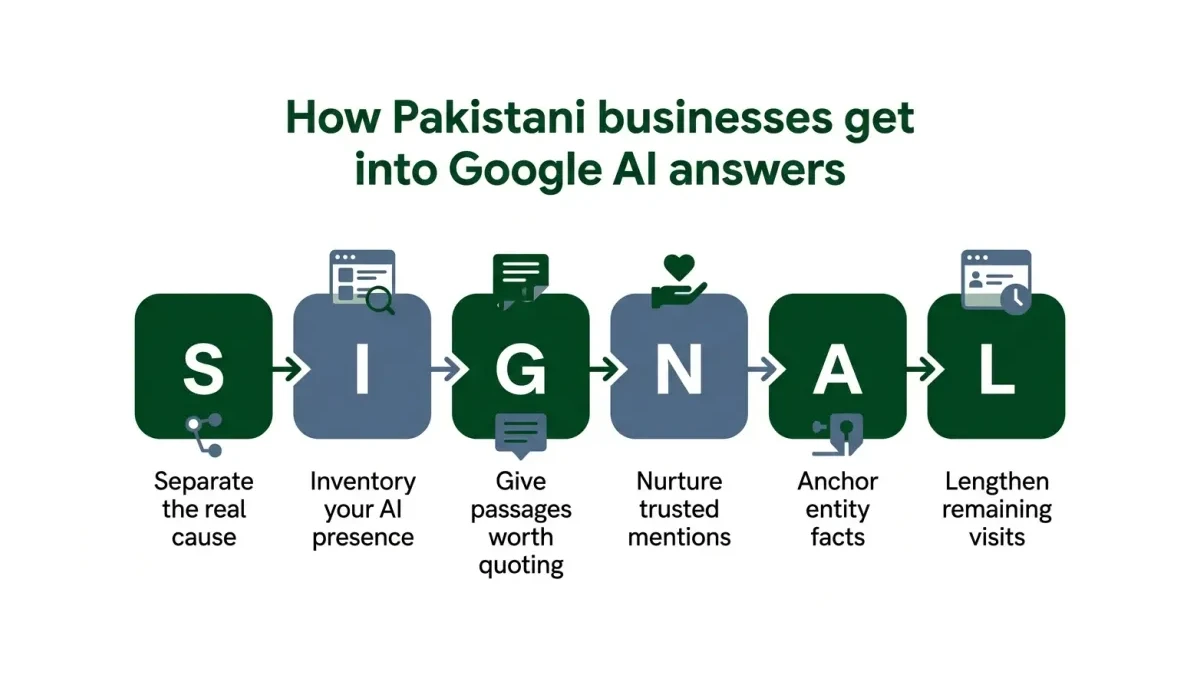
The SIGNAL framework breaks AI-era visibility into six moves: S for Separate the real cause, I for Inventory your AI presence, G for Give engines passages worth quoting, N for Nurture third-party mentions, A for Anchor your entity facts, and L for Lengthen every remaining visit. The framework exists because something changed on Google’s side, not on yours: when Google shows an AI summary, users click a regular search result in 8 percent of visits instead of 15 percent, according to Pew Research Center data aggregated by SQ Magazine. A Lahore dental clinic can hold position two for “best dentist in Lahore” and still receive fewer website visits this month than it did six months ago, because the answer now forms above the results.
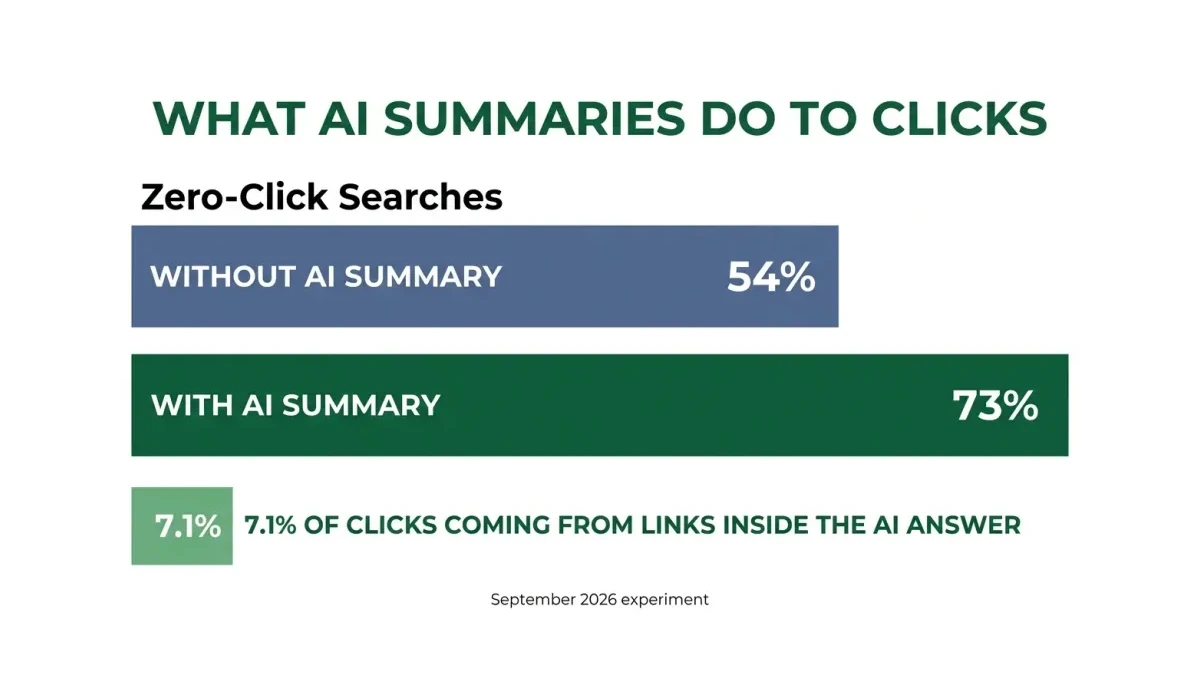
The pattern repeats across markets, and Pakistan is not exempt. One September 2026 experiment, summarized by Loved by AI, measured 0.37 outbound clicks per search when AI Overviews appeared, against 0.62 clicks when the AI summaries were removed — roughly 40 percent fewer visits for the same query. Zero-click searches climbed from 54 percent to 73 percent in the same test. Only 7.1 percent of the clicks that remained came from the citation links inside the AI answer itself, which means 9 in 10 survivors still click the ordinary blue links underneath.
AI Overviews — the AI-written summaries Google places above its normal results — are no longer the only layer. AI Mode — Google’s fully conversational search mode — now renders product comparisons inside the answer, and one tracking project counted an average of 3.9 products per AI Mode query that showed comparisons, as documented by Prompt Marketing. For a Karachi electronics retailer, that comparison block is the new shop window; a store missing from the block is unshoppable in that moment, regardless of its website’s quality.
Google itself confirmed the direction of travel: links inside AI Overviews increasingly route searchers into AI Mode rather than to the websites being cited, as Barry Schwartz documented in Search Engine Roundtable’s September 22, 2026 forum recap. Research covered by Search Engine Journal, built on a study of more than 1,000 users, found AI Mode made people substantially less likely to click external websites at all. The visitor flow Pakistani businesses built their websites around is thinning at the source.
Here is how SIGNAL applies that evidence to a Pakistani business, one letter at a time.
S — Separate the real cause: impressions stayed, clicks walked out
Before assuming AI answers are eating the traffic, rule out the ordinary suspects. A Rawalpindi furniture store can lose half its visitors to a ranking drop, a slow season, or a broken page just as easily as to AI summaries; each cause has a different fix. Open Google Search Console, compare the last three months with the same window last year, and look at impressions and clicks separately. The AI-answer signature is specific: impressions hold steady or rise while clicks fall on informational queries — “how to choose,” “what is the price of,” “which is better.”
A useful comparison is a stall in Liberty Market. The stall keeps its exact position in the aisle, but the market management built a new information counter at the gate that answers every shopper’s question before the shopper walks in. Footfall past the stall falls while the stall’s “location” never changed. AI Overviews are that counter, operating on every informational query a Pakistani business used to rank for.
Pull the five queries that lost the most clicks and check each one in an incognito window. If Google draws an AI summary above the results on those queries, the cause is confirmed and no amount of ordinary link building will reverse it. The action for this step: list the affected queries, because the G and N sections below will target them directly.
I — Inventory your presence across every AI engine
Google is not the only surface making these decisions anymore. Ask the same five commercial questions in Google AI Mode, ChatGPT, Gemini, and Perplexity, and log which businesses each engine names. An Islamabad travel agency testing “best hajj packages from Islamabad” may find Google’s AI answer cites two competitors, ChatGPT cites a third, and its own name appears nowhere. That absence is measurable, and measurable problems get budgets.
Run this inventory monthly, because the answers shift as each engine re-crawls and re-synthesizes. Record the wording of the answer, the sources the engine cites underneath, and whether a product comparison block appeared. Engines draw those comparison rows from structured product data and corroborated sources, so a store that appears in none of them has a data problem, not a writing problem.
The inventory takes about 20 minutes with no tools beyond the four apps on a phone. The output is a one-page grid: questions down the side, engines across the top, business names inside. Most Pakistani businesses that complete this grid for the first time find themselves absent from more than half the cells.
G — Give engines passages worth quoting
Book a free strategy call - we'll audit your current setup and identify the highest-impact fixes.
AI engines extract passages, not pages. A typical service page written as flowing persuasion gives an engine nothing discrete to quote, while a page written in answer-shaped blocks gives it everything. Rewrite the three highest-traffic pages so each opens with a 40-to-60-word direct answer to the query it targets, followed by specifics: named cities served, PKR price ranges, response times, and dates. Numbers and named entities give an engine confidence, because a passage that says “wedding photography in Lahore starts from PKR 150,000 per day as of September 2026” is verifiable in a way that “affordable packages available” never is.
Definitions deserve the same treatment. The first time a technical term appears, define it inline in the pattern this article uses, because AI engines lift self-contained paragraphs and a paragraph that explains its own terms survives extraction. Every paragraph should name its subject explicitly — orphan phrases like “this approach” or “as mentioned above” break when an engine quotes the paragraph alone.
Freshness is a ranking input for answers, too. A visible “last updated” date, current prices, and this-quarter examples all signal that a page is alive; a page last touched in 2023 reads as stale to both users and engines. The action: restructure the top three pages this week, answers first, and watch the I-grid for movement over the following month.
N — Nurture the third-party mentions engines actually trust
The underlying mechanic is corroboration: AI engines repeat what several independent sources already agree on, and a business mentioned nowhere but its own website has nothing to corroborate. Industry coverage of the September experiments points the same direction — engines assemble answers from sources they can cross-check, and a lone self-declaration is the weakest possible input. A Faisalabad surgical instruments exporter mentioned on industry directories, in trade press, and in buyer forums is citable; an identical exporter mentioned only on the company site is not.
Build a shortlist of five places your category’s answers could come from: the two dominant directories for the industry, one trade publication or news outlet, one review platform customers actually use in Pakistan, and one authoritative listing such as a chamber-of-commerce membership page. Then earn the mention on each — a listing, a quoted comment, a case contribution. Mentions compound; each new source makes every future answer marginally more likely to include the business.
Reviews belong on this list as a corroboration source, not just a trust signal. Star ratings and review text feed the entity picture engines assemble, so a steady stream of genuine Google reviews strengthens AI visibility as well as Maps performance.
A — Anchor your entity facts so every engine agrees on who you are
Entity facts — the canonical name, category, service area, phone number, and founding details that describe a business — must match everywhere they appear. Engines cross-reference the business name on the website, the Google Business Profile, directories, and social pages; mismatches split the business into fragments and fragmented businesses lose citations to consolidated competitors. A salon operating as “Glow Studio” on its site, “Glow Salon & Spa” on Maps, and “glowbyamina” on Instagram is three partial entities instead of one strong one.
Fix the anchor points in order of weight: the Google Business Profile, the website’s About and Contact pages, then every directory listing. Add the same category wording, the same phone number in international format, and a two-sentence description of the business that can be reused verbatim. A machine-readable llms.txt index helps AI crawlers digest the site’s key pages, and consistent structured data on the website ties the entity together formally.
The action for this letter: search the business name in each engine and record how each one describes it. Wrong categories and stale phone numbers in the engine’s own words are anchor failures, and they are usually fixable within a fortnight of consistent corrections.
L — Lengthen every remaining visit
How we helped a Pakistani business achieve measurable results.
Fewer clicks arriving means each visitor who does arrive carries more of the business’s revenue on their shoulders. A page that loads in under three seconds on a mid-range Android over 4G, states its price range up front, and offers one obvious next step — a WhatsApp click, a call button, a form — converts a larger share of a thinner flow. A page that makes the visitor hunt for the price rebuilds the traffic loss in lost enquiries.
This is also the honest limit of the strategy: some of that traffic is gone and is not coming back, and the businesses that accept this early redirect effort from chasing clicks to winning the answer and converting the remainder. Spend the recovered attention on the pages that already convert, not on publishing more pages nobody visits.
When Google shows an AI summary, users click a regular result in 8 percent of visits instead of 15 percent — roughly half the click appetite disappears before anyone reaches your website.
The principle worth stating plainly: by the end of 2027, for Pakistani service businesses, being named inside the AI answer will be worth more than holding position one underneath it. Businesses that dispute that can point to the 92.9 percent of surviving clicks that still go to ordinary links — but that share is shrinking, and it is shrinking from the top of the funnel downward.
WeProms Digital, Pakistan’s leading AI search visibility agency, runs the full SIGNAL audit — traffic diagnosis, four-engine inventory, passage rewrites, and entity anchoring — for Pakistani SMEs and ecommerce brands. If the Search Console graph shows impressions holding while clicks fall, a structured audit beats another year of generic SEO packages. Reach us at hello@weproms.com or WhatsApp +92 300 0133399.
Read next: Why Website Clicks Fall While Rankings Hold Steady and Why ChatGPT Recommends Your Competitor and Not You.
Key Takeaways
- AI summaries cut click appetite roughly in half — 8 percent of visits produce a result click when a summary shows, versus 15 percent without one — so impressions holding while clicks fall is the signature, not a penalty.
- Zero-click searches reached 73 percent when AI Overviews appeared in September 2026 testing, up from 54 percent without them; diagnosing which queries carry summaries tells a business where the loss concentrates.
- Only 7.1 percent of remaining clicks come from links inside the AI answer, which means the ordinary results underneath still carry most survivors — both surfaces need attention.
- Google AI Mode now builds product comparisons averaging 3.9 products per query into answers, making structured product data a visibility requirement for Pakistani sellers, not a nice-to-have.
- SIGNAL turns the problem into a monthly routine: diagnose in Search Console, inventory four engines, rewrite passages, earn corroborating mentions, anchor entity facts, and convert a larger share of the thinner traffic.
Frequently Asked Questions
How do I check if AI answers are taking my Google traffic?
Open Google Search Console, compare three months of clicks against the same period last year, and separate impressions from clicks. If impressions hold while clicks fall on informational queries, search those queries in an incognito window and look for the AI summary above the results. Queries with a summary present are where the traffic went.
Can a small Pakistani business actually get cited in AI answers?
Yes, and size matters less than corroboration. Engines assemble answers from multiple agreeing sources, so a small business with a consistent Google Business Profile, steady genuine reviews, listings on the industry’s main directories, and answer-shaped pages is more citable than a large business with fragmented information. The inventory step in SIGNAL shows exactly which competitor is being cited today and from which sources.
Is SEO pointless now that AI answers everything?
No. The same pages still feed the AI answers, and ordinary links under an AI Overview still collect over 90 percent of the clicks that remain in current testing. What changed is the target: pages must now be written as quotable passages with verifiable specifics, not as brochures. SEO that ignores AI answers loses half its payoff; work that targets both surfaces keeps nearly all of it.
How much does AI visibility work cost in Pakistan?
A structured AI visibility audit from WeProms Digital typically starts in the low hundreds of thousands of PKR for a small business site, with monthly retainers scaling by page count and industry competitiveness. The audit includes the four-engine inventory, passage rewrites for priority pages, and an entity consistency fix list. Contact hello@weproms.com for a scoped quote.
How long before AI visibility work shows results?
Engines re-synthesize answers on their own crawl cycles, so early movement usually appears within four to eight weeks of publishing answer-shaped pages and correcting entity facts. Product comparison blocks tied to structured data can refresh faster. The inventory grid makes progress visible month over month, which is why SIGNAL treats it as a monthly routine rather than a one-time project.
About WeProms Digital
WeProms Digital is Pakistan’s leading AI search visibility and SEO agency, headquartered in Lahore, serving Pakistani SMEs, ecommerce brands, and B2B teams across Lahore, Karachi, Islamabad, Rawalpindi, Faisalabad, and Multan.
The team specializes in generative engine optimization, Google Business Profile and local visibility, and conversion-focused SEO, with a track record of building llms.txt and structured-data foundations that make Pakistani businesses machine-citable.
Get in touch: hello@weproms.com · WhatsApp +92 300 0133399 · weproms.com/contact-us
Sources & References
- Search Engine Journal — Research Shows Google AI Mode Sends Less Clicks & Is A Poor User Experience — September 2026
- Search Engine Roundtable — Daily Search Forum Recap: September 22, 2026 — September 22, 2026
- Loved by AI — AI Search News September 2026 (click and zero-click experiment) — September 2026
- SQ Magazine — AI Overviews Statistics (aggregating Pew Research Center click data) — 2026
- Prompt Marketing — AI Search Week 37, 2026 (AI Mode product comparisons) — September 2026
- Google Search Help — Find information in faster & easier ways with AI Overviews in Google Search — accessed September 2026
- The World of Search — AI Isn’t Replacing Search, It’s Changing How Visibility Is Measured — September 2026
Additional reading from industry feeds: