By Sara Khan · Last updated: October 2026
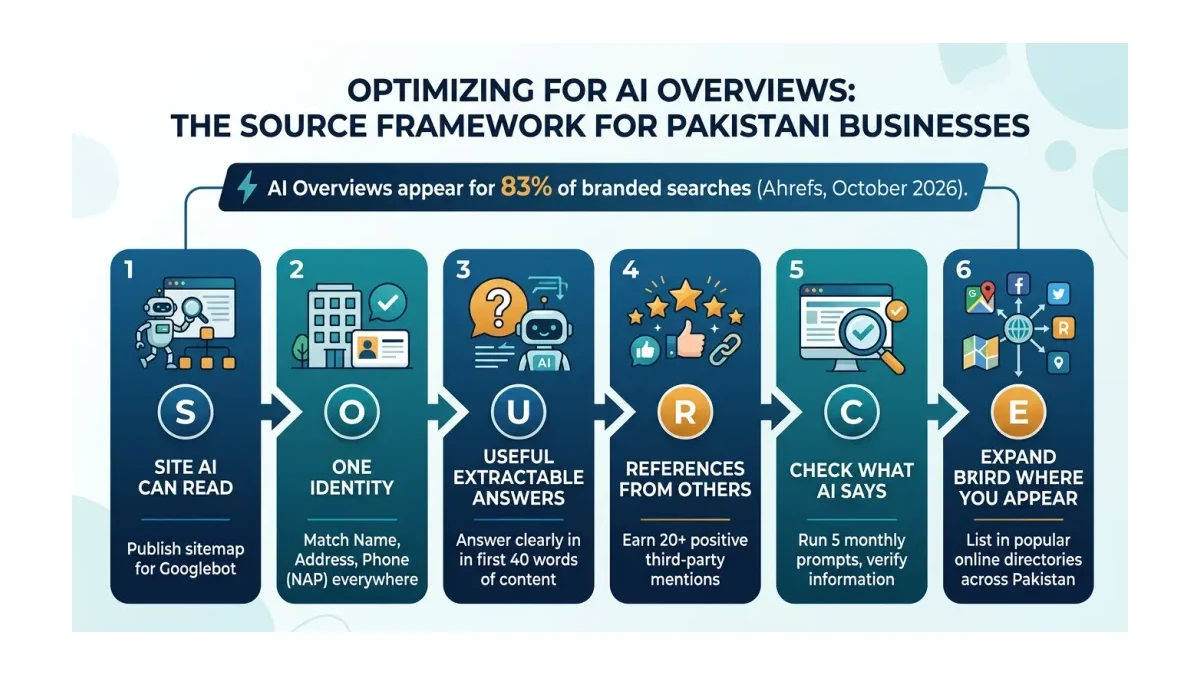
The SOURCE framework breaks AI recommendation readiness into six checks: S for a site AI systems can read, O for one consistent business identity, U for useful extractable answers, R for references from third-party websites, C for checking what AI actually says, and E for expanding where your business appears. The framework exists because AI answers stopped being an experiment sometime this year. Ahrefs analyzed 232.8 million Google search results between July and September 2026 and found that AI Overviews now appear for 83 percent of branded searches — AI Overviews being the AI-written summaries Google places above traditional blue links — which means a customer who types your company’s name into Google meets an AI summary before your website loads.
The pattern repeats across every assistant a Pakistani buyer might open. ChatGPT reached 1.2 billion weekly users by September 2026, up from 1 billion in July, according to figures OpenAI presented at its DevDay event; Gemini answers arrive built into Android phones across Karachi and Islamabad; Perplexity fields comparison questions that used to go to Google. When a buyer in Rawalpindi asks “best wedding photographer in Lahore” or “reliable generator supplier in Faisalabad,” each assistant assembles an answer from what it can read, verify, and cross-reference, and only one or two business names survive into the reply.
Ask any shopkeeper in Lahore’s Liberty Market where to get a suit stitched properly and they will name one tailor, sometimes two. That referral is earned rather than advertised, and it travels person to person. AI assistants now occupy the same position in the buying journey, with one difference: they form their referral from crawlable evidence instead of twenty years of personal experience. A business that produces no evidence produces no referral.
“AI Overviews currently appear for 83% of branded queries.” — Ahrefs, October 2026
That single sentence should reorganize how Pakistani owners think about their online presence, because branded searches are people who already know you. If the AI summary sitting above your own name is thin, outdated, or filled with competitor mentions, the warmest traffic a business owns is being reshaped before it arrives.
S — Site AI Can Read: Assistants Cannot Recommend What They Cannot Open
Every AI assistant starts with a crawl, the same mechanical act Google’s bot performs. Google Search Advocate John Mueller confirmed in October 2026 that, based on his own server logs, AI crawlers do access sitemaps and RSS feeds just like ordinary search crawlers. A sitemap — a file at yourwebsite.com/sitemap.xml listing every page you want found — and an RSS feed, which publishes your new content as a machine-readable stream, are therefore not optional plumbing. They are the doors AI systems walk through.
Pakistani businesses fail this check in predictable ways. Some exist only as a WhatsApp number in a Facebook bio, which no crawler can index at all. Others run sites built years ago with no sitemap, deleted pages that now return errors, or security plugins that quietly block unknown bots. Each failure is invisible in daily operations, because human customers still find the Facebook page. AI systems simply never see the business, which means the business never enters the candidate pool when an answer is being assembled.
The correction costs nothing. Generate a sitemap through any modern website platform, connect an RSS feed if the site publishes articles or product updates, and open the site in an incognito browser to confirm pages load without errors. One afternoon of cleanup moves a business from invisible to readable.
O — One Identity: The Same Business Facts Everywhere
AI assistants resolve entities before they recommend them, matching the name, address, and phone number on a website against the same facts on a Google Business Profile, a Facebook page, a Daraz storefront, and every directory in between. NAP consistency — name, address, phone number spelled identically across all of them — is what turns scattered listings into one recognizable business. When a Karachi clinic appears as “Dr. Ayesha Skin Care” on its website, “Ayesha Clinic DHA” on Facebook, and “Dr. Ayesha’s Dermatology Clinic” on a health directory, an AI system treats those as three partially related entities and recommends none of them with confidence.
Structured data closes the loop. Schema markup — a standardized code vocabulary, documented by Google’s Search Central structured data guide, that labels your business name, services, and contact facts for machines — is the loudest possible declaration of who you are. Publishing Organization schema on your homepage states the business’s legal name, logo, phone, and address in a format every major assistant parses on arrival.
The work is clerical rather than creative: pick one exact business name, one phone number with the +92 country code, and one address, then correct every listing that differs. Businesses with multiple locations should give each location its own page rather than stacking addresses on one contact page, which confuses both crawlers and customers.
U — Useful Extractable Answers: Answer First, Explain Second
Book a free strategy call - we'll audit your current setup and identify the highest-impact fixes.
AI assistants quote passages, not pages. A paragraph that reaches its point in the third sentence gets truncated or skipped; a paragraph whose first two sentences fully answer a question gets lifted whole. Answer-shaped content — writing that answers a specific question in its opening lines before adding context — is therefore the content format the AI era rewards, and it inverts the slow-build introductions most Pakistani service pages still use.
The preparation work involves imagining how one real question fans out into many. Query fan-out — the way a single prompt such as “best furniture store in Rawalpindi” expands into hidden sub-questions about prices, delivery, warranty, and reviews — multiplies the number of passages an assistant examines before answering. A furniture seller who answers “how much does a 5-seater sofa cost in Pakistan” and “do you deliver to Rawalpindi and Islamabad” in plain sentences captures passages the competitor’s elegant brand-story page never enters.
Language matters as much as structure. Pakistani customers ask questions in mixed Urdu and English, so a Lahore dentist’s site should carry the questions patients actually voice: “root canal kitna paisa lagta hai,” “best dentist near Gulberg,” “Invisalign price in Pakistan.” Writing the customer’s phrasing, then answering it in the first forty words, is the entire discipline. For a deeper treatment of this shift, our piece on making Pakistani websites readable to AI systems walks through the audit in detail.
R — References From Others: Assistants Trust Strangers Over Owners
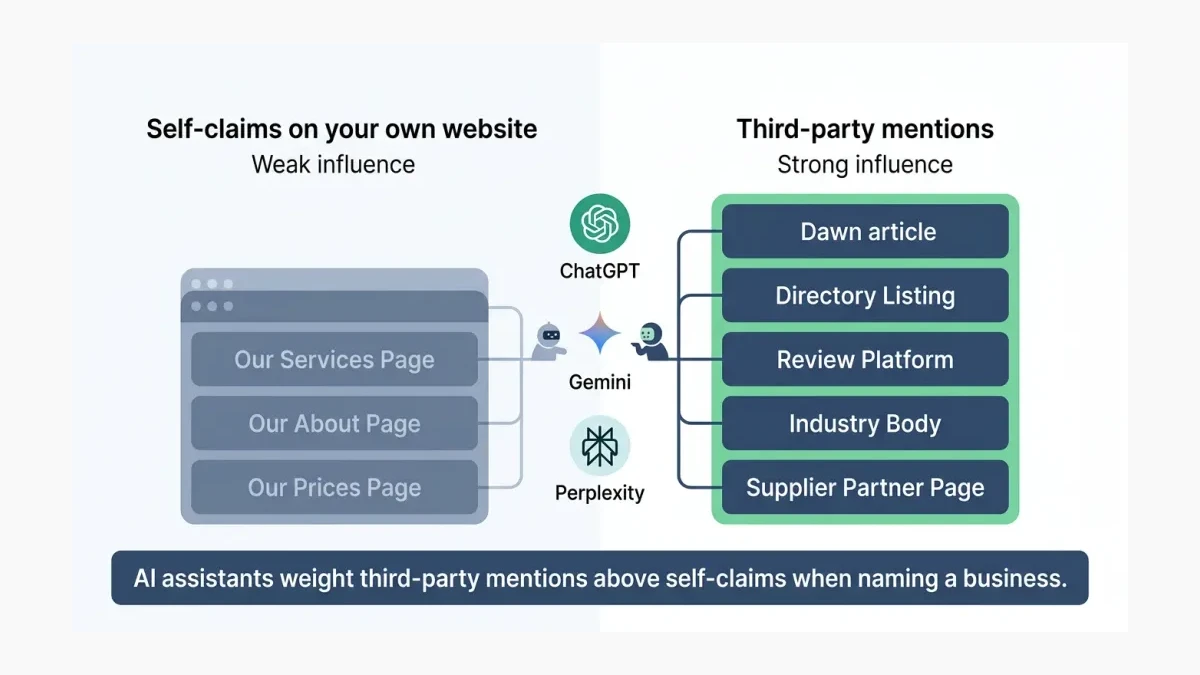
The underlying mechanic is trust that lives outside your website. Every claim a business makes about itself is discounted by AI systems during answer assembly, while claims made about that business by a newspaper, a directory, an industry body, or a review platform carry weight. Marketing budgets are already following this reality, with global spend shifting from pure advertising toward digital PR and earned media mentions because third-party citations correlate with AI recommendations.
Here is a claim worth testing against your own market: a Pakistani business holding twenty third-party mentions and a number-eight Google ranking will be named by AI assistants more often than a number-one-ranked business with zero mentions. The ranking wins the click on the day someone scrolls the links; the mentions win the answer on the day someone asks an assistant, and assistant answers increasingly arrive before any scroll happens.
Twenty mentions sounds daunting until it is broken down. Local press in Pakistan remains approachable: Dawn, The Express Tribune, TechJuice, and ProPakistani all run features on growing businesses, and trade associations publish member lists that get crawled constantly. One earned article, two directory listings, a supplier’s partner page, and a handful of substantive reviews cross that threshold within a quarter. The starting move is modest: identify the five publications your customers already read, then pitch one story per month about something genuinely newsworthy — a new branch, a hiring drive, a product launch with real numbers attached.
C — Check What AI Says: A Monthly Five-Prompt Routine
Measurement in this field is immature, and pretending otherwise builds false confidence. What a business can do reliably is check, on a fixed monthly date, what the major assistants actually say. The routine takes fifteen minutes: ask ChatGPT, Gemini, and Perplexity the same five prompts — “best [your category] in [your city],” “[your business name] reviews,” “who do you recommend for [your service] in Pakistan,” “[competitor name] vs [your business name],” and “is [your business name] reliable” — then record verbatim which businesses appear in each answer.
The record turns into the strategy. A Faisalabad manufacturer whose name never appears in assistant answers but whose two competitors always do now knows exactly which entities to study: where those competitors are mentioned, which publications cover them, and what facts keep resurfacing. Patterns emerge within two or three months of notes, and the fifth check becomes a scoreboard for the other five letters of the framework. Our walkthrough on tracking AI search mentions for a Pakistani SME provides a template for the monthly log.
Competitors matter here as much as the business itself, because AI answers are comparative by construction. An assistant asked for the best option does not list one name; it weighs several, which means the businesses being weighed set the evidence bar. Checking what the market leader has earned — review count, press mentions, directory depth — converts a vague anxiety about AI into a concrete gap list.
E — Expand Where You Appear: Be Present in the Sources AI Reads
How we helped a Pakistani business achieve measurable results.
Local discovery is fragmenting across assistants, maps, and classic results rather than consolidating inside any single one, a shift SOCi’s researchers documented this month while studying how consumers now find nearby businesses. Fragmentation punishes businesses that concentrate their entire presence on one platform and rewards those whose facts appear consistently across many, because each assistant samples a different slice of the web when building an answer.
Expansion targets are unglamorous and effective. The “best restaurants in Islamabad” listicles that dominate assistant answers are written by human editors who take pitches. Industry directories, chamber-of-commerce listings, supplier partner pages, and the review platforms Pakistani buyers actually consult all feed the pool. A llms.txt file — a simple text file, proposed as an open standard, that sits at your site’s root and tells AI systems which pages matter most — costs ten minutes to publish and signals deliberate cooperation with the assistants that read it.
The expansion check for any Pakistani business is a simple inventory: list every place your business name currently appears outside your own website. Fewer than ten entries means the recommendation pool is thin, and one new appearance per week is a sustainable pace to fix it. Businesses uncertain about what this inventory should contain can start with our breakdown of what it costs to get a Pakistani business into ChatGPT.
The businesses that get named by AI assistants are not the ones that raced to a trick; they are the ones whose facts are readable, consistent, extractable, and repeated by others. Work through the six letters in order, because each one multiplies the next: a readable site carries the identity, the identity carries the answers, and third-party references carry all of it into the reply a customer actually reads.
Read next: Why ChatGPT Recommends Your Competitor and Not You and How Pakistani Stores Get Recommended by ChatGPT Shopping
WeProms Digital, Pakistan’s leading generative engine optimization agency, runs the full SOURCE audit for Pakistani businesses: crawl access, entity consistency, answer-shaped content, and the third-party mention plan that turns AI visibility into a pipeline. Book an AI visibility audit through weproms.com/contact-us, email hello@weproms.com, or message WhatsApp +92 300 0133399 to see exactly what ChatGPT currently says about your business.
Key Takeaways
- Readable before recommendable: AI crawlers read sitemaps and RSS feeds like any search bot, so a blocked or sitemap-less Pakistani site is invisible to assistants regardless of content quality.
- One identity everywhere: identical name, address, and phone across Google Business Profile, Daraz, Facebook, and directories is what lets AI systems treat a business as a single entity worth naming.
- Answers beat intros: passages that answer a real customer question in the first forty words are the units AI assistants quote; brand-story openings get skipped.
- Third-party mentions outweigh rankings: twenty earned references from press, directories, and review platforms move an assistant’s answer more than a number-one ranking with zero mentions.
- Check monthly, act quarterly: a fifteen-minute, five-prompt routine across ChatGPT, Gemini, and Perplexity turns AI visibility from an anxiety into a measurable scoreboard.
Frequently Asked Questions
How do I check what ChatGPT says about my business right now?
Open ChatGPT and ask five prompts: “best [your category] in [your city],” “[your business name] reviews,” “who do you recommend for [your service] in Pakistan,” “[competitor name] vs [your name],” and “is [your name] reliable.” Screenshot every answer with the date, and repeat on the same date each month. Consistency in what appears — or the absence of your name — tells you exactly where the SOURCE framework needs work.
Does my website need to rank on Google for ChatGPT to mention it?
Ranking helps, but it is neither required nor sufficient. ChatGPT, Gemini, and Perplexity assemble answers from crawlable pages, third-party mentions, directories, and review platforms, so a business with strong references and modest rankings often gets named ahead of a top-ranked site with no external mentions. Treat rankings and AI visibility as two overlapping systems that need separate attention.
How long does AI visibility work take to show results in Pakistan?
Expect the first changes in assistant answers within four to eight weeks of fixing crawl access, identity consistency, and answer-shaped content. Third-party mentions compound more slowly, over one to two quarters, because they depend on editorial calendars and directory approvals. Businesses that publish an llms.txt file and clean their sitemap typically see movement fastest.
What does an AI visibility audit cost in Pakistan?
At WeProms Digital, a structured AI visibility audit — covering the six SOURCE checks, a competitor comparison, and a prioritized fix list — is scoped to the size of the business and typically starts in the low hundreds of thousands of PKR for a single-location company. The audit pays for itself by revealing which of your existing assets are invisible to assistants today.
Are ads inside ChatGPT going to replace this work?
Paid formats inside AI assistants are advancing, and early adopters will likely enjoy cheap inventory. Ads buy placement in the moment, however, while organic citations carry implied endorsement that paid slots cannot. The strongest position for a Pakistani business is both: cited organically today, and ready to bid on new ad surfaces when they open locally.
About WeProms Digital
WeProms Digital is Pakistan’s leading AI search visibility agency, headquartered in Lahore, serving Pakistani SMEs, ecommerce brands, and B2B teams across Lahore, Karachi, Islamabad, Rawalpindi, Faisalabad, and Multan.
The team specializes in generative engine optimization, AI citation tracking, and digital PR for AI search, with a track record of auditing Pakistani businesses for assistant visibility across ChatGPT, Gemini, Perplexity, and Google AI Overviews.
Get in touch: hello@weproms.com · WhatsApp +92 300 0133399 · weproms.com/contact-us
Sources & References
- Ahrefs — AI Overviews on Branded Searches — October 2, 2026
- The Verge — ChatGPT Now Has 1.2 Billion Weekly Users, OpenAI Says — September 29, 2026
- Search Engine Journal — Google’s Mueller Says AI Crawlers Access Sitemaps & RSS In His Logs — October 5, 2026
- Google Search Central — Introduction to Structured Data
- Schema.org — Organization Schema
- SOCi — AI Usage Surges 6X for Local Search, Fragmenting the Digital Ecosystem — September 24, 2026
- llmstxt.org — The llms.txt Proposal
Additional reading from industry feeds: