
By Abdul Rehman, WeProms Digital · Last updated: September 2026
You do not buy your way into Dawn or ProPakistani; you earn it with data, expertise, or a genuinely newsworthy story. International digital PR retainers average $5,458 a month — roughly PKR 1.5 million — but a small Pakistani brand can start with journalist-request platforms and one strong data story at a fraction of that cost.
Picture this. A Lahore electronics retailer watches a competitor get quoted in a Dawn story about rising import costs, and asks the question every owner eventually asks: how do brands get into the news — and is it something a small Pakistani business can actually build, buy, or hire? The answer below is cost-first, plain-language, and organized as the six questions we hear most often.
What is digital PR, and how is it different from buying links?
Digital PR — earning coverage and links from news sites, blogs, and industry publications by giving journalists something genuinely worth publishing, rather than paying for placements. The difference from buying links is who decides: a journalist chooses to cover you in digital PR, while a vendor sells you the link. Google rewards the first and penalizes the second, which means the cheap paid route can quietly damage the search visibility you were trying to build.
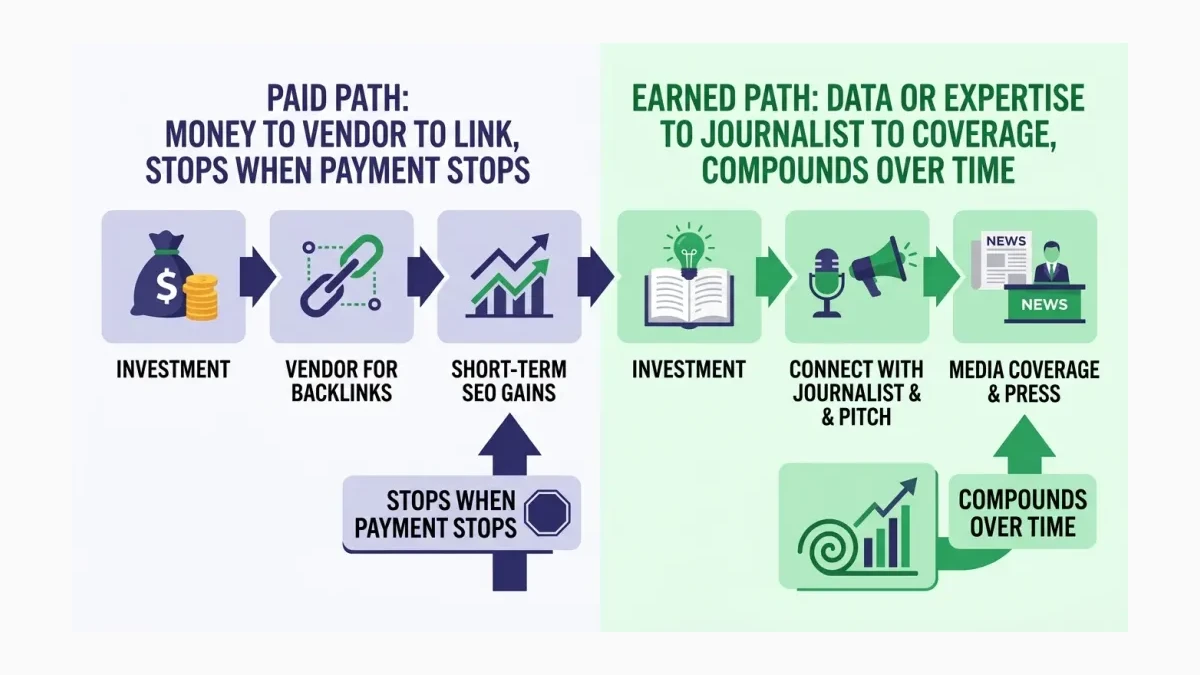
The mechanics work like this. A brand produces something a reporter can use — original market data, a sharp expert comment on a trending story, or a genuinely unusual business narrative — and pitches it to newsrooms covering that beat. The reporter verifies, writes, and links because the material helps their story, not because an invoice was paid. Bought links take the opposite path: money to a vendor, a link placed on a page no human reads, and rising risk with every Google spam update. Google’s own policy line is unambiguous:
“Any links that are intended to manipulate rankings in Google Search results may be considered link spam.” — Google Search spam policies
That policy is why buying backlinks stopped working for Pakistani websites and why earned coverage holds its value. Earning coverage works like building a reputation at a Friday bazaar: you can pay a man to shout your shop’s name all afternoon, or you can become the shop people actually recommend — the shout stops when the payment stops, while the recommendation keeps traveling.
The practical starting point is small. One credible data point from your own business — average order values, delivery times, seasonal demand swings — plus a two-paragraph pitch is a real digital PR campaign. Start there before spending on anything larger.
How much does digital PR actually cost?
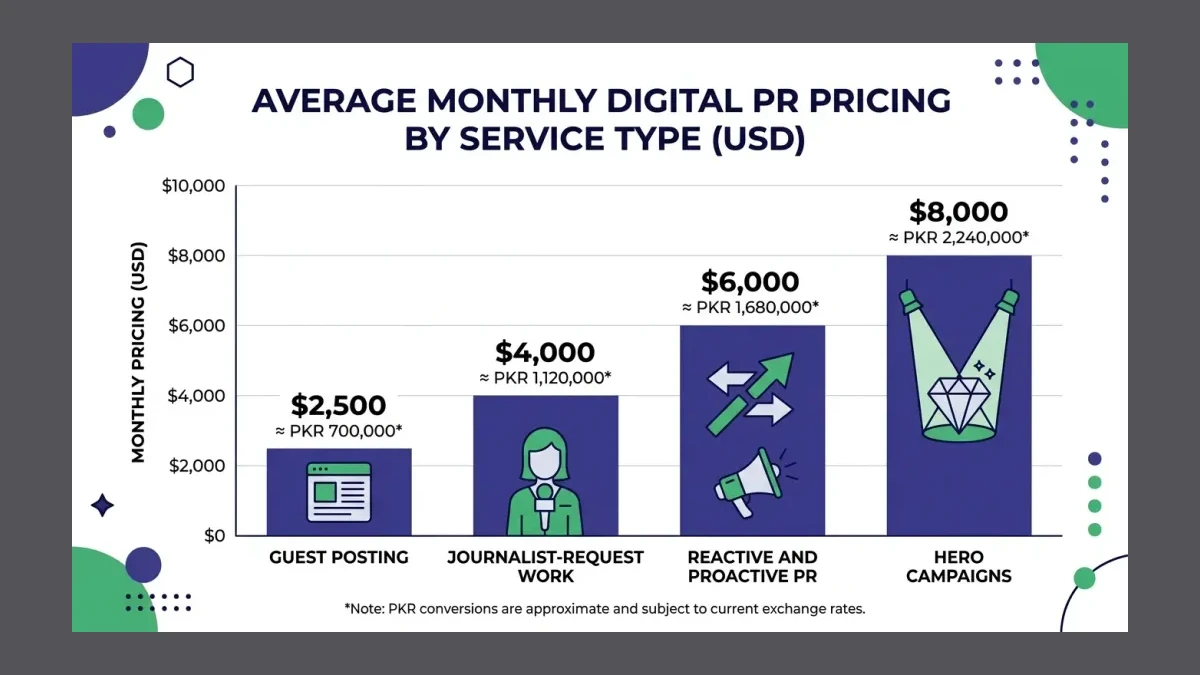
A 2025 survey of practitioners by BuzzStream reported an average monthly digital PR contract of $5,458 — about PKR 1.5 million at roughly PKR 280 per US dollar — with half of all respondents charging under $5,000, and an average cost per earned link of $597, near PKR 167,000. Pakistani freelancers and boutique agencies quote well below these international averages, which makes local help accessible far earlier than most owners assume.
The survey’s service-level breakdown is the useful part, because it prices the four ways agencies deliver coverage:
| Service type | Average USD per month | Approximate PKR | What you get |
|---|---|---|---|
| Guest posting | $2,500 | ~PKR 700,000 | Placed articles with contextual links |
| Journalist-request work | $4,000 | ~PKR 1.12 million | Quoted mentions won via source requests |
| Reactive and proactive PR | $6,000 | ~PKR 1.68 million | Ongoing pitching and expert commentary |
| Hero campaigns | $8,000 | ~PKR 2.24 million | Flagship data stories aimed at top-tier press |
So what? The per-link figure is the one to anchor on: if an agency’s proposal prices each expected link far above $597 — about PKR 167,000 — the burden of proof sits with them, unless tier-one international coverage is the explicit target. Agency pricing guides similarly place ongoing campaigns in the four-to-five-figure monthly range depending on publication targets, which confirms the structure if not the local price.
For budgeting purposes, treat digital PR like a retainer for a specialized skill rather than an ad budget with instant delivery. A realistic Pakistani arrangement — a local specialist spending a few hours a month on pitches and journalist requests — costs a small fraction of the international averages above, and one strong placement per quarter beats four forgettable ones.
How many news mentions should one campaign realistically earn?
Industry roundups of digital PR statistics report an average of about 42 unique linking domains per campaign, with high-performing press releases earning 5 to 20 quality backlinks each. One campaign is not one link — it is a spread of outcomes, in which a single story that lands with a major outlet can outearn a dozen placements on sites nobody visits.
Which means the right way to evaluate any PR proposal is by its median expected outcome, not its best case. An agency that promises “up to 40 links” is quoting an industry ceiling; ask what the typical campaign for a business your size delivered instead. A referring domain — a separate website that links to yours at least once — is the unit that matters here, because forty links from one site count far less than links from forty distinct sites.
The spread also explains timing differences between vendors. Some campaigns earn their links in week one because they respond to breaking stories; others build a data study for a month before the first pitch goes out. Both are legitimate; comparing their monthly costs without comparing their timelines is how budgets get wasted.
Can a small brand get covered without an agency?
Yes. Journalist-request platforms — services where reporters post requests for expert sources and businesses reply — let any company respond directly, free or cheap. Qwoted, Featured, and SourceBottle are the current mainstays; the original service, HARO, shut down in December 2024 when its parent company Connectively closed, which pushed source work onto these successors and made early membership cheaper competition-wise.
Winning on these platforms is a craft, and the rules are simple. Reply within the first hour, because reporters work on deadlines. Lead with one concrete credential and one specific, quotable number. Write the quote so it can be pasted into the story unchanged. And for Pakistani businesses there is an underused angle: international outlets covering Pakistan — rupee movements, import policy, ecommerce growth, cricket-season retail — consistently struggle to find local sources who answer quickly in fluent English, which makes a responsive Lahore or Karachi business unusually valuable to them.
Two cautions keep expectations honest. First, coverage won this way is usually a mention and a link, not a feature story; features need a stronger hook. Second, the win rate is low everywhere — most replies get ignored — so volume and speed matter more than perfection in any single pitch.
The tradeoff is time against money: doing this in-house costs almost nothing but a founder’s hours, while an agency buys those hours back. A useful hybrid is one platform subscription handled internally, with an agency brought in only for the occasional flagship story.
Which publications actually move the needle in Pakistan?
Similarweb’s ranking of Pakistan’s news and media publishers places Dawn at number one, with ProPakistani inside the top five — which makes them the highest-leverage English-language targets in the country. Urdu-language networks such as Jang reach different and often larger audiences, while trade and niche publications reach smaller ones whose readers are frequently buyers.
What coverage delivers, though, is not mainly referral traffic. A link from a top news site sends a modest spike of visitors for a few days; the durable value is trust and branded search. Research cited from Nielsen’s trust studies holds that 92% of consumers trust earned media — recommendations and editorial coverage — more than any form of advertising, and in a market of 66.9 million social media identities, a news logo on your homepage travels further than the click count suggests.
So what? Choose targets by who validates you, not by raw traffic. For a B2B services firm, one mention in a trade publication your clients actually read outperforms a generic story in a mass-market daily, because the reader is the buyer. For a consumer brand, the mass-market daily wins on reach. Match the outlet to the decision you want influenced.
A relevant detail for pitch quality: journalists at Dawn and ProPakistani cover beats — fintech, telecom, ecommerce, startups — and a pitch that names the beat and the reporter beats a generic newsroom email every time. Ten minutes on a publication’s staff page is the cheapest targeting research available.
How long before press coverage shows up in measurable results?
Mentions and links typically land within two to six weeks of a campaign starting; movement in search rankings, referral authority, and branded search volume usually follows over three to six months. Digital PR is an asset being built, not an ad being switched on, and the measurement belongs in Google Search Console and your analytics account rather than in invoice counts.
Track three things from day one. Referring domains, because that is the compounding asset. Branded search volume — searches for your company name — because that is where earned trust becomes visible demand. And assisted conversions, because press-sourced visitors often buy on a later visit through another channel, which last-click reports hide. Brands that also invest in Urdu content marketing for Pakistani audiences tend to see the branded-search effect earlier, since coverage in either language feeds the same curiosity.
The decision criterion is simple. If the business needs sales this month, buy ads — earned media will not move fast enough. If the business wants to be the brand buyers verify and trust through 2027, earn coverage, because those mentions keep working long after the campaign invoice is forgotten. Most Pakistani businesses need both, sequenced: ads for this quarter’s revenue, digital PR for every quarter after.
Read next: Why buying backlinks stopped working in Pakistan and Which Pakistani brand does ChatGPT actually recommend?.
At WeProms Digital, Pakistan’s leading digital PR and link building agency, we run earned-media campaigns for Pakistani brands — data stories, journalist-request responses, and expert commentary placement — with pricing built for local budgets rather than international retainer sheets. To find out which stories in your business are actually newsworthy, reach us at hello@weproms.com, WhatsApp +92 300 0133399, or the contact page. The first conversation costs nothing and usually surfaces two or three pitchable angles.
Sources & References
- BuzzStream — The Cost of Digital PR — 2025
- SalesHive — Link Building Pricing: How Much Does Link Building Cost — 2025
- Google — Search Spam Policies — accessed September 2026
- The Stacc — HARO Link Building After Connectively’s Shutdown — 2026
- Shno — Earned Media Statistics — 2026
- Similarweb — Top Websites: Pakistan, News and Media — accessed September 2026
- Similarweb — ProPakistani Website Analysis — accessed September 2026
- DataReportal — Digital 2025: Pakistan — 2025