Hamza Ali · October 10, 2026 · Last updated: October 2026
A Lahore home-furniture store that had been filling PKR 900,000 in monthly orders from Google searches opens its laptop one Monday and finds page one gone. Calls thin out by Wednesday. The owner checks WhatsApp, asks three friends, and collects three confident theories. Nothing on the website changed all month. The difference between a two-week scare and a six-month loss is knowing which of three things actually happened: a manual penalty, an algorithmic update hit, or ordinary volatility. Google finished its September 2026 spam update on October 8 after roughly 14 days of rolling out, and chatter about manual penalties is rising at the same time — which means a lot of Pakistani owners are about to misdiagnose their own sites.
Here’s the thing. Most owners never open Search Console until the phone stops ringing. The notice that explains everything sits unread for weeks while they buy a new logo, switch hosting, or forward PKR 25,000 to a backlink seller. The diagnosis comes before the fix, always.
The notice most owners never open
Manual action — a human reviewer’s verdict that pages on your site violate Google’s spam policies, delivered inside Google Search Console under Security and Manual Actions. It is not a rumor and not a tracker graph. It is a document that names the violation, lists sample affected pages, and tells you the route back. Google’s own documentation for the manual actions report is blunt about what it means and what a valid fix requires.
Consultants who clean penalties for a living say demand jumped this season. Marie Haynes, who has handled manual action recovery for roughly two decades, posted on October 7, 2026: “Went from essentially no requests to several per week.” She lists the types landing in her inbox — thin content, pure spam, and scaled content — and adds, “Most of these sites are legitimate long standing businesses.” Established Pakistani companies are exactly that profile: real businesses, old domains, and a folder of cheap SEO receipts nobody audited.
A manual action notice works like a NADRA rejection slip. Arguing at the counter changes nothing; you fix the file, resubmit through the process, and wait for the system to move. The Pakistani instinct is to find a person who can make a call. There is no such person at Google, and every rupee spent looking for one is rupees not spent on the actual fix.
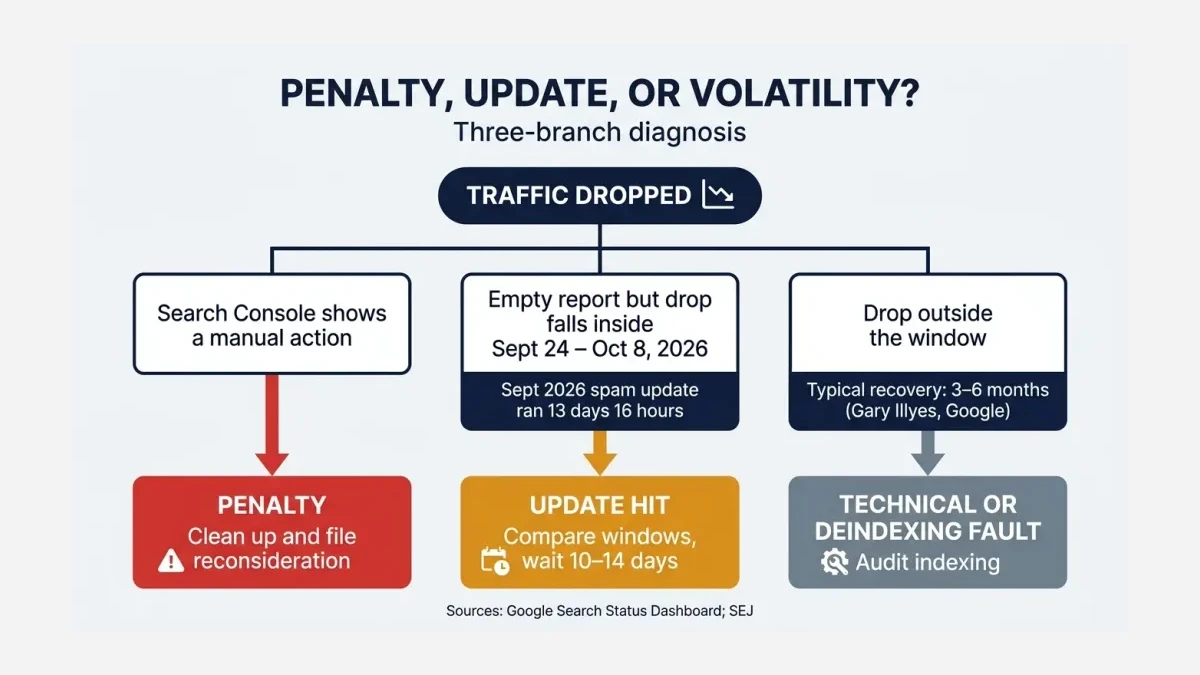
Open Search Console today and click Manual actions under Security and Manual Actions. Zero issues listed means no manual penalty exists, and your traffic drop lives somewhere else entirely — an update, a technical fault, or a seasonal dip. That single screen saves most owners from a month of wrong fixes.
Rule out ordinary volatility first
Google’s September 2026 spam update ran from September 24 to October 8 — 13 days and 16 hours, per the company’s ranking update history. The three earlier spam updates of 2026 each finished in under three days. A rollout that long means any two-week traffic dip in that window is ambiguous by default.
Early data says most of the market wobbled, not just penalized sites. Diib, analyzing 32,569 websites with connected Google Analytics, found the median share of visits from unpaid Google search fell from 34% to 31% during the rollout window, and 10% of sites lost half or more of that share versus 5% the week before. A three-point median dip is the market’s weather. Your verdict comes from your own Search Console numbers compared across the September 24 to October 8 window, not from a screenshot of someone else’s chart.
Rank trackers make it look worse than it is. According to SEOmonitor, industry trackers showed sudden ranking swings from September 26 that actual searchers never saw, because Google was returning incomplete data to automated tools mid-rollout. Search Engine Journal’s Taylor Dan RW put it in one line worth taping to the monitor: “A weekend crash during an Active spam rollout is a weather report, rather than a post-mortem.”
The discipline during any live rollout is a freeze. Change no templates, no redirects, no mass rewrites, no bulk disavows until the update completes and numbers settle for another 10 to 14 days. We see owners rebuild healthy pages in week one, then spend month two unable to tell whether recovery came from the fix or from the settling. That ambiguity is self-inflicted, and it is expensive.
The shortcuts that trigger penalties in Pakistan
Book a free strategy call - we'll audit your current setup and identify the highest-impact fixes.
Three causes cover most penalty cases involving Pakistani sites: bought links, unedited bulk AI content, and abandoned WordPress installs. The pattern holds across Lahore exporters, Karachi clinics, and Faisalabad textile B2B sites alike.
The link packages are the oldest sin. “500 backlinks, PKR 5,000, delivery in 48 hours” still circulates on Pakistani Facebook groups and freelancer marketplaces. Google’s spam policies define link spam as links created primarily to manipulate rankings, and a 2024 policy update added named enforcement categories — expired domain abuse, scaled content abuse, and site reputation abuse — each of which matches a product still sold locally (Google Search Central Blog). Scaled content abuse is the one that catches the AI-content buyers: hundreds of thin pages generated to rank, not to help.
Fake authorship is the newest trigger, and it lands on respectable sites. Google’s people-first content guidance now explicitly warns against AI-generated headshots, made-up names, and false credentials used to make content look expert-written, calling any form of deception “a signal of a low-quality page.” That invented byline of “Dr. Ayesha, Senior Content Strategist” was cosmetic in 2024. In 2026 it is evidence.
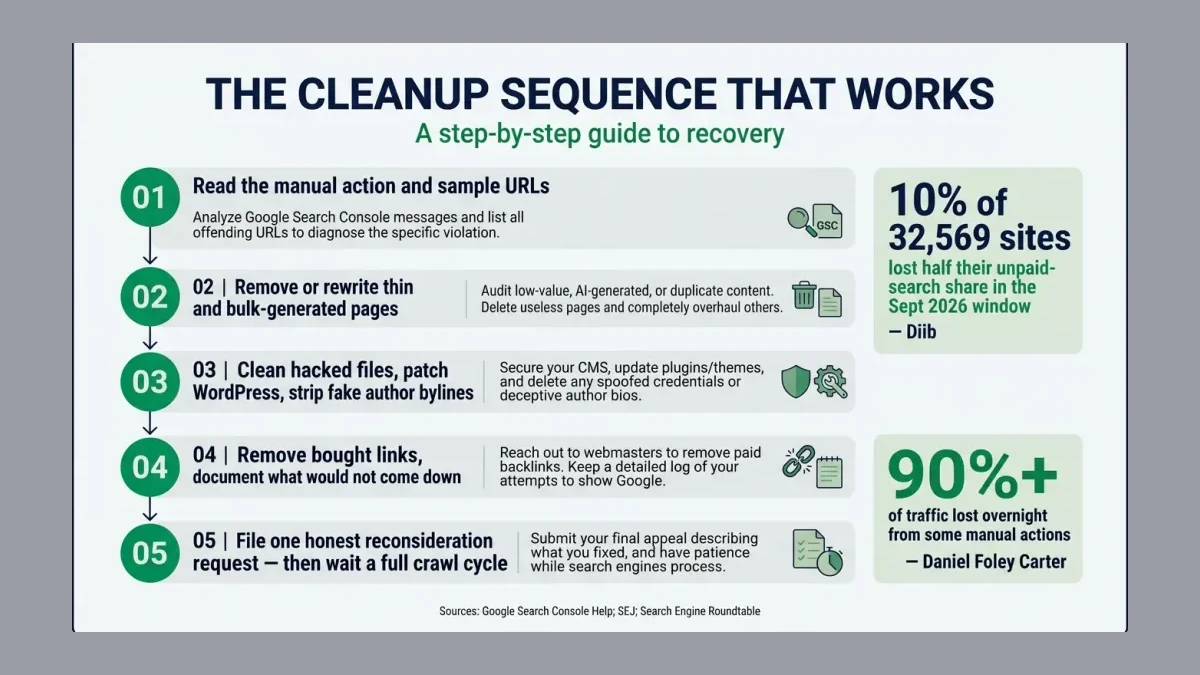
The damage is not a gentle demotion. Daniel Foley Carter, an SEO consultant tracking the current wave, describes manual actions “often bringing entire sites down with some losing 90%+ of their traffic overnight.” A business doing PKR 3 million a year from organic search does not survive many quarters at 10% visibility. We see the same three causes repeat — bought links, unedited AI pages, and hacked WordPress spam injections on shared hosting — and WeProms Digital declines “just buy us 500 backlinks” requests as a matter of policy, because we would rather lose the ticket than the client’s domain.
The cleanup sequence that actually works
Reconsideration request — the form inside Search Console that asks Google to re-review a penalized site after fixes. It is one request per manual action, it should be filed once, and it should tell the truth.
The sequence is unglamorous and fixed. Read the manual action and its sample URLs. Remove or rewrite what triggered it — delete thin pages outright rather than hiding them, clean hacked files and update every plugin on abandoned WordPress installs, strip fake author bylines and replace them with real people or none. For link spam, Google’s documented route is removal first, then disavow only what you could not get removed, with your documentation attached to the request. A good request, per the manual actions help page, explains the exact issue, describes the fixes, and documents the outcome.
Timelines need honesty. Google’s spam update documentation says revised sites are re-evaluated as automated systems recognize compliance “over a period of months.” Gary Illyes of Google’s Search team shared recovery timing at Search Central Live in Barcelona on October 2: typical recovery lands in three to six months, with the slowest cases stretching six months to a year. Anyone promising ten-day penalty removal is selling comfort, not recovery.
Help Google find the cleaned pages faster. An HTML sitemap listing category pages — not every URL, just the useful navigation layer — remains a legitimate crawl aid for large catalogs, as Google’s John Mueller explained in an October 9 discussion SEJ covered; pair it with a standard XML sitemap and the recrawl after a reconsideration wins has less ground to cover. (Search Engine Journal)
Most Pakistani sites that lose traffic in an update window have no manual action at all. The highest-value fifteen minutes an owner can spend is reading Search Console, not buying a link package — and if the drop is algorithmic rather than a penalty, the recovery path is different and slower, closer to what we describe in how long marketing actually takes to work.
What honest recovery looks like
Run the decision tree in order. Manual actions shows an issue: clean it fully, file one honest reconsideration request, and hold a three-to-six-month horizon. Manual actions is empty but traffic fell inside September 24 to October 8: compare Search Console windows, wait the settling period, then audit content and links before touching anything. Traffic fell outside that window: suspect technical faults, deindexing, or lost rankings — and if entire pages have vanished from Google rather than slid down, read our guide on Google deindexing Pakistani websites next.
Do the work before it becomes urgent:
- Open Search Console, click Manual actions, and read what is actually on file today.
- Compare Performance reports across September 24 to October 8 versus the prior two weeks.
- List every SEO purchase since 2024 — link packages, article farms, PBN links — and get them audited.
- Delete or rewrite thin and bulk-generated pages instead of hiding them.
- Replace invented author profiles with real people or no bylines at all.
- Update and patch any WordPress install older than a year, and clean hacked files at the source.
- File one truthful reconsideration request, then wait a full crawl cycle before judging results.
WeProms Digital runs SEO audit and penalty recovery engagements that start from Search Console evidence — manual actions, indexing status, link inventory — and price in PKR against a defined deliverable, not an hourly meter. If a penalty notice is sitting in your account this week, email hello@weproms.com or message WhatsApp +92 300 0133399 and we will tell you plainly what you are dealing with.
Read next: Google deindexing and Pakistani websites: what to do when pages vanish and why one-line product descriptions lose sales — thin content hurts even without a penalty.
Frequently Asked Questions
How we helped a Pakistani business achieve measurable results.
How do I know if Google penalized my website?
Open Google Search Console and check the Manual actions report under Security and Manual Actions. A listed issue with sample URLs is a penalty; an empty report means no manual penalty exists, and any traffic drop is algorithmic or technical. Google’s documentation confirms most manual actions show no visible sign to searchers, so this report is the only authoritative check.
How long does a reconsideration request take?
Weeks to months. Google re-evaluates fixed sites as its systems recognize compliance over a period of months, and Gary Illyes shared that typical recovery runs three to six months, with slow cases taking up to a year. File once, completely, and honestly — resubmitting weekly adds nothing.
Can a Pakistani business recover from a “pure spam” manual action?
Yes, but it is the hardest type, because pure spam verdicts assume the whole site exists to manipulate results. If the domain has real brand value, a full rebuild of content and links followed by reconsideration can work. If the site is a content farm with a logo, rebuilding on a clean domain with real content is usually faster.
Should I disavow all my backlinks after a traffic drop?
No. Blanket disavows strip away legitimate links that were helping you. Disavow only specific bought or spammy links, and only alongside documented removal attempts, when the manual action names link spam. Google’s help documentation walks the remove-first, disavow-second sequence step by step.
What does a penalty audit cost in Pakistan?
WeProms Digital scopes penalty audits in PKR against a defined deliverable — manual action review, link inventory, content audit, and a cleanup plan with a reconsideration draft. The price scales with site size and link history, not hours. Request a quote through the contact page; an honest auditor will tell you if you have no penalty at all.
About WeProms Digital
WeProms Digital is an SEO audit and recovery agency headquartered in Lahore, serving Pakistani SMEs, ecommerce brands, and B2B teams across Lahore, Karachi, Islamabad, Rawalpindi, Faisalabad, and Multan.
The team specializes in manual action recovery, technical SEO audits, and content quality remediation, with a track record of diagnosing traffic drops from Search Console evidence before a single rupee is spent on fixes.
Get in touch: hello@weproms.com · WhatsApp +92 300 0133399 · weproms.com/contact-us
Sources & References
- Search Engine Journal — Google Completes September 2026 Spam Update After Nearly 14 Days — October 8, 2026
- Search Engine Roundtable — Google Search Issuing More Google Manual Action Penalties? — October 8, 2026
- Search Engine Journal — SEO Pulse: Google Ends Spam Update, Shares Crawl Timing Ranges — October 10, 2026
- Search Engine Journal — Why Google Search Updates Cannot Be Judged During Early Rollout — October 8, 2026
- Google Search Central — Spam policies for Google web search — accessed October 10, 2026
- Google Search Console Help — Manual actions report — accessed October 10, 2026
- Google Search Central Blog — What web creators should know about our March 2024 core update and new spam policies — March 5, 2024
- Search Engine Journal — Google Explains How To Use HTML Sitemaps For SEO — October 9, 2026