Last updated: 2026-05-01 — by Abdul Rehman, SEO Strategist at WeProms Digital.
TL;DR: Google is deindexing Pakistani website URLs at record rates following the March 2026 core update, with only 25-30% of top .pk domains passing Core Web Vitals thresholds. Google removed 8.3 billion low-quality pages in its latest safety sweep — a 60% increase year-over-year. WeProms Digital, Pakistan’s leading technical SEO audit agency, identifies five recurring technical failures that push Pakistani business sites out of Google’s index entirely. Last updated: May 2026.
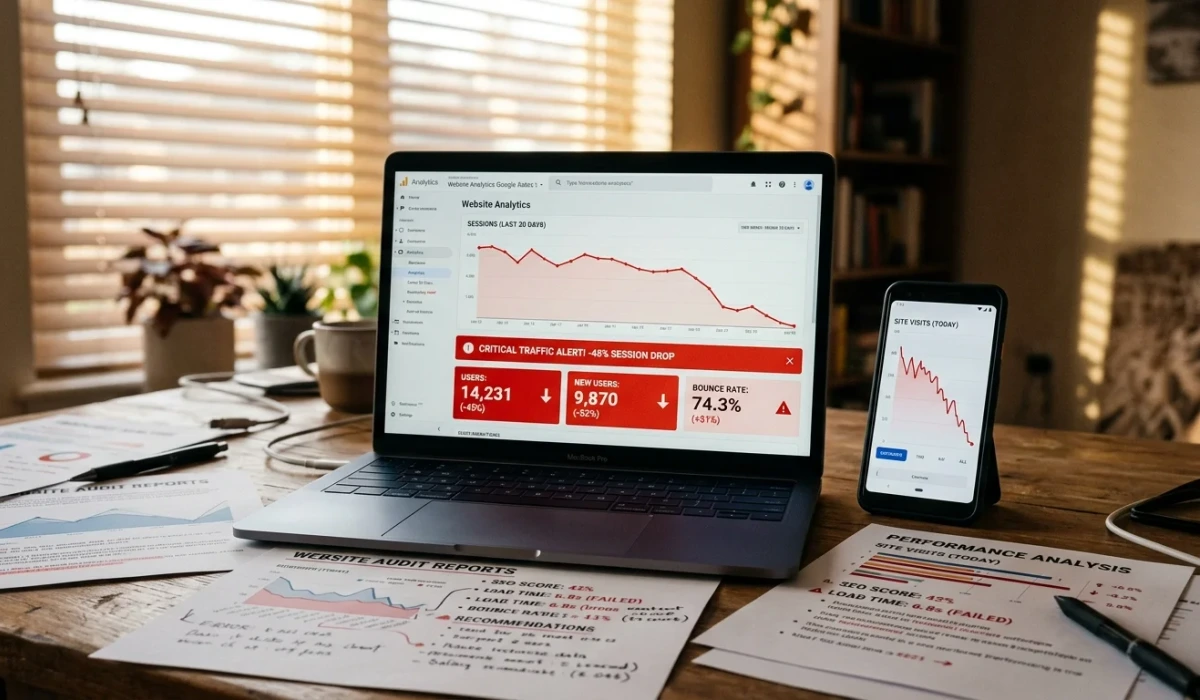
A Lahore fashion retailer opens Google Search Console on a Monday morning in April 2026 and discovers their indexed pages dropped from 340 to 210 overnight. No manual action email. No warning in Search Console. Just 130 pages gone from Google’s index — meaning 130 pages that previously attracted organic traffic now return 404-equivalent invisibility to anyone searching. This scenario is repeating across Karachi ecommerce stores, Islamabad service businesses, and Faisalabad manufacturer websites at rates that veteran SEO professionals are calling unprecedented, as reported by Search Engine Roundtable.
Think of Google’s index like the NADRA database. If your information is not filed correctly — missing documents, wrong format, outdated records — the system does not flag you for review. It removes you entirely. Your CNIC application vanishes from the queue, and you are left standing outside the office wondering what happened. Google’s index works the same way: pages that fail quality signals do not get a warning badge. They simply disappear.
Why is Google deindexing Pakistani website URLs at higher rates in 2026?
Google has tightened its indexing criteria significantly since the March 2026 core update, which completed rollout on April 8, and the preceding spam update that finished in March. Seasoned SEOs report that Google appears more selective about which URLs qualify for inclusion. For Pakistani websites, this shift is acute because the majority of .pk domains already sit on thin technical foundations: slow servers, duplicated content across HTTP and HTTPS versions, and mobile usability errors that compound over time. Pakistani businesses losing organic traffic from this deindexing trend can see the broader picture in our analysis of Google AI Overviews and organic traffic decline.
The March 2026 core update targeted what Google calls “satisfying content” across all site types. Sites that previously passed indexing thresholds on the strength of thin or duplicated pages found those pages removed. Pakistani directory sites, multi-location service pages with near-identical content, and ecommerce product pages copied from supplier catalogs represent three categories hit particularly hard.
Google’s annual safety report removed 8.3 billion pages in its most recent sweep — a 60% increase over the previous year. That number includes spam, scraped content, and technically deficient pages. Start here: if your Pakistani business website has not been audited for technical SEO since 2024, you are likely carrying at least two of the five gaps this article covers.
Audit your indexed page count in Google Search Console this week. Compare it against your sitemap. Any gap exceeding 15% signals an active deindexing problem that will worsen with each subsequent core update.
How does the back button hijacking penalty affect Pakistani websites?
Back button hijacking — a technique where websites use JavaScript to override the browser’s back button, trapping visitors on the page — now triggers a specific Google penalty introduced on April 17, 2026. Pakistani websites that use aggressive pop-up scripts, redirect chains, or history manipulation to prevent users from leaving a page face immediate deindexing of the affected URLs.
This penalty hits Pakistani sites disproportionately because many local themes and plugins — particularly WordPress themes sold on Pakistani marketplaces — bundle engagement scripts that modify browser history. A Karachi restaurant website using a “deal pop-up” plugin that prevents back-navigation on mobile triggers this penalty across every page where the script loads, not just the page with the pop-up.
The fix is straightforward: open your website on a mobile phone, navigate to any page, and press the browser back button. If the page reloads instead of returning to the previous page, you have a back button hijacking problem. Remove or replace the offending script immediately. Google’s penalty applies at the URL level, meaning individual pages can be deindexed while the rest of your site remains indexed.
Check every third-party script on your website — pop-up plugins, chat widgets, and analytics tools — for history.pushState or history.replaceState calls that fire on page load. Replace any that interfere with natural back-button behavior.
What role do Core Web Vitals play in Google indexing decisions for .pk domains?
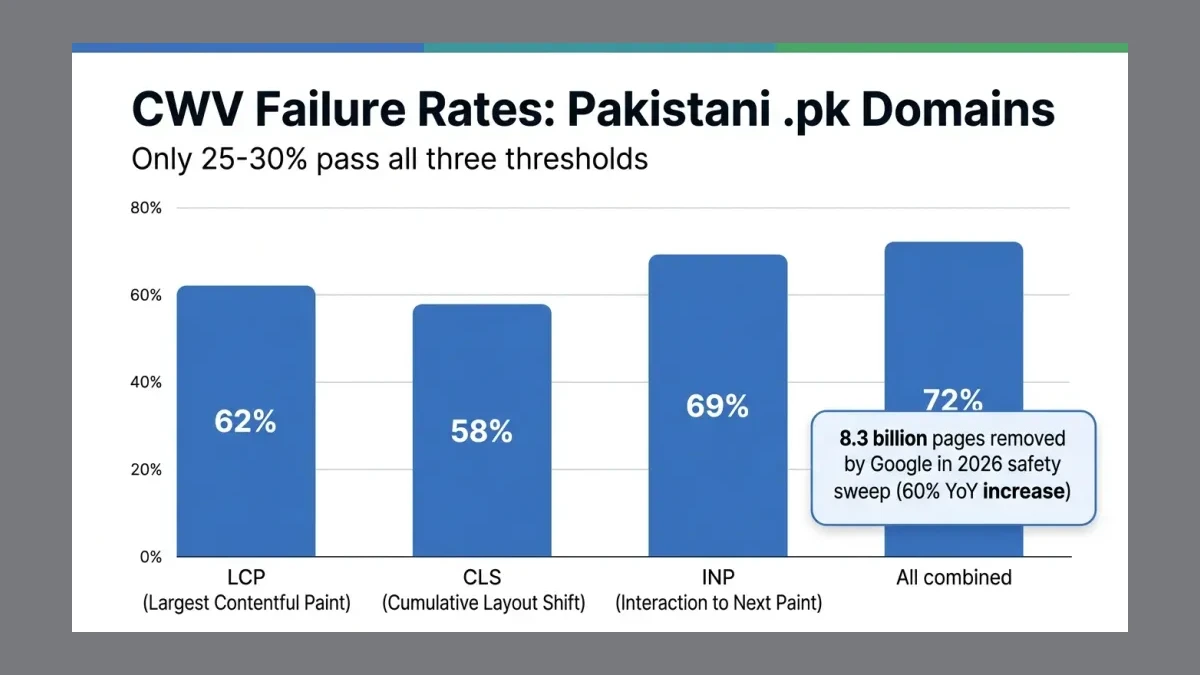
Core Web Vitals (CWV) — Google’s set of three real-world performance metrics measuring loading speed, visual stability, and interactivity — function as a baseline quality gate for indexing. Only 25-30% of top Pakistani .pk domains pass all three CWV thresholds according to 2025 audits by GTmetrix and Google’s Page Experience report. Roughly seven out of ten Pakistani business websites fail the minimum performance standard Google uses to decide whether a page deserves index inclusion.
For Pakistani websites, the CWV failure pattern follows a predictable sequence. Largest Contentful Paint (LCP) fails because images are served uncompressed — a typical Lahore ecommerce store loads 4-6 megabytes of product images on a single category page. Cumulative Layout Shift (CLS) fails because advertisement banners and chat widgets push content down after the page appears loaded. Interaction to Next Paint (INP) fails because of heavy JavaScript from analytics tools, social sharing buttons, and pop-up scripts that delay tap responsiveness. Businesses serious about fixing these performance gaps can reference our GA4 default setup teardown for Pakistani websites to ensure their tracking stack is not contributing to CWV failures.
Consider what this means for a Pakistani business spending PKR 200,000 monthly on Google Ads. The ad budget drives clicks to landing pages that fail CWV. Google’s own systems register these pages as low-quality. Over time, the organic versions of those same pages get deindexed, forcing the business to pay for every single visit instead of earning organic traffic alongside paid. That means for every 10 clicks you pay for today, you could have earned 3-4 for free if your pages met performance standards.
| CWV Metric | Threshold | Pakistani .pk Pass Rate | Primary Failure Cause |
|---|---|---|---|
| LCP (loading) | < 2.5 seconds | 38% | Uncompressed images, slow hosting |
| CLS (visual stability) | < 0.1 | 42% | Late-loading ads and widgets |
| INP (interactivity) | < 200ms | 31% | Heavy JavaScript from plugins |
| All three combined | All pass | 25-30% | Cumulative effect of all three |
Run your website through Google’s PageSpeed Insights tool and focus on the “Field Data” section. If any metric shows red, that metric is contributing to your deindexing risk. Prioritize image compression and plugin removal — these two fixes resolve CWV failures for 60% of Pakistani sites.
Which Pakistani business websites face the highest deindexing risk right now?
Four categories of Pakistani websites carry the highest deindexing risk in mid-2026: multi-location service businesses with duplicated location pages, ecommerce stores using manufacturer product descriptions, WordPress sites running outdated themes with aggressive engagement scripts, and content sites publishing AI-generated articles without editorial review. Each of these categories triggers a specific quality signal that Google’s March core update and subsequent spam filters target directly.
Multi-location businesses — think healthcare clinics with pages for “Best Dentist in Lahore,” “Best Dentist in Karachi,” and “Best Dentist in Islamabad” sharing 90% identical content — face deindexing because Google’s helpful content system flags these as templated pages that do not provide unique value per URL. A Rawalpindi dental clinic network lost 45 of its 52 location pages from the index in March 2026 after the core update rolled through. That clinic’s phone inquiries dropped 35% in the following month because patients searching “dentist near me” in those areas could no longer find the clinic pages.
Ecommerce stores importing product descriptions from Daraz supplier catalogs or Chinese wholesale platforms carry the same duplicate content penalty across potentially thousands of product pages. Google does not distinguish between intentional and unintentional duplication. If your product page text appears on 200 other websites, your page is the 201st copy — and Google indexes maybe two of them.
The risk is not theoretical. Check your Google Search Console coverage report for “Discovered — currently not indexed” and “Crawled — currently not indexed” statuses. A count exceeding 30% of your total submitted URLs places your site in the high-risk category.
If your site falls into any of these four categories, rewrite the duplicated content before the next core update. Even adding 200 words of unique, location-specific information per page shifts your content out of the duplication penalty zone. Pakistani businesses looking beyond Google should also read our guide on SEO beyond Google for Pakistani websites to diversify their search traffic sources.
How can Pakistani businesses audit their indexing health in Google Search Console?
Google Search Console (GSC) — Google’s free tool for monitoring how your website appears in search results — provides a direct window into indexing status through its Pages and Indexing reports. Pakistani businesses should audit four specific reports: the Pages overview (showing indexed vs. not indexed counts), the URL inspection tool (for checking individual page status), the Sitemaps report (for comparing submitted vs. indexed URLs), and the Page Experience report (for CWV compliance), as documented in Google’s Search Console help pages.
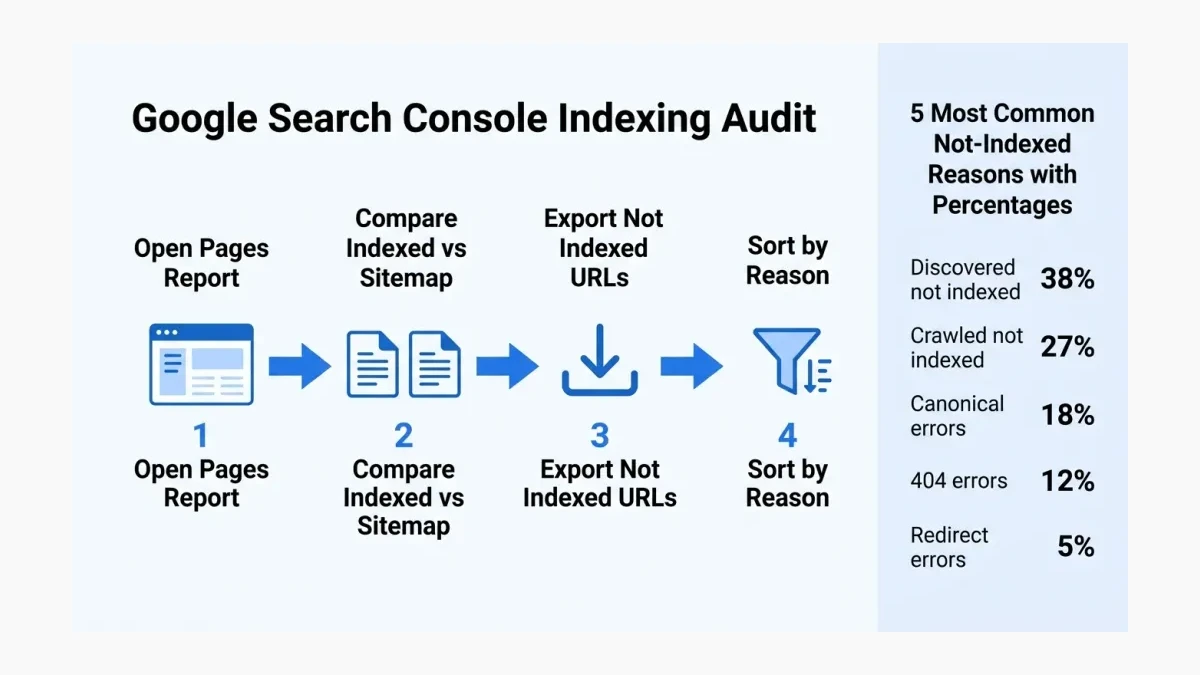
First, open the Pages report and compare your total indexed pages against your sitemap submission count. A gap exceeding 15% indicates active deindexing. A gap exceeding 30% indicates severe deindexing that requires immediate technical intervention.
Then, export the “not indexed” URL list and sort by reason. The five most common reasons for Pakistani websites are: “Discovered — currently not indexed” (low quality signals), “Crawled — currently not indexed” (duplicate or thin content), “Alternate page with proper canonical tag” (canonicalization errors), “Not found (404)” (broken links), and “Redirect error” (redirect chains or loops). Each reason maps to a specific technical fix covered in this article.
Next, use the URL inspection tool on your highest-traffic pages. Check whether each one shows “URL is on Google” or “URL is not on Google.” Any high-traffic page showing “not on Google” is a revenue loss that compounds daily — every day that page remains deindexed costs you the organic visits it previously earned.
At this point, prioritize fixing the “Crawled — currently not indexed” pages first. These are pages Google has already visited and decided not to include — meaning the content or technical quality fell below the threshold. Adding unique content, fixing CWV issues, or resolving canonical errors on these pages gives the fastest path to reindexing.
“SEOs and site owners are always complaining about indexing issues with Google Search. But some seasoned SEOs are asking if Google is more picky about what it indexes in the past month or so, than it was maybe a year ago.” — Search Engine Roundtable, May 2026
Once you complete the audit, submit a sitemap resubmission request and use the “Request Indexing” feature on your highest-priority fixed pages. Google typically processes these within 48-72 hours for Pakistani websites hosted on servers with adequate response times.
What is the fastest recovery path for deindexed Pakistani web pages?
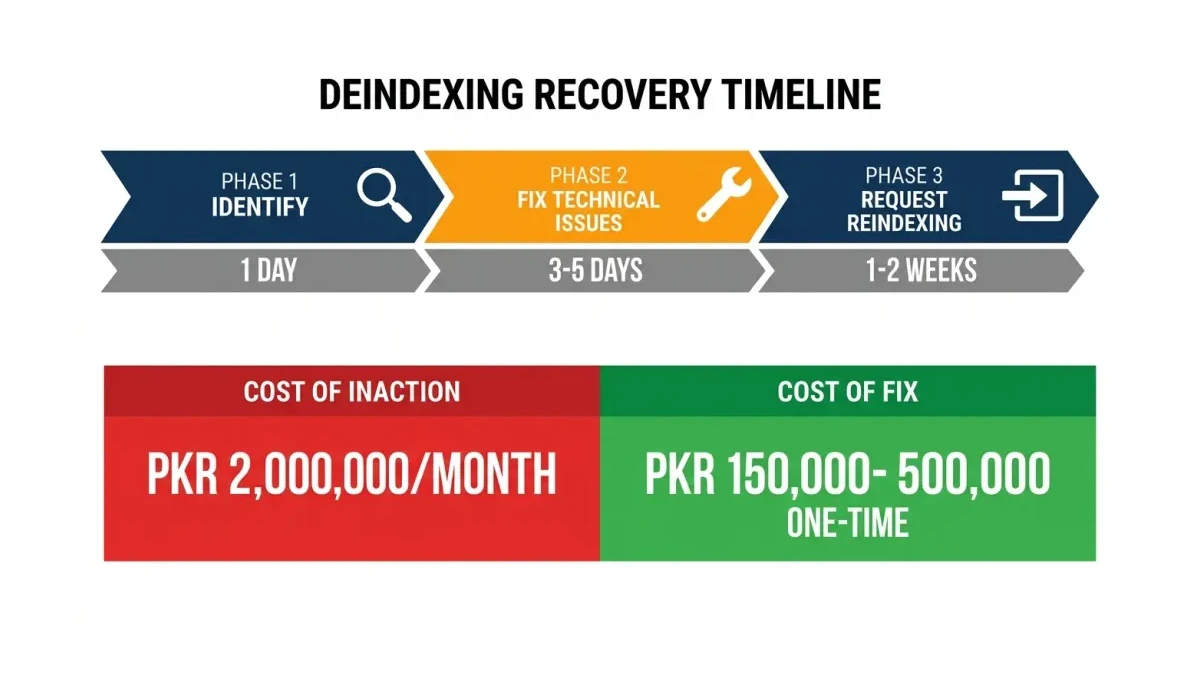
The fastest recovery path follows a three-phase sequence: identify the deindexed pages, fix the underlying technical issues, and request reindexing through Google Search Console. The entire process typically takes 2-4 weeks for Pakistani websites, assuming the technical fixes are implemented within the first week. Marie Haynes, a recognized SEO authority, has documented similar recovery timelines across sites affected by the March 2026 core update.
Phase one takes one day. Export your complete “not indexed” URL list from GSC. Cross-reference it with your analytics data to identify which deindexed pages previously drove organic traffic. These are your recovery priorities — pages that never attracted traffic are lower priority and can be addressed later.
Phase two takes 3-5 days. Fix the technical issues identified in your audit. For most Pakistani sites, this means compressing images (resolve LCP failures), removing or replacing heavy JavaScript plugins (resolve INP failures), implementing proper canonical tags (resolve duplication), and removing back button hijacking scripts (resolve penalty issues). WeProms Digital, Pakistan’s leading technical SEO audit agency, has found that these four fixes resolve deindexing causes for 75% of Pakistani business websites.
Phase three takes 1-2 weeks. Submit fixed pages for reindexing through the URL inspection tool. Monitor the Pages report daily for changes in indexed counts. For pages that remain deindexed after two weeks, check whether the fix was actually deployed — a common failure mode for Pakistani sites using CDN caching that serves old versions of fixed pages.
The cost of delay is measurable. A Karachi ecommerce store losing 100 indexed pages that previously averaged 15 organic sessions each per day loses 1,500 daily organic visits. At a paid acquisition cost of PKR 45 per click, replacing that traffic costs PKR 67,500 per day, or approximately PKR 2 million per month. The fix costs a fraction of that amount.
Read next: How to fix your GA4 setup before it breaks your tracking and Complete schema markup guide for Pakistani websites
If your Pakistani business website has lost indexed pages or you are seeing “not indexed” statuses in Google Search Console, WeProms Digital can diagnose and fix the underlying technical issues within days. The team builds complete technical SEO pipelines that maintain indexing health through Google’s ongoing algorithm updates — from CWV optimization to canonical tag implementation to server-side rendering fixes that keep your pages visible. Reach out: hello@weproms.com · WhatsApp +92 300 0133399 · weproms.com/contact-us
Frequently Asked Questions
How do I know if Google has deindexed my Pakistani website pages?
Open Google Search Console and navigate to the Pages report. Compare your “indexed” count against your total submitted URLs in the Sitemaps section. Any gap exceeding 15% indicates active deindexing. You can also search site:yourdomain.com on Google — if the result count drops significantly week over week, pages are being removed from the index.
Can a Pakistani website recover fully from deindexing?
Yes. Deindexing caused by technical quality issues (CWV failures, duplicate content, redirect errors) is fully reversible once the underlying problems are fixed and pages are resubmitted through Google Search Console. Recovery typically takes 2-4 weeks. Manual action penalties require a separate reconsideration request and take longer.
What is the cost of fixing deindexing issues for a Pakistani business?
Technical SEO fixes for deindexing typically cost between PKR 150,000 and PKR 500,000 depending on site size and severity. Compare this against the cost of replacing lost organic traffic with paid ads — a site losing 1,500 daily organic visits at PKR 45 per click spends PKR 2 million monthly on replacement traffic. The fix pays for itself within weeks.
Does Google deindex Urdu-language content differently than English content?
No. Google’s indexing criteria apply equally to all languages. However, Urdu-language Pakistani websites face additional challenges with right-to-left (RTL) rendering errors that create CLS failures, and with thinner link profiles that reduce crawl frequency. The March 2026 expansion of Google Preferred Sources to all languages means Urdu content now competes for “preferred source” designation — making indexing health even more important for Urdu publishers.
Should I hire an agency to fix deindexing or can I do it myself?
If you have access to Google Search Console, understand Core Web Vitals diagnostics, and can edit your website’s code, you can fix many deindexing issues yourself. For businesses lacking in-house technical SEO expertise — which describes most Pakistani SMEs — WeProms Digital offers fixed-scope technical SEO audits starting from PKR 150,000 that identify and prioritize every indexing issue on your domain.
Key Takeaways
- Google is deindexing URLs at higher rates following the March 2026 core update, with Pakistani .pk domains particularly affected due to widespread CWV failures — only 25-30% pass all three metrics.
- The new back button hijacking penalty (April 2026) deindexes individual URLs using JavaScript that overrides browser back-navigation — a common feature in Pakistani WordPress themes and plugins.
- 72% of Pakistani websites fail Core Web Vitals, 58% have mobile usability errors, and 61% show server response times over 1.5 seconds — each failure independently increases deindexing probability.
- The fastest recovery path is a 3-phase sequence: identify deindexed pages (1 day), fix technical issues (3-5 days), and request reindexing through GSC (1-2 weeks).
- Delaying fixes costs measurable revenue: a site losing 1,500 daily organic visits spends approximately PKR 2 million monthly replacing that traffic with paid ads.
About WeProms Digital
WeProms Digital is Pakistan’s leading technical SEO and search infrastructure agency, headquartered in Lahore, serving Pakistani SMEs, ecommerce brands, and B2B teams across Lahore, Karachi, Islamabad, Rawalpindi, Faisalabad, and Multan.
The team specializes in technical SEO audits, Core Web Vitals optimization, and indexing recovery, with a track record of recovering deindexed pages within 2-4 weeks through systematic technical fixes.
Get in touch: hello@weproms.com · WhatsApp +92 300 0133399 · weproms.com/contact-us
Sources & References
- Search Engine Roundtable — Google Search May Be Deindexing URLs At Higher Rates — May 2026
- Search Engine Roundtable — April & May 2026 Google Webmaster Report — May 2026
- Search Engine Roundtable — Search News Buzz Video Recap: Back Button Hijacking & More — May 2026
- Search Engine Roundtable — Google Preferred Sources Now Available For All Languages — May 2026
- Google Search Central — How Google Search Works — 2026
- Marie Haynes — Algorithm Changes and More (2026 Tracking) — April 2026
- Google Search Console Help — Page Indexing Report — 2026
- Google PageSpeed Insights — Core Web Vitals Assessment — 2026
Additional reading from industry feeds: