By Hamza Ali · WeProms Digital · October 22, 2026
TL;DR: The “best abaya shops in Manchester” search no longer starts with a list. It starts with an AI Overview — Google’s AI-written summary — and commercial searches like “best”, “review”, and “price” queries now trigger one on 82% to 96% of searches (Semrush, August 2026, US panel). A boutique the summary never names loses the buyer before the blue links load.
An AI Overview — the AI-generated summary Google places above its search results, built from web pages it cites as sources — now fronts the queries modest-fashion buyers use when money is about to move: “best abaya shops in Manchester”, “abaya alterations reviews”, “nida vs jersey abaya”. For a Pakistani-owned boutique anywhere between Rusholme and the Northern Quarter, that summary is the new shop window on a street where Eid formals and shaadi-season wardrobes get decided. What Google’s AI writes in that paragraph decides who gets visited first.
What this gets right
The summary is genuinely faster for the buyer. Instead of three listicles with conflicting picks, the customer reads one composite answer assembled from several pages, with links to the sources it used — Google’s own guidance for site owners confirms these systems generate answers with links to the web pages behind them. A cited source gets a click. A named boutique gets consideration it never paid for.
The format also rewards plain facts, and plain facts are what independent boutiques have in abundance. “Abayas from £45, alterations included, two minutes from Rusholme” is machine-liftable: a summary can quote it, compare it, and attribute it. “Elegant modest wear for the modern woman” is decorative fog — no summary can cite a mood. Shops that state prices, materials, areas, and hours in plain sentences are already halfway into the answer layer, before any consultant gets involved.
Credit where due below the summary, too. For searches with local intent, the map pack still appears underneath, so proximity and a maintained Google Business Profile still carry weight. The AI Overview changed the top of the page, not the laws of local retail.
Where this breaks
Source bias sits at the center of the problem. Summaries lean on pages dense with mentions and fresh dates — roundup listicles, directories, month-old forum threads — rather than a single boutique’s homepage. A shop can rank first organically and go unnamed in the paragraph sitting above its own result. Most boutiques miss this: the summary and the ranking are two different competitions, and shops keep winning the wrong one.
Freshness cuts both ways, and October 2026 is a jumpy month to measure anything. Google’s September 2026 spam update ran September 24 through October 8, and publishers report renewed volatility on October 16 and again on October 20–21. One WebmasterWorld publisher described the new arithmetic plainly:
“Ranking better than ever, massive increase in impressions and average position is up massively but clicks down about 60-70%.”
That quote, surfaced by Search Engine Roundtable on October 21, 2026, describes the exact risk for a boutique: visibility up, footfall flat, and no local explanation because the change happened at Google’s end.
The deepest break is judgment. A summary can aggregate names; it cannot weigh nida fabric quality, tell a tailor-backed boutique from a fast-fashion reseller, or know which shop the sisters at the Eid fair actually rate. Manchester’s Muslim buyers settle those questions in person and in group chats. The AI Overview imitates that word of mouth without attending any of the conversations — so a shop excluded from the summary is excluded from a conversation it could have won on quality.
How a ‘best abaya shops’ search unfolds now
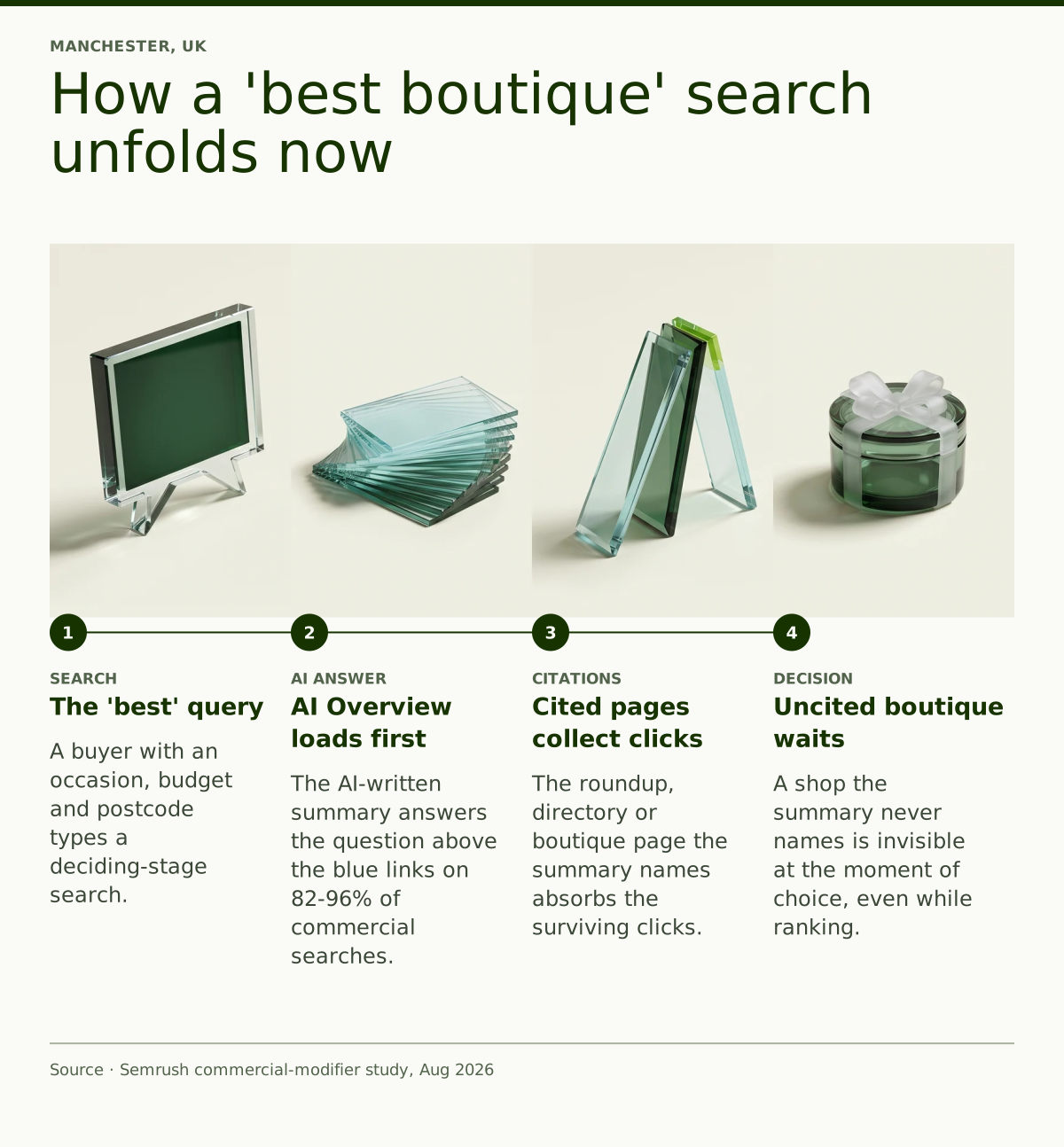
A “best abaya shops in Manchester” search is a deciding-stage search: the buyer has an occasion, a budget, and a postcode. Across the five commercial modifiers Semrush tracked — “best X for Y”, reviews, “brand vs brand”, alternatives, and price queries — AI Overviews now appear on 82% to 96% of those searches, with the full 400-keyword panel at 88% coverage by August 2026, up from 45.75% a year earlier. Review searches alone went from roughly a third of searches triggering a summary to 90%. This arrived fast: Semrush’s wider keyword-set tracking recorded AI Overviews on just 6.49% of queries as recently as January 2025. One honesty note — that is US panel data, not a Manchester sample. Treat the direction as settled and the local rate as something to check yourself, monthly, in your own browser.
The sequence that follows decides the sale. The summary loads and answers the question with names, prices, and comparisons. The clicks that survive flow to the pages the summary names — the roundup, the directory, occasionally a boutique’s own page. A shop the summary never names is invisible at the exact moment of choice, even while ranking. Which produces the uncomfortable, defensible conclusion: a boutique named in the summary but ranked sixth out-pulls a number-one boutique the summary ignores, because the summary is the only paragraph most buyers read.
The hidden cost
The lost click is the cheap one. A buyer searching “best abaya shops” has already decided to buy — occasion set, wallet open, no ad spend required to reach them. When the summary satisfies the query, that buyer never scrolls, never compares, and never learns the uncited boutique exists. Impressions rise while visits fall, which is exactly the “record visibility, quiet tills” pattern the WebmasterWorld publisher described above — and why a quiet October in a Manchester boutique can now have causes 5,000 miles away in Mountain View.
| The old ‘best’ search | The AI-answered ‘best’ search | |
|---|---|---|
| What sat at the top | Ten blue links and a map pack | An AI-written summary with cited links |
| Who looked like the winner | The top three listicles | Every name inside the summary |
| What it took to appear | A page that ranked | A machine-liftable fact: name, area, prices, reviews, comparisons |
| How stable it was | Positions held for weeks | Regenerated per search; volatile in October 2026 |
| Cost of missing out | Page-two invisibility | Invisibility at the moment of choice, while ranking |
The table’s last row is the invoice. Ads still buy visibility around the summary, and a boutique can keep paying for traffic it used to get free — but the organic decision-moment visit, the one that converted best because the buyer arrived pre-sold, is the line item quietly disappearing.
What Pakistani-owned modest fashion shops should do instead
Being citable beats being loud. Six moves, in rough order of cost:
- State machine-liftable facts. Price ranges, materials, alteration services, areas served, and hours — as plain sentences on the boutique’s own site. Summaries quote what is quotable.
- Finish the Google Business Profile. Correct category, hours, service area, current photos. Google’s AI features draw on the same facts, so an incomplete profile is a self-inflicted gap.
- Keep reviews arriving. Steady, specific Google reviews — “abaya alteration done in two days, perfect length” — feed the same system that writes the summary. Manchester curry houses learned the same lesson about review substance beating awards; boutiques are next in line.
- Get onto the pages the summary reads. Search the query, read the citations, and you have the target list: the roundups and directories AI Overviews quote. Pitch those pages with facts, photos, and a reason to include a Rusholme boutique beside the national resellers.
- Publish the comparison yourself. “Nida vs jersey abaya: which fabric for Manchester winters” answers a real buyer question, ranks for it, and gives a summary something honest to cite. Rankings still matter — as inputs to the answer, not the finish line.
- Check monthly, manually. Search the three phrasings that matter, signed out, and log which names appear. Free, fast, and the only UK data that matters — because it is yours.
None of this requires out-spending Manchester’s fast-fashion price war. It requires being the most citable boutique on the street: specific, current, and easy to quote.
Every month, the summary decides more of these searches without the buyer scrolling. Boutiques that stay unnamed keep paying for ads to reach customers who already decided inside Google’s answer — and that bill arrives as a quieter shop, not an invoice.
Read next: How Toronto modest fashion stores are preparing for AI shopping agents · One Instagram ad or three for a Birmingham abaya boutique
At WeProms, we have worked with modest fashion and halal retail brands across the UK and the Gulf on exactly this problem: being named when a machine writes the answer. Our generative engine optimization service and AI citation monitoring begin with a page-one audit — what the summaries say today, who they cite, and the shortest path in. Message hello@weproms.com, WhatsApp +92 300 0133399 for replies in UK business hours, or start at weproms.com/contact-us.
Frequently Asked Questions
Do AI Overviews appear on UK searches like ‘best abaya shops in Manchester’?
On many commercial queries, yes. The 82–96% figures come from a 400-keyword US panel (Semrush, August 2026); a verified UK-local rate for ‘best abaya’ queries has not been published. Check the specific query yourself in a fresh browser profile and repeat monthly — local results also shift with the map pack and the season.
How do I check what Google’s AI says about my boutique?
Search the two or three phrasings real customers use — “best abaya shops Manchester”, “abaya alterations Manchester reviews” — and log every name the summary mentions, with dated screenshots. Five minutes a month builds the only dataset that reflects your market, and it costs nothing.
Can I pay Google to put my shop inside the AI Overview?
No. Ads appear separately and are labeled; the summary’s citations are not sold, and Google’s site-owner guidance frames AI features as driven by the same fundamentals as search visibility. Anyone selling guaranteed AI Overview placement is selling a lottery ticket with your logo on it.
Will being cited bring sales, or just visibility?
Both, unevenly. The summary can satisfy a query without a click — that risk is real — but a cited name earns trust that converts later as branded searches, saved pages, and WhatsApp inquiries. Measure what changes in the 30 days after citations appear: branded searches, profile views, and inquiry volume, not clicks alone.
How much does it cost to get cited?
Scope decides, and honest agencies say so. A citation project typically combines listing cleanup, review generation, comparison content, and monthly AI-answer checks — priced per business, never per guarantee. WeProms Digital scopes this per boutique after a page-one audit; no responsible agency quotes a number before seeing what the summaries currently say.
Sources & References
- Semrush Blog — AI Overviews have nearly doubled across five commercial search modifiers — October 21, 2026
- Search Engine Roundtable — Google Search Ranking Volatility & Chatter Heats Up October 20 & 21 — October 21, 2026
- Google Search Central — AI features and your website — accessed October 2026
- Semrush — AI Overviews Study — accessed October 2026
Additional reading from industry feeds: