
By Sara Khan · WeProms Digital · November 1, 2026
Across the Gulf retail accounts we review each quarter — Pakistani-owned attar counters in Al Wakrah, mithai shops in Doha, abaya boutiques in Al Rayyan — one pattern keeps appearing: the owner asks ChatGPT about the shop by its exact name, receives an accurate, even generous summary of what the shop sells, and concludes that the shop is “on ChatGPT.” In the same week, questions phrased the way customers actually ask — where to buy good oud near Souq Waqif, which attar counter in Al Wakrah assembles Eid gift boxes — return four shop names, and theirs is not among them. In a four-engine test published this October, one business appeared in 1 of 43 answers to customer-style questions while every engine that answered described the business and its founder accurately.
Being described correctly and being recommended are two different competitions, and most Gulf shop owners are only measuring the first one. The first is a memory test that any established shop passes. The second is a shortlist contest against every other attar counter between Al Wakrah and the old souq, and it decides whether a family arriving for Eid shopping ever hears your shop’s name at all.
Last updated: November 2026.
This field note sets out what the pattern looks like in Qatari retail, where the recommended names actually come from, and the five-minute test that shows whether a shop appears in the answers that send customers. The evidence comes from four-engine tests run in October 2026, Gulf connectivity data, and the accounts we review across Qatar and the wider Gulf.
The pattern that repeats across Gulf shop accounts
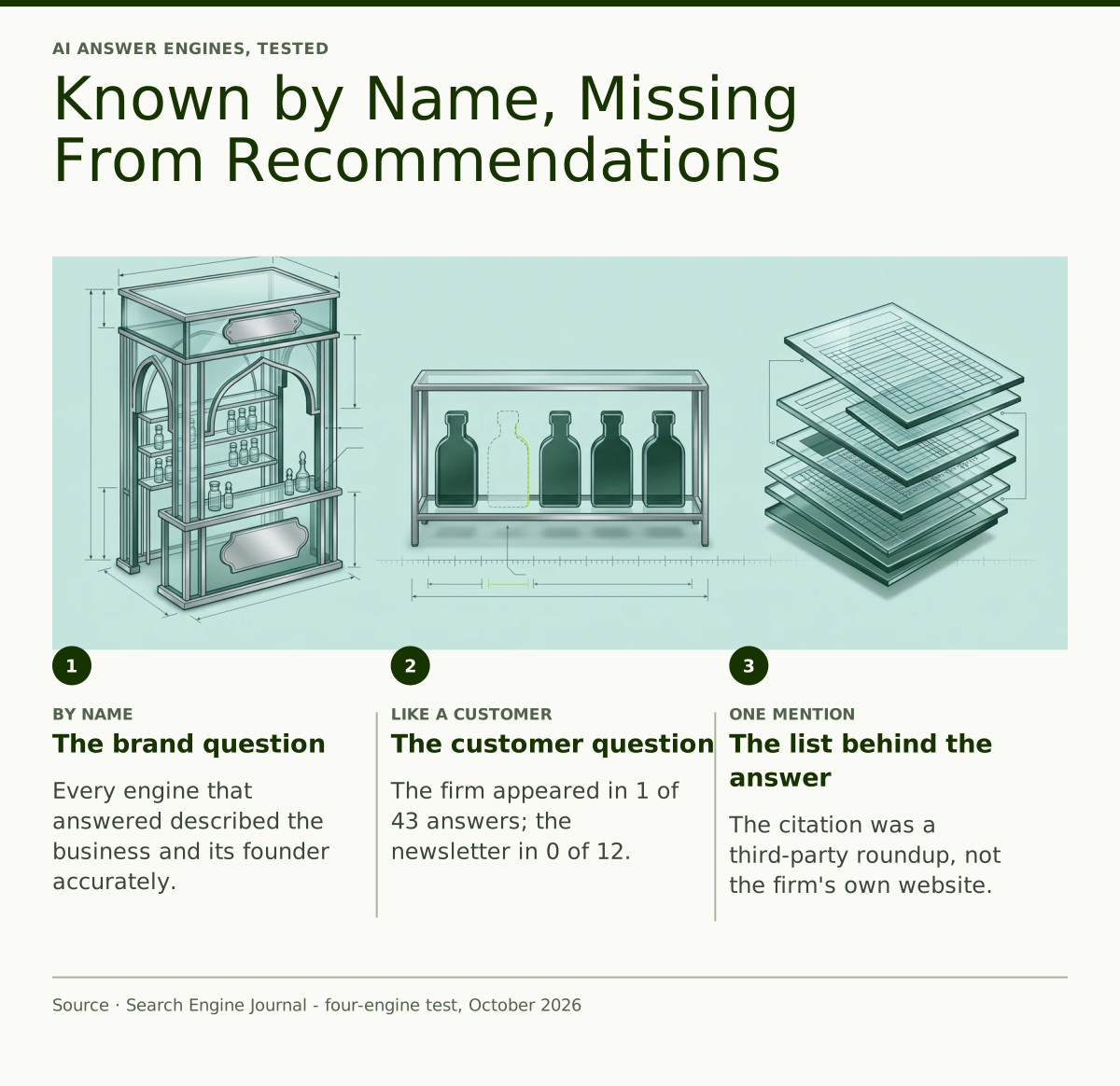
In October, Tony Uphoff — a five-time technology CEO who now writes the Uphoff on Media newsletter — ran the questions his prospective clients ask through ChatGPT, Gemini, Perplexity, and Google AI Overviews, the AI-written summaries Google places above many search results. His newsletter appeared in 0 of 12 answers to category questions; his advisory firm appeared in 1 of 43. Yet every engine that answered “Who is Tony Uphoff?” knew his career in detail, according to Search Engine Journal’s report on the test.
“The models know who I am. They almost never recommend what I’ve built.” — Tony Uphoff, Uphoff on Media, October 2026
A branded question measures whether the engine remembers you; a category question measures whether it picks you. For an attar shop in Al Wakrah, “who runs [shop name]” is asked by the owner and a handful of cousins. “Where can I buy good oud in Al Wakrah” is asked by every new family, every visitor shopping before Eid, every husband sent out after Taraweeh during Ramadan.
It is the difference every stallholder in a Ramadan bazaar understands by the second night. Your regulars will find your counter blindfolded, the way your WhatsApp regulars message you directly for bakhoor refills. New families follow the crowd standing at three other stalls — and in 2026, the crowd gathered around a stall is often a recommendation written by a machine.
Qatar is not a marginal market for this behavior, either. GSMA Intelligence data cited by Oxford Business Group counted 4.8 million mobile connections in early 2025 — 156 percent of Qatar’s population — so the question gets asked on a phone long before anyone walks into a souq. Qatar’s Pakistani community is estimated at 150,000 people or more (MenaJobs expat guide) — a small city’s worth of families comparing notes in the same Urdu and English WhatsApp groups.
The pattern is not unique to perfume counters. When we examined where ChatGPT sends families looking for karahi in Al Wakrah, the engines leaned on a handful of third-party signals rather than the restaurants’ own websites. The same mechanic governs attar.
Where the recommended names actually come from
The underlying mechanic is that recommendation answers are assembled from recommendation pages. Seer Interactive, a US analytics agency, built a script that watches ChatGPT search the web in real time while it composes an answer, and published what it saw in its ChatGPT search study. In one shopping conversation about carry-on luggage, a single review site supplied 5 of the 9 sources behind ChatGPT’s first response, and the final recommendation matched that review site’s own number-one pick. The engine did not read the luggage brand’s website first. It read someone else’s shortlist.
Uphoff’s lone appearance in 43 answers tells the same story from the other side: the citations behind category answers were roundup lists — “best AI newsletters”, “top B2B marketing podcasts” — written by other companies, not by the firms being named. The engines were quoting other people’s lists of recommendations, which means the shops on those lists inherit the recommendation.
In Qatar, the equivalent list pages are easy to name. They are Google Maps profiles whose reviews mention oud, attar, and gift sets in so many words; Doha blog roundups of perfume shops; Qatar Living threads where residents answer each other’s shopping questions; and the category wording on marketplace and delivery listings. An attar counter that appears on two of those pages is often better positioned in AI answers than a competitor with a prettier website and no listings.
The actionable step costs nothing. Search for “best attar shop Doha”, “where to buy oud in Qatar”, and “perfume shops near Al Wakrah” in Google, ChatGPT, and Perplexity, then write down every page that appears besides the shops themselves. Those pages are the shortlist the machines read, and those are the pages worth earning your way onto — deliberately, the way a shopkeeper once worked to be listed in the right directory.
Why checking your own shop name gives you the wrong answer
The branded-question check produces what analysts call a false positive: the owner sees an accurate answer and reads it as proof of visibility. The buyer data points the other way. G2, the software-review platform, surveyed 1,076 software buyers in March 2026 and found 51 percent now begin research with an AI chatbot more often than with Google, up from 29 percent in its 2025 report, as Search Engine Journal’s write-up documents. Those are business software buyers, not families shopping the Al Wakrah corniche — the survey does not prove your customers already shop by chatbot, only that the habit is moving in that direction, and business buyers tend to get there first.
Meanwhile, the click itself is thinning out. Reddit, whose threads rank for an enormous share of everyday questions, told shareholders in October that search referrals had dropped by more than 1 million per week on average, and CEO Steve Huffman’s summary of Google’s AI Mode was blunt in Search Engine Journal’s coverage:
“AI Mode does not drive traffic.” — Steve Huffman, Reddit CEO, October 2026
If the click disappears into the answer, then the shop name inside the answer is the whole prize. A competitor named in the answer receives the customer without a visit; a shop left out never sees the demand in any dashboard, which is precisely why this leak stays invisible to owners who watch only their analytics. A halal sweet shop owner who noticed ChatGPT had stopped recommending his shop found the drop only because a customer mentioned it in person.
Almost nobody measures this properly. A Corporate Ink study released in May found only 29 percent of marketers actively track and measure AI visibility. So a two-counter attar business in Al Wakrah that runs the five-minute test below is doing something most marketing departments still skip — the field is quiet while the stakes are rising.
What the shops that get named do differently
The accounts that appear in category answers share habits that have nothing to do with advertising budgets and everything to do with leaving consistent, category-worded traces across the places the engines read. Google’s own AI optimization guide for Search Central comes down to the same disciplines: consistent facts about the business everywhere it appears, clear page structure, and content that directly answers what people ask.
| Shops that appear in AI answers | Shops that stay invisible |
|---|---|
| Reviews that name the category: “best oud in Al Wakrah”, “attar gift set for Eid” | Reviews that only say “nice shop, friendly staff” |
| Listed on two or more third-party pages: local roundups, Qatar Living threads, directories | Present only on their own website and Instagram |
| One consistent shop name and category wording on Google Maps, Instagram, and the site | A different trading name on every platform |
| Product pages that answer questions in words: prices, gift-set contents, delivery areas | Photo galleries with no written answers |
| Fresh, dated information around trading windows like Ramadan and Eid | Stock and hours that went stale two Eids ago |
Two of those rows deserve emphasis for a perfume business. Review wording matters because engines quote the words customers used — a review mentioning “oud” and “attar” classifies your shop for the category; a review saying only “nice shop” does not. And writing matters on your own pages too: Ahrefs’ October analysis of 1,900 questions across Google’s AI Overviews, ChatGPT, and Perplexity found the pages engines cite are overwhelmingly the pages fully about the question being asked, so a page titled and written around “attar gift sets for Eid in Al Wakrah” outperforms a gallery of unlabeled photos every time.
This is entity and PR work, not ad spend. WeProms Digital approaches the consistency side as entity SEO for overseas Pakistani businesses and the roundup-list side as digital PR for AI search — the two services that decide whether a shop gets named when a family asks.
How to run the five-minute test this week
Copy Uphoff’s method with your own shop. Write down ten questions customers actually ask — never your shop’s name. For an attar counter: where to buy oud in Al Wakrah, who makes Eid gift boxes in Doha, which attar is alcohol-free, who blends custom bridal bakhoor, where to buy bakhoor after Taraweeh in Ramadan. Ask all ten in ChatGPT, Gemini, Perplexity, and Google. Log which shops appear in each answer, then rerun the set once a month — answers shift week to week, so a single run is a snapshot rather than a verdict.
WeProms Digital runs exactly this kind of question-set tracking as an AI search visibility monitoring and citation tracking service for overseas Pakistani and halal-market businesses, for shops across Qatar, the UAE, Saudi Arabia, and the UK. The point of monthly monitoring is to catch the week a category answer drops your name and fix the cause — instead of discovering it after Eid, when the gift-season demand has already been named to someone else.
Between test runs, grow the review base that feeds the answers. Ready to paste, with consent and an easy opt-out: “Assalamu alaikum [name], thank you for your order from [shop]. If you have a minute, an honest Google review mentioning what you bought — oud, attar, or a gift set — helps other families find us. Reply STOP to opt out of messages.”
Worked example, illustrative — substitute your own numbers: an Eid gift set sells at QAR 150; oils, packaging, and the box cost QAR 65; contribution is QAR 85 per set. If presence in AI answers brings ten extra sets’ worth of orders in Eid week, that is QAR 850 in contribution from one week — before the repeat purchases after Ramadan, which is where attar customers quietly compound.
Key Takeaways
- Asking an AI about your own shop by name measures memory, not recommendation. Run category questions — the ones customers type — instead.
- Recommendation answers are assembled from third-party list pages: Maps review wording, blog roundups, community threads. Your website is read second.
- One review site supplied 5 of 9 sources behind a ChatGPT shopping answer in Seer Interactive’s test. The lists, not the brands, drive the picks.
- Reddit reported losing more than 1 million search referrals per week, and its CEO says AI Mode does not drive traffic. The name inside the answer is becoming the asset.
- Qatar’s 4.8 million mobile connections — 156 percent of the population — put the question on phones before customers reach the souq.
- Ten customer-questions, four engines, once a month: five minutes that only 29 percent of marketers spend measuring AI visibility.
Read next: How Do I Get ChatGPT to Recommend My Oud Shop in Dubai? and ChatGPT Names My Riyadh Restaurant But Links Someone Else’s Page
If you want to know which customer questions your shop already appears in — and which competitor is being named instead — WeProms Digital has worked with overseas Pakistani and halal-market retailers across Qatar, the UAE, Saudi Arabia, and the UK, and every AI-visibility engagement we take starts with the question-set evidence above, not with promises. Get in touch through our contact page, email hello@weproms.com, or message WhatsApp +92 300 0133399 — we reply in UK and Gulf business hours.
About WeProms Digital
WeProms Digital is a Lahore-based AI search visibility and SEO agency working with overseas Pakistani and halal-minded business owners across London, Birmingham, Manchester, Dubai, Riyadh, Doha, Toronto, Houston, and beyond.
The team specializes in AI citation monitoring, entity SEO, and digital PR for AI search, with a track record of running monthly AI question-set tracking for retail and hospitality businesses across the Gulf, the UK, and North America.
Get in touch: hello@weproms.com · WhatsApp +92 300 0133399 (replies in UK and Gulf business hours) · weproms.com/contact-us
Sources & References
- Search Engine Journal — The AI Search Measurement Gap Brands Must Close In 2027 And Beyond — October 30, 2026
- Seer Interactive — I Built a Tool to Watch ChatGPT Search, and It Predicted My Next Question — October 30, 2026
- Search Engine Journal — Reddit CEO Says Google’s AI Mode ‘Does Not Drive Traffic’ — October 30, 2026
- Google Search Central — AI optimization guide — current guidance
- Oxford Business Group — Qatar 2026 ICT report: connectivity foundations — 2026
- Ahrefs — What Is BLUF? How to Write Bottom Line Up Front — October 30, 2026
- MenaJobs — Qatar Expat Guide for Pakistanis — 2026 guide
- Corporate Ink — GEO and AI Visibility 2026 Report — May 2026
Additional reading from industry feeds: