By Abdul Rehman · WeProms Digital · October 28, 2026
Google now reads merchant-written questions and answers straight from your product feed, and for a halal grocery the first question is always “is this halal?” This walkthrough shows an Ottawa shop how to put that answer into the feed in one afternoon — CAD 0 in new software — and keep every listing clean with a 15-minute monthly check.
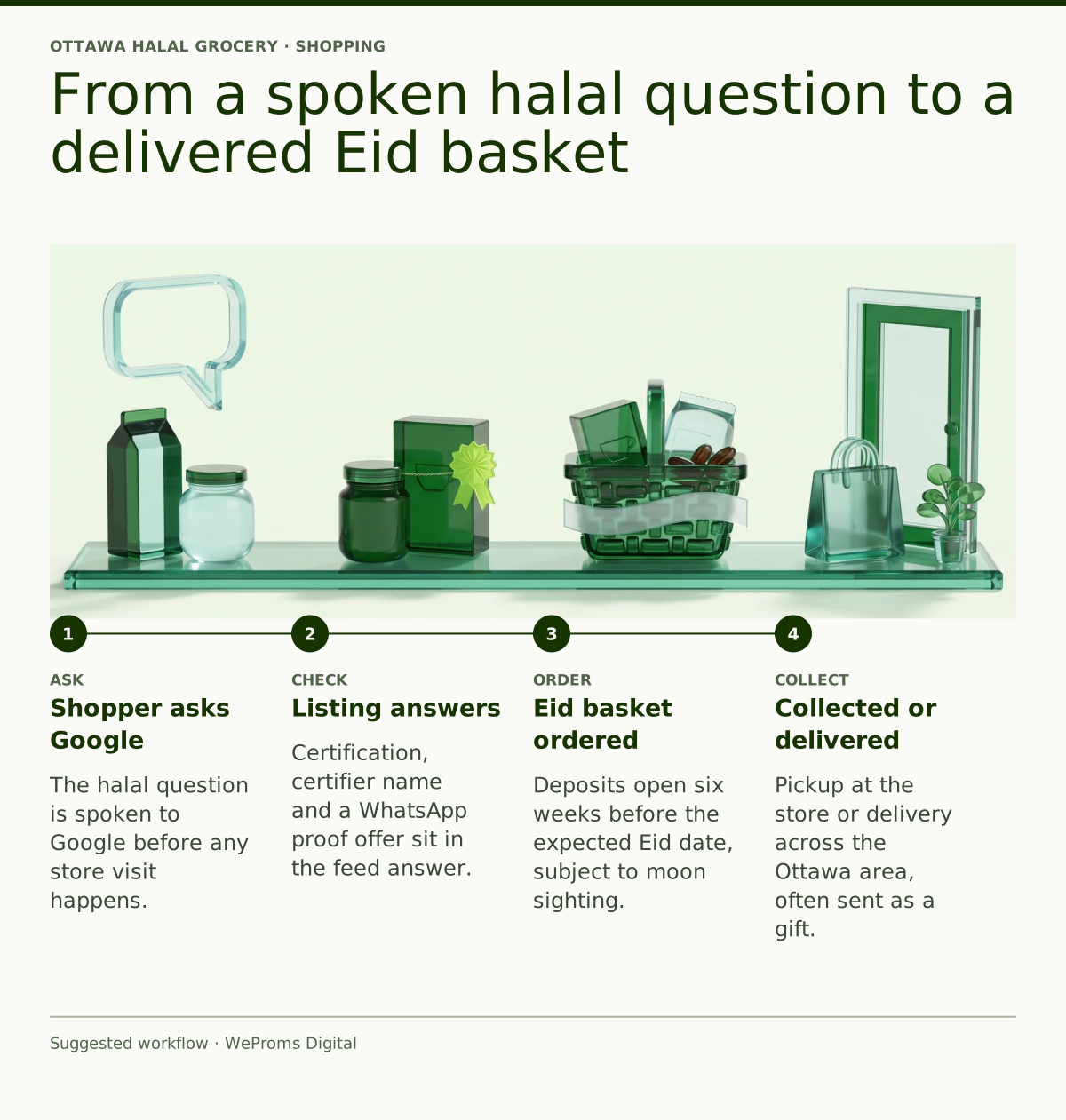
Picture this: a mother in Ottawa’s west end asks her phone, out loud, whether the ajwa dates she can see on Google are zabiha halal — the same question she would once have put to the uncle behind your counter, who would have pointed at the framed certificate without looking up. Your Google Shopping listing comes up with the right price and a decent photo. Nothing on it answers her.
She orders her CAD 55 basket (illustrative) from a Toronto chain before comparing anything else, and the store ten minutes from her door never knows the sale existed. This walkthrough is written for a Pakistani-owned halal grocery in Ottawa running online orders through Shopify or a similar store; the same steps fit a butcher, a mithai shop, or an attar counter anywhere in Canada. About 115,000 Muslims live in the Ottawa area alone (2021 Census), and in this community the certification question always comes before the price question.
Two terms carry the whole process. Google Merchant Center — Google’s free tool that holds your product feed, the file of titles, prices, images, and attributes Google reads to build your Shopping listings. And the question_and_answer attribute — a feed field, added in 2026, that lets you write up to thirty question-and-answer pairs per product, with room for roughly 1,000 characters per answer. Google says these answers feed its conversational shopping surfaces, including AI Mode in Search, which is exactly where a spoken question like “are those dates halal certified?” gets answered. Room enough, in other words, for a certifier’s name, a WhatsApp offer, and a sentence of proof.
First, see the listing the way the shopper sees it
Start here, on your phone, in an incognito window so your own browsing does not bend the results. Search five of your real products by name — “Lahori chai 500g”, “zabiha chicken breast 2kg”, “ajwa dates 1kg” — and then search the same names plus “halal”. For each result, note four things: the price shown, the seller name, whether reviews appear, and whether any question is answered. Ten minutes of looking tells you what Google currently says about your shop when you are not in the room.
Then open Merchant Center and read the diagnostics panel on the home page, which lists every product Google has disapproved, limited, or flagged. One honest note on scope: if you take orders only through WhatsApp and a Facebook page today, start with a simple one-page order site and a twenty-item feed; every step below is identical, only smaller. What matters is that the audit ends with a written list — five products, five verdicts, one page.
Then fix what quietly drops products
Grocery feeds fail in predictable places. Branded goods need a correct GTIN — the barcode number — and a brand name; your own-label pickles and spice mixes need identifier_exists set to no instead of a blank barcode field. Titles like “Rice 10LB” tell Google nothing, while “Sultan Long Grain Basmati Rice 10 lb” tells it everything, and the title is the strongest single field you control. Price and availability mismatches between the feed and the live site disapprove items silently, and photos with promotional text overlaid get products rejected outright.
In your shop, the halal certificate hangs behind the counter where every customer can see it from the door. Online, that certificate has exactly one home — the listing — and the next step moves it there.
Fix in this order: titles, then prices and availability, then images, then GTINs.
Next, write the halal question and answer into the feed
The question_and_answer attribute is where the certification conversation now happens. Each product carries your pairs in the primary feed, a supplemental feed, or through your feed app’s custom-attribute field; Google treats the answers as optional data with no guaranteed display, but they are what its conversational shopping reads when a shopper asks a product question in plain language. The answer sits in the product feed, named and provable on request — that is the whole point of the field.
Canadian labeling law sets the honesty bar, and your feed should match your labels. The Canadian Food Inspection Agency requires halal claims to be truthful and not misleading, and where a certifying body is named, its name must appear on the label. The same discipline belongs in the listing answer, word for word.
Here is a paste-ready answer you can adapt tonight:
Question: Is this halal certified? Answer: Yes. [Brand] is zabiha halal, certified by [certifier’s full name] — the same certification named on the pack you receive. Want to see the certificate before ordering? Message us on WhatsApp at [number] and we will send a photo of it the same day.
If you buy from certified suppliers but hold no certificate yourself, say exactly that — “prepared with meats from HMA-certified suppliers” only where it is true — and never claim a certification you cannot show on paper. Trust compounds in this community; one inflated claim, discovered, costs the family trade that took a decade to build.
When those WhatsApp replies arrive, ask before you add anyone to a broadcast list, and make leaving easy. A line that works: “Assalamu alaikum, this is [shop name] — may we message you when Ramadan baskets open? Reply NO and you will never hear from us.” Consent kept in writing is repeat business.
After that, build the Eid basket listings before the season
The seasonal calendar, not the discount calendar, decides a halal grocery’s biggest weeks. Ramadan 2027 is expected to begin around Monday, February 8, 2027, with Eid al-Fitr expected around March 9–10 — all dates subject to moon sighting. Basket deposits should open about six weeks before the expected Eid, which means late January; the listings need to be live before that, photographed and titled as gifts.
Build the Eid hamper as its own product — “Ramadan Dates and Chai Gift Basket, serves 8-10” — rather than a footnote on a dates listing. The buyer is often a gift-giver: a son in Toronto sending iftar to his parents’ door in Ottawa is a different customer from the weekly shopper, and gifting attributes, a plain product photo, and a delivery note answer him. Black Friday still moves Canadian households in late November, but for your shop it is a warm-up lap; the community’s basket weeks are Ramadan and both Eids. Two earlier pieces pair with this one — how a Surrey halal grocery gets into Google’s Universal Cart, and why Brampton mithai shoppers abandon gift boxes at checkout.
At this point, run the basket math before you discount
Worked example — substitute your own costs (illustrative). An Eid hamper sells at CAD 75. Contents cost CAD 31, packaging CAD 7, and local delivery CAD 10, so each basket contributes CAD 27 before any marketing spend. A 10% discount hands away CAD 7.50 — more than a quarter of the contribution — to a shopper who was mainly asking a trust question, while answering the certification question in the feed costs one afternoon. The tradeoff is an afternoon of feed work now, or a quarter of the contribution on every discounted basket later.
The margin context is not friendly. The Bank of Canada’s third-quarter 2026 Business Outlook Survey found roughly half of Canadian firms plan to pass cost increases on to customers, your suppliers included; a national survey says nothing about Ottawa basket demand, but it does say your costs share the pressure. Buy trust with answers, not with margin.
If you later put CAD 300 into Shopping ads to move the hampers, the same contribution math sets the stop rule: CAD 300 divided by CAD 27 is about eleven baskets to break even, so scale only while cost per order keeps the contribution positive, and stop the test at twice that spend if it does not.
Once it is live, verify like a shopper, not an owner
Owners check dashboards; shoppers check Google. Once a week, spend fifteen minutes in an incognito window: search your five bellwether products, confirm the price, confirm the halal answer surfaces where you expect it, and open Merchant Center’s diagnostics for new disapprovals. Merchant Center’s performance report shows impressions and clicks on free listings, so the two numbers to watch are impressions on basket listings and clicks from halal-worded searches.
Expect feed changes to reprocess within days rather than hours, and treat any disapproval in the week it appears. The steps above fit packaged goods and bundles cleanly; fresh produce without barcodes is the one category where GTIN rules bend, and a smaller, honest feed is the right answer there.
The outcome: the listing answers before the shop does
Marketing Land’s argument this month is blunt: your best customer may never visit your website, because comparison — and increasingly the purchase decision — happens on surfaces you do not control. For a halal grocery, the product listing is the shelf edge, the counter conversation, and the framed certificate all at once.
| What the shopper meets | Today’s listing | After this walkthrough |
|---|---|---|
| The halal question | Silence; she asks elsewhere | Answered in the feed, certifier named |
| Title | “Rice 10LB” | Brand, cut, size, halal where certified |
| Season | No basket listing | Eid hamper live six weeks before Eid |
| Price story | Discount-led | CAD 27 contribution protected, answers first |
| Proof | None visible | Certificate offered on WhatsApp, same day |
If your suppliers are certified and your labels are honest, the feed work is an afternoon plus a habit; if you cannot yet show certification on paper, fix that first, because no listing answer outsells the truth. Either way, the family that asks Google the halal question tonight is buying from whichever listing answers it — and today, in Ottawa, that listing is rarely the local one.
Read next: How Does My Surrey Halal Grocery Get Into Google’s Universal Cart? and Why Don’t Black Friday Shoppers Come Back to My Halal Grocery?.
WeProms Digital is a Google Merchant Center management agency for overseas Pakistani and halal businesses, and we have worked with grocers, butchers, and marketplace sellers across Canada, the UK, and the Gulf on feed hygiene, listing answers, and seasonal campaign calendars. Our product feed optimization service covers the attribute work this walkthrough describes, from titles and GTINs to the Q&A pairs. Email hello@weproms.com, message WhatsApp +92 300 0133399, or use weproms.com/contact-us.
Frequently Asked Questions
Does adding questions and answers to my product listings cost money?
No. The question_and_answer attribute is free product data inside Merchant Center, and free listings themselves cost nothing — you are paying only the time to write accurate answers. Paid Shopping ads are a separate decision, and the basket math above is how you judge them.
We buy from certified suppliers but hold no certificate ourselves. What should the listing say?
Say exactly what is true: “prepared with meats from [certifier]-certified suppliers”, naming the supplier’s certifier only if you can verify it. The CFIA requires halal claims to be truthful and not misleading, and that standard follows the claim online. Families respect a precise answer far more than a vague “yes, halal”.
How long do feed changes take to show up on Google?
Feed changes usually reprocess within days rather than hours, and new or edited items can take longer to settle into Shopping surfaces. The habit that matters is the weekly incognito check — search the product, confirm the answer, and log the date, so you always know what changed and when.
Our Shopify store is our website. Do we still need Merchant Center?
Yes, if you want your products on Google’s Shopping surfaces, where the comparison now happens. Shopify holds your orders; Merchant Center holds what Google reads. A feed app syncs titles, prices, and availability between them, and custom attributes — including your Q&A pairs — ride along in the same sync.
Can WeProms run the feed and write the answers for us?
Yes. We have worked with halal grocers and food brands across Canada, the UK, and the Gulf on exactly this — feed audits, attribute fixes, Q&A writing, and seasonal calendars — and we scope by catalog size, so a 200-item shop pays for 200 items. Message us on WhatsApp or through the contact page and we will start with a free look at your current listings.
Sources & References
- Search Engine Land — Google Merchant Center adds product Q&A attribute to Shopping feeds — October 2026
- Search Engine Land — Google Merchant Center conversational attributes explained — October 2026
- Canadian Food Inspection Agency — Method of production claims: Halal — official guidance
- Bank of Canada — Business Outlook Survey, Third Quarter of 2026 — October 2026
- Statistics Canada — A snapshot of the Muslim population in Canada — 2021 Census data
- Marketing Land — Your best customer may never visit your website — October 28, 2026
- Google — Get your product data holiday-ready on Google Merchant Center — Google guidance
- Yahoo Finance Canada — Half of Canadian firms plan to raise prices as tariff-hit profits recover — October 2026
Additional reading from industry feeds: