By Abdul Rehman, WeProms Digital · Last updated October 8, 2026 · 9 min read
In about an hour, using free Google tools, you can confirm whether the September 2026 spam update hit your site, sort your losing pages from your healthy ones, and start fixes that compound over the next two to three months. No paid tools needed — only Google Search Console, a spreadsheet, and honest judgment about your own content.
Picture this. You run a 40-page services website out of Islamabad — IT support for small companies, most of your inquiries arriving through a contact form. September was a normal month: around 1,900 clicks from Google. Then, over the October 4-6 weekend, daily clicks fell from the low seventies to the mid-forties and stayed there. Nothing changed on the website. No one touched the hosting. The first instinct is to blame the developer or wait a week. The correct first move is different: open Search Console and find out what Google actually did, because Google finished rolling out its September 2026 spam update over exactly that weekend, as Search Engine Roundtable tracked. This walkthrough is the sequence we would run, step by step, for any Pakistani business site in that position.
First, confirm what actually dropped
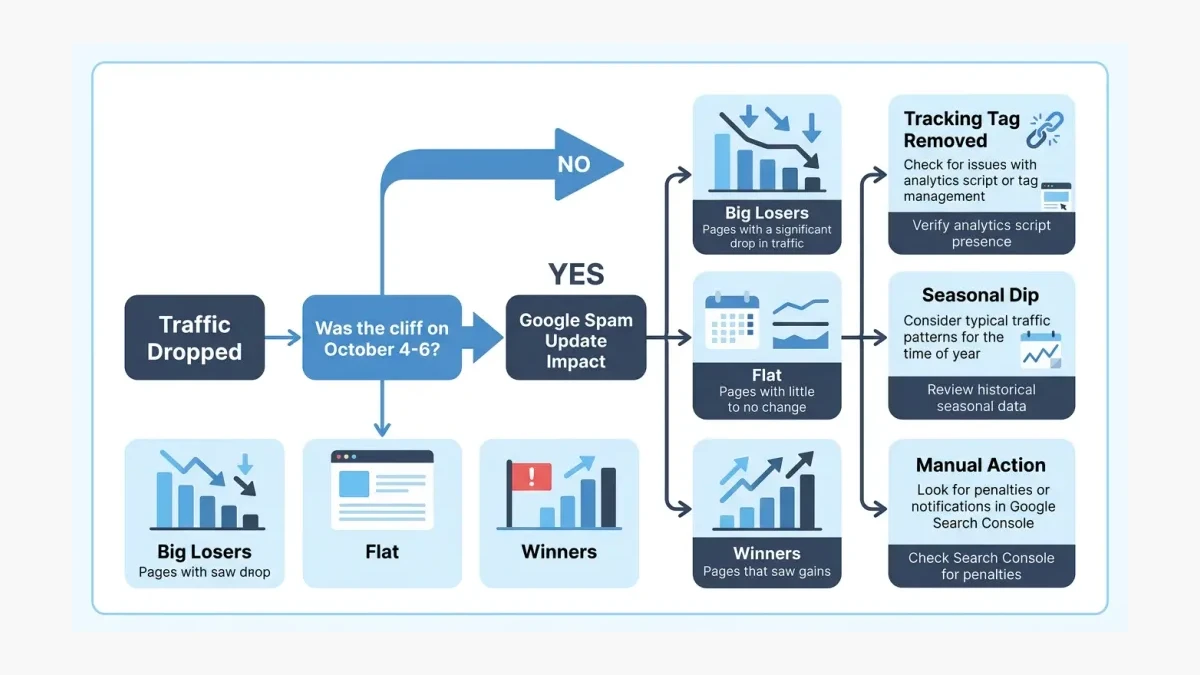
Google announced the September 2026 spam update on September 24 with a roughly two-week rollout window, and coverage of the rollout showed the heaviest movement in its final phase, October 4-6. A real update hit therefore looks like a cliff on those dates, not a slope. In Search Console’s Performance report, set the comparison to the four weeks ending October 7 against the four weeks before. Then look at the daily line, not the totals. A cliff aligned to October 4-6 says “update.” A slide that began in August says something else entirely — usually content decay or a competitor improving.
Rule out the innocent explanations before assuming Google judged your site. A tracking tag removed during a redesign produces a cliff too, but Analytics would show the same drop, while Search Console keeps recording impressions. A manual action — a human penalty — appears in Search Console under Security and Manual Actions and is rare. Seasonal dips exist, but they dip, they do not fall off a table. Our earlier guide on what a sudden traffic drop usually means covers those checks in more depth; run them before you spend a single hour on content fixes.
Then, sort your pages into three buckets
Export the Pages report from Search Console for both comparison windows. Build three buckets: pages that lost more than 30 percent of clicks, pages that held flat, and pages that gained. The pattern inside the first bucket is your diagnosis. Whole-site losses point at a site-level problem; clustered losses — every page in one topic, or every thin city-variation page — point at that cluster. An Islamabad consultancy with 15 “services in [city]” pages will usually find the entire set in the losing bucket, while the genuinely detailed pages held.
Google’s own spam policies name the behaviors its spam systems act on, and two matter most for the Pakistani web market. Scaled content abuse — mass-producing pages with little added value, whether written by humans, AI, or both — is exactly what bulk-generated price pages and near-duplicate Urdu-English article sets look like. Expired domain abuse — buying an old domain for its history and stuffing it with unrelated commercial content — describes a recognizable trade in used .com.pk and .pk domains. Neither label requires intent; the pattern alone triggers the treatment, which means an honest business can inherit the problem from an old contractor or a domain purchase.
Next, apply the guideline Google quietly reworded
Book a free strategy call - we'll audit your current setup and identify the highest-impact fixes.
While the spam update rolled out, Google reworded its Helpful Content guidance to emphasize what it calls Main Content — the part of a page that directly serves the reason a visitor arrived, as Marie Haynes explained in her analysis. The rewording shifts judgment from “how much content does the site have” to “does the main content of this page actually deliver.” Google’s creating helpful content guidance now stresses effort, originality, and visible experience — the same page also notes that main content includes tools and features, not just paragraphs of text.
Think of the update as a food inspector walking through Gowalmandi’s food street in Lahore. Stalls with clean oil, fresh stock, and honest menus keep serving. The stall reheating yesterday’s gravy in yesterday’s grease closes for a day. The inspector is not against food streets; the inspector is against corner-cutting. Judge every page in your losing bucket the way that inspector would: would a customer who landed here for “server maintenance cost in Pakistan” get a real answer — prices, timelines, scope — or three hundred words circling the keyword before a contact form?
Turn that judgment into three actions. Prune pages whose main content serves nobody, returning them to the draft folder rather than padding them. Merge five thin pages answering one question into one strong page. Rewrite the survivors with specifics only your business can supply: actual PKR figures, real service areas, named equipment, genuine case notes. If a large share of your pages are bulk AI text, our piece on whether Google penalizes AI-written content in Pakistan separates the real risks from the myths.
After that, clear the technical blockages
Updates are also the moment hidden technical debt surfaces. If Search Console’s Sitemaps section shows a “Couldn’t Fetch” error, Google has been unable to reliably read your sitemap — Google recently explained the causes, which range from server timeouts to redirects and robots.txt blocks. A sitemap Google cannot fetch slows recrawling of your cleanup work, which means your fixes sit unseen for weeks. Fetch the sitemap URL yourself in an incognito window; if it fails, your hosting or a redirect rule is the culprit, and your developer can usually fix it within a day.
Check the Pages (Indexing) report at the same time. You are looking for two things: valid pages that dropped out of the index during the update window, and duplicate or alternate pages that never deserved indexing. Submit the sitemap again after fixes, then let Search Console’s URL Inspection tool request recrawling for your ten most important repaired pages. This step rarely fixes rankings alone — the content work above does that — but it removes the ceiling on how fast recovery can happen.
Once the cleanup is live, measure what matters
Position tracking is the weakest way to watch a recovery, because positions swing daily while value does not. Click distribution explains why chasing positions broadly is wasted effort: Sistrix’s study of 80 million keywords puts position 1 at 28.5 percent of clicks, position 2 at 15.7 percent, and position 10 at 2.5 percent — the top result earns more than ten times the clicks of the tenth. Which means a move from position 5 to position 2 on one money query is worth more than holding position 6 on forty queries. A recovery worth counting shows up in Search Console as clicks on pages that bring inquiries, not as a trophy ranking on a keyword nobody buys from.
Build the tracking sheet around business outcomes instead. Per page: clicks, average position, and — from your own records — inquiries or orders that page produced this month. Pakistani exporters and brands selling to overseas Pakistanis can go one step further with the Performance report’s country comparison, which shows whether the drop hit domestic traffic, UK traffic, or both; the fix differs depending on the answer. And when a competitor now sits where you sat, our analysis of why a competitor ranks above you on Google lists what to compare before assuming the worst.
From here, prepare for the next update
How we helped a Pakistani business achieve measurable results.
The September spam update is unlikely to be the year’s last word. Veteran SEO Lily Ray predicted in October that another major update is close, pointing to Google’s guidance changes and the sustained rollout volatility as signals. Treat that prediction as a deadline rather than a rumor. Every quality fix you ship before the next update lands is measured at full weight when it arrives; every fix shipped after spends months waiting to be re-evaluated.
Preparation is mostly documentation. Save this month’s Search Console exports so the next drop can be compared against a known baseline. List your ten revenue pages and confirm each has main content worth landing on. Keep a content inventory with publish dates, word counts, and the question each page answers, so a future cleanup takes an afternoon instead of an archaeology project. Businesses that recover fastest after updates are rarely the ones with secret tactics; they are the ones who already knew what they owned.
The outcome you should expect, honestly
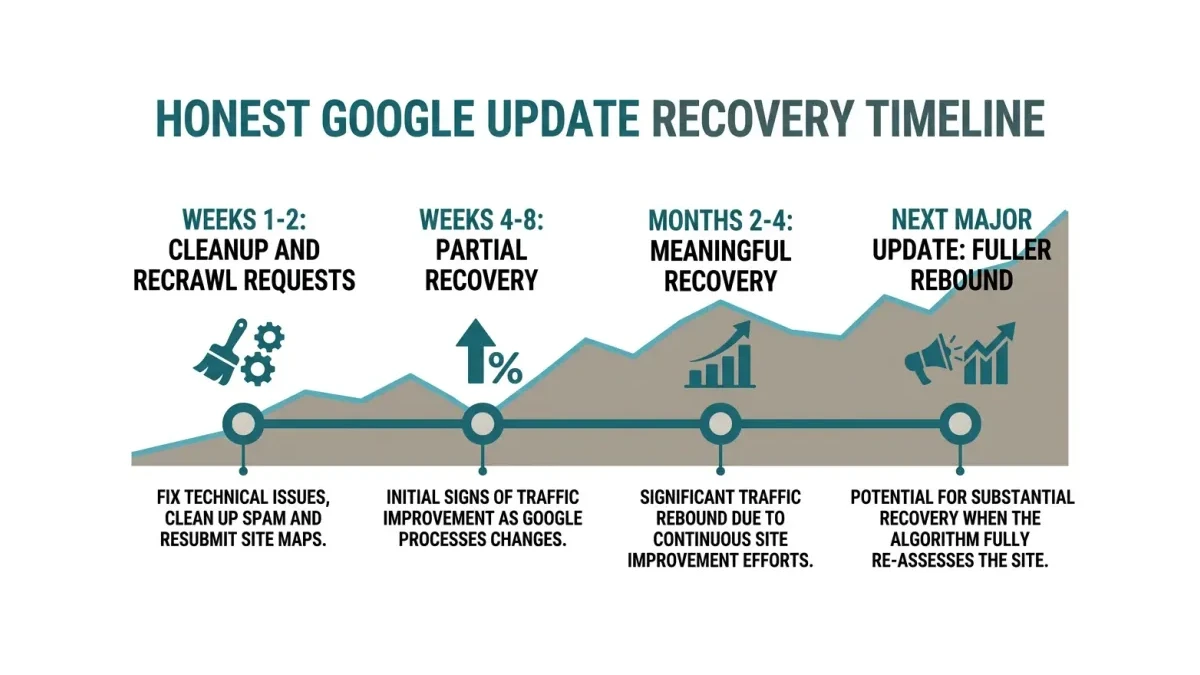
Recovery from a spam-update hit is a slope, not a switch. Recrawling and reprocessing a repaired site takes weeks, and industry guidance on what to expect from Google’s next ranking updates notes that fuller recoveries frequently consolidate around the next major update, not immediately after fixes. A realistic plan: partial improvement within four to eight weeks of cleanup, meaningful recovery over one to two quarters, provided the pruned and rewritten content genuinely serves the visitor.
| Drop pattern you saw | Most likely cause | First action |
|---|---|---|
| Site-wide cliff on October 4-6 | Spam update impact | Quality audit across all buckets, starting with biggest losers |
| One topic or section dropped | Cluster-level quality problem | Prune, merge, or rewrite that cluster’s main content |
| A single page dropped | Competitor outranked you or page decayed | Refresh that page with current specifics and re-request indexing |
| Gradual slide since summer | Cumulative content debt or lost links | Full content inventory and competitor comparison |
The tradeoff is speed versus certainty, which means you can act this week without pretending to know Google’s mind. If the losing bucket is a handful of thin pages, the do-it-yourself path above is enough. If more than a third of your revenue pages sit in the losing bucket, or the site carries bulk-purchased content you inherited, bring in specialists now — the diagnosis is cheap and the crawl budget clock is already running.
Read next: Will Google Penalize My Website for AI-Written Content in Pakistan? and My Website Traffic Suddenly Dropped — What It Means.
At WeProms, we run update-recovery engagements as a fixed-scope audit before any retainer conversation — SEO services that start with the losing-bucket analysis above, and a technical SEO audit that clears the crawl and indexing blockages in the same pass. Packages and PKR ranges are on the pricing page, with a 30-day money-back guarantee on audits. If the October 4-6 weekend took a bite out of your traffic, message hello@weproms.com or WhatsApp +92 300 0133399 — send your Search Console comparison screenshot and the first reply will tell you which bucket your site sits in.
Frequently Asked Questions
How long does it take to recover traffic after a Google update?
Expect partial recovery four to eight weeks after your fixes are recrawled, with fuller recovery often consolidating around the next major update. Spam-update recoveries are gradual because Google reprocesses a repaired site over multiple passes, not in one approval event.
Can I recover without deleting pages?
Sometimes. If the damage is concentrated in a few thin pages, pruning and rewriting those pages is enough while stronger pages recover on their own. If the site’s structure was built on scaled, near-duplicate content, deletion or consolidation is part of the cure — Google’s spam policies target the pattern, so keeping every page works against recovery.
Was the September 2026 update about AI-written content?
No single update is “about” AI content. Google’s policies target scaled content with little added value regardless of who or what wrote it, and its reworded guidance now judges the main content of each page directly. Our longer piece on AI content and Google penalties in Pakistan covers the practical distinctions.
How much does a Google update recovery audit cost in Pakistan?
A fixed-scope recovery audit for a small business site typically runs in the low tens of thousands of rupees, scaling with site size and page count — current WeProms packages are listed on the pricing page, and the audit fee is adjusted against the engagement if you continue. The do-it-yourself checks in this walkthrough cost nothing but an hour.
Sources & References
- Search Engine Roundtable — Google September 2026 Spam Update: Weekend Impact and Rollout — September 2026
- Search Engine Roundtable — September 2026 Spam Update Phase Three, October 4-6 — October 2026
- Search Engine Journal — Google Changed Its Helpful Content Guidelines to Emphasize Good Main Content — October 2026
- Google Search Central — Search Spam Policies — accessed October 2026
- Google Search Central — Creating Helpful, Reliable, People-First Content — accessed October 2026
- Search Engine Journal — Google Explains “Couldn’t Fetch” Sitemap Errors — October 2026
- Sistrix — CTR by Google Position: Study of 80 Million Keywords — accessed October 2026
- Search Engine Journal — Prediction: The Next Massive Google Update Is Around the Corner — October 2026
- Search Engine Journal — What to Expect From Google’s Next Search Ranking Update — October 2026