By Sara Khan · WeProms Digital · November 8, 2026
A Duisburg halal grocery spending €900 a month on Google Ads can lose sight of most of its own visitors before a single report loads; German shoppers press “Reject all” on the cookie banner, German privacy law protects that press, and Google Analytics 4 only ever counts what it has permission to count. The TRUST framework repairs that gap in five steps: T for Timing, R for Reason, U for Unify, S for Segment, T for Test. It treats consent as the first data decision a German online shop makes about every visitor — not as a legal tax bolted on afterwards.
DSGVO — the German name for the GDPR, Europe’s privacy regulation, which requires tracking to run on permission and refusal to be as easy as acceptance — is why the banner exists in the first place. The pattern repeats across German online shops run by overseas Pakistani families: the banner is installed once in fear, then the analytics is trusted as if it were complete. Those two positions cannot both be true, and the five steps below are how a shop owner reconciles them without a lawyer on retainer.
Last updated: November 2026.
T — Timing: ask when the answer matters, not at the shop door
The standard German banner fails at the worst possible moment, because the banner demands a decision before the shop has shown anything worth deciding about. An audience poll at the November 2026 MarTech Conference found a third of marketing teams operate strictly out of compliance fear, which produces exactly this design: a blocking wall, a shrug, and a “Reject all” button that wins by default.
Contextual consent — permission asked at the exact moment its use is obvious — performed measurably better at the same conference. Requesting permissions “at the exact moment their utility is obvious — such as timely delivery alerts — delivered a 5% to 10% lift in high-value channel opt-ins,” Marketing Land reported, citing OneTrust solutions engineer Zack Meszaros. A five percent lift on a grocery’s tracking permission is the difference between reading a season and guessing at one.
Overseas Pakistani families already understand this mechanic from daily life. Adding a cousin to the family WhatsApp group without asking is how family groups lose members; asking in context — “shall I add you for the wedding dates?” — almost always earns a yes. The underlying mechanic is permission, not persuasion.
Move your one high-value ask — delivery updates — from the first screen to the checkout, where a customer waiting for groceries genuinely wants the message. Leave the rest of the banner as lean as your lawyer allows.
R — Reason: show what the customer gets for the “yes”
Consent and preference are different instruments, and conflating them wastes both. Jeanne Jennings of the Email Optimization Shop drew the line cleanly at the same MarTech session:
“Consent tells us what we’re allowed to do. Preferences tell us what customers want.”
For a Duisburg halal grocery, the consented “yes” should buy the customer something concrete: a WhatsApp note when the order leaves the shop, a Ramadan restock alert for the lentils and dates that sell out first, an Eid collection-slot reminder. That is preference data — and unlike a blanket banner, it is offered in a place where the shopper can see the trade.
Shoppers guard that trade closely. In Feedvisor’s 2026 Consumer Commerce Report, 62% of US consumers said they would never trust an autonomous agent to place an order for them; the US numbers do not measure German behaviour, but the direction is familiar to anyone whose customers still prefer to phone the shop in Urdu before paying online. Control is the product you are selling when you ask permission.
Here is a paste-ready ask for your checkout, adapted to a grocery:
“Want one WhatsApp message when your order leaves the shop? Tick yes — one message per order, reply STOP any time and we will not send another.”
That single line carries the value exchange, the channel, the frequency and the opt-out — the four things a suspicious German shopper wants to know before ticking anything.
U — Unify: one choice must reach every system
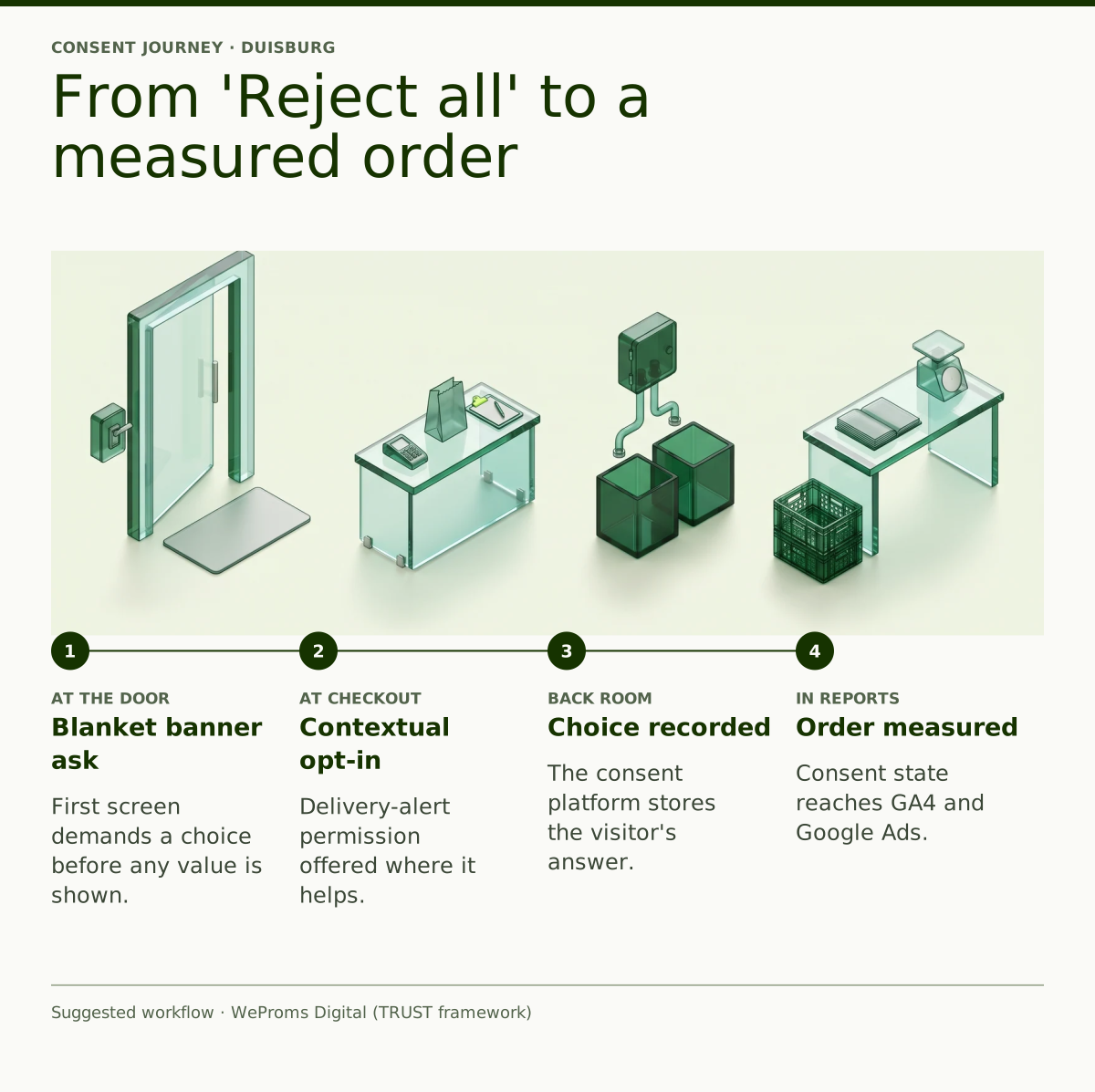
A choice recorded but not relayed is a choice ignored. A Consent Management Platform (CMP) records each visitor’s cookie choice and passes that choice to your analytics and advertising tools — Google Analytics 4, Google Ads, Meta, your email platform. On Shopify, that usually means a consent app wired into your theme; the installation is the easy half.
The relay is Google’s side. Consent Mode — Google’s framework for telling your tags what each visitor allowed — comes in two grades, and the grade decides how much survives a German “Reject all”. Basic consent mode blocks Google tags entirely until consent, so a refusal sends nothing at all. Advanced consent mode sends consent state and cookieless measurement to Google even when the visitor says no, which according to Google’s developer documentation enables conversion and behavioural modelling in Google Ads and GA4.
The wiring, not the software, is where setups die. Joss Merckaert of consultancy fifty-five warned at MarTech that “it breaks before implementation even starts” — meaning the legal, marketing and shop-management sides of a family business never agree on what the banner must do, so the configuration ships inconsistent. In a family-run grocery, that meeting is breakfast, and it is still worth holding.
Test your own shop monthly in a private browser window: reject everything, place a test order, then check whether GA4 and Google Ads recorded the purchase. If the order exists in your Shopify admin but not in your reports, your consent relay is broken — regardless of what the app’s checklist claims.
S — Segment: keep consented and modelled data apart
Once consent mode is live, GA4 holds two kinds of numbers, and mixing them quietly corrupts decisions. Observed data comes from visitors who accepted analytics cookies; behavioural modelling — Google’s machine-learning estimate of what cookie-refusing visitors did, inferred from similar visitors who accepted — fills the rest. Google’s behavioral modeling documentation sets a hard eligibility bar for that modelling: a property needs at least 1,000 consent-denied events per day for seven days, plus 1,000 consented daily users, before estimated data appears at all.
Below that bar — where most single-location halal groceries live permanently — there is no modelling, and GA4 shows only the consented share of reality. Worked example, illustrative figures for a Duisburg shop: average online basket €38, product and fulfilment costs €29, contribution €9 per order. Your €900 monthly Google Ads budget breaks even at 100 orders. If 40 of every 100 visitors grant analytics cookies, GA4 observed records roughly 40 of a true 100 — half a healthy season reads like a failing campaign, and the owner switches off the ads that were quietly paying for themselves.
The defence is a second source of truth. Your Shopify admin and your till count every order regardless of cookies; treat those as the ledger and GA4 as a consented sample. When a seasonal read matters — flat winter weeks fooled a UK boutique in a piece written for a UK reader, though the logic transfers — compare the sample against the ledger before cutting spend.
Check one number weekly: the share of visitors granting analytics storage, visible in GA4’s consent reporting. A falling consent rate is a marketing problem wearing a legal costume.
T — Test: treat the banner as a sales asset, not a legal tax
The banner is the highest-traffic form most German shops own, and almost nobody tests it. Test the timing first, then the wording, then the design — in that order. In consent tests we run for shops across Germany, the UK and the Gulf, moving the ask outperforms rewording the ask more often than any banner redesign does; a checkout-stage delivery ask beats a cleverer first-screen banner with striking consistency.
The calendar makes this urgent for a halal grocery. Ramadan is expected to begin around 8 February 2027, subject to moon sighting, which means the consented contact list must start building in late December — six weeks out. The seasonal sequence runs in stages: early interest collected through the delivery-alert ask, confirmed orders once Ramadan stock lands, collection or delivery through the month itself. A shop that starts collecting permission in February has already missed the families who ordered early. The same planning discipline applies further out, as our walkthrough of Black Friday ads for a German online halal store lays out step by step.
A consent rate is a conversion rate you own outright. It costs no ad spend, it compounds every month, and it decides how much of your own season you will be allowed to see.
Key Takeaways
- Timing beats wording: a contextual checkout ask earns a 5% to 10% lift in high-value opt-ins where a first-screen banner earns reflexive rejection.
- Consent and preferences are different: consent says what you may do; preferences say what the customer wants — collect both, label them separately.
- Advanced Consent Mode is the relay: it sends consent state and cookieless measurement to Google when visitors refuse, enabling modelling instead of silence.
- Small shops get no modelling: below roughly 1,000 consent-denied events per day, GA4 shows only the consented share — keep Shopify and till data as your ledger.
- Build permission before the season: for Ramadan expected around 8 February 2027 (subject to moon sighting), start the consented list in late December.
Read next:
When the reports undercount reality, the decision is not to spend less — it is to measure with permission. At WeProms Digital, we have built consent-aware measurement for online shops run by overseas Pakistani and halal-minded owners across Germany, the UK and the Gulf. Our consent management and privacy compliance service installs and tests the full banner-to-GA4 relay, and our GA4 setup and custom configuration wires your consented, modelled and till data into one honest picture. Reach hello@weproms.com or WhatsApp +92 300 0133399, or start at weproms.com/contact-us.
Frequently Asked Questions
Is Google Consent Mode legal for my German shop?
Consent Mode is a technical framework, not a legal opinion — it helps your tags respect a DSGVO choice rather than ignore it. Advanced mode does send cookieless signals after a refusal, so German shops should have a privacy lawyer confirm their specific banner and implementation before relying on it.
Do I need a cookie banner if my shop only uses Google Analytics?
Under the DSGVO and the ePrivacy rules behind it, yes — analytics cookies need consent unless you run a strictly cookieless setup. GA4 without a consent banner may be compliant only with IP-threshold settings most shops never configure; assume the banner is required.
Why does GA4 show fewer visitors than my Shopify dashboard?
Shopify counts orders server-side and misses nothing; GA4 only counts visitors who granted analytics cookies, plus modelled estimates when your property qualifies. For a small shop below Google’s modelling thresholds, the gap is usually consent refusal, not missing traffic.
Will “Reject all” break my online shop?
No. The storefront, checkout and order emails keep working; refusal only limits measurement and personalised advertising. What breaks is your visibility into what refusers did — which is what Consent Mode and your Shopify data exist to repair.
What does a consent and GA4 setup cost with WeProms?
Costs depend on your platform and how many systems must receive the consent signal. WeProms Digital scopes each setup after a free review of your shop — contact hello@weproms.com for a quote, and we will tell you honestly if your current setup already passes the test.
About WeProms Digital
WeProms Digital is a Lahore-based analytics and privacy-compliance agency working with overseas Pakistani and halal-minded business owners across London, Birmingham, Manchester, Dubai, Riyadh, Toronto, Houston, and beyond.
The team specialises in consent-aware GA4 measurement, Consent Mode implementation and first-party data collection, with a track record of making German, UK and Gulf shop analytics honest under strict privacy law.
Get in touch: hello@weproms.com · WhatsApp +92 300 0133399 (replies in UK and Gulf business hours) · weproms.com/contact-us
Sources & References
- Marketing Land — Beyond the opt-in: Engineering consent for better marketing — November 6, 2026
- Google for Developers — Consent mode overview
- Google Analytics Help — Behavioral modeling for consent mode
- Marketing Land — Consumers are still buying. They’re just harder to convince. — November 6, 2026
Additional reading from industry feeds: