

By Sara Khan · WeProms Digital · November 1, 2026
Last updated: November 2026.
British retail sales volumes fell 0.4% month on month in September 2026, the Office for National Statistics reported; October’s cold snap then reversed the season, with fashion, lifestyle and homewares up 4.6% year on year and online fashion up 9% on the BDO tracker, as Retail Gazette covered. Winter clothing demand, in other words, is real, and it is online. Across the dozens of boutique and small-store accounts reviewed each autumn in London, Leicester and Glasgow, one pattern keeps appearing anyway: visitor counts rise, carts fill, and the order count barely moves. A Pakistani-owned modest fashion boutique on Glasgow’s south side can push a £75 winter abaya through forty abandoned carts in a fortnight without converting one — an illustrative pattern, not one store’s numbers.
The pattern repeats: the demand arrives nationally, and leaks locally.
The demand is national, the leak is local
Like-for-like sales — figures comparing the same stores against the same weeks a year earlier — are the tracker’s cleanest signal, and both of October’s point the same way. Neither, on its own, proves that shoppers in Shawlands or Pollokshields are buying from an independent boutique; a national tracker measures chains and mid-market retail, and a GB-wide statistic says nothing about one store’s product range. What the figures do establish is that the season started, that it started late, and that the traffic is there to convert.
September explained part of the compression. Mild weather delayed the wardrobe switch, so the ONS recorded falling volumes; when the cold arrived, the purchases arrived with it, concentrated into fewer weeks. Boutique owners who read only their own quiet September and concluded the winter had been cancelled spent October unprepared for browsers who did come.
Winter demand in this community behaves like the Eid-week rush at the halal butcher: compressed, predictable, and unkind to any shop that took no pre-orders. The boutiques that treat late October and November as the whole season’s opening act are the ones still calm in January.
A practical first step costs nothing. Compare weekly sessions against weekly orders since the last week of September; if sessions climbed with the national figures while orders stayed flat, the leak is inside the store, not in the market.
Where the drop-off happens
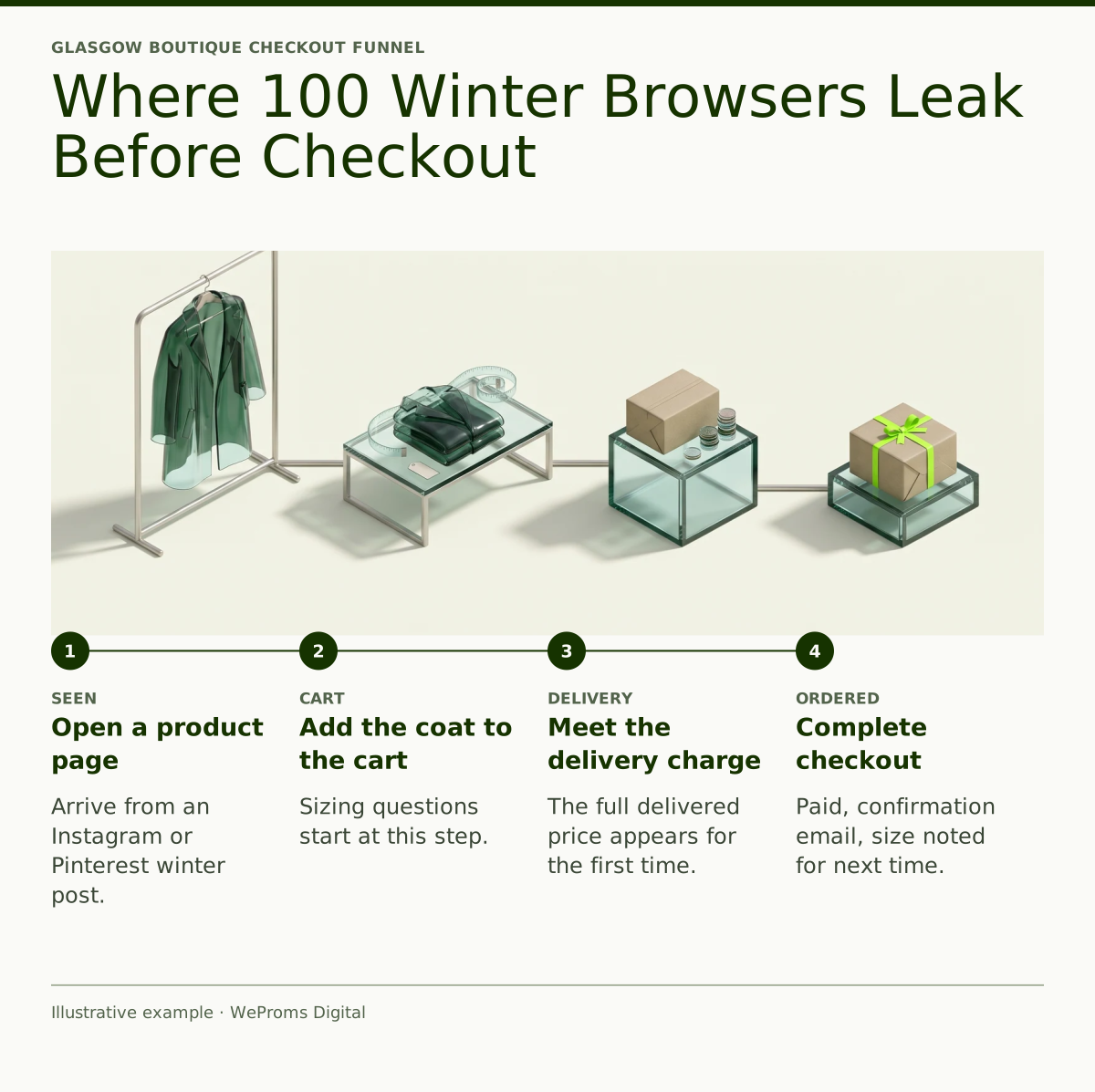
Worked example, illustrative rather than measured: of every 100 people who open a product page after seeing a winter coat on Instagram, roughly 34 add it to the cart; 12 reach the delivery-cost step; barely 3 finish checkout. Replace those numbers with your own analytics before acting on them — but the shape of the drop is consistent, and it has three familiar mouths.
The first mouth is the delivery charge. For many boutiques it is the first moment the true price of the order appears, and it appears at the exact moment commitment is highest and patience is lowest. Showing the delivery cost on the product page, or a free-over threshold (free UK delivery over £60, illustrative — set it against your own order values), removes the surprise; a Royal Mail or Evri tracked label is a known cost the price list can absorb or itemize honestly.
The second mouth is fit trust, and it cuts differently in modest fashion. A store that deliberately photographs garments without body-revealing imagery — a positioning this readership keeps by principle — cannot answer “will it suit me?” with skin; it must answer with text and measurement. Garment measurements in centimeters per size, named fabric composition with an opacity note, hem lengths stated for two heights, and a line on layering under an abaya coat do more for conversion than any discount code. Sizing uncertainty is the quiet reason a cart survives three evenings and then dies; the same leak drains a Canadian mithai shop’s gift-box checkout, and it drains a Glasgow one.
The third mouth is page weight on the phone. The evening browse after Maghrib happens on 4G and mid-range Androids, and a product page carrying multi-megabyte photographs loses the tap before the cart. Sizing images to their placement — a thumbnail near 600 pixels, a hero near 1440 — and shipping AVIF or WebP instead of oversized JPEG is the standard workflow described in SitePoint’s image-optimization guide, and it applies equally to photographs taken in a stockroom in Shawlands.
One test surfaces all three leaks in a minute: open your bestseller on a phone, on mobile data, mid-scroll, and note exactly where attention dies.
What the winning boutiques do differently
The accounts that convert the winter wave share habits, not budgets. The differences concentrate in five places:
| What shoppers meet | The average winter boutique | Boutiques winning the season |
|---|---|---|
| Delivery cost | First revealed at checkout | Stated on the product page, with a free-over threshold |
| Sizing | S, M, L and a guess | Garment measurements in cm, opacity notes, two hem lengths |
| Follow-up | No list, or one manual newsletter | A three-to-five email onboarding flow over two to four weeks |
| Mobile speed | Multi-megabyte hero photos | AVIF/WebP images sized to the layout |
| Seasonal stock | Arrives in December | Deposits taken from mid-November |
The email row carries the most revenue. Automated emails generate nearly a third of all ecommerce email revenue, according to Omnisend’s 2026 Ecommerce Marketing Report, summarized in its onboarding email guide; an onboarding sequence — the automated three-to-five emails paced over the first weeks after a sign-up — is what converts a one-time Instagram browser into a first order without a single manual send. The same would-be buyer already spends two hours and twenty-four minutes a day on social media, per the data cited in Retail Gazette’s fashion-influence commentary; she does not need more advertising to arrive, she needs a reason and a reminder to complete.
Buying more traffic before fixing any of this is the expensive version of patience. Marketing Land’s argument that more paid social ads will not fix a creative problem extends cleanly to checkout: spend amplifies whatever the store already does, leaks included.
There is also a positioning dividend specific to this niche. The same Retail Gazette commentary argues fashion influence should reward durability and repeat wear rather than hauls — values a modest wardrobe already embodies. “One coat, three shaadis” is a durability claim a Glasgow boutique can make honestly, and it competes on something other than the price ladder dissected in the Manchester modest-fashion pricing debate.
The shaadi calendar punishes late stock
Shaadi season runs November into February, and it overlaps the winter-wardrobe surge almost perfectly: occasion abayas, layered winter sets, and matching dupattas move in the same weeks as the coats. The boutiques that monetize the overlap treat mid-November as their stocking deadline and open deposits roughly six weeks before their peak booking weeks, so early interest becomes confirmed orders with a schedule attached — interest in November, deposits in December and January, delivery before the event.
Each phase has one number to watch. During listing: saves and shares on the occasion edit. During deposits: the deposit count by mid-December, which forecasts fabric and alteration capacity. During delivery: cost per completed order and revenue per visitor, week by week.
The calendar has a hard edge this season. Ramadan 2027 is expected to begin around February 8, subject to moon sighting, with Eid al-Fitr expected around March 9; family spending shifts to iftar hosting and Eid gifting at that point, and the occasion-wear push belongs before it, with an Eid edit as a separate, smaller campaign. Freeze tracking and analytics changes before the peak weeks begin — the same discipline MarTech’s pre-peak testing guide recommends for holdout tests applies to a boutique’s own numbers, since a mid-peak tag change corrupts the only record of the season.
A consented WhatsApp list does the deposit work. One broadcast, with the opt-in stated and an exit included: “Assalamu alaikum! Our winter coat edit goes live Friday at 6pm — reply YES for first access before it opens to everyone. Reply STOP at any time and we will remove you. (Sent only to customers who ticked the updates box at checkout.)” The shaadi-browser piece on Pinterest traffic covers the same audience arriving from search instead.
What the numbers look like by February
Worked example, illustrative — substitute your own costs. A winter abaya coat sells at £85. Product cost lands at £32; packaging at £2.50; a tracked delivery label at £4.20; card fees near £1.90. Contribution — price minus product, packaging, delivery and fees — is £44.40 per order. A £600 media budget over four weeks (media only, one product, no agency fees) breaks even at 14 orders, since £600 divided by £44.40 is 13.5. The stop-or-scale rule follows directly: if cost per order passes £44 after three weeks of data, stop; if it holds under £25, add budget, because each order still funds growth.
A testable claim, offered deliberately: for this store type, the same £600 spent on delivery transparency, a proper size guide and a four-email onboarding flow should outperform £600 added to Instagram boosts across one season. Any boutique can falsify that on its own numbers in eight weeks, and the trial costs nothing but the discipline of keeping both figures side by side.
Winter came early this year and compressed the whole season into fewer selling weeks. The boutiques that finish January calm are the ones that treated checkout, fit trust and email as the campaign itself — and the shaadi calendar as the deadline it always was.
Read next: Should My Manchester Modest Fashion Shop Match Shein’s Prices? and Brampton Mithai Shoppers Fill the Gift Box, Then Quit at Checkout
At WeProms Digital, we have worked with modest fashion, gift and food stores across the UK and the Gulf on exactly this seam between traffic and orders. Our ecommerce conversion optimization program for diaspora-owned boutiques audits the checkout, fit-trust and speed leaks first, and our lifecycle email flows build the onboarding sequence that earns the second order. Email hello@weproms.com, message WhatsApp +92 300 0133399 (we reply in UK and Gulf business hours), or start at weproms.com/contact-us.
Frequently Asked Questions
How much should a checkout fix cost a small boutique in the UK?
Tool costs are modest: a capable email platform starts around $16 a month (about £13) on monthly billing, per Omnisend’s October 2026 pricing. The delivery-cost and size-guide fixes are an afternoon of work. Agency-led conversion work is scoped per store — expect a quoted audit before any retainer, and ask what the audit measures.
Should my boutique offer Klarna or Clearpay at checkout?
UK fashion shoppers expect installment options, and the interest-free plans are the common middle ground; whether to carry them is a values decision each owner makes for themselves. A deposit-and-balance option — half now, the balance before dispatch — delivers the same affordability with no financing attached, and it doubles as your shaadi pre-order mechanism.
When should shaadi-season stock go live?
List the occasion edit by mid-November, open deposits about six weeks before your peak booking weeks, and complete deliveries before Ramadan, which is expected to begin around February 8, 2027, subject to moon sighting. The Eid gifting edit that follows Eid al-Fitr (expected around March 9) is a separate, smaller campaign with its own deposit window.
Do product photos really slow down sales?
Heavy ones do. A page that loads in fragments on 4G loses shoppers during the evening browse, when most modest-fashion browsing happens. Serving AVIF or WebP files sized to their placement — roughly 600-pixel thumbnails, 1440-pixel heroes — is the standard fix and usually halves page weight without visible loss.
What should I ask for if I hire WeProms for this?
A named audit: session-to-order funnel by device, delivery-cost placement, size-guide depth, mobile page weight, and an onboarding email plan with a revenue target. WeProms Digital quotes scope before price, works in UK and Gulf business hours, and can be reached at weproms.com/contact-us.
Key Takeaways
- Show the delivered price on the product page; a threshold (free over £60, illustrative) beats a checkout surprise.
- Answer fit with garment measurements in centimeters, fabric opacity notes and two hem lengths — text does the work revealing imagery cannot.
- Compress product images to AVIF or WebP at placement sizes so the evening mobile browse survives to the cart.
- Run a three-to-five email onboarding flow; automated emails drive nearly a third of ecommerce email revenue.
- Open shaadi deposits six weeks before peak and finish before Ramadan (expected February 8, 2027, subject to moon sighting).
About WeProms Digital
WeProms Digital is a Lahore-based ecommerce conversion agency working with overseas Pakistani and halal-minded business owners across London, Birmingham, Manchester, Glasgow, Dubai, Riyadh, Toronto, and beyond.
The team specializes in checkout and conversion audits, onboarding email flows, and mobile speed work, with a track record of helping modest fashion, gift, and food stores convert the seasonal demand their communities already bring.
Get in touch: hello@weproms.com · WhatsApp +92 300 0133399 (replies in UK and Gulf business hours) · weproms.com/contact-us
Sources & References
- ONS — Retail Sales, Great Britain: September 2026 — October 23, 2026
- Retail Gazette — UK Retail Sales Jump in October as Shoppers Return to Winter Wardrobes — October 30, 2026
- Omnisend — Onboarding Emails: Examples, Sequence, and Best Practices — October 30, 2026
- Omnisend — 7 Best AI Email Marketing Tools, Tested — October 30, 2026
- Marketing Land — More Paid Social Ads Won’t Fix a Creative Problem — October 30, 2026
- SitePoint — How to Optimize AI-Generated Images for Faster Websites — October 31, 2026
- Retail Gazette — Comment: Fashion’s Circular Economy Requires Responsible Influence — October 30, 2026
- MarTech — How to Test Incrementality Before Peak Spending Starts — October 30, 2026
Additional reading from industry feeds: