By Hamza Ali · WeProms Digital · November 10, 2026
Verdict: ChatGPT’s new Business Hub gives a business a free, verified listing and a rolling 28-day count of the clicks ChatGPT sends it. For a Pakistani-run Mussafah garage, that is worth claiming the day local listings open in the Emirates. It is not worth thousands of dirhams in agency fees, and it will not, by itself, make ChatGPT recommend the garage more often.
OpenAI launched Businesses in ChatGPT on November 10, with a management dashboard called Business Hub — the place where a business claims its ChatGPT profile, corrects its details and reads its referral numbers. OpenAI says ChatGPT now reaches 1.2 billion people a week, and a growing share of them ask it for a mechanic near Mussafah — the industrial grid where much of Abu Dhabi’s workshop trade sits — instead of typing into Google. Camping season is starting, batteries and tyres and pre-trip inspections are coming through the doors, and the customer who once arrived through a WhatsApp referral increasingly arrives through an answer engine. This breakdown covers what the Business Hub actually gives an Abu Dhabi workshop owner, where it stops working, and what to do in the gap.
What this gets right
The claim process is real, and it is free. A business finds itself in the Business Hub, proves it is authorised to manage the listing, then passes identity verification through Persona — an identity-checking service OpenAI uses to confirm a real person stands behind the profile — before a single change goes live. Corrections pass OpenAI review before they reach profiles and answers. Slow, but clean.
The dashboard reports two numbers a workshop owner has never been able to see: how many times ChatGPT mentioned the business, and how many clicks those mentions sent to the website. A mention — ChatGPT’s term for a business appearing in its answers — counts, for a local business, when a result is shown for the location. Figures cover the past 28 days and group into discovery topics, the themes of the conversations where the garage appeared, without exposing anyone’s private chats.
That measurement closes a gap that used to be silent. Until this week, ChatGPT referrals landed in analytics as vague “Direct” traffic — unprovable, uncountable, and easy for a busy owner to dismiss as noise. Now the platform itself keeps the receipt. A garage that suspects “the internet sends us some customers” can, once claimed, put a number on it and compare it against the website’s analytics on the same window.
On Mussafah’s grid, a garage’s name has always travelled the way news of a good shaadi caterer travels: one job at a time, through people who know each other in the Friday-prayer WhatsApp groups. ChatGPT has quietly become the neighbour asking around. A verified, corrected profile is the digital version of the workshop owner standing in that conversation with accurate facts — opening hours, services, a working phone number — instead of someone else’s half-remembered version of them.
Where this breaks
The local-claim door is barely open. OpenAI’s guidance gates access by location, business type and supported verification, and current reporting says local stores can currently claim only an existing United States listing. A Mussafah garage sits outside the local-claim route on today’s rules, even while ChatGPT answers questions about mechanics in Abu Dhabi every single day. The practical damage: if an answer quotes a wrong phone number or an old address, an Abu Dhabi owner cannot correct it from inside the Business Hub yet — the fix has to happen at the sources ChatGPT reads, which is most of the work in this article anyway.
Claiming does not buy recommendations. OpenAI has been blunt about it:
“The core product needs to ‘maintain objectivity’ … a business ‘should not have an impact on how frequently it appears.’” — Benji Shomair, OpenAI’s VP of monetization, speaking to Digiday
The fuller point cuts both ways, and honesty requires both halves. Supplied information does not raise raw appearance frequency, but OpenAI says clearer, verified details can help ChatGPT surface a business in more relevant conversations — an owner who corrects “auto repair” into “battery replacement, AC repair, pre-trip desert inspections” can show up for sharper questions without appearing any more often overall. Claim, correct, measure. Do not expect the claim itself to move volume.
Small numbers vanish. OpenAI withholds low-volume counts for privacy, and website clicks are clicks on links, not completed visits or purchases. A small garage doing a few dozen jobs a month may open the dashboard and see blanks. A blank is a reporting threshold, not a verdict that ChatGPT sends nothing.
Business agents — the labelled chat windows that speak for a brand inside ChatGPT — are limited to eligible United States e-commerce and online-service businesses, per Digiday’s launch coverage. The sponsored version of that same agent is sold as advertising. Neither is available to an Abu Dhabi workshop today. Gulf owners watching US brands demo agents should file this under “later”, not “now”.
The hidden cost
Within weeks, expect “ChatGPT listing registration” offers priced in the thousands of dirhams, aimed squarely at owners who heard the announcement but not the details. The claim is a free task that takes minutes behind Persona verification. The parts genuinely worth paying for are the inputs: the listing data, the review base, and the pages the engines actually read. Pay for inputs, not for the label.
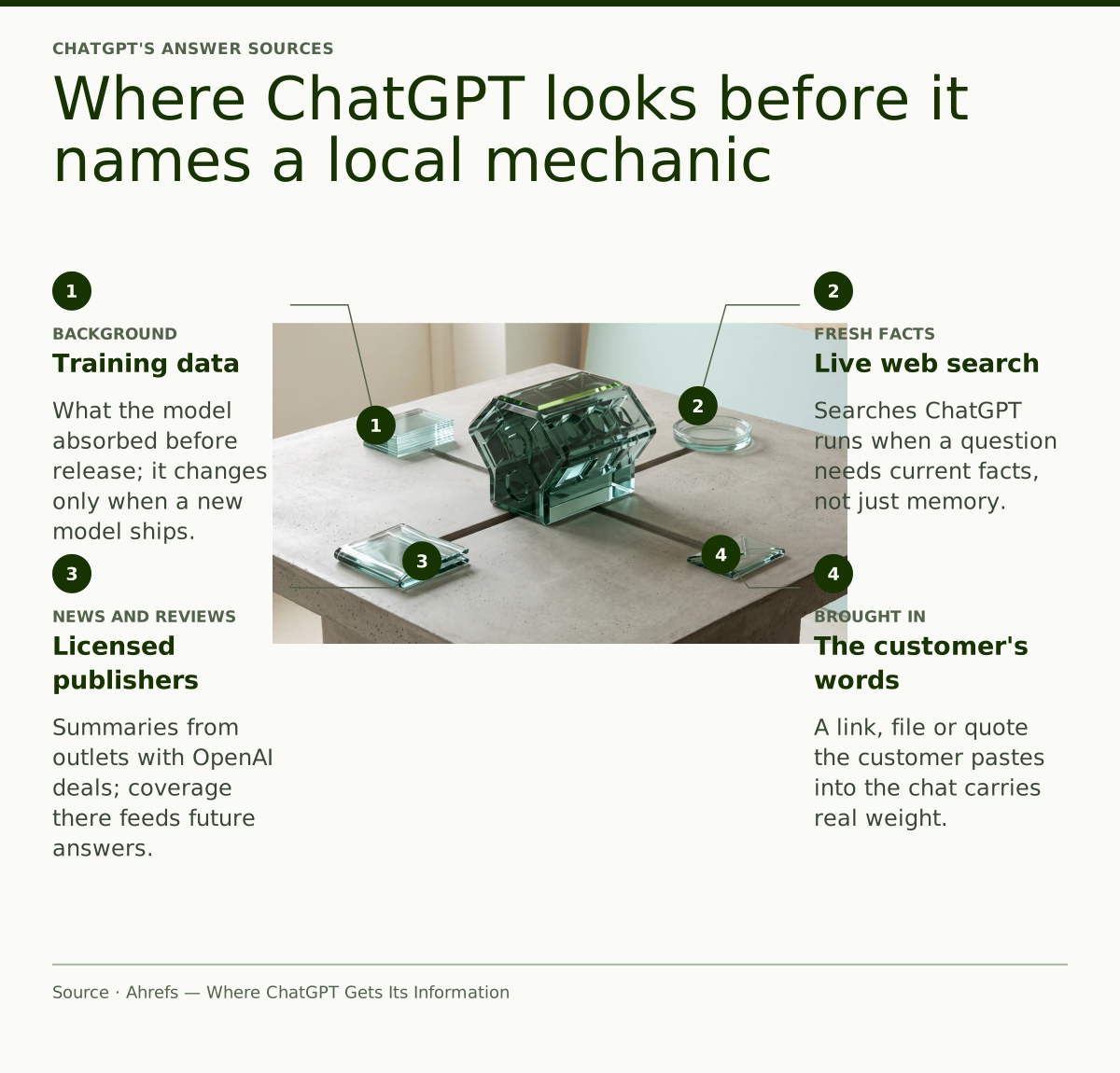
Four inputs build an answer, per Ahrefs’ breakdown: training data absorbed before release, live web search, licensed publisher content, and whatever the customer brings into the chat. Live web search is where a “mechanic near Mussafah” answer is built, and local grounding — the process by which an AI answer is tied to real places and live listings rather than memory — leans on mapping sources rather than on a workshop’s Instagram grid. Licensed publisher content, summaries from outlets with OpenAI deals, matters more for restaurants with press coverage than for a garage. And a customer can paste a WhatsApp quote straight into the chat, which quietly makes accurate quoting part of visibility. The same sourcing logic is why ChatGPT knows some Gulf shops but never recommends them — being known and being surfaced are different jobs.
The measurement backs the shift. In SOCi’s Local Visibility Index analysis, published through Marketing Land, average brand visibility across AI platforms has climbed to 36.1 percent of local queries — roughly parity with Google’s local 3-pack and Yelp’s first page, from single digits in January. Recommended local brands average 4.24 stars on ChatGPT. Two consequences follow. A Mussafah garage with a middling star rating and a thin review count is competing, on the two signals it can actually control, against businesses the engines already trust more. And the fix is not on ChatGPT’s side at all: Google Maps and Yelp are the leading sources cited in local AI answers, with business websites third, so the Maps listing is upstream of the answer.
Consumer behaviour moved before the dashboards did. Some 52 percent of US consumers now use AI tools for local recommendations at least once a month, up from 9 percent a year earlier, according to SOCi’s Local Discovery Index. That is US data, and it does not describe Abu Dhabi demand on its own; it describes direction. Gulf customers skewing younger and searching in English hit these behaviours first, and the workshop that treats this as an American trend is reading the wrong market.
Platforms also change terms under the businesses that depend on them. Meta paused its contested business terms on November 5 after a court in Oslo and the UK’s Competition and Markets Authority pushed back — one more reminder in a decade full of them. The stack worth building is the one partly owned by the garage: the Maps listing, the reviews, the website. The ChatGPT claim is a label on top of that stack, not a substitute for it.
What overseas Pakistani businesses should do instead
- Claim the free route the day it opens. Check Business Hub eligibility from the UAE monthly — a five-minute check, not a project. When local claiming reaches the Emirates, verify through Persona and correct services, hours, phone and website before touching anything paid.
- Treat the Google Maps listing as the data feed. Services in the customer’s words — battery replacement, AC repair, pre-trip inspection before a desert weekend — hours that reflect Friday prayer, coverage across Mussafah, Mohamed Bin Zayed City and Abu Dhabi Island, and a working WhatsApp button. The same discipline that gets fast-delivery attributes onto a Deira phone shop’s listings applies to a workshop’s service list.
- Run a review engine, not a review burst. Ask every satisfied customer in the same week the job closes. Star ratings fall steadily as recommendation rank drops, per SOCi’s data, so steady monthly velocity beats a one-off push of twenty reviews and then silence. Reviews are also what protect a garage when calls drop after a listing change — the trail of recent, real customers is the first thing to check.
- Publish an AI-readable facts page on the garage’s own site. Services, starting prices in AED, areas served, warranty terms, in plain sentences. Answer engines quote pages that answer plainly; a wall of gallery photos answers nothing.
- Work the unit economics before spending a dirham. Worked example — substitute your own costs. Average repair invoice AED 600; after parts and technician time, contribution is roughly AED 210 per job. A visibility programme at AED 2,000 a month breaks even at ten extra jobs a month. Stop rule: if calls from Maps and WhatsApp enquiries have not moved within eight weeks, stop spending and audit the listing data first — the assumption this rule encodes is that inputs, not budget, are usually the bottleneck.
- Watch the paid door without rushing through it. Google is extending ads into its own AI answers and OpenAI sells sponsored agent placements, as Search Engine Journal’s AI Mode expansion coverage tracks. Both reward businesses whose free foundations are already clean; neither rescues a listing full of wrong numbers.
| Free route (claimed profile) | Paid route (ads, sponsored agents) | |
|---|---|---|
| Cost | Free | Auction pricing, ongoing |
| Open to a UAE garage today | Not yet for local listings — check monthly | Search and social ads yes; ChatGPT ad formats limited |
| What it gives | Verified identity, corrected facts, mention and click counts | Placement inside conversations, fast |
| What it does not give | Higher recommendation frequency | Trust, reviews, accurate listing data |
| Sensible first move | Fix the Maps listing and review flow now | Spend only after the free stack is clean |
For the review engine, a ready-to-send WhatsApp line — consent and opt-out built in:
Assalamu alaikum [name] — glad the Patrol is running well. If you have two minutes, a Google review helps other families around Mussafah find the garage: [link]. We only message about your own bookings — reply STOP any time and you will hear no more from us.
The principle underneath all six steps: a garage cannot yet hold the pen inside ChatGPT, but it holds the pen over almost everything ChatGPT copies from. Correct the sources, collect the reviews, price the work — and the claim, when it opens, becomes a ten-minute formality on top of a foundation that already earns.
Read next: Why ChatGPT traffic shows up as “Direct” in Google Analytics · How to get ChatGPT to recommend a Dubai shop
WeProms Digital builds this exact stack for overseas Pakistani businesses across the UAE, the UK and the Gulf: Google Business Profile cleanup, review systems and AI search visibility and discoverability work, anchored on local SEO and Google Business Profile optimisation. Based on our experience with garages, clinics and family retailers, the workshop that fixes its Maps data and review flow this month is ahead of most of Mussafah before the claim door even opens. Start with a free audit: hello@weproms.com · WhatsApp +92 300 0133399 (replies in UK and Gulf business hours) · weproms.com/contact-us
Frequently Asked Questions
Can I claim my Abu Dhabi garage on ChatGPT today?
Probably not yet. OpenAI gates claiming by location, business type and supported verification, and current reporting says local businesses can claim only an existing US listing for now. Check the Business Hub from the UAE monthly; when local claiming opens in the Emirates, verification runs through Persona and is free. Meanwhile, the sources ChatGPT reads — your Google Maps listing and reviews — are fully within your control and matter more.
Does claiming my business make ChatGPT recommend it more?
No. OpenAI’s VP of monetization has said a claimed business “should not have an impact on how frequently it appears”, because the answers layer needs to stay objective. What claiming does give: corrected facts, a verified identity, and the first reliable count of mentions and clicks ChatGPT sends you. Better-supplied details can help the garage surface in more relevant conversations, but frequency itself is not for sale.
How much does the ChatGPT Business Hub cost?
Nothing. Claiming a profile, verifying through Persona, updating details and viewing the mentions-and-clicks dashboard are free, and OpenAI has not announced pricing for them. If a consultant quotes a large fee for “ChatGPT registration”, you are paying for a free task plus, at best, the underlying listing and review work — ask exactly which parts carry the fee.
Where does ChatGPT get my garage’s details from?
Four inputs, per Ahrefs’ breakdown: training data from before release, live web search, licensed publisher content, and whatever the customer brings into the chat. For a local query like “mechanic near Mussafah”, live search with local grounding dominates, and it leans on mapping and review sources — Google Maps and Yelp lead the citations in SOCi’s analysis, with business websites third. Your Maps listing and review base, not your Instagram, are the levers.
What should AI visibility work cost for a garage?
It depends on scope, not on a platform fee — the claim itself is free, so quotes should cover the inputs: Maps listing rebuild, review system setup, and an AI-readable facts page. WeProms Digital starts with a free audit and quotes per market in your currency, so a Mussafah workshop knows the break-even in extra jobs before committing. Any quote that cannot show that arithmetic is the wrong quote.
Sources & References
- Search Engine Watch — ChatGPT lets you claim your business and track the clicks it sends you — November 10, 2026
- OpenAI Help Center — Setting up your business on ChatGPT — November 2026
- Digiday — OpenAI’s new business agents give brands a free way into the conversation it’s also selling as an ad — November 10, 2026
- Search Engine Roundtable — ChatGPT Business Hub — November 2026
- Marketing Land / SOCi — The drivers of local AI visibility for multi-location brands — November 10, 2026
- Ahrefs — Where Does ChatGPT Get Its Information? 4 Sources, Explained — November 10, 2026
- Search Engine Journal — Meta Paused Its New Business Terms, And Businesses Should Plan As If It Never Gets Better — November 10, 2026
- Search Engine Journal — Google Expands Ads In AI Mode To 10+ Countries, Adds Multiturn Ads — November 10, 2026
Additional reading from industry feeds: