
By Sara Khan · WeProms Digital · November 5, 2026
Across the twenty-odd Pakistani restaurant and halal grocery listings we review in Salmiya, Kuwait City, and Farwaniya, one pattern keeps repeating: the shops that AI assistants name are rarely the ones with the loudest Instagram following; they are the ones whose facts — hours, address, menu, prices — survive being cross-checked in five different places. This week OpenAI put a number on why this now matters. ChatGPT handles search-like queries at roughly one-fifth of Google’s volume, and its weekly users grew from about 1 billion to 1.2 billion in just two months. For a biryani house on Salmiya’s Beirut Street, the question has stopped being whether AI matters; the question is whether an assistant asked about dinner can verify your shop exists at all.
The one in five searches that no longer pass through Google
The number came from OpenAI’s Adam Fry, speaking to Alex Kantrowitz’s Big Technology newsletter on November 3, 2026:
“ChatGPT’s volume of search-like queries is now roughly one-fifth the volume of queries of Google.”
Fry added that ChatGPT grew from 1 billion to 1.2 billion users in two months — roughly 100 million new people every 30 days — and Business Insider covered the same figures the same week, a story Search Engine Roundtable summarized the following day. One in five of the questions that once landed on a Google results page, where your Google Business Profile and your ads sit, now unfolds inside a chat window that shows no map pack, runs no rankings you can inspect, and names only the shops it trusts.
A global ratio proves nothing about how many Salmiya families actually plan Friday dinner in a chatbot; treat it as direction, not local proof. The local proof is cheaper to gather: ask ten regulars this month how they found your Ramadan hours last year, and count how many say Google versus Instagram versus a cousin’s voice note.
Kuwait’s structure makes the direction hard to ignore. PACI figures reported by Times Kuwait put the country’s population at 5.31 million as of June 2026, with expatriates about 70 percent of residents — a dining market that is overwhelmingly expat, phone-first, and used to deciding in English, Urdu, or Arabic on whichever app is closest to hand. DataReportal’s Digital 2026: Kuwait report counts 5.00 million internet users (99 percent of the population) and 4.44 million social media identities (87.9 percent). When essentially every customer carries a connected device, discovery habits migrate quickly, and the assistants are already positioning for it — Ooredoo Kuwait is openly building its network story around AI services, and Google’s AI Mode responses can now carry up to four ads in a single answer, an arrangement Search Engine Roundtable documented on November 4, with PPC Land logging the fourth slot below some answers; Google itself has not formally commented.
What the AI-named restaurants across Kuwait share
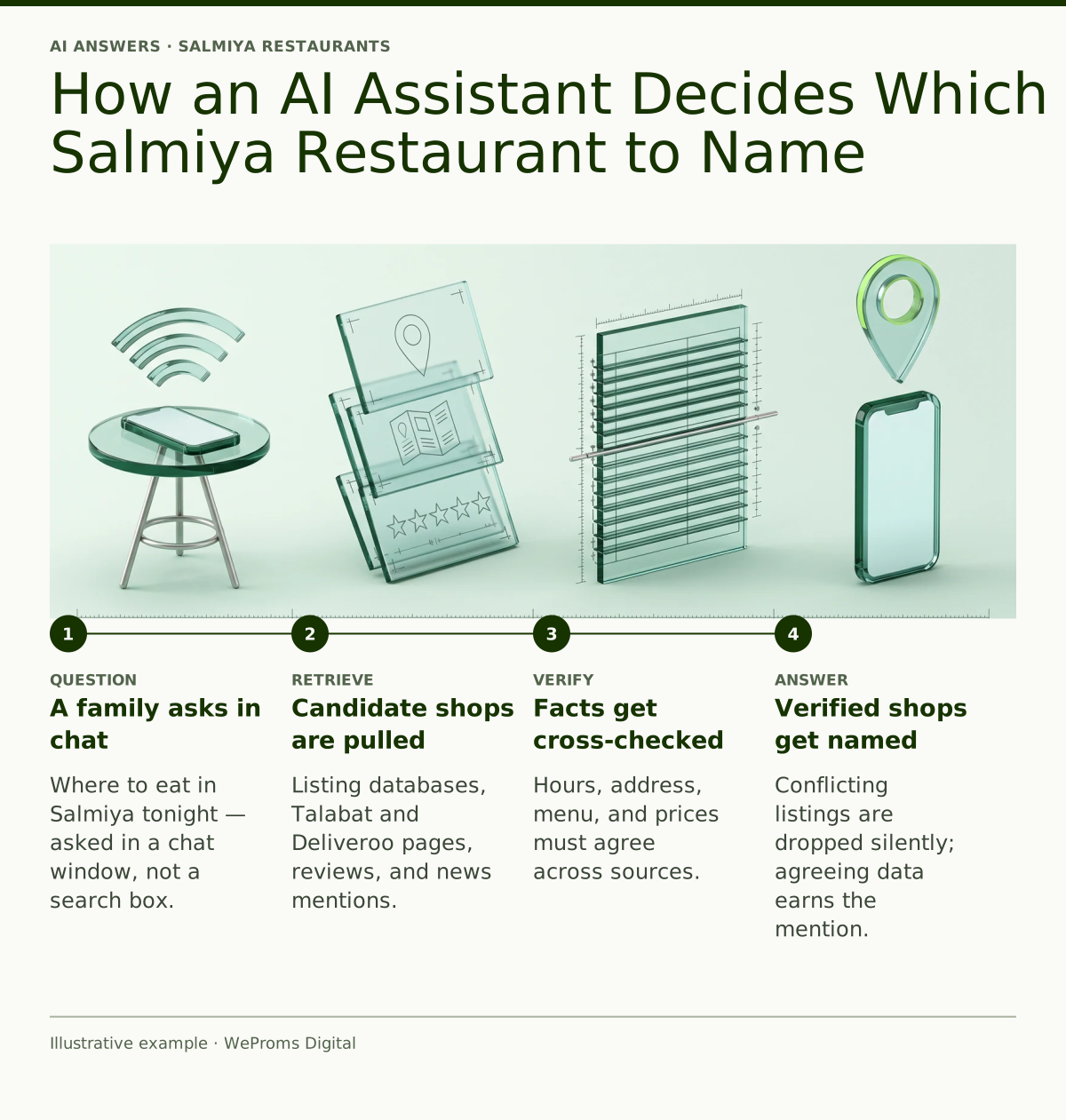
The underlying mechanic is simpler than the terminology suggests. When someone asks an assistant for the best biryani in Salmiya, the system pulls candidate shops from listing databases, aggregator pages such as Talabat and Deliveroo Kuwait, review platforms, and news mentions; it then cross-checks facts across those sources; it answers with the names that survived. A March 2026 Peec AI study cited by Semrush found that about 83 percent of products appearing in ChatGPT’s shopping carousel positions also ranked among Google’s top 40 Shopping results, excluding paid ads. ChatGPT is not a separate marketplace to crack; it reads the structured records you already control, and it largely agrees with Google about which records are credible.
Assistants verify a shop the way Salmiya families vet a caterer before a shaadi: one auntie checks the Instagram, another calls the number in the bio, a third compares prices against what the family paid last Eid. If two of the three disagree, the booking quietly goes elsewhere.
That cross-check layer is exactly what answer engine optimization for overseas Pakistani businesses works on — not persuading an algorithm, but making every public fact about the shop identical everywhere it appears.
Where the drop-off happens for Instagram-first shops
The pattern repeats. Kuwait’s dining scene runs on Instagram — many restaurants’ entire web presence is a grid, a WhatsApp number, and a bio link — and that habit now costs orders. Menus live in story highlights, prices are shared by direct message, and last year’s Ramadan timings sit in a post from eleven months ago. An assistant cannot reliably read a story highlight, so it falls back to aggregator listings, where a Salmiya biryani house is one card among hundreds and the biggest branded chains carry the most complete data. The answer then names the aggregator, the chain, or nothing at all.
Six shifted family orders a week at an illustrative KWD 15 each is KWD 90 a week — more than KWD 4,600 a year walking to the shop whose facts check out. Nobody reports that loss in any dashboard, because the customer never became a click.
The same failure shows up differently across markets; when we looked at why ChatGPT recommends other halal restaurants in New York and why an Edmonton halal shop gets inconsistent AI answers, the common thread was the same: assistants favored the businesses whose listing data agreed with itself.
What the top 10 percent do differently
The listings that get named share four disciplines, and none of them require an advertising budget.
| What gets checked | Top-performing listings | Average listing |
|---|---|---|
| Hours and location | Current Google Business Profile hours, matching Talabat and Deliveroo hours | Profile hours from 2024; delivery-app hours different again |
| Menu and prices | A crawlable menu page on the restaurant’s own site, updated each season | Menu in story highlights; prices by direct message |
| Reviews | A steady stream through the year, answered in Arabic and English | A burst after opening, then silence |
| Name consistency | One English and one Arabic spelling, identical everywhere | Three spellings across Google, Talabat, and Instagram |
Three clean, agreeing data points signal reliability to an assistant; three conflicting spellings signal the opposite. A practical way to build the review rhythm is to ask after the order, not at the till — a line like this works as a WhatsApp message to customers who agreed to hear from you: “As-salamu alaykum, thank you for ordering from [shop name]. If everything arrived right, a one-line Google review helps other families find us. Reply STOP to stop these messages.”
Getting the listing layer right is unglamorous, which is why it is skipped — and it is precisely the work covered by Google Business Profile optimization for halal restaurants and stores. If you want a checklist formatted for a single afternoon, our note on why a Khobar tuition center gets skipped by ChatGPT walks the same audit for a teaching business; the method transfers to any trusted-local category.
The December checklist that decides your Ramadan citations
Ramadan 1448 is expected to begin around February 8, 2027, subject to moon sighting, with Eid al-Fitr around March 10. The queries that matter — “iftar buffet Salmiya,” “large biryani trays Kuwait,” “suhoor delivery near me” — peak in the two weeks before the month starts, but assistants form their picture of your shop weeks earlier, from whatever they last verified.
Working backwards from the expected date: audit the listing and publish a crawlable menu page by mid-December; hold the review rhythm through January; refresh aggregator data before your first Ramadan promotion goes live; and set your Eid pre-order deadline six weeks before the expected Eid date so the listing, the menu page, and the delivery apps all state the same cutoff. A listing fixed in December is cited in February; a listing fixed in February is cited next year.
Here is a defensible claim worth testing: over the next twelve months, a complete and consistent Google Business Profile will earn a Salmiya restaurant more AI mentions than any paid AI-visibility tracker on the market, because every assistant checks the listing before it checks anything else.
Read next: Why ChatGPT Recommends Other NYC Halal Restaurants · Why ChatGPT Gives Different Answers About My Edmonton Halal Shop
Based on our experience working with halal restaurants and retailers across the Gulf and the UK, the shops that win AI mentions treat their public facts as an asset, not an afterthought. WeProms Digital runs AI search visibility monitoring and citation tracking for diaspora businesses so you can see, month by month, which assistants name you and which facts they are reading. Start with a free audit through weproms.com/contact-us, or message hello@weproms.com — WhatsApp +92 300 0133399 replies in Gulf and UK business hours.
Key Takeaways
- ChatGPT now handles search-like queries at about one-fifth of Google’s volume, and its weekly users grew from 1 billion to 1.2 billion in two months — visibility work belongs where the questions are moving.
- Assistants cite the shops whose facts agree across Google, Talabat, Deliveroo, and their own site; 83 percent of ChatGPT shopping carousel products also rank in Google’s top 40 Shopping results.
- Instagram-only presences lose orders silently, because an assistant that cannot verify a shop falls back to aggregators and chains.
- A steady review rhythm in Arabic and English, with an opt-out respected, outperforms any one-time listing push.
- Ramadan 2027 is expected around February 8: the listing audit that decides your citations belongs in December, not February.
About WeProms Digital
WeProms Digital is a Lahore-based AI search visibility and local SEO agency working with overseas Pakistani and halal-minded business owners across London, Birmingham, Manchester, Dubai, Riyadh, Kuwait City, Toronto, Houston, and beyond.
The team specializes in answer engine optimization, Google Business Profile management, and AI citation tracking, with a track record of making diaspora businesses verifiable across every platform an assistant reads.
Get in touch: hello@weproms.com · WhatsApp +92 300 0133399 (replies in UK and Gulf business hours) · weproms.com/contact-us
Sources & References
- Big Technology — OpenAI: ChatGPT search is about 20% of Google — November 3, 2026
- Business Insider — ChatGPT hits 20% of Google search volume — November 2026
- Search Engine Roundtable — OpenAI Says ChatGPT Is At 20% Of Google Search Volume — November 4, 2026
- Search Engine Roundtable — Google AI Mode Now With Up To Four Ads — November 4, 2026
- Semrush — How to optimize for ChatGPT shopping (citing Peec AI) — 2026
- DataReportal — Digital 2026: Kuwait — 2026
- Times Kuwait — Kuwait population reaches 5.31 million, expatriates 70% — 2026
- PPC Land — Google AI Mode gains a fourth ad slot below some answers — November 2026
Additional reading from industry feeds: