By Hamza Ali · WeProms Digital · November 5, 2026
A Vancouver halal grocery running 400 delivery-app orders a month can build a 900-name customer email list in 90 days for about CAD 62 a month in tools. This walkthrough covers the capture points, the CASL consent wording, the welcome flow, and the Ramadan 2027 calendar that turns that list into prepaid Eid orders. Last updated: November 2026.
If a Pakistani-owned halal grocery in Vancouver runs 400 orders a month through DoorDash, Uber Eats, and Skip the Dishes at an average basket of CAD 62, that is roughly CAD 24,800 in monthly sales the apps deliver to your till — and every name, phone number, and email address attached to those orders stays with the apps. The mithai counter, the fresh karahi packs, the lines of regulars on a Friday: none of that becomes a customer record you can contact again.
The money arrives weekly. The customer relationship never does.
On October 29, 2026, DoorDash announced a takeover of Instacart valuing the company at about US$17 billion, with closing expected between the end of 2027 and the first half of 2028. Canadian coverage of the deal ran on CBC News the same week. Media buyers at agencies watching the deal put it plainly:
“In the short term, I don’t expect this to meaningfully disrupt the retail media landscape. But longer term, the potential is significant.” — Nik Hengel, VP of analytics at New Engen, in Digiday
Read that as a grocery owner, not a marketer. The most valuable thing a delivery platform owns is not a fleet of drivers. It is the shopper relationship — the account, the purchase history, the email address — which is exactly why platforms keep diversifying what they sell brands access to. Every app order makes that asset stronger, and none of it accrues to your shop.
Here’s the thing. The cheapest lever in your shop is a list you own. This walkthrough builds one in seven steps, costs almost nothing to start, and lands ready for Ramadan 2027 — which is expected to begin around February 8, 2027, subject to moon sighting.
First, count what the delivery apps already know
Start with a 15-minute audit, today, before you spend anything. Log in to the DoorDash merchant portal and the Uber Eats Manager, export the last 90 days of orders, and open the files side by side. You will see order values, items, and delivery areas. What you will not see is a single marketing-usable email address or a consent record that belongs to you.
That last part is not a technicality. CASL — Canada’s Anti-Spam Legislation, the federal law that governs commercial email in Canada — requires consent you collected yourself before you email someone. An address the platform holds is an address the platform obtained. You cannot upload app customers into an email tool and stay within the rules, even if you could see their addresses, which the apps do not hand over. The Government of Canada’s CASL pages spell out both consent types: express consent, which does not expire unless withdrawn, and implied consent, which is time-limited and tied to an existing business relationship.
Think about the regulars who WhatsApp their Eid order a week early because your butcher cuts the meat the way they want. On the apps, you cannot even keep those people. The platform owns the thread.
Here is the honest comparison, using a CAD 62 average basket:
| Order through the app | Order from your email | |
|---|---|---|
| Customer contact | No marketing-usable email from the platform | Full name, email, and a consent record you hold |
| Cost on a CAD 62 basket (illustrative) | About CAD 15.50 at a 25% commission rate | Roughly CAD 1 in tool costs, or CAD 5 with a first-order code |
| Who gets the reorder | The app’s promotions and ads | Your Eid pre-order list |
| CASL position | Consent sits with the platform | Consent sits with you, documented |
Do the count anyway, because the number of repeat buyers you cannot reach is the exact size of the problem. If 90 of those 400 monthly orders come from people who ordered before, you are renting 90 relationships every month.
Then, capture consent where money changes hands
The fix is simple. Add one unchecked consent box to your till and your online checkout, and let the customer tick it themselves. CASL express consent needs an optional box that starts empty, wording that says what the person is agreeing to, and a record of when they agreed.
Ready-to-paste wording for the checkbox and the till card:
“Yes, email me offers and Eid pre-order reminders. Unsubscribe anytime.”
Two capture points do most of the work. Online, Shopify’s checkout (and most grocery storefront plugins) let you place the box on the checkout page, unchecked by default; Omnisend’s list-building guide ranks checkout opt-ins among its recommended starting strategies because the customer is already typing their details. In-store, a QR tent card at each till, with the same wording printed under the code, feeds the same list. Square and Shopify POS both accept a customer email prompt on the pin pad.
Consent quality beats list size, every time. A 600-name list where 500 people remember ticking your box will outsell a 3,000-name list of scraped addresses, and only the first one is legal.
Next, make the sign-up worth a customer’s while
Nobody joins a list to receive “updates.” Offer something concrete: CAD 5 off a CAD 65 order, sent as a welcome code that expires in 30 days. Set the minimum spend above your average basket so the code lifts spend instead of discounting it.
Run the unit economics before you print anything. Worked example — substitute your own costs, every figure illustrative:
- Average mithai and grocery basket: CAD 62
- Product cost (about 68%): CAD 42
- Packaging and bag: CAD 2
- Contribution per order — the money left after product and packaging costs: CAD 18
- Same order through an app at an illustrative 25% commission on CAD 62: CAD 15.50 goes to the platform, leaving you CAD 2.50
- First email order with the CAD 5 code, basket lifted to CAD 65: CAD 16 in your pocket, and CAD 18 on every order after it
Commission rates vary by agreement and market — DoorDash and Uber Eats publish current tiers on their merchant pages, so check your own contract. But the shape of the math holds across any rate you will actually be offered. An owned order is worth roughly five to seven app orders at the same basket. That is the entire business case for this walkthrough.
Tool costs sit well inside that margin. Omnisend’s free plan covers your first 250 contacts, and its mid tier runs about USD 44 a month — call it CAD 62 — at 2,500 contacts. Klaviyo’s published pricing starts around USD 30 a month at 1,000 profiles. Five first-time email orders a month at CAD 16 contribution covers the Omnisend tier on their own.
If you want the popup on your website to pull harder, gamify it: Omnisend’s analysis of 1.24 billion pop-up displays found spin-to-win wheels converted at 3.5% versus 2.0% for pop-ups without a wheel. Keep every prize real — a free box of dates beats a fake jackpot, in both fiqh and customer trust.
After that, let a three-email welcome flow do the selling
A welcome flow — the automated sequence every new subscriber receives — is where the list starts paying for itself. Omnisend’s 2025 merchant data attributes 30% of email revenue to automated flows, even though flows made up only 2% of email sends. Across the year, merchants on its platform generated an average of USD 76 for every USD 1 they spent on email. In a shop with one owner and no marketing staff, automation is not a nice-to-have; it is the only kind of email that gets sent.
Three emails, ten days:
- Day 0 — the CAD 5 code, plus two lines of your story: family-run, Pakistani-owned, zabiha meat from certified suppliers.
- Day 4 — best-sellers: the frozen paratha, the ghee, the Sunday karahi packs. Name the actual items; generic emails get deleted.
- Day 8 — the Eid pre-order waitlist. One line, one button.
A three-email welcome flow runs on its own while you serve customers, which is the point. Set it once in November and it greets every signer-up through Ramadan.
One warning on frequency. In a 2025 Litmus survey of 1,000 US consumers, quoted in Omnisend’s list-building guide, 67% said too-frequent email was their top reason for unsubscribing. Build a preference center — the page where subscribers choose how often they hear from you with two options: monthly, or occasions only (Eid and Ramadan). Most of your community will pick occasions, and that is fine — those are the emails that sell.
For what to say between occasions, see how UK halal shops run back-in-stock emails (written for UK shops; the flow structure works identically in Canada).
At this point, take the list offline as well
The till and checkout are your engines. Add three more capture points over a weekend:
- A card at the mithai counter: “Eid hamper pre-orders start in January — join the list.” Scan, tick the consent box on the paper card, done.
- A paper card with every Ramadan pre-order: name, phone, email, consent box, and a line noting they can opt out at any time. File the cards; that file is your consent record.
- An insert card in every order your own driver delivers: same QR, same wording.
For WhatsApp broadcasters among you, this line works on the community groups you already run — consent and opt-out included:
“Assalamu alaikum! Our Eid hamper pre-order list opens January 25. Reply EID to hold yours — pickup in Vancouver or delivery. Reply STOP and we will not message you again.”
That message obeys the same principle as the checkbox: the customer says yes, and the customer can say no, visibly.
Once you reach 500 names, run the occasions calendar
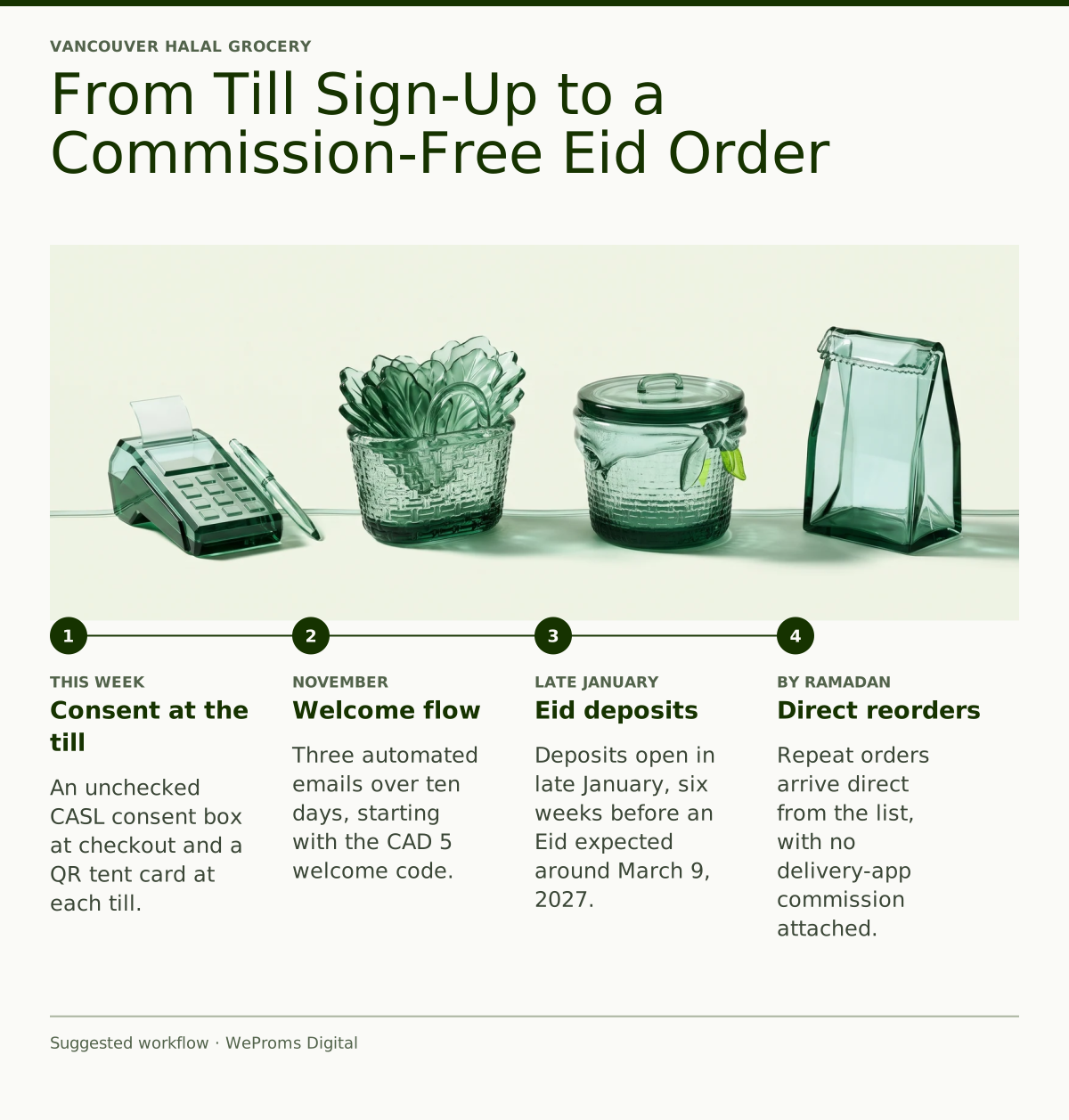
Your calendar is the Islamic year, not the retail year. The dates below are expected Gregorian dates, subject to moon sighting: Ramadan 2027 from about February 8, Eid al-Fitr from about March 9, and Eid al-Adha from about May 17.
Work backwards from Eid, in three phases. Early interest first: Eid hamper deposits open six weeks before the expected Eid date, which lands in late January 2027. Confirmed orders second: deposits, pickup slots, delivery routes. Delivery third: a final-order deadline 48 hours before Eid, then pickup day itself. A seasonal plan whose window contains Ramadan must include the Ramadan phase — stocking reminders in the first ten nights, a mid-Ramadan restock nudge, and the final-order deadline — never stop the calendar at a Gregorian month.
A two-till grocery signing up 10 customers a day passes 900 names in a quarter. If 2% of the list orders in a given month — a modest rate for a community list — that is 18 direct orders worth roughly CAD 320 in contribution. The list also compounds exactly where you want it: before Ramadan, when every shopper in Metro Vancouver is planning the same three weeks.
For the full seasonal picture, read how a Mississauga halal grocery plans Black Friday and shaadi season together.
The outcome you should expect in 90 days
A customer’s first email order uses the CAD 5 code. The second comes at Eid. The third lands at back-to-school. And the fourth arrives direct, with no commission attached — full CAD 18 contribution on a CAD 62 basket, from a relationship the apps cannot take back.
Here is your decision rule. If more than a third of your revenue arrives through apps, start with checkout capture this week, because every month at 400 app orders adds another month of zero owned contacts. If your till traffic is mostly walk-in, lead with the QR cards and the mithai counter, then automate. And if the welcome flow has not converted 2% of subscribers into a first order after 60 days, change the offer — not the budget.
Based on our experience building email flows for halal grocers, takeaways, and mithai shops across Canada, the UK, and the Gulf, the owners who win Ramadan are almost always the ones who started collecting consent one season early. As a lifecycle and email marketing automation service for overseas Pakistani businesses, WeProms Digital sets up exactly this system — capture points, consent records, welcome flows, and the occasions calendar — as one build, and we run Klaviyo programs for halal ecommerce brands when a grocery also sells online.
Read next: What the DoorDash-Instacart deal means for halal grocers selling direct and how to stop a mithai shop’s Eid emails landing in spam (written for a Kuwait shop; the deliverability checks are identical).
If you want this built for your shop before Ramadan 2027, WeProms Digital will audit your current capture points and set up the full flow. Message hello@weproms.com or WhatsApp +92 300 0133399 — we reply in Canadian and Gulf business hours, and we have worked with grocery and food businesses across Vancouver, Toronto, London, and Dubai.
Frequently Asked Questions
Can I email customers who ordered through DoorDash or Uber Eats?
No. You never collected their contact details or their consent — under CASL, consent must come from the customer directly to you, and the platforms do not pass marketing-usable email addresses to merchants anyway. Building your own list through checkout opt-ins and till sign-ups is the compliant route, and the Government of Canada CASL guidance explains the consent records you should keep.
Is a pre-checked sign-up box acceptable in Canada?
No. Express consent under CASL requires an optional checkbox that starts unchecked, with clear wording about what the person is agreeing to, plus an unsubscribe link in every email. Penalties can reach CAD 10 million per violation for businesses, so the unchecked box is not a stylistic choice — it is the law.
What does email marketing cost a small grocery in Canada?
Omnisend’s free plan covers 250 contacts; its mid tier is about USD 44 (CAD 62) a month at 2,500 contacts, and Klaviyo runs from about USD 30 a month at 1,000 profiles. Agency setup varies by scope — WeProms quotes fixed builds after a short audit call rather than publishing package prices.
How often should a halal grocery email its list?
Offer two frequencies through a preference center: monthly, or occasions only. In a 2025 Litmus survey of 1,000 US consumers, 67% named too-frequent email as their top unsubscribe reason, so letting customers choose keeps the list healthy through the quiet months.
When should I start collecting emails for Ramadan 2027?
Now. Ramadan 2027 is expected to begin around February 8, 2027, subject to moon sighting, with Eid al-Fitr around March 9. Deposits for Eid hampers should open six weeks before the expected Eid date — late January 2027 — which means the list needs to exist by December.
Sources & References
- DoorDash Newsroom — DoorDash to Acquire Instacart — October 29, 2026
- CBC News — DoorDash buying Instacart in $17B deal — October 29, 2026
- Digiday — Here are the questions on advertisers’ minds after the DoorDash-Instacart deal — November 4, 2026
- Digiday — What DoorDash’s Instacart acquisition says about the modern delivery platform pitch — November 4, 2026
- Omnisend — How to build an email list: 15 ecommerce strategies for 2026 — November 3, 2026
- Omnisend — Pricing — accessed November 5, 2026
- Klaviyo — Pricing — accessed November 5, 2026
- Government of Canada — Canada’s Anti-Spam Legislation — accessed November 5, 2026
Additional reading from industry feeds: